Opioid Conversion Calculator: Equianalgesic Dose Converter
In short: Free opioid conversion calculator: convert total daily doses between morphine, oxycodone, hydrocodone, hydromorphone, oxymorphone, codeine and fentanyl patch using verified equianalgesic doses, with incomplete cross tolerance dose reduction guidance. Use the calculator above, then read the guide below to interpret your result and its limitations.
Convert a total daily dose from one opioid to another using verified equianalgesic doses. The calculator shows the full calculated dose and the guideline style starting range of 50 to 75 percent of calculated, which accounts for incomplete cross tolerance. Methadone and tramadol are deliberately excluded: neither can be converted safely with a simple table.
The equianalgesic reference table
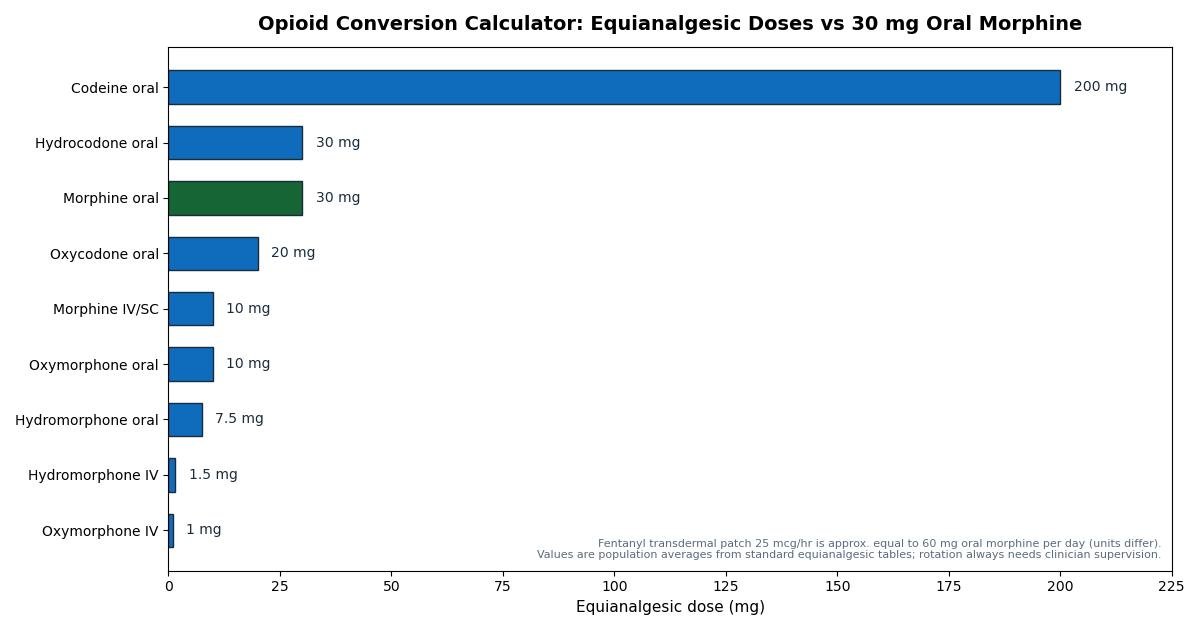
Every conversion on this page is built from the table below. Each row is the dose of that drug and route considered equianalgesic to 30 mg of oral morphine, which is the standard reference point in published equianalgesic tables. These values were verified against the Yale palliative care equianalgesic module and the Canadian guideline for opioids in chronic noncancer pain before being coded into the calculator. The table expresses population averages from clinical experience: two patients can respond differently to the same numbers, which is why rotation always happens under clinician supervision.
| Drug and route | Equianalgesic dose | Equal to |
|---|---|---|
| Morphine, oral | 30 mg | reference standard |
| Morphine, IV or SC | 10 mg | 30 mg oral morphine |
| Oxycodone, oral | 20 mg | 30 mg oral morphine |
| Hydrocodone, oral | 30 mg | 30 mg oral morphine |
| Hydromorphone, oral | 7.5 mg | 30 mg oral morphine |
| Hydromorphone, IV | 1.5 mg | 30 mg oral morphine |
| Oxymorphone, oral | 10 mg | 30 mg oral morphine |
| Oxymorphone, IV | 1 mg | 30 mg oral morphine |
| Codeine, oral | 200 mg | 30 mg oral morphine |
| Fentanyl transdermal patch | 25 mcg/hr | about 60 mg oral morphine per day |
The fentanyl anchor is approximate: published tables map a 25 mcg per hour patch to a range of 60 to 134 mg of oral morphine per day. Methadone and tramadol have no row here because they cannot be converted with a simple table; see the section below.
How opioid conversion works
Opioid rotation, switching a patient from one opioid to another, is common when pain control is poor, side effects are intolerable, or the route of administration must change. Because opioids differ in potency, you cannot swap milligram for milligram. Equianalgesic tables solve this by expressing every opioid as the dose that gives roughly the same analgesia as a fixed amount of oral morphine, conventionally 30 mg.
The conversion itself is simple ratio arithmetic. If the patient takes a daily dose D of the current opioid, and the equianalgesic values are E_current and E_target, then the target dose equals D multiplied by E_target divided by E_current. For example, a patient on 30 mg of oral morphine per day converting to oral oxycodone: 30 multiplied by 20 divided by 30 equals 20 mg of oxycodone per day. Converting the other way, 8 mg of oral hydromorphone per day to oral morphine: 8 multiplied by 30 divided by 7.5 equals 32 mg of morphine per day. Route changes work the same way: 10 mg of IV morphine per day converts to oral morphine as 10 multiplied by 30 divided by 10, which is 30 mg per day, reflecting the roughly 3 to 1 oral to parenteral ratio for morphine in chronic pain.
One input rule matters more than any other: always enter the total daily dose. Equianalgesic tables are built from 24 hour totals. A patient taking 10 mg of oxycodone three times daily enters 30 mg, not 10 mg. For as needed use, enter the average actually taken per day. Entering a single tablet strength instead of the daily total is the most common conversion error and it produces a dangerously low result that looks reassuring.
Why the dose is reduced: incomplete cross tolerance
The calculated equianalgesic dose is only the first number. Standard clinical practice never starts the new opioid at the full calculated dose, because tolerance is drug specific. A patient tolerant to morphine is not equally tolerant to oxycodone or hydromorphone: this is incomplete cross tolerance. Starting at 100 percent of the calculated dose can therefore overshoot, causing excessive sedation and respiratory depression in a patient who looks, on paper, to be on an equivalent regimen.
The accepted correction is to reduce the calculated dose by 25 to 50 percent and titrate from there, so the recommended starting range is 50 to 75 percent of the calculated equianalgesic dose. This calculator shows both numbers: the full calculated dose for reference, and the 50 to 75 percent starting range that a clinician would actually begin with. From the earlier example, 8 mg of oral hydromorphone per day calculates to 32 mg of oral morphine per day, and the recommended starting range is 16 to 24 mg per day, with 16 mg representing the 50 percent reduction. The size of the reduction is a clinical judgment: larger reductions are usual in older or frail patients, in renal or hepatic impairment, when pain is currently well controlled, or when switching to a drug the patient has never taken.
Reduction does not end the job. A breakthrough pain plan is part of every rotation: teaching references commonly suggest a rescue dose of about 5 to 15 percent of the total daily dose, available as needed while the new regimen is titrated. The patient should be reassessed within the first days, with clear instructions on what to do if pain breaks through or if drowsiness, confusion, or slowed breathing appear.
Worked examples
Example one, tablet to tablet. A patient takes oxycodone 10 mg three times daily, a total of 30 mg per day, and needs to switch to oral morphine because of formulary limits. The equianalgesic value for oral oxycodone is 20 mg and for oral morphine is 30 mg. Target dose equals 30 multiplied by 30 divided by 20, which is 45 mg of oral morphine per day. The starting range is 50 to 75 percent of 45, which is 22.5 to 33.75 mg per day. A practical starting regimen near that range, for instance 15 mg twice daily, would then be titrated.
Example two, route change. A postoperative patient receives morphine 10 mg IV per day and is switching to oral morphine for discharge. The equianalgesic value for IV morphine is 10 mg and for oral morphine is 30 mg. Target dose equals 10 multiplied by 30 divided by 10, which is 30 mg of oral morphine per day. The starting range is 15 to 22.5 mg per day. Note the 3 to 1 oral to IV ratio used here reflects chronic pain experience; in acute pain some references use a higher oral equivalent, so the discharging clinician confirms the ratio for the setting.
Example three, to a potent opioid. A patient on 60 mg of oral morphine per day needs rotation to oral hydromorphone. Target dose equals 60 multiplied by 7.5 divided by 30, which is 15 mg of oral hydromorphone per day. The starting range is 7.5 to 11.25 mg per day. Because hydromorphone is several times more potent per milligram, small absolute errors matter more here, which is exactly why the reduction step exists.
Drug by drug notes
Morphine remains the reference standard and is generally considered the opioid of first choice. The 10 mg parenteral to 30 mg oral ratio used here reflects chronic pain practice; the same sources note that single dose potency studies in acute pain suggest a higher oral equivalent, so context matters. Morphine accumulates in severe renal impairment because of its active metabolite, so hydromorphone is often preferred there.
Oxycodone is about 1.5 times as potent as oral morphine: 20 mg of oral oxycodone is the equianalgesic standard. It has no parenteral equianalgesic value in these tables because an injectable form is not in common use. Hydrocodone is roughly equal in potency to oral morphine at 30 mg, and it is only available in combination products in many markets, which limits dose flexibility.
Hydromorphone is about 4 times as potent as oral morphine: 7.5 mg oral or 1.5 mg IV equals 30 mg of oral morphine. It is the usual alternative when morphine metabolites are a concern in renal disease. Oxymorphone is about 3 times as potent as oral morphine by mouth (10 mg) and about 30 times by injection (1 mg), reflecting its low oral bioavailability.
Codeine is the weakest entry at 200 mg equianalgesic to 30 mg of morphine, and it carries a special caution: it is a prodrug that must be converted to morphine by the liver enzyme CYP2D6, and up to 10 percent of Caucasians lack enough of this enzyme for codeine to work at all. Doses above about 60 mg at a time add side effects without much extra analgesia, so codeine suits only mild to moderate pain.
The fentanyl transdermal patch is the outlier in units and in rules. The commonly cited anchor is that a 25 mcg per hour patch is approximately equal to 60 mg of oral morphine per day, though published tables give a range of 60 to 134 mg. Patches are labelled for opioid tolerant patients only, defined as patients taking at least 60 mg of oral morphine per day or an equivalent for a week or longer. Never initiate a patch in an opioid naive patient from a calculator result. When converting away from a patch, remember that fentanyl forms a depot in the skin and continues to be absorbed after the patch is removed, so the old and new regimens need planned overlap.
What this calculator does not do: methadone and tramadol
Two commonly asked about drugs are deliberately absent from the table, and their absence is a safety feature. Methadone has a dose dependent, non linear equianalgesic relationship with other opioids: published references note that conversion from oral morphine to oral methadone can range from about 4 to 1 up to 14 to 1 depending on the starting dose, and methadone accumulates unpredictably because of its long and variable half life. No single table value can represent it, so this tool refuses the conversion entirely. Anyone rotating to or from methadone needs a specialist and a methadone specific protocol.
Tramadol is excluded for a different reason. It combines weak mu opioid activity with serotonin and noradrenaline reuptake inhibition, a dual mechanism that equianalgesic opioid math was never designed to describe. Treating tramadol as just another opioid in a conversion table misrepresents how it works and how it is stopped: it also carries seizure and serotonin syndrome considerations that pure opioid tables ignore. Tramadol should not be used in equianalgesic calculations at all. For total opioid burden expressed as morphine milligram equivalents, including tramadol, see the companion MME calculator.
A safe rotation workflow
A calculator result becomes a clinical plan through a short workflow. First, confirm the current total daily dose from the actual prescribing record and what the patient really takes, including as needed doses. Second, choose the target opioid and route for a reason: side effect profile, organ function, formulation availability, and cost. Third, run the conversion and apply the incomplete cross tolerance reduction, choosing the larger reduction for vulnerable patients. Fourth, write the breakthrough pain plan and the monitoring plan before the patient leaves: who checks in, when, and what triggers a call. Fifth, reassess within days and titrate to effect, because no table predicts an individual. Document the equianalgesic values used, the reduction applied, and the reason, so the next clinician can follow the logic.
Limitations
Equianalgesic tables are approximations, and every major reference says so explicitly. They describe average analgesic strength, not sedation, euphoria, withdrawal suppression, or any single patient's response. They do not adjust for age, frailty, renal or hepatic impairment, interacting medicines such as benzodiazepines, sleep apnoea, or the difference between acute and chronic pain. They assume the patient is tolerant and the pain is opioid responsive; neither assumption should go unchecked. Wide ranges in the published literature, such as the 60 to 134 mg span for the fentanyl patch anchor, are a reminder that the table is a starting estimate. This calculator inherits all of these limits. It is a decision support aid for clinicians, not a substitute for judgment, and every rotation it informs should be supervised by a clinician who can monitor the patient.
Key takeaways
- An equianalgesic dose is the amount of one opioid that produces roughly the same pain relief as a standard amount of another opioid.
- Enter the total daily dose of the opioid the patient is currently taking, select the target opioid, and the calculator applies the standard formula: target dose equals current dose multiplied by the ratio of the two equianalgesic values.
- Because of incomplete cross tolerance.
- Methadone is excluded because its equianalgesic ratio is dose dependent and non linear: published references note the oral morphine to methadone conversion can range from about 4 to 1 up to 14 to 1, so a single table value would be dangerous.
Frequently asked questions
What is an equianalgesic dose?
An equianalgesic dose is the amount of one opioid that produces roughly the same pain relief as a standard amount of another opioid. Tables express each opioid as the dose equal to 30 mg of oral morphine. For example, 20 mg of oral oxycodone, 7.5 mg of oral hydromorphone and 200 mg of oral codeine are each considered equianalgesic to 30 mg of oral morphine. These are population averages from clinical experience and published tables, not exact values for any single patient.
How do I convert from one opioid to another with this calculator?
Enter the total daily dose of the opioid the patient is currently taking, select the target opioid, and the calculator applies the standard formula: target dose equals current dose multiplied by the ratio of the two equianalgesic values. The result is the calculated equianalgesic daily dose of the target opioid, shown alongside a recommended starting range of 50 to 75 percent of that calculated dose to account for incomplete cross tolerance. Always enter total daily doses, not single tablet strengths.
Why does the calculator recommend starting at 50 to 75 percent of the calculated dose?
Because of incomplete cross tolerance. Tolerance to one opioid does not transfer completely to another, so a patient switched at the full calculated equianalgesic dose may be more sensitive to the new drug than the table predicts, which risks oversedation and respiratory depression. Standard clinical practice therefore reduces the calculated dose by 25 to 50 percent when starting the new opioid, then titrates up while monitoring. This calculator shows both the full calculated dose and the 50 to 75 percent starting range.
Why are methadone and tramadol not in the conversion table?
Methadone is excluded because its equianalgesic ratio is dose dependent and non linear: published references note the oral morphine to methadone conversion can range from about 4 to 1 up to 14 to 1, so a single table value would be dangerous. Tramadol is excluded because it has a dual mechanism, combining weak mu opioid agonism with serotonin and noradrenaline reuptake inhibition, which means equianalgesic opioid math does not apply to it. Converting to or from methadone requires specialist supervision, and tramadol should not be used in equianalgesic calculations.
Can I use this calculator to start a fentanyl patch?
Only with caution and never in an opioid naive patient. Fentanyl transdermal patches are labelled for opioid tolerant patients only, defined in FDA labelling as patients taking at least 60 mg of oral morphine per day or an equivalent for a week or longer. The calculator uses the commonly cited anchor that a 25 microgram per hour patch is approximately equal to 60 mg of oral morphine per day, but published tables map that patch strength to a wider range of 60 to 134 mg, and patch absorption varies between patients. Any patch initiation needs direct clinician supervision.
Is the converted dose a prescription I can give directly?
No. The calculated dose is a starting point for a clinician led opioid rotation, not a prescription. Equianalgesic tables are population averages, and the right dose for an individual depends on age, kidney and liver function, other medicines, pain type, and how tolerant the patient is. Standard practice is to start at the reduced range, provide a breakthrough pain plan, monitor closely for the first days, and titrate. When in doubt, convert conservatively and consult a pain or palliative care specialist.
References
- Yale Assessment Module Training. Equianalgesic Doses: Opioid Analgesics. https://assessment-module.yale.edu/im-palliative/equianalgesic-doses-opioid-analgesics
- National Opioid Use Guideline Group. Canadian guideline for safe and effective use of opioids for chronic noncancer pain: clinical summary for family physicians. Can Fam Physician. 2011;57(11):1257-1266. Table 4, oral opioid analgesic conversion table. http://www.cfp.ca/content/57/11/1257/T10
- Foley KM. The treatment of cancer pain. N Engl J Med. 1985;313:84-95. (Equianalgesic dosing chart adapted in chronic pain management references; notes the variable oral morphine to methadone conversion range.)
- Dowell D, Ragan KR, Jones CM, et al. CDC Clinical Practice Guideline for Prescribing Opioids for Pain. MMWR Recomm Rep. 2022;71(RR-3):1-95. (Caution thresholds for total daily opioid dose; see the companion MME calculator.)
- British Pain Society
- NICE Guidance