Opioid Tapering Calculator
In short: Free opioid tapering calculator: build an illustrative step-by-step dose reduction schedule in mg and MME, with taper-rate guidance from the CDC 2022 guideline. Educational use only. Use the calculator above, then read the guide below to interpret your result and its limitations.
This opioid tapering calculator builds an illustrative, step-by-step dose reduction schedule for long-term opioid therapy. Enter your current total daily dose, choose a taper rate, and receive a dated schedule showing each step in milligrams and morphine milligram equivalents (MME), with pause guidance and withdrawal-monitoring notes. The schedule is educational only: every real taper must be individualized, agreed with the patient, and supervised by a clinician. Never change your opioid dose without medical guidance.
What is opioid tapering?
Opioid tapering means gradually reducing the dose of an opioid over weeks or months instead of stopping it suddenly. Clinicians and patients consider a taper when the balance of benefits and harms has shifted: for example, when pain has improved, when pain and function are not meaningfully better on the current dose, when side effects are harming quality of life, or when there are safety concerns such as an overdose event or risky drug combinations. The U.S. Department of Health and Human Services (HHS) guide for clinicians stresses that tapering plans should be individualized based on patient goals and concerns, and the CDC 2022 clinical practice guideline emphasizes that recommendations should support, not replace, individualized patient-centered care.
A taper is a collaborative process, not a fixed formula. The schedule this calculator produces is illustrative: it shows what a steady percentage-based reduction looks like on paper so that patients and clinicians can discuss a realistic plan. The right taper for a real person also weighs how long they have taken opioids, their current dose, their pain condition, their mental health, and the support available to them.
How to use this calculator
Start by selecting the opioid and entering the current total daily dose, meaning everything taken in 24 hours. You can enter the dose in milligrams or in morphine milligram equivalents (MME); the calculator converts between the two using CDC conversion factors and shows both in the results. Next, choose the taper rate as a percentage reduction per week. The default is 10%, the calculator refuses rates above 25% per week, and any rate above 10% displays a warning because faster tapers carry a higher risk of withdrawal symptoms.
Then set how many weeks to stay on each dose before the next reduction (the step interval), an optional minimum dose floor in milligrams, and the start date. If the floor is zero, the schedule continues until the dose reaches zero. If you set a floor, the schedule holds at that dose for one step and then stops. The results show a summary (starting dose in mg and MME, total number of steps, total taper length), a table with each step's date, dose, MME, and percentage of the original dose, plus pause guidance and withdrawal-monitoring notes.
The taper maths behind the schedule
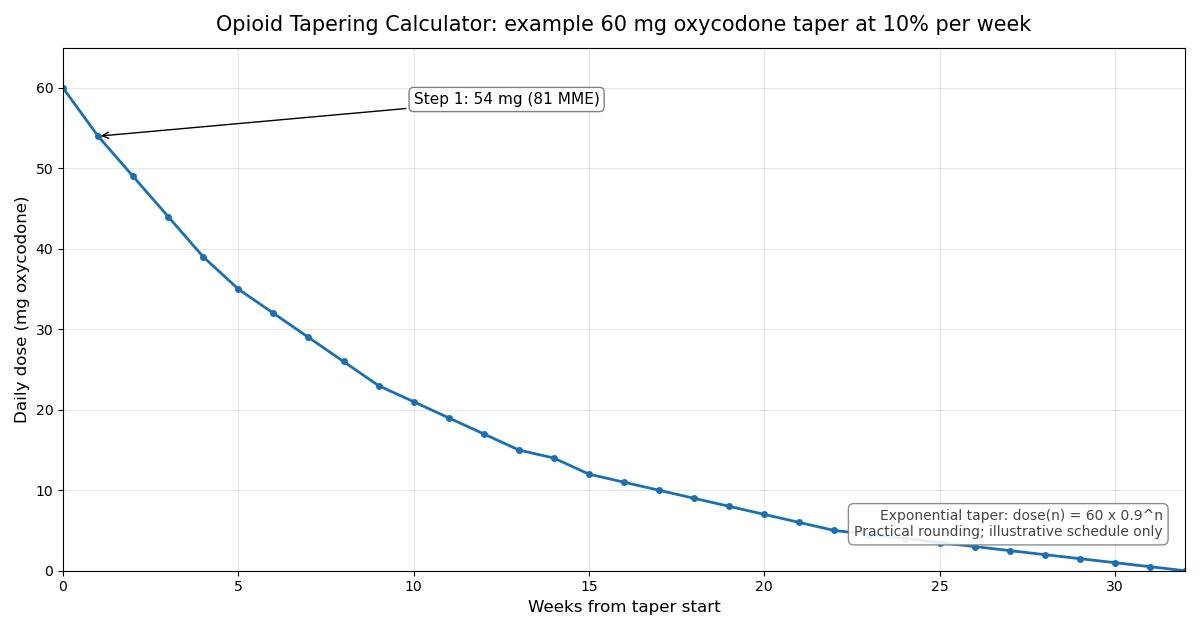
This calculator uses an exponential taper model: each step's dose equals the starting dose multiplied by (1 minus the rate) raised to the power of the step number. In symbols, dosen = start x (1 - r)n. With a starting dose of 60 mg of oxycodone and a 10% weekly rate, step 1 is 60 x 0.9 = 54 mg (81 MME), and step 2 is 60 x 0.92 = 48.6 mg, which rounds to 49 mg (73.5 MME). Because the percentage applies to the current dose at each step, the absolute milligram reduction gets smaller as the taper proceeds, which is the point of a gradual taper.
Two practical rules keep the schedule realistic. First, doses are rounded to practical increments: the nearest 0.5 mg below 5 mg, and the nearest whole milligram at 5 mg and above. If rounding would stall the taper (the rounded dose no longer falls), the calculator forces one practical increment down so the schedule always progresses. Second, each step's MME is the dose multiplied by the CDC conversion factor for the chosen opioid, and the percentage of the original dose is shown so you can see progress at a glance. Step dates are computed in UTC, one interval apart, starting from your chosen start date.
What the guidelines say about taper rates
The CDC clinical practice guideline for prescribing opioids for pain (Dowell et al., United States, 2022) gives rate benchmarks that depend on how long a patient has taken opioids. For patients taking opioids for a year or more, it suggests reducing by 10% per month or slower. For patients taking opioids for weeks to months, it suggests reducing by 10% of the original dose per week or slower until 30% of the original dose is reached, then by 10% of the remaining dose each week. For patients taking opioids for years, it suggests a taper slower than 10% per week, for example 10% per month.
The HHS guide for clinicians adds practical detail: individualize the taper rate, and remember that the longer the previous opioid therapy, the longer the taper may take. It describes common tapers as dose reductions of 5% to 20% every 4 weeks, notes that slower tapers (10% per month or slower) are often better tolerated after more than a year of use, and says faster tapers can be appropriate for some patients, namely a decrease of 10% of the original dose per week or slower until 30% of the original dose is reached, followed by a weekly decrease of 10% of the remaining dose. It also says tapers may be paused and restarted when the patient is ready, that a taper counts as successful as long as the patient is making progress toward a safer dose, and that once the smallest available dose is reached, the interval between doses can be extended, stopping when the opioid is taken less often than once a day.
One honest caveat: this calculator compounds the percentage on the current dose at every step (the exponential model), which corresponds to the "percentage of remaining dose" approach in the guidelines. It does not reproduce the fixed linear "10% of the original dose" decrement the guidelines describe for the early phase. Treat the schedule as an illustration of steady percentage-based tapering, and let the clinician adapt it.
When clinicians consider tapering
The HHS guide lists situations in which clinicians should consider tapering to a reduced dose or discontinuing opioid therapy: when pain improves; when the patient receives treatment expected to improve pain; when the patient requests dosage reduction or discontinuation; when pain and function are not meaningfully improved; when the patient is receiving higher doses without evidence of benefit; when there is current evidence of opioid misuse; when side effects diminish quality of life or impair function; when the patient experiences an overdose or another serious event; when there are warning signs of an impending event such as confusion, sedation, or slurred speech; and when the patient takes medications that raise risk, such as benzodiazepines. Any of these is a reason for a careful conversation, not for an abrupt dose change.
Risks of rapid tapering and stopping suddenly
Rapid tapers and abrupt discontinuation carry real risks for physically dependent patients. The HHS guide lists acute withdrawal symptoms, exacerbation of pain, serious psychological distress, and thoughts of suicide, and warns that patients may seek other sources of opioids, potentially including illicit opioids, to treat their pain or withdrawal symptoms. For that reason, HHS does not recommend abrupt opioid dose reduction or discontinuation unless there are indications of a life-threatening issue, such as warning signs of an impending overdose. The CDC 2022 guideline likewise cautions against rapid tapers undertaken without patient collaboration. If a taper ever feels unsafe, the correct response is to contact the prescribing clinician promptly, not to push through alone.
Pause and hold guidance
A taper does not have to move forward every step. The HHS guide states that tapers may be paused and restarted when the patient is ready, and that pauses can give the patient time to adjust to a new dose, learn new pain-management skills, or start other treatments. In practice, "holding" means staying on the current step's dose for extra weeks instead of reducing on schedule. A taper can still count as successful while moving slowly: the HHS guide says tapers may be considered successful as long as the patient is making progress, however slowly, toward a safer dose. If withdrawal symptoms, worsening pain, or a drop in daily function appear after a reduction, tell the clinician before the next scheduled step rather than silently enduring it or abandoning the plan.
Monitoring for withdrawal
During a taper, watch for signs of opioid withdrawal and report them early. Common early signs include restlessness, anxiety, sweating, yawning, and trouble sleeping; later signs can include nausea, vomiting, diarrhea, muscle aches, and goosebumps. These symptoms are the main reason tapers are slowed or paused, so reporting them promptly is part of the plan, not a failure of it. Clinicians sometimes use structured assessment tools such as the Clinical Opiate Withdrawal Scale (COWS) to evaluate withdrawal in clinical settings; this is clinical context only, not a self-assessment instrument, and scoring should be left to trained professionals.
Do not treat withdrawal by taking extra opioid doses, borrowing someone else's medication, or seeking illicit opioids; tell your clinician instead, because unsupervised dose changes can be dangerous. Seek urgent help if you experience thoughts of suicide or self-harm, severe vomiting or diarrhea that prevents keeping fluids down, or any sign of overdose such as extreme drowsiness, slow breathing, or confusion in someone around you.
MME conversion factors used in this calculator
Morphine milligram equivalents (MME) put different opioids on a common scale by multiplying the dose by a conversion factor. This calculator uses the CDC conversion factors: morphine 1, oxycodone 1.5, hydrocodone 1, hydromorphone 4, oxymorphone 3, codeine 0.15, tramadol 0.1, and tapentadol 0.4. For example, 60 mg of oxycodone equals 90 MME (60 x 1.5), and 100 mg of tramadol equals 10 MME (100 x 0.1). MME values are approximate and intended for comparison and communication, not as exact measures of effect in an individual.
Worked example
Take a patient on 60 mg of oxycodone daily, which equals 90 MME. With a 10% weekly rate, one-week steps, and no dose floor, the calculator produces this start: step 0 is 60 mg (90 MME, 100% of the original dose), step 1 is 54 mg (81 MME, 90%), and step 2 is 49 mg (73.5 MME, 81.7%). The schedule continues with shrinking reductions until it reaches zero after 32 steps (32 weeks). The chart above plots this exact taper. Notice how the weekly milligram drop gets smaller over time: that is the exponential model at work, and it is why percentage-based tapers feel gentler at low doses than fixed-milligram decrements.
Limitations of this planner
This planner illustrates one tapering approach (steady exponential reduction) and cannot capture everything a clinician weighs. It does not distinguish extended-release from immediate-release formulations, account for kidney or liver impairment, drug interactions, or individual differences in dependence and metabolism, and its rounded doses may not match available tablet or capsule strengths, so a pharmacist's input matters. It also does not cover transitions to medications for opioid use disorder, which need specialist care. Most importantly, a schedule is not a prescription: the decision to taper, the rate, and every adjustment belong in a shared decision between patient and clinician.
Key takeaways
- There is no single right speed: the taper should be individualized and agreed with the patient and clinician.
- Each step reduces the current dose by the chosen percentage, compounding every step: at 10% per week, 60 mg becomes 54 mg, then about 49 mg, then about 44 mg, and so on.
- MME stands for morphine milligram equivalents: a way to put different opioids on one common scale by multiplying the dose by a CDC conversion factor (for example, oxycodone x 1.5, hydromorphone x 4, tramadol x 0.1).
- No.
Frequently asked questions
How fast should an opioid taper be?
There is no single right speed: the taper should be individualized and agreed with the patient and clinician. As benchmarks, the CDC 2022 guideline suggests 10% per month or slower for patients who have taken opioids for a year or more, 10% of the original dose per week or slower (until 30% of the original dose is reached, then 10% of the remaining dose weekly) for weeks to months of use, and slower than 10% per week for years of use. The HHS guide describes common tapers of 5% to 20% every 4 weeks and notes that slower tapers are often better tolerated after more than a year of use.
What does the 10% per week rate mean in this calculator?
Each step reduces the current dose by the chosen percentage, compounding every step: at 10% per week, 60 mg becomes 54 mg, then about 49 mg, then about 44 mg, and so on. This is the exponential model dose(n) = start x (1 - r)^n, which matches the guidelines' 'percentage of remaining dose' approach. It differs from a fixed '10% of the original dose' linear decrement, so treat the schedule as illustrative and let your clinician adapt it.
What is MME and why does the calculator show it?
MME stands for morphine milligram equivalents: a way to put different opioids on one common scale by multiplying the dose by a CDC conversion factor (for example, oxycodone x 1.5, hydromorphone x 4, tramadol x 0.1). Showing both milligrams and MME at every step makes it easier to compare steps and to communicate the plan clearly with your clinician. MME values are approximate and meant for comparison, not as exact measures of effect in an individual.
Can I stop opioids suddenly once the dose is very low?
No. Abrupt discontinuation in physically dependent patients risks acute withdrawal symptoms, worsening pain, serious psychological distress, and thoughts of suicide, and the HHS guide does not recommend abrupt reduction unless there is a life-threatening issue such as warning signs of overdose. The HHS guide suggests that once the smallest available dose is reached, the interval between doses can be extended, stopping when the opioid is taken less often than once a day, with clinician guidance.
What should I do if withdrawal symptoms appear during a taper?
Tell your clinician promptly: withdrawal symptoms are the usual reason a taper is slowed or paused, and reporting them is part of the plan. Tapers can be paused and restarted when you are ready, and holding at the current step is normal. Clinicians sometimes use structured tools such as the Clinical Opiate Withdrawal Scale (COWS) to assess withdrawal in clinical settings; scoring is for trained professionals, not self-assessment. Do not take extra doses, borrow medication, or seek other opioid sources for withdrawal symptoms.
Is this taper schedule a medical recommendation?
No. This calculator produces an illustrative educational schedule, not a prescription or medical recommendation. Real tapers must be individualized, collaborative, and supervised by a qualified clinician who knows your history, pain condition, and other medications. Never start, change, or stop an opioid regimen based on this schedule alone.
References
- Dowell D, Ragan KR, Jones CM, Baldwin GT, Chou R. CDC Clinical Practice Guideline for Prescribing Opioids for Pain - United States, 2022. MMWR Recomm Rep. 2022;71(3):1-95. doi:10.15585/mmwr.rr7103a1.
- HHS Guide for Clinicians on the Appropriate Dosage Reduction or Discontinuation of Long-Term Opioid Analgesics. U.S. Department of Health and Human Services.
- British Pain Society
- NICE Guidance