Neuropathic Pain Dosing Planner: First-Line Drug Titration and Renal Dose Adjustment
In short: Plan titration steps for first-line neuropathic pain drugs (gabapentin, pregabalin, duloxetine, venlafaxine XR, amitriptyline) with renal dose adjustment by creatinine clearance, per NICE NG173 and BNF dosing tables. Use the calculator above, then read the guide below to interpret your result and its limitations.
Neuropathic pain, the burning, shooting or electric pain that follows nerve injury or disease, responds poorly to ordinary painkillers such as paracetamol and NSAIDs. Its first-line treatment is a small set of medicines whose doses must be built up gradually, a process called titration, and whose safe maximum depends on kidney function. This planner helps you and your clinician map out that titration: choose a first-line drug, enter the current daily dose and kidney function, and it returns the next titration step, the per-dose split, and the renal-adjusted ceiling, using the schedules recommended by NICE guideline NG173 and the dosing tables of the BNF. Use the calculator below first, then read the guidance that follows.
Titration and renal dose planner
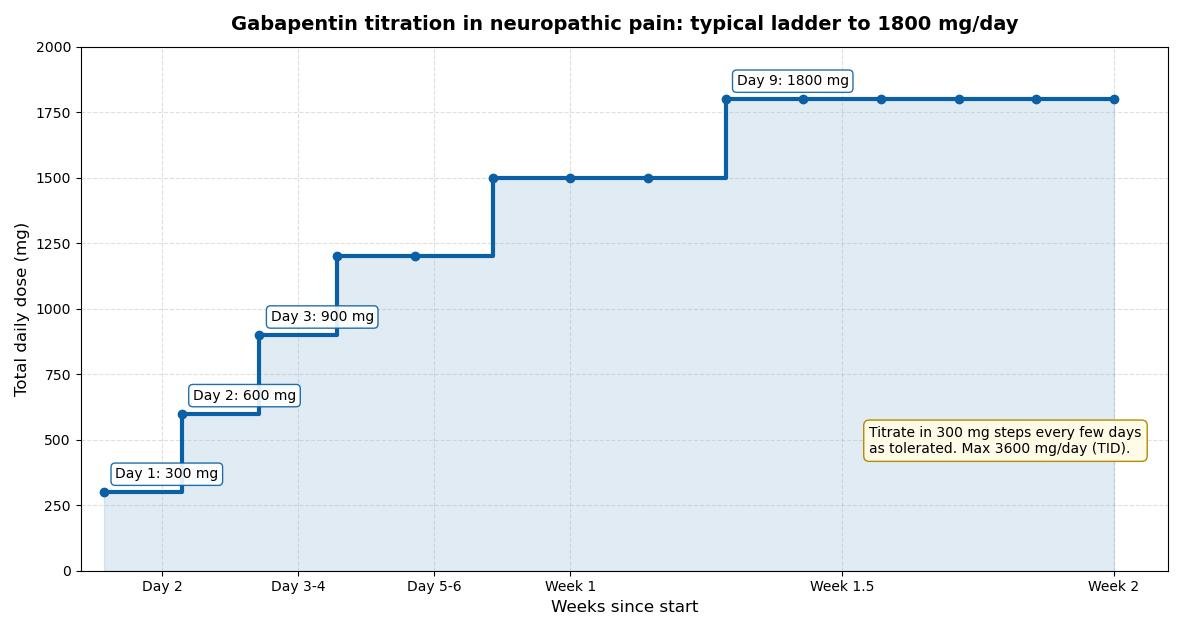
Figure: the standard gabapentin titration ladder in neuropathic pain, reaching 1800 mg per day by about week 2, with further 300 mg steps to a maximum of 3600 mg per day in divided doses.
Which drugs are first-line for neuropathic pain
NICE guideline NG173 on neuropathic pain in adults recommends four drugs as initial treatment: amitriptyline, duloxetine, gabapentin or pregabalin. The international NeuPSIG recommendations reach a similar conclusion, giving strong recommendations to the gabapentinoids (gabapentin and pregabalin), tricyclic antidepressants such as amitriptyline, and serotonin-noradrenaline reuptake inhibitors (duloxetine and venlafaxine). These medicines were developed for other purposes, epilepsy and depression, but they calm the overactive pain signalling of damaged nerves, and they have the best balance of benefit and harm for long-term neuropathic pain. Tramadol and strong opioids are deliberately not first-line: their long-term benefit in neuropathic pain is limited and their harms, including dependence and overdose, are substantial. Choosing among the four first-line options depends on the patient. Gabapentin and pregabalin suit most adults but cause sedation and dizziness, so they need caution in people who drive or are at risk of falls. Duloxetine and venlafaxine suit patients with coexisting depression or anxiety. Amitriptyline is effective and inexpensive, but its anticholinergic effects, dry mouth, urinary difficulty, constipation and sedation, and its cardiac effects in overdose, make it a careful choice in older adults and in anyone with heart disease. Renal function also shapes the choice, as explained below.
Standard titration schedules
Titration matters because starting at a full therapeutic dose of any of these drugs commonly causes intolerable sedation, dizziness or nausea, while starting low and rising slowly lets the body adapt. The table below gives the standard titration ladder for each first-line drug, verified against the BNF dosing tables and the manufacturers' labelling summarised in DailyMed. Each step assumes the previous dose was tolerated.
| Drug | Starting dose | Titration | Usual target | Maximum |
|---|---|---|---|---|
| Gabapentin | 300 mg day 1 | 600 mg day 2, 900 mg day 3, then up in 300 mg steps every few days | 900 to 1800 mg/day in 3 divided doses | 3600 mg/day |
| Pregabalin | 150 mg/day | Increase to 300 mg/day after 3 to 7 days, then in 150 mg steps | 300 mg/day in 2 divided doses | 600 mg/day |
| Duloxetine | 30 mg/day for 1 week | Increase to 60 mg/day | 60 mg/day | 120 mg/day (little extra pain benefit above 60 mg) |
| Venlafaxine XR | 75 mg/day | Increase to 150 mg/day after about 2 weeks | 150 mg/day | 225 mg/day |
| Amitriptyline | 10 to 25 mg at night | Increase by 10 to 25 mg each week | 50 to 75 mg at night | 150 mg at night |
A few practical points apply across all five. First, doses are increased only if the current dose is tolerated and pain control is still inadequate; there is no obligation to reach the maximum. Second, elderly patients and those with significant comorbidity usually titrate more slowly than the table suggests. Third, pregabalin reaches its target faster than gabapentin, which can matter when pain is severe, but its misuse potential means some clinicians prefer gabapentin. Fourth, the antidepressant options, duloxetine, venlafaxine and amitriptyline, need the same gradual approach to avoid nausea and agitation early in treatment, and they all require a slow taper when stopped.
Renal dose adjustment
Kidney function is the main reason a standard titration schedule has to be modified. Gabapentin and pregabalin are excreted almost entirely unchanged in the urine, so when the kidneys filter more slowly the drug accumulates and the same dose produces higher blood levels, with more sedation, dizziness and confusion. For this reason both drugs have formal renal dosing bands tied to creatinine clearance, and the planner applies them automatically. The bands used here are:
| Creatinine clearance | Gabapentin max | Pregabalin max |
|---|---|---|
| 60 mL/min or above | 3600 mg/day (full dose) | 600 mg/day (full dose) |
| 30 to 59 mL/min | 1400 mg/day | 300 mg/day (start 75 mg/day) |
| 15 to 29 mL/min | 700 mg/day | 150 mg/day (start 25 to 50 mg/day) |
| Below 15 mL/min | 300 mg/day once daily | 75 mg/day once daily (start 25 mg/day) |
Patients on dialysis need an extra supplement after each session because dialysis removes the drug: 125 to 350 mg of gabapentin, or 25 to 100 mg of pregabalin, after each four-hour haemodialysis session. The other three drugs behave differently. Duloxetine needs no dose reduction across the bands, but it should be avoided entirely when creatinine clearance is below 30 mL/min. Venlafaxine XR keeps its normal schedule down to a clearance of 50, then the maximum is reduced by 25 percent at clearances of 30 to 50 and by 50 percent below 30. Amitriptyline needs no renal adjustment at all, since it is cleared by the liver, though liver disease is its own reason for caution. Because renal function is so central, the planner estimates creatinine clearance with the Cockcroft-Gault equation from age, weight, sex and serum creatinine, using adjusted body weight when actual weight exceeds 120 percent of ideal body weight, the same approach used in hospital dosing practice.
How to use this planner
Select the drug and enter the total daily dose the patient is currently taking. Then provide kidney function in whichever way is easiest: enter a known creatinine clearance directly, or let the planner calculate it from age, sex, weight, height and serum creatinine. The planner then reports four things. First, the renal band and the renal-adjusted maximum daily dose for that drug, so you can see the ceiling before planning any increase. Second, the next titration step above the current dose, capped at that ceiling, or a message that the current dose is already at the renal maximum. Third, the per-dose split of that next step, for example 300 mg three times daily for a 900 mg gabapentin total, rounded to practical tablet strengths. Fourth, the full titration ladder with the current position marked, which is useful for printing or saving as a plan. A worked example: a patient on gabapentin 900 mg per day with a clearance of 80 mL/min gets a next step of 1200 mg per day (400 mg three times daily) under a 3600 mg ceiling, while the same patient with a clearance of 40 gets the same next step but under a 1400 mg ceiling, and with a clearance of 20 the ceiling is 700 mg. Every plan carries the reminder that titration follows tolerability under clinician supervision: the planner does arithmetic, it does not examine the patient.
Titration principles and safety
Several safety principles sit behind the numbers. Sedation and dizziness are the commonest reasons titration fails, so dose increases are best scheduled when the patient can rest afterwards, and driving or operating machinery should be avoided until the response to each new dose is known. Combining these drugs with alcohol, benzodiazepines or opioids multiplies sedation and fall risk. Amitriptyline deserves special mention in older adults: its anticholinergic effects can worsen cognition, cause urinary retention and constipation, and provoke cardiac rhythm problems, so it is usually started at 10 mg and raised slowly, with an ECG considered in those with cardiac history. Duloxetine and venlafaxine can raise blood pressure and, combined with other serotonergic drugs such as tramadol, SSRIs or St John's wort, can contribute to serotonin syndrome, so the full medication list should be reviewed before starting. Gabapentin and pregabalin can cause swelling of the feet and weight gain, and pregabalin in particular has misuse potential, so supplies should be monitored. None of these drugs should be stopped abruptly: gabapentin and pregabalin need tapering over at least a week to avoid rebound pain, anxiety and sleep disturbance, and the antidepressants need an even slower taper to avoid discontinuation symptoms. Finally, neuropathic pain treatment is a trial with a defined endpoint. If an adequate dose has been reached and maintained for several weeks without meaningful benefit, or if side effects block further increases, that is a signal to switch to another first-line drug or to seek specialist pain review, not to keep pushing the same drug higher.
Key takeaways
- NICE guideline NG173 recommends amitriptyline, duloxetine, gabapentin or pregabalin as initial treatment for neuropathic pain in adults, and the NeuPSIG recommendations likewise give strong recommendations to gabapentinoids (gabapentin, pregabalin), tricyclic antidepressants and serotonin-noradrenaline reuptake inhibitors (duloxetine, venlafaxine).
- The standard gabapentin schedule starts at 300 mg on day 1, 600 mg on day 2 and 900 mg on day 3, in three divided doses, then increases in 300 mg steps every few days as tolerated.
- Yes for gabapentin and pregabalin, which are excreted largely unchanged by the kidneys, so their maximum daily dose falls as creatinine clearance falls: gabapentin to 1400 mg per day at CrCl 30 to 59, 700 mg per day at CrCl 15 to 29 and 300 mg per day below 15, and pregabalin to 300, 150 and 75 mg per day in the same bands.
- Serum creatinine, together with age, weight and sex, is used in the Cockcroft-Gault equation to estimate creatinine clearance, which is the standard bedside measure of kidney function for drug dosing.
Frequently asked questions
- Which drugs are first-line for neuropathic pain?
- NICE guideline NG173 recommends amitriptyline, duloxetine, gabapentin or pregabalin as initial treatment for neuropathic pain in adults, and the NeuPSIG recommendations likewise give strong recommendations to gabapentinoids (gabapentin, pregabalin), tricyclic antidepressants and serotonin-noradrenaline reuptake inhibitors (duloxetine, venlafaxine). Tramadol and strong opioids are not first-line because their long-term benefit is limited and their harms are substantial.
- How fast can I increase gabapentin?
- The standard gabapentin schedule starts at 300 mg on day 1, 600 mg on day 2 and 900 mg on day 3, in three divided doses, then increases in 300 mg steps every few days as tolerated. The usual effective range is 900 to 1800 mg per day, with a maximum of 3600 mg per day. Each increase should follow tolerability under clinician supervision, and renal impairment requires lower doses.
- Do I need a lower dose if I have kidney disease?
- Yes for gabapentin and pregabalin, which are excreted largely unchanged by the kidneys, so their maximum daily dose falls as creatinine clearance falls: gabapentin to 1400 mg per day at CrCl 30 to 59, 700 mg per day at CrCl 15 to 29 and 300 mg per day below 15, and pregabalin to 300, 150 and 75 mg per day in the same bands. Duloxetine should be avoided when CrCl is below 30, venlafaxine XR doses are reduced by 25 percent at CrCl 30 to 50 and by 50 percent below 30, and amitriptyline needs no renal adjustment.
- Why does this planner ask for creatinine?
- Serum creatinine, together with age, weight and sex, is used in the Cockcroft-Gault equation to estimate creatinine clearance, which is the standard bedside measure of kidney function for drug dosing. Because gabapentin and pregabalin clearance tracks kidney function closely, the planner uses the estimated clearance to cap the maximum daily dose and to choose the correct renal titration band.
- Can I stop these drugs suddenly once the pain is better?
- No. Gabapentin, pregabalin, duloxetine, venlafaxine and amitriptyline should all be tapered gradually rather than stopped abruptly, because sudden discontinuation can cause withdrawal symptoms such as rebound pain, anxiety, sleep disturbance, nausea and, for the antidepressants, electric-shock-like sensations. Any taper plan should be agreed with the prescribing clinician.
- When should titration slow down or stop?
- Titration should slow down or pause when side effects such as excessive sedation, dizziness, confusion, swelling of the feet or urinary difficulty appear, and it should stop at the lowest dose that gives acceptable pain relief. There is no benefit in pushing to the maximum licensed dose if pain is already controlled, and persistent lack of response after an adequate trial at a therapeutic dose is a reason to switch drugs or seek specialist review rather than to keep increasing.
Related calculators
- Morphine Milligram Equivalent (MME) calculator
- NSAID renal risk checker
- Opioid conversion calculator
- Opioid tapering planner
References
- NICE. Neuropathic pain in adults: pharmacological management in non-specialist settings. NICE guideline NG173. nice.org.uk/guidance/ng173
- British National Formulary (BNF): gabapentin, pregabalin, duloxetine, venlafaxine and amitriptyline monographs, dosing and renal impairment tables.
- Finnerup NB et al. Pharmacotherapy for neuropathic pain in adults: a systematic review and meta-analysis. Lancet Neurology (NeuPSIG recommendations).
- Gabapentin and pregabalin US prescribing information (DailyMed): titration schedules and maximum doses.
- British Pain Society
- NICE Guidance