Drug Half-Life Calculator: Remaining Concentration and Time to Clear
In short: Estimate how much of a drug remains after a given time using first-order elimination kinetics: enter the half-life, initial concentration and elapsed time to get the remaining concentration, the percentage eliminated and the number of half-lives elapsed. Includes a time-to-target-concentration mode, a worked example and a decay chart. Use the calculator above, then read the guide below to interpret your result and its limitations.
Enter a drug half-life to estimate how much drug remains in the body after a given time, or flip to the second mode to find out how long it takes to drop to a target concentration. The calculator uses first-order elimination kinetics, the standard model for most drugs at therapeutic concentrations.
First-order model: C(t) = C0 x (1/2)^(t / half-life). Time to target: t = half-life x ln(C0 / target) / ln(2).
Worked example
A drug has an elimination half-life of 2 hours and a starting plasma concentration of 100 mg/L. What is the concentration after 6 hours? Six hours is exactly three half-lives, so the concentration is 100 x (1/2)^3 = 100 / 8 = 12.5 mg/L. Working the other way, how long does it take to fall from 100 to the target of 12.5 mg/L? The time-to-target formula gives t = 2 x ln(100 / 12.5) / ln(2) = 2 x ln(8) / ln(2) = 2 x 3 = 6 hours. Both modes of this calculator agree on the same pair of numbers, because they are the same equation rearranged.
What a drug half-life actually means
A drug half-life, written t-half or t1/2, is the time required for the plasma concentration of a drug to drop to exactly half of its current value. It is a standard pharmacokinetic parameter printed on every drug label, and it governs dosing intervals, washout periods and drug interaction windows. What it does not mean is that a fixed amount of drug disappears per hour. Elimination of most drugs at therapeutic concentrations is a first-order process: the rate of elimination is directly proportional to the amount of drug present, so a constant fraction is removed per unit of time rather than a constant amount. When there is a lot of drug in the body, elimination is fast in absolute terms; when little remains, elimination slows down in lockstep. This is why the concentration curve bends and flattens instead of declining in a straight line.
The first-order model can be written in two equivalent forms. The one this calculator uses is C(t) = C0 x (1/2)^(t / t-half), where C0 is the starting concentration and t is the elapsed time. The classical form is C(t) = C0 x e^(-k x t), where k is the elimination rate constant. The two are linked by the relationship k = 0.693 / t-half, the 0.693 being the natural logarithm of 2. That relationship is the standard derivation found in pharmacokinetics teaching: because half-life equals ln(2) divided by the rate constant, and ln(2) is approximately 0.693. The University of Alberta open textbook An ABC of PK/PD states it exactly this way: elimination is usually first-order, it has a first-order elimination rate constant (kel for one-compartment drugs), and therefore an elimination half-life of 0.693 / kel. One useful consequence of this mathematics is that the half-life of a first-order process does not depend on the starting concentration: whether you start at 200 or 20 mg/L, the time to halve is the same. That is only true while elimination stays first-order, and it is one of the reasons the model can mislead when it is pushed outside its range.
The 5-half-life rule
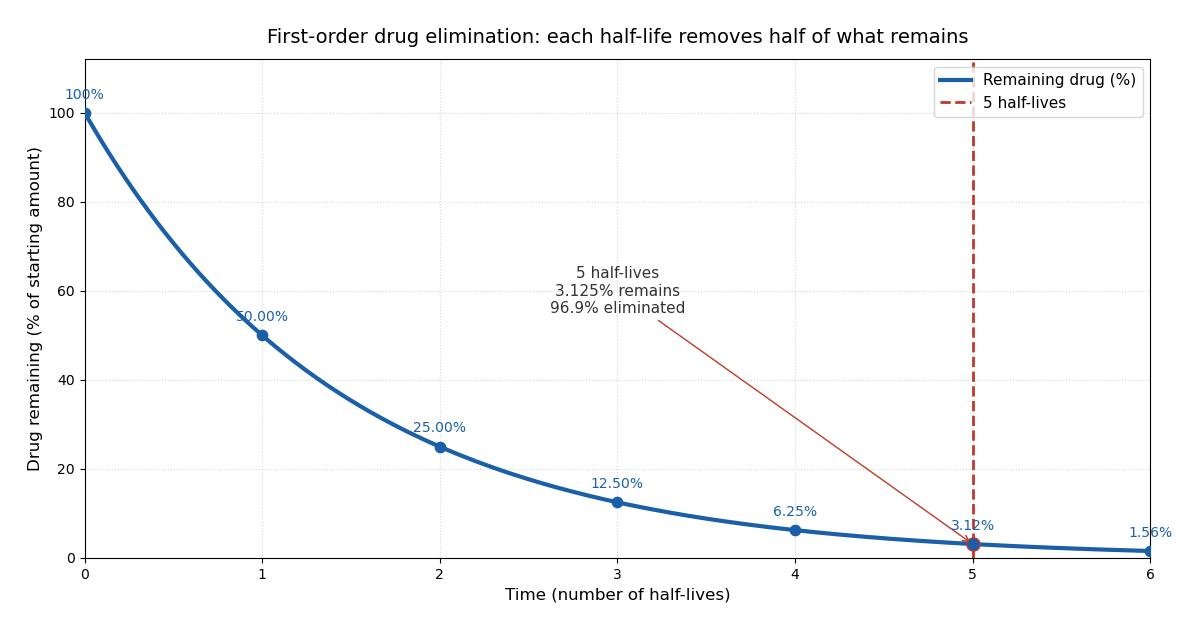
Because each half-life removes half of what remains, the remaining fractions form a simple geometric sequence: 1/2 after one half-life, 1/4 after two, 1/8 after three, 1/16 after four and 1/32 after five. In percentages, elimination reaches 50% after one half-life, 75% after two, 87.5% after three, 93.75% after four and 96.875% (about 97%) after five. Strictly speaking, a first-order curve never reaches zero: there is always a dwindling trace left. But by convention, taught in clinical pharmacokinetics courses and drug dosing references, elimination is considered essentially complete after 4 to 5 half-lives, and steady-state dosing is considered to have reached its plateau in the same window. If you want a stricter threshold, about 6.6 half-lives gets you to 99% eliminated (since (1/2)^6.6 is roughly 0.01), and about 10 half-lives gets you to 99.9%. The same clock runs in reverse for repeated dosing: after one half-life of regular dosing you are at 50% of the eventual steady-state concentration, after two at 75%, and after 4 to 5 the plateau is effectively established. That plateau principle is why loading doses exist: for a drug with a very long half-life, waiting for 4 to 5 half-lives to reach steady state may be clinically unacceptable, so an initial larger dose fills the tank faster.
This rule makes half-lives concrete. Acetaminophen has a half-life of roughly 1 to 4 hours, so a single dose is essentially cleared within a day. Diazepam has an elimination half-life of 20 to 100 hours depending on the source, which is why it can accumulate with repeated dosing and why it is used for alcohol withdrawal tapers. Fluoxetine sits at 2 to 4 days, azithromycin at about 68 hours (explaining why its effect lingers days after the course finishes), and amiodarone at 15 to 142 days, meaning a patient is still clearing amiodarone months after stopping it. The published ranges are wide because half-life is not a property of the molecule alone: it depends on the volume of distribution and clearance in that particular body. The Drugs.com half-life table and GoodRx medication guides are useful compilations of these ranges. Remember that each range already reflects population variability, and an individual patient can sit outside it.
Why the time-to-target calculation matters
Clinicians and patients use the time-to-target logic more often than the remaining-concentration logic. A surgeon wants to know when a sedative will be functionally cleared before anaesthesia; a psychiatrist wants to know the washout period before starting a drug that interacts with the current one; a patient on lithium wants a sense of how long the drug lingers after stopping. The rearranged formula, t = t-half x ln(C0 / C-target) / ln(2), answers these directly. Suppose a drug sits at 80 mg/L, its half-life is 10 hours, and the lab wants to see it below 5 mg/L. The calculator returns t = 10 x ln(16) / ln(2) = 10 x 4 = 40 hours, exactly four half-lives, which you can sanity-check: 80 to 40 to 20 to 10 to 5 is four halvings. If the target is a detection cutoff rather than zero, the answer is always finite; asking how long until the concentration is literally zero is the one question the model cannot answer, because the answer is never.
When the single-half-life model fails
The calculator is deliberately simple, and real pharmacokinetics is not. Here are the main ways the model breaks down, roughly in order of importance.
Multi-compartment behaviour. The simple formula assumes the body is one well-mixed compartment. Many drugs first distribute rapidly into blood and highly perfused organs, then slowly into fat and muscle, then leak back out. Such drugs show two half-lives: a fast distribution (alpha) half-life and a slower terminal (beta) elimination half-life. Using only the early, fast half-life wildly underestimates how long the drug lingers. The An ABC of PK/PD textbook makes this precise: slow redistribution from tissues back to plasma puts a brake on elimination, so the terminal half-life calculated from the terminal rate constant is longer than the one predicted from the central compartment alone. Diazepam in older adults is the textbook clinical example.
Zero-order and saturable elimination. At therapeutic concentrations most drugs follow first-order kinetics, but a few do not, and any drug can switch behaviour when its elimination pathways saturate. Phenytoin follows saturable Michaelis-Menten kinetics within its therapeutic range: a small dose increase can produce a disproportionate concentration jump. Ethanol is eliminated at an approximately constant rate (zero-order) at typical concentrations, which is why there is no meaningful half-life for alcohol. In overdose, even a normally first-order drug can saturate its metabolic enzymes and switch to zero-order clearance, making the simple model dangerously optimistic. This is one reason the calculator must never be used for overdose assessment.
Active metabolites. The parent drug is not always the whole story. Fluoxetine itself has a half-life of 2 to 4 days, but its active metabolite norfluoxetine has a half-life of roughly a week or more, which is why GoodRx notes that fluoxetine can interact with other medications for up to 5 weeks after the last dose. Diazepam has active metabolites with half-lives up to 100 hours. When a metabolite is pharmacologically active, the washout clock is set by the metabolite, not the parent.
Impaired clearance. Half-life is not a fixed property of the drug; it is a property of the drug in a particular patient. Renal impairment lengthens the half-life of renally cleared drugs such as aminoglycosides and lithium. Hepatic impairment, genetic variation in metabolic enzymes (for example CYP2D6 polymorphisms) and drug interactions that inhibit or induce those enzymes all shift the effective half-life, sometimes dramatically. The published half-life is a population average, and the individual in front of you may be far from average.
Absorption and formulation. The model starts the clock at a peak concentration and assumes no further drug is entering the system. With extended-release formulations, depot injections or transdermal patches, absorption can be the rate-limiting step, so the apparent half-life reflects absorption rather than elimination (the flip-flop phenomenon). The model also ignores the absorption phase entirely: it assumes the starting concentration is already the post-distribution peak.
Practical uses and limits of this tool
Used with its assumptions in mind, a half-life calculator is genuinely useful. It gives a quick sense of washout timing when switching between interacting medications, an estimate of when a missed dose has faded enough that the next scheduled dose is safe, and a teaching illustration of why the effect of a short-half-life drug wears off quickly while a long-half-life drug accumulates. It also builds intuition for steady state: the mirror-image rule means that if it takes two weeks for a drug to clear, it also takes about two weeks of dosing to reach full effect, which is why patients are counselled that some antidepressants need weeks before their benefit is felt.
The limits are just as important. This is an educational tool, not dosing advice. Do not use it to decide when to drive, when a drug is safe in pregnancy or breastfeeding, when it is safe to consume alcohol, or how to adjust a prescribed dose. Never use it in overdose or poisoning: call emergency services and a poison control centre instead, because kinetics in overdose frequently stop being first-order. The calculator assumes a single compartment, a constant half-life, no active metabolites, complete distribution before the clock starts and a healthy adult with normal renal and hepatic function. Any deviation from those assumptions makes the output approximate, and in clinical situations the only reliable number is a measured drug level interpreted by a clinician or pharmacist.
Key takeaways
- A drug half-life is the time it takes for the plasma concentration of a drug to fall by half.
- Mathematically the concentration never quite reaches zero under first-order kinetics.
- For drugs that follow first-order kinetics at therapeutic concentrations, the half-life is independent of the dose.
- Several factors make a single half-life value misleading.
Frequently asked questions
What is a drug half-life?
A drug half-life is the time it takes for the plasma concentration of a drug to fall by half. It is not a fixed amount disappearing per unit time: in first-order elimination, a constant fraction is eliminated, so the absolute amount cleared gets smaller as the concentration falls. After one half-life 50% remains, after two 25% remains, and after three 12.5% remains.
How long does it take for a drug to be completely eliminated?
Mathematically the concentration never quite reaches zero under first-order kinetics. By convention, elimination is considered essentially complete after about 4 to 5 half-lives, when 93.75% to 96.9% of the drug has been cleared. After 6.6 half-lives roughly 99% is gone. This same rule runs in the other direction for repeated dosing: steady state is reached after 4 to 5 half-lives of regular dosing.
Does the half-life depend on the dose?
For drugs that follow first-order kinetics at therapeutic concentrations, the half-life is independent of the dose. Doubling the dose doubles the amount eliminated per unit time but the time to halve the concentration stays the same. This breaks down when elimination pathways become saturated, for example in phenytoin dosing or in overdose, where kinetics can switch from first-order to zero-order.
Why do some drugs take much longer to clear than their half-life suggests?
Several factors make a single half-life value misleading. Drugs that distribute into tissues and then slowly leak back (multi-compartment drugs such as diazepam in older adults) clear more slowly than the initial plasma half-life implies. Active metabolites can have their own, much longer half-lives: fluoxetine clears in days, but its active metabolite norfluoxetine persists for weeks. Renal or hepatic impairment also lengthens the effective half-life.
Can half-life be used to estimate drug test detection windows?
Only very roughly. While 4 to 5 half-lives give a sense of how long a drug lingers, actual detection depends on the test cutoff, the dose taken, whether the drug was used once or chronically, and whether active metabolites are detected. For example, the parent drug may clear in hours while a metabolite remains detectable for days.
What is the formula the calculator uses?
For remaining concentration the calculator uses C(t) = C0 x (1/2)^(t / t-half), where C0 is the starting concentration, t is the elapsed time and t-half is the half-life. For the time needed to reach a target concentration it rearranges the same equation: t = t-half x ln(C0 / C-target) / ln(2). Both come from the first-order elimination model with rate constant k = 0.693 / t-half.
References
- An ABC of PK/PD, University of Alberta (Pressbooks): Half-life of elimination. Elimination of drug from the plasma is usually a first-order process with half-life 0.693 / kel. Available at https://pressbooks.openeducationalberta.ca/abcofpkpd/chapter/half-life-elim/
- Rowland M, Tozer TN. Clinical Pharmacokinetics and Pharmacodynamics: Concepts and Applications. Standard reference for first-order elimination, the elimination rate constant and steady-state principles.
- Lauver, Puschner, Hegg. Clinical Pharmacokinetics handout: time to steady state is 4 to 5 half-lives; after 4 half-lives 93.75% and after 5 half-lives 96.88% of the equilibrium concentration is reached.
- LibreTexts Chemistry, Half-lives: first-order integrated rate law [A] = [A]0 x e^(-kt) and t1/2 = 0.693 / k, independent of initial concentration.
- Drugs.com, Drug Half-life Explained: drug-specific factors affecting half-life; half-life table (diazepam 20 to 100 hours, fluoxetine 2 to 4 days, amiodarone 15 to 142 days, warfarin about 1 week).
- GoodRx, What Does Drug Half-Life Mean: fluoxetine interactions possible for up to 5 weeks after the last dose; azithromycin half-life about 68 hours.
- American Academy of Clinical Toxicology
- MedlinePlus
Reviewed for medical accuracy by Dr. Taimoor Asghar. Last reviewed 2026-10-05.