Salicylate Toxicity Calculator: Aspirin Poisoning Severity and the Done Nomogram
In short: Assess aspirin (salicylate) poisoning severity using the Done nomogram: enter ingestion type, serum salicylate level and hours since ingestion to get the severity band, the 6 hour rule, chronic toxicity handling, and hemodialysis indications. Emergency information tool with 1200+ words of evidence based guidance. Use the calculator above, then read the guide below to interpret your result and its limitations.
Severity assessment tool
Enter the ingestion pattern, the serum salicylate level, and the time since ingestion. The tool applies the Done nomogram staging only when it is valid (acute ingestion, level drawn at or after 6 hours), handles chronic toxicity by a separate clinical pathway, and flags hemodialysis indications from the EXTRIP workgroup.
If your laboratory reports mg/L, divide by 10. Therapeutic levels after usual doses are roughly 3 to 10 mg/dL.
The Done nomogram is valid only for levels drawn at or after 6 hours. Leave blank if the timing is unknown and the tool will say so explicitly.
What this tool assesses
Aspirin (acetylsalicylic acid) and related salicylates are among the most widely available medicines in the world, and overdose remains a genuine toxicological emergency. Acute salicylate toxicity usually follows a single intentional ingestion by a younger adult, while chronic toxicity usually affects an older adult who has been taking therapeutic doses repeatedly over days and drifts into inadvertent overdose (Olson, 2018; Wikipedia contributors, 2025). The two patterns behave very differently: the same serum concentration that produces a mild illness after a single acute ingestion can accompany life threatening illness in chronic toxicity. This page provides an emergency information tool that stages severity from the serum salicylate level, the ingestion type and the timing, then flags hemodialysis indications using the recommendations of the EXTRIP workgroup (EXTRIP Workgroup, 2017). It is written for clinicians and for informed lay readers who want to understand what the numbers mean. It is not a substitute for Poison Control, a medical toxicologist, or emergency department care.
How the Done nomogram works
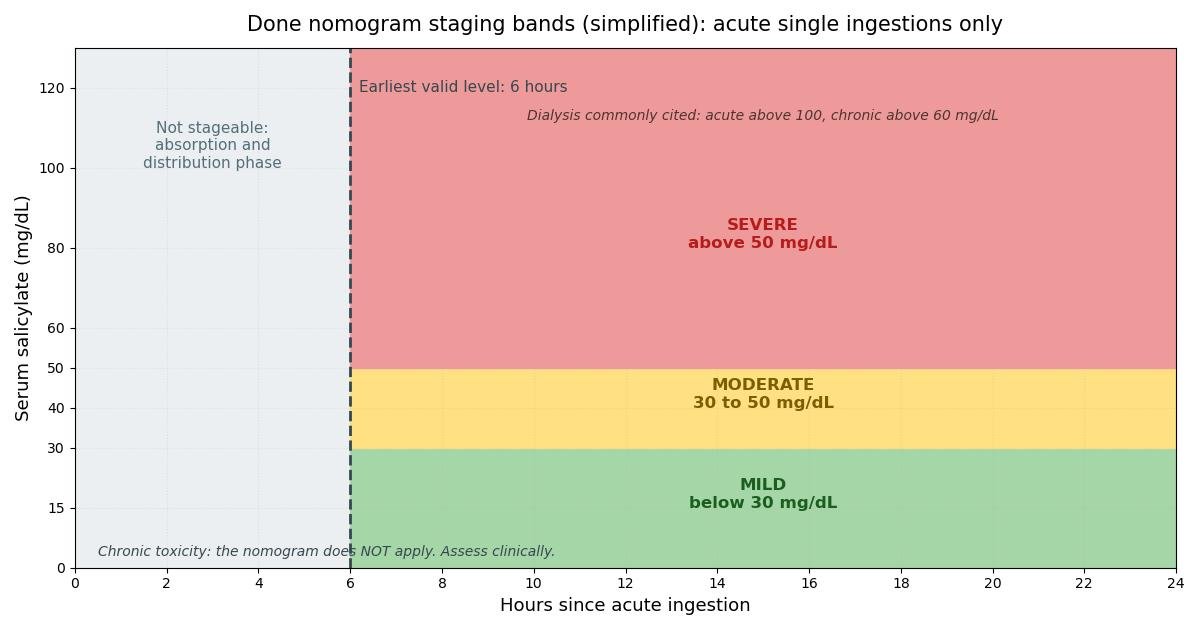
The Done nomogram, introduced by A. K. Done in 1960, was the first systematic attempt to turn a serum salicylate concentration into a prediction of poisoning severity (Done, 1960). The principle is simple: after a single acute ingestion, plot serial serum salicylate levels against the hours since ingestion on a standardized chart. Higher curves on the chart correspond to greater expected toxicity, because they represent higher peak concentrations. Clinicians read the chart by finding the point where the measured level and the elapsed time intersect, then noting which severity zone it falls into. The nomogram brought welcome order to a confusing overdose, but it carries strict conditions that are often forgotten. It was derived from acute single ingestions of non enteric coated aspirin in children and young adults. It applies only to acute ingestion, not to chronic repeated dosing. It applies only when the time of ingestion is known. And it applies only to levels drawn at or after 6 hours post ingestion, because earlier samples are taken while absorption and distribution are still under way.
Why the 6 hour rule matters
After an acute overdose, aspirin tablets dissolve, the drug is absorbed from the gut, and then distributes from blood into tissues, including the brain. For the first several hours the measured blood level is a moving target: it can look reassuringly low while tablets are still dissolving in the stomach. A level drawn before 6 hours therefore underestimates the eventual peak and cannot rule out serious toxicity. Delayed absorption makes this worse: enteric coated or sustained release tablets, large ingestions that slow gastric emptying, tablet bezoars (concretions of pills trapped in the stomach), and worsening acidosis can all push the peak many hours later (OzEMedicine, 2025). Standard practice is to draw the first level as early as practical, then repeat every 2 hours until two consecutive levels are falling, which confirms the peak has passed. The calculator above treats any acute level drawn before 6 hours, or with unknown timing, as not stageable by the nomogram and says so explicitly rather than giving a false sense of precision.
Acute versus chronic: why the nomogram cannot stage chronic toxicity
Chronic salicylate toxicity is a different disease wearing the same laboratory label. It develops over days as repeated doses accumulate, particularly in older adults using salicylates for pain or rheumatic disease. Because there is no single time zero, there is nothing meaningful to plot on the nomogram's time axis. Because dosing has been ongoing, distribution into tissues is already complete and there is no absorption phase to wait out. Acid base and fluid disturbances are entrenched, protein binding is reduced at higher concentrations so more free drug reaches the brain, and the patient population is older with less physiological reserve. The practical consequence, repeated across toxicology references, is that patients with chronic toxicity can be profoundly ill with serum levels of only 30 to 40 mg/dL, levels that would be modest in an acute ingestion (BMJ Best Practice, 2025; OzEMedicine, 2025). Chronic toxicity is therefore assessed clinically: confusion, dyspnea, malaise and dehydration in an older adult on regular salicylates should trigger urgent evaluation even when the number looks unalarming. This calculator keeps the two pathways separate. Choosing chronic switches off the nomogram entirely, lowers the dialysis concern threshold, and upgrades the severity rating whenever concerning clinical features are present.
Serum level severity bands
When the nomogram conditions are met, severity is commonly staged from the serum salicylate concentration drawn at or after 6 hours. This calculator uses the widely taught acute bands: below 30 mg/dL mild, 30 to 50 mg/dL moderate, and above 50 mg/dL severe. Published sources vary around these cutoffs, and honesty requires saying so: BMJ Best Practice places severe poisoning above 70 mg/dL (700 mg/L) for acute ingestion, OzEMedicine describes moderate toxicity from 30 to 75 mg/dL with potentially lethal levels above 75 mg/dL, and an NHS laboratory guide uses 30 to 50 mg/dL for mild toxicity, 50 to 70 for moderate, and above 70 for severe (BMJ Best Practice, 2025; OzEMedicine, 2025; Royal Liverpool pathology guide, 2014). The task-specified 30 and 50 mg/dL cutoffs used here sit at the cautious end of that published range, which is appropriate for an emergency information tool. Whatever the exact number, the clinical context always modifies interpretation: a level of 45 mg/dL in a patient with pulmonary edema and confusion is severe poisoning regardless of which band the number falls in.
| Band | Serum salicylate (acute, at or after 6 hours) | Typical features |
|---|---|---|
| Mild | Below 30 mg/dL | Nausea, vomiting, tinnitus, deafness, lethargy, dizziness |
| Moderate | 30 to 50 mg/dL | Dehydration, restlessness, sweating, tachypnea and hyperventilation; respiratory alkalosis often present |
| Severe | Above 50 mg/dL | Confusion, agitation, coma, seizures, pulmonary or cerebral edema, refractory acidosis, renal failure |
The classic mixed acid base disorder
Salicylate poisoning produces one of the most recognizable acid base patterns in medicine. Salicylate directly stimulates the medullary respiratory center, driving hyperventilation and a primary respiratory alkalosis that appears early and may be the only blood gas abnormality in a mild overdose. Meanwhile, salicylate uncouples oxidative phosphorylation, the process by which mitochondria make energy, which forces cells toward anaerobic metabolism and generates ketoacids and lactate. The result is a high anion gap metabolic acidosis that supervenes as poisoning progresses, so the classic established picture is respiratory alkalosis plus high anion gap metabolic acidosis together (Wikipedia contributors, 2025; BMJ Best Practice, 2025). In severe intoxication the respiratory limb can swing toward acidosis because of central nervous system depression or pulmonary edema, which is why arterial blood gases must be followed serially and never interpreted from a single snapshot. Recognizing the mixed pattern matters because it points away from simpler explanations: a tachypneic older adult with confusion and a high anion gap acidosis who is taking aspirin may be labeled as sepsis or diabetic ketoacidosis unless salicylate toxicity is considered.
Other clinical features
Early features include nausea, vomiting, abdominal pain, tinnitus (ringing in the ears) and deafness, which are familiar to anyone who has taken slightly too much aspirin. As toxicity advances there is sweating, flushed skin, tremor and excitability, then hyperventilation, fever from uncoupling of oxidative phosphorylation, and disturbed consciousness progressing to coma. Disordered glucose metabolism is a subtle but important feature: the brain can be starved of glucose even when blood glucose looks normal, because salicylate impairs glucose use in the central nervous system. Guidelines therefore recommend giving dextrose to any salicylate poisoned patient with altered mental status even when the measured blood glucose is normal (ACEP Now, 2023). Hypokalemia is common and matters for treatment, coagulation can be disturbed, and rare features include hepatotoxicity and rhabdomyolysis. Pulmonary edema deserves special emphasis because it can be precipitated by overly aggressive intravenous fluids and because it converts a stable patient into a critical one.
Urinary alkalinization: the rationale
Enhanced elimination is the mainstay of moderate salicylate poisoning, and its logic is a beautiful piece of applied chemistry. Salicylic acid is a weak acid. In alkaline urine a much larger fraction of the drug exists in its ionized, charged form, and ionized molecules cannot be reabsorbed across the renal tubular epithelium back into the blood. Raising urine pH therefore traps salicylate in the tubule lumen so it is excreted: this is ion trapping, and it markedly increases renal salicylate clearance. The standard regimen combines volume repletion with intravenous sodium bicarbonate, typically a bolus of 1 to 2 mEq per kg followed by an infusion of dextrose containing sodium bicarbonate and potassium chloride, titrated to a urine pH between 7.5 and 8.0 and an arterial pH between 7.50 and 7.60. Potassium must be repleted because hypokalemia prevents effective urinary alkalinization. The same chemistry helps the brain: keeping blood slightly alkaline keeps more salicylate ionized in plasma, which reduces its movement across the blood brain barrier into the central nervous system. Acetazolamide is not used because it acidifies the blood and worsens brain penetration of the drug.
Hemodialysis indications
Hemodialysis is the definitive treatment for severe salicylate poisoning. Salicylate is almost ideal for extracorporeal removal: small molecule, water soluble, small volume of distribution, and largely unbound from plasma proteins at toxic concentrations (Wikipedia contributors, 2025). The EXTRIP workgroup, after systematic review and a two round Delphi consensus, recommended extracorporeal treatment for severe salicylate poisoning, for any patient with altered mental status, for acute respiratory distress syndrome requiring supplemental oxygen, and whenever standard therapy is failing, regardless of the measured concentration. On numbers alone, EXTRIP strongly recommends treatment above 7.2 mmol per L, approximately 100 mg/dL, and above 6.5 mmol per L, approximately 90 mg/dL, when kidney function is impaired (EXTRIP Workgroup, 2017). Bedside teaching commonly cites above 100 mg/dL after acute ingestion and above 60 mg/dL in chronic toxicity, and several sources advise involving nephrology early when the level approaches 60 mg/dL, when it rises despite optimal treatment, or when the patient deteriorates regardless of the number (ACEP Now, 2023; UCSF Hospital Handbook, 2025). Dialysis is also indicated regardless of the level for renal failure, pulmonary or cerebral edema, refractory acidosis despite fluids and bicarbonate, a rising level despite alkalinization or activated charcoal, inability to tolerate bicarbonate therapy because of fluid overload or heart failure, and for patients who require intubation. Intubation itself is hazardous in salicylate poisoning: the brief loss of hyperventilation during the procedure can precipitate a fatal acidosis, so alkalinization should be started first, ventilation must match the patient's own compensatory hyperventilation, and dialysis beforehand is preferred when feasible.
Why the clinical picture outweighs the number
The most dangerous error in salicylate poisoning is treating the laboratory value instead of the patient. A level of 55 mg/dL in a comfortable, hyperventilating young adult after a witnessed acute ingestion is a different illness from a level of 35 mg/dL in a confused, dyspneic older adult who has been taking aspirin daily for a month. The nomogram was built for the first patient and has nothing to say about the second. Serial levels matter more than any single value: a level that is rising despite treatment signals ongoing absorption or failing elimination and pushes toward dialysis even when the absolute number is below every threshold. Symptoms such as altered mental status, pulmonary edema and refractory acidosis are indications for dialysis in their own right at any concentration. This is why the calculator upgrades severity whenever concerning clinical features are checked, and why its dialysis flag list includes every clinical indication alongside the numeric thresholds. The number informs judgment; it never replaces it.
Worked example
Consider a 24 year old who took a single large ingestion of non enteric coated aspirin 8 hours ago. The serum salicylate drawn at 8 hours is 62 mg/dL, and the patient is alert with tinnitus, vomiting and marked hyperventilation. Selecting acute ingestion, 62 mg/dL, and 8 hours, the calculator stages this as severe because the level exceeds 50 mg/dL and the sample was drawn after the 6 hour mark, so the nomogram is valid. It does not flag dialysis on numbers alone, since 62 mg/dL is below the 100 mg/dL acute threshold, but it notes that nephrology should be involved early and that serial levels every 2 hours are required to confirm the peak. If the same patient developed confusion, the altered mental status flag would upgrade the urgency and add a clinical indication for dialysis regardless of the level. Now contrast a 78 year old taking aspirin daily for arthritis who presents confused and tachypneic with a level of 38 mg/dL. Selecting chronic ingestion, the calculator switches off the nomogram entirely, notes that chronic toxicity can be severe at this concentration, and with the altered mental status flag present it stages the case as severe with a dialysis indication. Two different diseases, two different pathways, one tool.
What this tool cannot do
This calculator cannot examine the patient, read an arterial blood gas, spot a tablet bezoar on examination, detect that a level is still rising, or judge whether an enteric coated preparation has delayed absorption. It stages from a single entered level and cannot substitute for serial measurements, which are the standard of care until two consecutive levels are falling. It knows nothing about co ingestants such as acetaminophen, which must be screened for in every intentional overdose. Its severity bands are an educational simplification of a published range, and they deliberately sit at the cautious end. Above all, it cannot provide the clinical judgment that distinguishes the patient who needs only observation and alkalinization from the patient who needs a dialysis catheter within the hour. Anyone with suspected salicylate poisoning needs an emergency department, Poison Control, and usually a medical toxicologist. Use this tool to understand the numbers while help is on the way, not instead of help.
References
- Done AK. Salicylate intoxication: significance of measurements of salicylate in blood in cases of acute ingestion. Pediatrics. 1960;26:800-807. (Original description of the Done nomogram.)
- EXTRIP Workgroup. Extracorporeal treatment for salicylate poisoning: systematic review and recommendations. Annals of Emergency Medicine. 2017;69(1):71-84. (Dialysis indications: above 7.2 mmol/L, about 100 mg/dL; above 6.5 mmol/L, about 90 mg/dL, with impaired kidney function; clinical indications regardless of level.)
- BMJ Best Practice. Salicylate poisoning: criteria. 2025. (Mild below 300 mg/L, moderate 300 to 700 mg/L, severe above 700 mg/L for acute ingestion; chronic toxicity severe at much lower levels.)
- OzEMedicine. Salicylates overdose. 2025. (Acute level below 6 hours does not exclude toxicity; moderate 300 to 750 mg/L, potentially lethal above 750 mg/L after 6 hours; dialysis above 80 mg/dL.)
- ACEP Now. 10 pitfalls of salicylate poisoning. 2023. (Dextrose for altered mental status even with normal glucose; nephrology consult as levels approach 60 mg/dL; EXTRIP thresholds.)
- UCSF Hospital Handbook. Salicylate overdose. 2025. (Nephrology for level above 100 mg/dL, or above 60 mg/dL in patients over 60; alkalinization targets; serial levels.)
- Olson KR, ed. Poisoning and Drug Overdose. 7th ed. McGraw-Hill; 2018. (Acute versus chronic patterns; management principles.)
- Wikipedia contributors. Salicylate poisoning. Wikipedia. 2025. (Mixed acid base disorder; toxic dose above 150 mg/kg; dialysis criteria summary.)
- American Academy of Clinical Toxicology
- MedlinePlus
Key takeaways
- The Done nomogram, introduced by Done in 1960, plots serial serum salicylate concentrations against the time since a single acute ingestion to estimate poisoning severity.
- Chronic salicylate toxicity arises from repeated therapeutic doses over days, so there is no single time zero to plot on the nomogram and no absorption phase to wait out.
- The classic picture is a mixed respiratory alkalosis and high anion gap metabolic acidosis.
- No single level alone mandates dialysis: the clinical condition matters more than the number, especially in chronic toxicity.
Frequently asked questions
What is the Done nomogram and when does it apply?
The Done nomogram, introduced by Done in 1960, plots serial serum salicylate concentrations against the time since a single acute ingestion to estimate poisoning severity. It applies only to acute single ingestions of non enteric coated aspirin and only to levels drawn at or after 6 hours post ingestion, because before 6 hours the drug is still in the absorption and distribution phase and the level underestimates peak concentration. It does not apply to chronic toxicity, to enteric coated or sustained release preparations, or when the timing of ingestion is unknown.
Why does chronic salicylate toxicity not follow the nomogram?
Chronic salicylate toxicity arises from repeated therapeutic doses over days, so there is no single time zero to plot on the nomogram and no absorption phase to wait out. Tissue distribution is already complete, acid base and fluid disturbances are entrenched, and older adults with chronic toxicity can be profoundly ill with serum levels as low as 30 to 40 mg/dL. For that reason the nomogram cannot stage chronic toxicity: management is driven by clinical features and repeated levels, with a lower threshold for hemodialysis.
What acid base changes are typical in salicylate poisoning?
The classic picture is a mixed respiratory alkalosis and high anion gap metabolic acidosis. Salicylate directly stimulates the medullary respiratory centre, producing hyperventilation and a primary respiratory alkalosis that appears early and may be the only abnormality in a mild overdose. Uncoupling of oxidative phosphorylation then generates ketoacids and lactate, producing a high anion gap metabolic acidosis that supervenes as poisoning progresses. In severe intoxication the respiratory component can shift toward acidosis because of CNS depression or pulmonary edema, so both arterial blood gases and serial levels are needed to follow the course.
At what serum salicylate level is hemodialysis indicated?
No single level alone mandates dialysis: the clinical condition matters more than the number, especially in chronic toxicity. The EXTRIP workgroup strongly recommends extracorporeal treatment at levels above 7.2 mmol/L, about 100 mg/dL, after acute ingestion, and at above 6.5 mmol/L, about 90 mg/dL, when kidney function is impaired. Commonly cited bedside thresholds are above 100 mg/dL after acute ingestion and above 60 mg/dL in chronic toxicity. Dialysis is also indicated regardless of the measured level for altered mental status, pulmonary or cerebral edema, renal failure, refractory acidosis despite fluids and bicarbonate, a rising level despite treatment, or inability to tolerate bicarbonate therapy.
Why is urinary alkalinization used in salicylate poisoning?
Salicylic acid is a weak acid, and in alkaline urine a larger fraction exists in its ionized form, which cannot be reabsorbed across the renal tubule. This process, called ion trapping, markedly increases renal salicylate clearance. Treatment combines volume repletion with intravenous sodium bicarbonate, titrated to a urine pH between 7.5 and 8.0 and an arterial pH between 7.50 and 7.60, with potassium repleted because hypokalemia prevents effective alkalinization. Alkalinization also keeps salicylate in its ionized form in blood, reducing its movement into the brain.
What are the limitations of this calculator?
This calculator stages severity from the serum salicylate level, ingestion type and timing, and selected clinical features, but it cannot examine the patient, interpret blood gases, detect a rising trend on serial levels, or judge whether absorption is complete. Levels drawn before 6 hours after an acute ingestion underestimate peak concentration, and chronic toxicity is not stageable by the nomogram at all. It is an emergency information tool for clinicians and never replaces Poison Control, a medical toxicologist, or emergency department care: anyone with suspected salicylate poisoning should call Poison Control or go to an emergency department immediately.
Severity bands at a glance