Iron Overdose: Toxicity Band and Deferoxamine Dosing Aid
In short: Acute iron poisoning assessment tool: interpret peak serum iron bands, check deferoxamine chelation indications, and calculate weight-based deferoxamine infusion rates with safety caps. Emergency information, not medical advice. Use the calculator above, then read the guide below to interpret your result and its limitations.
Enter a peak serum iron result, body weight, and time since ingestion to get a toxicity-band interpretation, a deferoxamine indication check against published poison-centre criteria, and weight-based infusion rates with the published safety caps. Built for education and emergency-department reference; it does not prescribe treatment.
Calculator
Use the peak level drawn 2 to 6 hours after ingestion (up to about 8 hours for extended-release tablets).
Weight is used for the deferoxamine rate in mg per kg per hour.
Needed to judge whether the iron level is a peak level or a post-distribution level.
Elemental iron, not tablet weight. A 324 mg ferrous sulfate tablet holds about 65 mg of elemental iron and a 325 mg ferrous gluconate tablet about 38 mg; check the product label because content varies by brand and formulation.
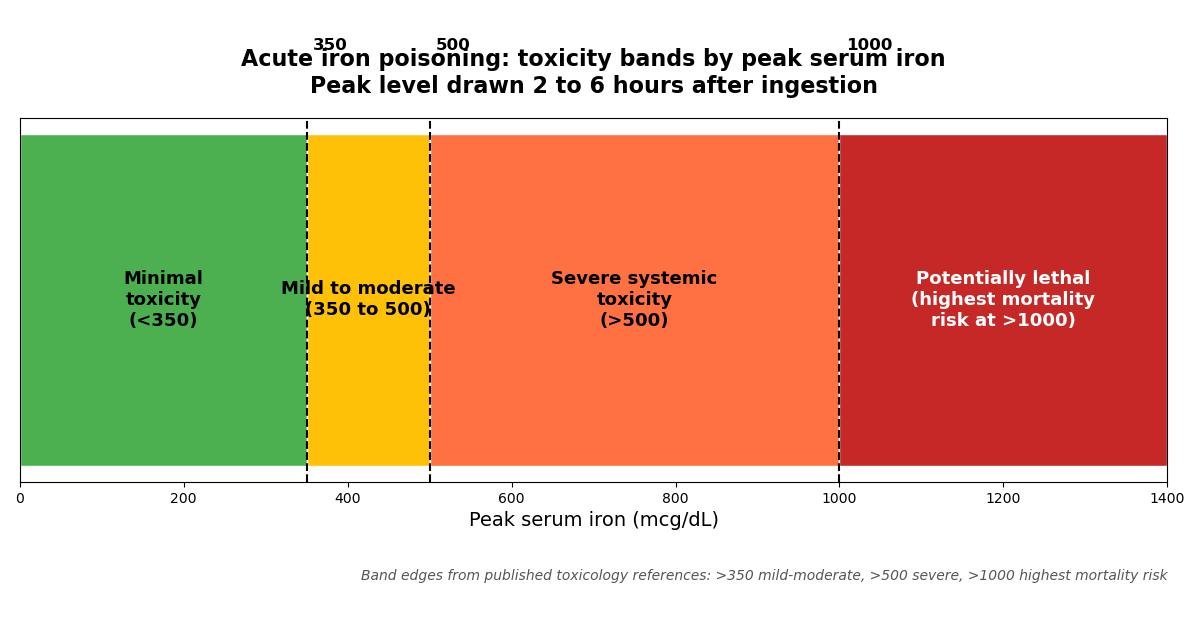
How to read your serum iron result
Serum iron is the single most useful laboratory test after an iron overdose, but only if it is drawn at the right time. Toxicology references describe the peak concentration, usually drawn between 2 and 6 hours after ingestion, as the level that predicts toxicity best. A level of 200 mcg/dL means very different things at 4 hours and at 14 hours, because by 14 hours much of the iron has left the bloodstream and lodged in tissues. The calculator above interprets the number you enter as a peak level and then adjusts its advice based on the time you entered.
The band edges used here come from published poisoning literature. Peak concentrations above 350 mcg/dL are generally associated with mild to moderate toxicity, and concentrations above 500 mcg/dL are associated with more serious, systemic toxicity, according to a widely cited Medscape review of pediatric iron poisoning. An Ohio State toxic-substance monograph uses the same landmarks: below 350 minimal toxicity, 350 to 500 moderate, above 500 severe systemic toxicity. Emergency board-review material adds that levels above 1000 mcg/dL carry the highest risk of death. Keep in mind that rare deaths have been reported with so-called peak levels below 400 mcg/dL, almost always because the sample was drawn much later than 6 hours and was not a true peak. A single reassuring number drawn late is not a clean bill of health.
Two conversions are worth knowing. Some laboratories and poison centres report iron in micromoles per liter: 500 mcg/dL is approximately 90 micromoles per liter, which is why the Ontario Poison Centre protocol cites a threshold of 90 micromoles per liter. A normal adult serum iron is roughly 50 to 170 mcg/dL depending on the laboratory, so a level of 300 or 400 after an overdose is not borderline high, it is solidly in the toxic range.
Why the timing of the blood draw matters
Iron has complicated, multi-compartment behaviour in the body. After tablets dissolve, iron is absorbed from the gut, circulates bound to transferrin, and then moves into tissues, especially the liver. The blood level therefore rises to a peak and then falls even while total body iron is unchanged. Guidelines from the American College of Emergency Physicians describe the peak as occurring between 2 and 6 hours after ingestion, and recommend a repeat level at 8 to 12 hours to rule out delayed absorption. For extended-release preparations the peak can be as late as 8 hours, and bezoars, meaning concretions of tablets stuck together in the stomach, can delay absorption even further.
This is why the calculator asks for hours since ingestion. A level drawn at 1 hour is not yet a peak and will underestimate the exposure. A level drawn at 12 hours has already lost its predictive value, because iron that has distributed into tissues no longer shows up in the blood. Management of serious iron poisoning therefore uses multiple serial serum iron concentrations, not one snapshot. If the only available level is a late one, toxicologists base decisions on the clinical picture, the ingested dose, the X-ray, and the trend of repeat levels.
TIBC: a number you should not rely on
For many years clinicians ordered a total iron binding capacity (TIBC) alongside serum iron, reasoning that if the serum iron stayed below the TIBC, no free iron would be available to cause tissue damage. That reasoning is now considered wrong. The ACEP iron-toxicity simulation case states plainly that TIBC is not recommended: at high serum iron values the TIBC itself can be falsely elevated, and the protective theory was never supported by evidence. The Medscape review agrees, noting that because the TIBC is difficult to interpret in this setting, it is not currently recommended in managing acute iron overdose. The calculator on this page therefore ignores TIBC entirely, and you should ask your laboratory and your toxicologist to do the same. A reassuring TIBC result must never be used to talk a symptomatic patient out of chelation.
How much elemental iron was swallowed
Iron tablets state their salt weight on the label, but toxicity depends on elemental iron. A 324 mg ferrous sulfate tablet contains about 65 mg of elemental iron, a 325 mg ferrous gluconate tablet about 38 mg, and a 200 mg ferrous fumarate tablet about 65 mg, with liquid and paediatric preparations varying further. Always convert the swallowed tablets to milligrams of elemental iron before applying dose thresholds.
Two ingestion thresholds recur in the literature. Several protocols consider chelation when more than 20 mg/kg of elemental iron has been ingested, alongside the serum iron criterion of about 400 mcg/dL in one pregnancy-focused treatment review. The danger zone for severe systemic toxicity and increased mortality is widely set at 60 mg/kg of elemental iron or more, cited both in a University of Calgary clinical pharmacology pearl and in a Tulane pharmacology overview of acute iron poisoning. The calculator applies these bands when you enter the ingested elemental iron: below 20 mg/kg is below the typical referral threshold, 20 to 60 is the chelation-threshold range where clinical assessment decides, and 60 or more is the danger zone. These bands guide urgency, not treatment; a symptomatic patient with a lower ingested dose still needs full evaluation.
The five stages of iron poisoning
Textbooks describe five classic clinical stages, and knowing them matters because stage 2 is a trap. Stage 1, from about half an hour to 6 hours after ingestion, is local gut injury: nausea, vomiting, diarrhoea, abdominal pain, and sometimes gastrointestinal bleeding, caused by the direct caustic effect of iron on the mucosa. Stage 2, from 6 to 24 hours, is the latent phase: the vomiting settles and the patient looks better, but iron is redistributing into cells and causing ongoing cellular injury. Discharge decisions made during this deceptive calm are among the classic errors in iron poisoning.
Stage 3, roughly 12 to 24 hours and in some descriptions up to 48 to 72 hours, brings shock and metabolic acidosis, with distributive and cardiogenic shock, coagulopathy, coma, and progressive multi-organ failure including acute respiratory distress and renal failure. Stage 4, at 2 to 3 days (some sources say 24 to 96 hours), is hepatotoxicity: massive iron deposition causes acute hepatic necrosis. Stage 5, at 2 to 8 weeks, is bowel obstruction from scarring and stricture after the caustic bowel injury, sometimes presenting as gastric outlet obstruction. Not every patient passes through every stage in order, and severe poisoning can skip the latent phase entirely, which is why the Calgary pearl warns that an absent latent phase does not preclude deterioration.
Deferoxamine: how the antidote works and how it is given
Deferoxamine (desferrioxamine, brand name Desferal) is a chelator that binds ferric iron in the blood to form ferrioxamine, a water-soluble complex excreted in the urine. It limits iron entry into cells and also chelates intracellular iron. One hundred milligrams of deferoxamine binds about 8.5 mg of elemental iron, which is why the calculator shows the total elemental iron the 24-hour cap can chelate. The pinkish red discoloration of the urine, sometimes called vin-rose urine, is a visible sign that chelation is happening, although its absence does not exclude severe toxicity.
Published poison-centre protocols agree on when to start. The Ontario Poison Centre protocol, referencing Micromedex and Toxinz, indicates deferoxamine when serum iron exceeds 90 micromoles per liter (500 mcg/dL), or at lower or unknown levels when there is evidence of systemic toxicity such as shock, acidosis, gastrointestinal hemorrhage, or coma. The Utah Poison Control protocol adds two practical triggers: iron above 500 mcg/dL even with mild symptoms, and iron above 350 mcg/dL with severe symptoms or tablets visible on the abdominal X-ray. Pregnancy is not a contraindication. Intramuscular dosing is not recommended by the Ontario protocol; the intravenous route is preferred.
On dosing, the Utah protocol starts the infusion at 5 mg/kg/h and increases to 15 mg/kg/h if no hypotension occurs, delivering the first 1000 mg over about an hour in a 70 kg patient. The Ontario protocol caps the infusion rate at 15 mg/kg/h intravenously, up to a total of 80 mg/kg or 6 g, continued until signs and symptoms improve. In severe poisoning the rate is rarely titrated as high as 40 mg/kg/h, but only in consultation with the on-call toxicologist. Infusion typically runs 6 to 12 hours and should not exceed 24 hours. The calculator implements the conservative, widely cited limits: start 5 mg/kg/h, maximum 15 mg/kg/h, and a 24-hour cap of the lower of 6 g and 80 mg/kg. It deliberately does not offer the 40 mg/kg/h toxicologist-only rate, because that decision belongs to the bedside team. The treatment endpoint is clinical improvement, not a target urine colour or a fixed number of hours.
Deferoxamine cautions: hypotension, lung injury, and infection
Speed kills with this drug. High-dose or rapid deferoxamine infusion is associated with hypotension, flushing, urticaria, and anaphylactoid reactions, which is exactly why the 15 mg/kg/h ceiling exists and why the Utah protocol starts at 5 and titrates only if blood pressure holds. If hypotension occurs, the standard response is to reduce the infusion rate while continuing resuscitation. Prolonged high-dose infusion beyond 24 hours has been associated with acute respiratory distress syndrome, so the 24-hour limit is a safety boundary, not a suggestion. Deferoxamine may also promote infection with Yersinia enterocolitica, and patients with severe renal impairment may need hemodialysis as an adjunct to remove the ferrioxamine complex, since the complex is dialyzable. Baseline blood work (blood count, chemistry panel, blood gas, lactate, clotting studies) and serial monitoring at least every 4 hours are part of the Utah protocol, along with frequent poison-control or toxicologist consultation.
The older product-monograph schedule still appears in reviews: an initial 1000 mg by slow intravenous infusion at no more than 15 mg/kg/h, then 500 mg at 4-hour intervals twice, then another 500 mg over 4 to 12 hours, with no more than 6000 mg in 24 hours and later doses at no more than 125 mg per hour. Modern poison-centre practice has largely moved to the continuous-infusion approach the calculator models, but the 6 g per 24 hour ceiling is common to both. Either way, decisions to exceed the cap or prolong treatment are made with a toxicologist, never by protocol alone.
What this tool cannot do, and what to do right now
This calculator works with three numbers and one checkbox. Real iron poisoning involves far more: the exact preparation swallowed, whether tablets are still visible on X-ray, co-ingested drugs (always check salicylate and paracetamol levels in an overdose), the trend of serial iron levels, blood gases, lactate, clotting, liver function, urine output, and the trajectory of the patient. Whole bowel irrigation may be considered for large ingestions or pill fragments on X-ray, activated charcoal does not bind iron and has no role, and gastric lavage is rarely useful. None of that is captured here, and none of it should be decided from a web page.
If you are dealing with a real or suspected iron overdose: call your local poison control centre immediately or go to the nearest emergency department. Bring the tablet bottle or a photo of the label so the team can calculate the elemental iron dose. Do not try to induce vomiting, do not wait to see if symptoms improve on their own (remember the deceptive latent phase), and do not give or withhold deferoxamine based on any calculator output. In hospital, deferoxamine decisions are made by the treating team with a toxicologist, using serial levels and the clinical picture. This page exists so that patients, families, students, and clinicians can understand the published thresholds and protocols, not to direct care.
Key takeaways
- Draw serum iron between 2 and 6 hours after ingestion to capture the peak concentration, which is the level that predicts toxicity best.
- Peak concentrations above 350 mcg/dL are generally associated with mild to moderate toxicity, and concentrations above 500 mcg/dL are associated with more serious, systemic toxicity.
- Total iron binding capacity (TIBC) is an indirect measure of transferrin, and the old idea that toxicity cannot occur when serum iron is below the TIBC is not supported by evidence.
- Stage 1 (about 0.5 to 6 hours): local gut injury with nausea, vomiting, diarrhoea, abdominal pain and sometimes gastrointestinal bleeding.
Frequently asked questions
When should serum iron be drawn after an iron overdose?
Draw serum iron between 2 and 6 hours after ingestion to capture the peak concentration, which is the level that predicts toxicity best. For extended-release preparations the peak may not occur until about 8 hours, and a repeat level at 8 to 12 hours is recommended to rule out delayed absorption. Levels drawn much later can look falsely low because iron redistributes from blood into tissues, and nonpeak levels are very hard to interpret.
What serum iron level means severe toxicity?
Peak concentrations above 350 mcg/dL are generally associated with mild to moderate toxicity, and concentrations above 500 mcg/dL are associated with more serious, systemic toxicity. Levels above 1000 mcg/dL carry the highest reported risk of death. These are peak-level interpretations only; a low level drawn long after ingestion does not rule out severe poisoning because iron may already have moved into tissues.
Why is TIBC not recommended in acute iron overdose?
Total iron binding capacity (TIBC) is an indirect measure of transferrin, and the old idea that toxicity cannot occur when serum iron is below the TIBC is not supported by evidence. At high serum iron values the TIBC itself can be falsely elevated, making the comparison misleading. Current poisoning-management guidance recommends against using TIBC in acute iron overdose.
What are the five stages of iron poisoning?
Stage 1 (about 0.5 to 6 hours): local gut injury with nausea, vomiting, diarrhoea, abdominal pain and sometimes gastrointestinal bleeding. Stage 2 (6 to 24 hours): a deceptive latent phase where symptoms improve while cellular injury continues. Stage 3 (12 to 24 hours, sometimes up to 72): shock, metabolic acidosis, coagulopathy, coma and multi-organ failure. Stage 4 (2 to 3 days): hepatic failure from iron deposition in the liver. Stage 5 (2 to 8 weeks): bowel obstruction from scarring after the caustic injury.
What is the standard deferoxamine dosing protocol for acute iron poisoning?
Published poison-centre protocols indicate deferoxamine when peak serum iron exceeds 500 mcg/dL, or above 350 mcg/dL with severe symptoms, shock, acidosis, gastrointestinal bleeding, coma, or tablets visible on abdominal X-ray. Infusion starts around 5 mg per kg per hour and is increased to a maximum of 15 mg per kg per hour if no hypotension occurs, up to a cap of 80 mg per kg or 6 g in 24 hours. Infusion typically runs 6 to 12 hours and should not exceed 24 hours. Higher rates (up to 40 mg per kg per hour in severe poisoning) are only used under direct toxicologist supervision because rapid infusion causes hypotension, and prolonged high-dose infusion beyond 24 hours has been linked to acute lung injury.
Can this calculator replace Poison Control or emergency care?
No. This is an information and education tool for understanding published thresholds and dosing references. Acute iron poisoning is a medical emergency that needs an emergency department, poison control centre, or medical toxicologist. Do not use any calculator output to start, stop, or change deferoxamine treatment; all chelation decisions must be made by the treating clinicians.
Sources
- Ontario Poison Centre. Deferoxamine protocol (faxable sheet, revised November 2024; dosing per Micromedex and Toxinz): indication serum iron above 90 micromol/L (500 mcg/dL) or lower/unknown with systemic toxicity; maximum infusion rate 15 mg/kg/h IV up to 80 mg/kg or 6 g; duration typically 6 to 12 hours, not exceeding 24 hours; higher rate up to 40 mg/kg/h only with toxicologist; hypotension, acute lung injury beyond 24 hours, Yersinia enterocolitica risk.
- Utah Poison Control Center. Deferoxamine for acute iron poisoning protocol (January 2025): indications including iron above 500 mcg/dL with mild symptoms and above 350 mcg/dL with severe symptoms or tablets on X-ray; start 5 mg/kg/h titrating to 15 mg/kg/h; first 1000 mg over about 1 hour in a 70 kg patient; 6 to 8 g total in 24 hours; serial labs and urine monitoring every 4 hours.
- Medscape. Pediatric iron poisoning: peak serum iron drawn 2 to 6 hours; above 350 mcg/dL mild to moderate toxicity, above 500 mcg/dL more serious toxicity; TIBC not recommended; late nonpeak levels difficult to interpret; rare deaths with late peak below 400 mcg/dL.
- American College of Emergency Physicians. Iron toxicity simulation case: five stages (0.5 to 6 h local; 6 to 24 h latent; 12 to 24 h shock; 2 to 3 days hepatic failure; 3 to 6 weeks sequelae); peak 2 to 6 hours; repeat level at 8 to 12 hours; TIBC not recommended; activated charcoal ineffective for iron.
- University of Calgary, Clinical Pharmacology Pearl of the Week (June 2019): life-threatening toxicity may develop above 60 mg/kg elemental iron; serum iron at 4 to 6 hours prognostically relevant; deferoxamine indication including serum iron above 90 micromol/L; hypotension and ARDS as complications; toxicologist consultation before treatment.
- SCIRP. Iron overdose during pregnancy: case and treatment review: chelation initiation above 400 mcg/dL or 20 mg/kg elemental iron; intravenous rate not exceeding 15 mg/kg/h; initial 1000 mg, then 500 mg at 4-hour intervals, additional 500 mg over 4 to 12 hours; not more than 6000 mg in 24 hours; subsequent doses not exceeding 125 mg/hour.
- Ohio State University toxic substance blog, Iron: peak 4 to 6 hours; below 350 minimal, 350 to 500 moderate, above 500 severe systemic toxicity.
- EM Board Bombs. Iron poisoning review: levels 350 to 500 mild to moderate gastrointestinal symptoms; above 500 severe toxicity; above 1000 highest risk of death.