Rumack-Matthew Nomogram: Paracetamol Poisoning Calculator
In short: UK MHRA single-line Rumack-Matthew nomogram for a single acute paracetamol ingestion with a known time. It uses one 100 mg/L-at-4-hours treatment line for every patient and rejects blank or out-of-window inputs.
Plot the level on the nomogram
What the Rumack-Matthew nomogram is
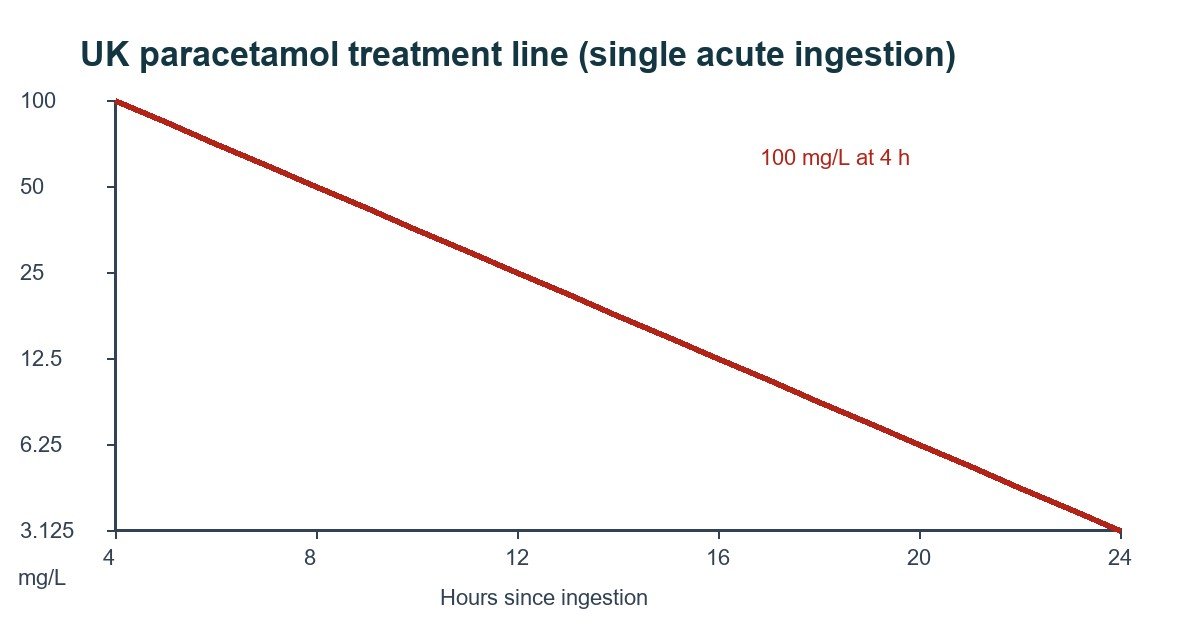
The Rumack-Matthew nomogram is a semilogarithmic plot of serum paracetamol concentration against hours since a single acute ingestion. This UK implementation uses the current single treatment line beginning at 100 mg/L at 4 hours. It supports an urgent toxicology assessment; it does not replace a poisons service or bedside clinical judgement.
Paracetamol is safe at therapeutic doses, but in overdose a fraction of each dose is converted by cytochrome P450 enzymes into the toxic metabolite N-acetyl-p-benzoquinone imine (NAPQI). NAPQI is normally neutralised by glutathione. When glutathione stores are overwhelmed, NAPQI binds to liver proteins and causes centrilobular hepatic necrosis. NAC works by replenishing glutathione, which is why it must be given before irreversible injury occurs. The nomogram translates a timed blood level into a prediction of whether the patient is heading for glutathione depletion, which is the whole basis of the treatment decision.
How to read the nomogram
Find the time since a single acute ingestion on the horizontal axis and the serum concentration on the logarithmic vertical axis. Under current UK MHRA guidance, compare the point with one treatment line beginning at 100 mg/L at 4 hours and falling with a 4-hour half-life: 50 mg/L at 8 hours, 25 mg/L at 12 hours, 12.5 mg/L at 16 hours and about 3.1 mg/L at 24 hours. A point on or above that line indicates N-acetylcysteine for every patient; historical high-risk-factor selection is not used.
The rules for reading the plot are strict. First, the nomogram applies only to a single acute ingestion with a known ingestion time. Second, it is valid only for levels drawn between 4 and 24 hours after ingestion. A level drawn before 4 hours cannot be interpreted, because absorption may still be incomplete and the early level can sit falsely low, giving dangerous reassurance. Repeat the level at or after 4 hours. Third, a level drawn after 24 hours lies outside the validated range; at that point management is clinical, guided by detectable paracetamol, liver function tests and toxicology advice, not by the plotted lines.
Historical nomogram lines and current UK practice
The original nomogram was published in 1975 by Barry H. Rumack and Henry Matthew in Pediatrics. They plotted serum paracetamol concentrations against time in untreated overdose patients and drew a line, starting at 200 mg/L at 4 hours, that separated patients who developed hepatic injury (defined as AST or ALT of 1,000 IU/L or more) from those who did not. The line used a 4-hour half-life slope chosen because it discriminated the two groups in their dataset, not because it reflected paracetamol pharmacokinetics, a point later emphasised by Seifert and colleagues in Clinical Toxicology in 2015.
The original 200 mg/L prognostic line and later 150 mg/L treatment line remain important historically and are still used in some jurisdictions. UK MHRA guidance changed in 2012 to one 100 mg/L-at-4-hours treatment line for all patients, removing the former high-risk-factor split. This page explicitly implements that UK rule; clinicians elsewhere must use their current national poisons guidance.
The current UK single treatment line
In current UK practice the decision is made against one 100 mg/L-at-4-hours line for every patient. A level on or above the line indicates N-acetylcysteine. A level below it is only reassuring when the ingestion was a single acute event, the time is known, the sample was taken within 4 to 24 hours, and there are no features that independently require treatment or specialist advice.
Historical risk factors such as chronic alcohol excess, malnutrition and enzyme-inducing medicines remain clinically relevant, but they no longer select a separate treatment line in the UK algorithm. Unknown time, staggered/repeated ingestion, modified-release products, delayed absorption, symptoms or abnormal liver tests require management outside the nomogram with a poisons service or clinical toxicologist.
N-acetylcysteine: the antidote
NAC is the only proven antidote for paracetamol poisoning. It supplies cysteine for glutathione synthesis, restoring the liver's capacity to detoxify NAPQI, and it may also improve hepatic microcirculatory flow in established injury. It can be given intravenously or orally; the standard intravenous regimen is a three-bag protocol: 150 mg/kg in 200 mL of diluent over 60 minutes, then 50 mg/kg in 500 mL over 4 hours, then 100 mg/kg in 1,000 mL over 16 hours, for a total of 300 mg/kg over 21 hours. A newer two-bag regimen of 200 mg/kg over 4 hours followed by 100 mg/kg over 16 hours has been shown to substantially reduce anaphylactoid reactions (odds ratio about 0.23) and vomiting (odds ratio about 0.37) compared with the traditional three-bag protocol.
Timing matters enormously. When NAC is started within 8 hours of ingestion, the risk of severe hepatotoxicity is around 2.9 percent; started within 10 hours it is about 6.1 percent; started after 10 hours it rises to roughly 26.4 percent. These figures, from published management summaries of paracetamol poisoning, explain the golden rule: do not delay NAC while waiting for a level if the ingestion was large, the time is uncertain, or the patient is already symptomatic. Treatment remains beneficial even when started 15 to 24 hours after ingestion, and it should never be withheld simply because the presentation was late, especially since reported ingestion times are often inaccurate. Common adverse effects of intravenous NAC are anaphylactoid reactions (flushing, rash, bronchospasm), which are managed by slowing or pausing the infusion rather than abandoning treatment. If the patient presents within 4 hours of ingestion and can protect their airway, activated charcoal at 1 g/kg given just before NAC can reduce absorption.
Worked examples
Example 1: at 4 hours, 200 mg/L is above the UK 100 mg/L treatment line, so NAC is indicated.
Example 2: at 4 hours, 100 mg/L lies exactly on the UK treatment line, so NAC is indicated for every patient; no high-risk-factor split is applied.
Example 3: at 8 hours, the UK line is 50 mg/L. A level of 60 mg/L is above it, so NAC is indicated.
Example 4: 300 micromol/L converts to about 45.3 mg/L. At 4 hours this is below the UK line, but the result is only applicable to a single acute ingestion with a reliable time and must be interpreted within the full toxicology assessment.
| Scenario | Position on nomogram | Decision |
|---|---|---|
| 4 h, 200 mg/L | Above 100 mg/L line | NAC indicated |
| 4 h, 100 mg/L | On treatment line | NAC indicated |
| 8 h, 60 mg/L | Above 50 mg/L line | NAC indicated |
| 8 h, 40 mg/L | Below 50 mg/L line | Nomogram alone does not indicate NAC; confirm eligibility and clinical context |
| 2 h, any level | Outside valid window | Repeat at or after 4 h; manage clinically |
| 30 h or unknown time | Outside valid window | Do not use nomogram; seek specialist guidance |
When the nomogram must not be used
The nomogram was derived from single acute ingestions with known timing, and every use outside that setting is unsafe. In staggered overdoses, where tablets were taken over several hours, no single time zero exists and the level cannot be plotted; these patients generally need NAC on clinical grounds. Repeated supratherapeutic ingestions, the pattern seen in chronic pain patients who gradually exceed the daily maximum, are similarly outside the nomogram; management rests on symptoms, liver function tests and detectable paracetamol. Modified-release or extended-release preparations absorb slowly and unpredictably, so a level that looks reassuring at 4 hours can rise later; such cases need serial levels and usually NAC until the picture is clear. Massive ingestions, sometimes flagged when the level sits above a 300 mg/L line at 4 hours, carry a high risk of early severe toxicity and may warrant higher NAC dosing under specialist direction. If the ingestion time is unknown, start NAC without waiting for the level, then use the measured concentration and clinical course to guide continuation. Finally, the nomogram was developed in a specific population and should always be combined with bedside assessment: vomiting, abdominal pain, rising transaminases or an abnormal INR all demand treatment regardless of where a point falls on the graph.
Limitations and evidence
The nomogram is empirical and depends on a reliable ingestion time, a single acute immediate-release exposure, and a sample within 4 to 24 hours. Ingestion histories can be wrong and co-ingestants can delay absorption. This implementation therefore uses the current UK single 100 mg/L line but repeatedly directs all ineligible, uncertain or clinically concerning cases to poisons-service or toxicology guidance. Jurisdictions using a different national threshold should not use this implementation for treatment decisions.
Key takeaways
- The nomogram is valid for a single acute paracetamol ingestion when the serum level is drawn between 4 and 24 hours after ingestion.
- Absorption of paracetamol is not necessarily complete in the first few hours, so an early level can underestimate the peak concentration and falsely place the patient below the treatment line.
- Current UK MHRA guidance uses one line beginning at 100 mg/L at 4 hours for every patient; a point on or above it indicates NAC.
- Historical high-risk factors no longer select a separate UK treatment line, although they still matter to the overall clinical assessment.
References
- Rumack BH, Matthew H. Acetaminophen poisoning and toxicity. Pediatrics. 1975;55(6):871-876. The original nomogram with the 200 mg/L at 4 hours prognostic line.
- Rumack BH, Peterson RC, Koch GG, et al. Acetaminophen overdose: 662 cases with oral acetylcysteine therapy. Arch Intern Med. 1981;141:380-385. Established the 150 mg/L treatment line, 25 percent below the original.
- Seifert SA, Kirschner RI, Martin TG. Acetaminophen concentrations prior to 4 hours of ingestion: impact on diagnostic decision-making and treatment. Clin Toxicol (Phila). 2015. Documents the history of the lines, the empirical 4-hour half-life slope, and why pre-4-hour levels are unreliable.
- White SJ. The acetaminophen toxicity equations: "solutions" for acetaminophen toxicity based on the Rumack-Matthew nomogram. Ann Emerg Med. 2005;45(5):563. Derives the line equations used by this calculator.
- American Academy of Clinical Toxicology
- MedlinePlus
Medically reviewed by Dr. Taimoor Asghar, Physician and Community Medicine Researcher. Last reviewed: 5 October 2026. Published by Doctor With Data.