What is Clostridioides difficile infection?
Clostridioides difficile, still widely called Clostridium difficile, is an anaerobic, spore-forming, toxin-producing bacterium that colonises the gut when the normal microbiota is disrupted, most often by antibiotics. It is one of the leading causes of healthcare-associated infectious diarrhoea worldwide. The clinical spectrum is wide: some infected people have only mild watery diarrhoea, while others develop severe colitis with abdominal pain, fever and a raised white cell count. In severe cases the disease can progress to pseudomembranous colitis, toxic megacolon, sepsis and death.
Diagnosis typically rests on symptoms consistent with infection plus laboratory detection of toxin or toxin genes in stool. Risk factors are familiar to anyone who works in hospitals: recent antibiotic exposure (notably clindamycin, fluoroquinolones and broad-spectrum cephalosporins), advanced age, hospitalisation and prolonged stays, and use of acid-suppressing medicines. The organism spreads through hardy spores that persist on surfaces and survive alcohol-based hand gels, which is why infection-control practice emphasises hand hygiene with soap and water, isolation precautions and careful environmental cleaning alongside drug treatment.
Because the severity of infection varies so much, clinicians have long wanted a simple bedside way to estimate prognosis at the moment of diagnosis. Several scoring systems were proposed over the years, but few were adequately validated, and the risk factors they used were largely the same ones. The ATLAS score was built to answer that need: a small set of variables that are already available when the diagnosis is made, combined into a number that predicts whether the current treatment is likely to work.
What the ATLAS score predicts
The ATLAS score predicts clinical cure of C. difficile infection at the end of treatment, that is, whether the diarrhoea resolves and no further CDI therapy is needed. It is a treatment-response score rather than a severity label. The five items are combined into a total from 0 to 10, and the total is read in three bands: 0 to 3 indicates lower risk of treatment failure, 4 to 6 indicates moderate risk, and 7 to 10 indicates higher risk. The lower the score, the higher the chance that the treatment course will succeed.
It is just as important to understand what ATLAS does not predict. It was not designed to estimate the risk of recurrence, meaning the return of infection after an initially successful treatment, and it does that job poorly. In the derivation work, the correlation between the score and cure at the end of treatment was strong, but the correlation with later recurrence was weak and not statistically significant. Clinicians therefore use ATLAS for the immediate question, whether this episode is likely to respond to therapy, and look elsewhere for guidance on recurrence risk.
The score also does not replace the bedside assessment of how sick the patient is right now. A patient can have a reassuring ATLAS score and still be critically ill, and a patient with a high score may be clinically stable. The number is one input among several, and it supplements rather than overrides clinical judgement.
How the ATLAS score was derived
The score was derived and validated by Miller MA and colleagues and published in BMC Infectious Diseases in 2013. The authors started from a practical observation: the previously proposed prognostic systems all used essentially the same bedside risk factors, so they combined the simplest and most readily collected ones into a single tool. They then tested it on patient-level data from two large phase 3 clinical trials that compared fidaxomicin with vancomycin for C. difficile infection, the 003 and 004 studies, analysing the modified intention-to-treat population with complete data for all candidate variables, a combined group of 967 patients.
Each patient's ATLAS score was calculated from values at the time of diagnosis and matched against the actual cure rate after ten days of study treatment. The correlation was strong: the reported R squared was 0.88 with a P value below 0.001. Patients with a score of 0 had a cure rate of about 98 percent, and the cure rate fell stepwise as the score rose, reaching about 55 percent at a score of 7. This dose-response relationship, visible across the whole range of the score, is what makes ATLAS useful as a prognostic bedside tool rather than a simple yes-or-no test.
A deliberate design choice was to leave out variables that are not usually available when the diagnosis is made. Strain type was omitted because it is not known at the time of diagnosis, and the same reasoning applied to the change in creatinine from baseline, since the baseline value is often unavailable. The result is a score that can be completed with the history and the routine blood results already in hand.
The five components of the ATLAS score
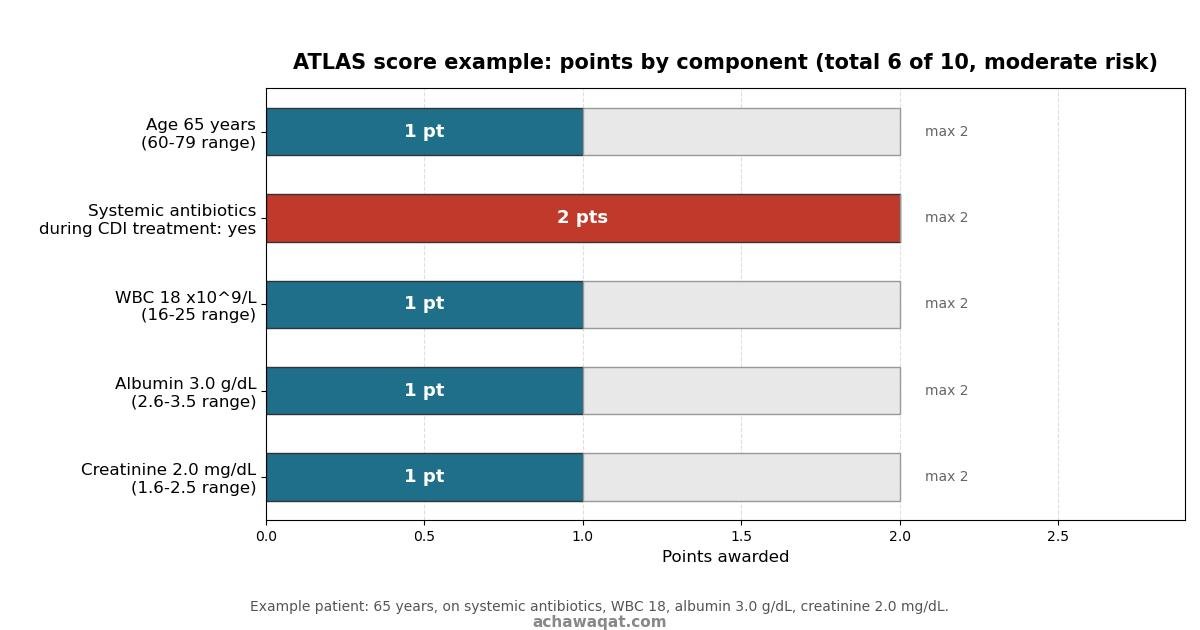
ATLAS is an acronym for its five items: Age, Treatment with antibiotics, Leukocyte count, Albumin, and Serum creatinine. Each item contributes 0, 1 or 2 points, except the antibiotics item, which contributes 0 or 2.
- Age. Under 60 years earns 0 points, 60 to 79 years earns 1 point, and 80 years or older earns 2 points. Older patients with CDI are more likely to have comorbidities, reduced physiological reserve and poorer treatment response, which is why age carries weight in the score.
- Systemic antibiotics during CDI treatment. Receiving other systemic antibiotics while being treated for CDI earns 2 points; receiving none earns 0. This is the only binary item and one of the two items worth a full 2 points, reflecting how strongly ongoing antibiotic exposure was linked to treatment failure in the derivation data.
- White blood cell count. Below 16 x10^9/L earns 0 points, 16 to 25 earns 1 point, and above 25 earns 2 points. Marked leukocytosis is a classic marker of severe CDI and signals a vigorous inflammatory response to the infection.
- Serum albumin. Above 3.5 g/dL earns 0 points, 2.6 to 3.5 earns 1 point, and 2.5 or below earns 2 points. Low albumin reflects a combination of poor nutritional reserve, chronic illness and the protein loss of severe colitis, and it is a well-established marker of poor outcomes across many infections.
- Serum creatinine. 1.5 mg/dL or below earns 0 points, 1.6 to 2.5 earns 1 point, and above 2.5 earns 2 points. A rising creatinine signals acute kidney injury, often from dehydration and third-spacing in severe diarrhoeal illness, and identifies patients whose disease is already affecting other organs.
Adding the five contributions gives the total from 0 to 10. Because the thresholds are fixed, two clinicians scoring the same patient at the same time should arrive at the same number, which is part of what makes the score practical for communication between teams: a score of 6 means the same thing to everyone who knows the system.
Why concurrent antibiotics add two points
The antibiotics item deserves special attention because it is the least obvious of the five. It does not refer to the CDI therapy itself, whether that is vancomycin, fidaxomicin or another agent. It refers to systemic antibiotics prescribed for other infections, such as a pneumonia or urinary tract infection, that the patient is receiving while the CDI is being treated.
The rationale comes directly from the trial data. Patients who received other systemic antibiotics during CDI treatment had lower cure rates and slower resolution of diarrhoea than those who did not. Continuing to expose the gut to broad-spectrum antibiotics while trying to clear C. difficile further disrupts the microbiota, prolongs the ecological disturbance that allowed the infection to take hold, and makes it harder for the bowel to recover. Reports from the trial programme described meaningfully delayed resolution of diarrhoea in patients on concomitant antibiotics.
In practice, this item is also the most actionable part of the score. A clinician reviewing a patient with CDI should always ask whether the other antibiotics are still needed. Stopping unnecessary systemic antibiotics is a core principle of antimicrobial stewardship, and the ATLAS score gives that principle a prognostic number: the patient paying 2 points for this item is the patient most likely to benefit from a careful review of every concurrent prescription.
Using ATLAS alongside severity markers
The ATLAS score supplements standard severity assessment; it does not replace it. Clinical guidelines and hospital practice use their own severity markers, including marked leukocytosis, a rising creatinine, hypotension, ileus, abdominal distension with signs of megacolon, and the need for intensive care. These markers drive urgent decisions such as surgical consultation, escalation of therapy and close monitoring, and they must be acted on regardless of what the ATLAS number says.
The sensible way to combine the two is to treat ATLAS as the prognostic overlay on the clinical picture. A patient with fulminant features needs aggressive management even with a low ATLAS score, because the score predicts the likely response to a standard treatment course, not the immediate danger. Conversely, a clinically stable patient with a high ATLAS score, for example an 82-year-old on concurrent antibiotics with a low albumin, deserves closer follow-up, early review of the treatment plan and a low threshold for escalation, even if they look well on the day of diagnosis.
It also helps to remember the population the score came from. The derivation patients were enrolled in clinical trials with defined inclusion criteria, and trial populations are never a perfect mirror of everyday practice. External evaluations, including a study in two Mexican teaching hospitals that found patients scoring 3 or less had an excellent prognosis while scores of 4 to 7 carried a greater probability of colectomy, broadly support the band interpretation, but local validation remains limited. The score informs judgement; it does not substitute for it.
Limitations of the ATLAS score
Every prognostic score has boundaries, and ATLAS is no exception. The most important limitation is that it predicts end-of-treatment response, not recurrence. The correlation with later recurrence in the derivation work was weak and statistically non-significant, so a low score should never be read as reassurance that the infection will not return.
The score is also deliberately simple, which means it leaves out information a clinician might consider relevant: inflammatory markers beyond the white cell count, imaging findings, the trajectory of symptoms over the first days of treatment, and strain characteristics. Simplicity is the point of a bedside score, but it is also the price. Two patients with the same score of 5 can look quite different at the bedside, and the score cannot capture that difference.
Finally, ATLAS was derived in the era of the fidaxomicin versus vancomycin trials, and both the patient mix and the treatment landscape have shifted since. The thresholds themselves are fixed by the publication, but the absolute cure rates attached to each score may drift as practice changes. Treat the published cure percentages as properties of the derivation cohort, and the risk bands as the durable part of the tool.
How CDI treatment guidance has evolved
When the ATLAS score was derived, metronidazole and vancomycin were the standard therapies for C. difficile infection, and fidaxomicin was the new agent being tested against vancomycin in the trials that supplied the derivation data. Since then, treatment guidance has evolved considerably. Fidaxomicin is now generally preferred over vancomycin for an initial episode of CDI, vancomycin remains an acceptable alternative, and metronidazole plays a much smaller role than it once did.
Guidance for recurrent disease has changed too, with newer options and microbiota-based strategies entering practice, and recommendations continue to be updated as evidence accumulates. This calculator deliberately focuses on the severity assessment itself rather than recommending any specific drug, because drug recommendations are the part of CDI care most likely to change. Whatever the current first-line therapy is, the question ATLAS answers, how likely is this patient to respond to a standard treatment course, remains clinically useful.
How to use this calculator
Enter the patient's age in years, select whether systemic antibiotics for other infections are being given during CDI treatment, and enter the white cell count, serum albumin and serum creatinine. If your laboratory reports albumin in g/L, creatinine in micromol/L or the white cell count per microlitre, use the unit selectors and the calculator will convert the values before scoring. The result shows each component's points, the total out of 10, and the risk band with a short interpretation.
Record the score at the time of diagnosis, alongside the standard severity assessment, and use it as a baseline for monitoring. A rising score on repeat calculation, for example from a climbing creatinine or a falling albumin, is a signal that the disease is progressing. As with any prognostic tool, the number supports the clinical decision; it never makes it.
Key takeaways
- The ATLAS score predicts clinical cure at the end of C.
- Scores of 0 to 3 indicate lower risk of treatment failure, scores of 4 to 6 indicate moderate risk, and scores of 7 to 10 indicate higher risk.
- Receiving other systemic antibiotics while being treated for C.
- Not reliably.
Frequently asked questions
What does the ATLAS score predict in C. difficile infection?
The ATLAS score predicts clinical cure at the end of C. difficile infection treatment: whether diarrhoea resolves and no further CDI therapy is needed. Higher scores mean a higher risk of treatment failure. It was not designed to predict recurrence of infection after successful treatment, and it does that job poorly.
What is a good ATLAS score?
Scores of 0 to 3 indicate lower risk of treatment failure, scores of 4 to 6 indicate moderate risk, and scores of 7 to 10 indicate higher risk. In the derivation study, cure rates fell stepwise as the score rose, from about 98 percent at a score of 0 to about 55 percent at a score of 7.
Why do antibiotics taken during CDI treatment add two points?
Receiving other systemic antibiotics while being treated for C. difficile infection further disrupts the gut microbiota and was associated with lower cure rates and slower resolution of diarrhoea in the trial data. This item awards 2 points, the largest single contribution in the score, and refers to antibiotics for other infections, not the CDI therapy itself.
Can the ATLAS score predict whether C. difficile will come back?
Not reliably. In the derivation work the correlation between ATLAS and cure at the end of treatment was strong, but the correlation with later recurrence was weak and not statistically significant. Recurrence risk should be assessed with other clinical information and current guidance.
Does the ATLAS score replace guideline severity assessment?
No. ATLAS supplements, but does not replace, clinical judgement and standard severity assessment. Signs of severe or fulminant disease, such as marked leukocytosis, acute kidney injury, hypotension, ileus or toxic megacolon, still drive urgent management regardless of the ATLAS number.
When should the ATLAS score be calculated?
At the time of diagnosis, using the clinical and laboratory values available then, because that is how the score was derived. It can be rechecked if the clinical picture changes, but it is meant as a bedside estimate made with information at hand, not a score that requires special tests.
Medical disclaimer
This calculator is for educational and informational purposes only. It is not medical advice, does not diagnose any condition and does not recommend any treatment. The ATLAS score is a prognostic aid derived from clinical trial data and must be interpreted by a qualified clinician as part of a full assessment. If you or someone you care for has symptoms of C. difficile infection, please seek professional medical care promptly.
Sources
- Miller MA, Louie TJ, Mullane K, et al. Derivation and validation of a simple clinical bedside score (ATLAS) for Clostridium difficile infection which predicts response to therapy. BMC Infect Dis. 2013;13:148. (Source of the five-component scoring algorithm and the published cure-rate relationship used in this calculator.)
- Louie TJ, Miller MA, Mullane KM, et al. Fidaxomicin versus vancomycin for Clostridium difficile infection. N Engl J Med. 2011;364:422-431. (The phase 3 trial programme whose patient data underpin the ATLAS derivation.)
- Zarate M, et al. Application of the ATLAS score for evaluating the severity of Clostridium difficile infection in teaching hospitals in Mexico. Braz J Infect Dis. 2015;19(4):399-402. (External evaluation of ATLAS in a hospital cohort.)