What is infective endocarditis?
Infective endocarditis is an infection of the inner lining of the heart, most often the heart valves. Bacteria circulating in the bloodstream attach to the valve surface, form vegetations (clumps of organisms, fibrin and platelets), and damage the valve. Left untreated, the infection destroys valves, throws infected emboli to the brain, lungs and other organs, triggers abscesses around the valve, and can cause heart failure, stroke and death. It remains a serious disease even in modern hospitals, which is why early, accurate diagnosis matters so much.
The typical organisms are those that live harmlessly in the mouth or on the skin but become dangerous when they enter the blood and reach a damaged or prosthetic valve. Staphylococcus aureus is the commonest cause in most settings, often in people who inject drugs, have prosthetic valves, or have indwelling vascular devices. Viridans group streptococci from the mouth cause subacute disease, classically after dental procedures. The Streptococcus gallolyticus (bovis) group is associated with colonic disease, the HACEK group of fastidious gram-negative organisms causes culture-difficult endocarditis, and Coxiella burnetii causes Q fever endocarditis, which is almost always blood-culture negative.
The clinical picture varies. Some patients present dramatically, with high fever, rigors and a new murmur. Others present indolently over weeks, with low-grade fever, fatigue, weight loss and anaemia, and the diagnosis is missed because the symptoms overlap with so many other conditions. This variability is exactly the problem the Duke criteria were created to solve: a standardised way of combining the available evidence so that diagnosis does not depend on one clinician's pattern recognition alone.
Why the Duke criteria exist
Before standardised criteria, infective endocarditis was diagnosed using loose clinical definitions that differed between hospitals, making it hard to compare studies or audit care. The first widely used framework was proposed by von Reyn and colleagues in 1981, based on clinical, microbiologic and pathologic findings. It was an important step, but it predated modern echocardiography and struggled with the many patients who never reached the operating theatre or the autopsy table.
The Duke criteria, published by Durack and colleagues in 1994, were the first to build echocardiographic findings into the diagnosis. They introduced the now-familiar structure of major and minor criteria, and defined definite, possible and rejected categories. The modified Duke criteria by Li and colleagues in 2000 refined the original: they removed the echocardiographic minor criterion, which had been double-counting imaging evidence, and clarified the microbiologic definitions. The modified Duke criteria became the standard used in clinical practice and research worldwide for more than two decades.
Medicine changed in those two decades. Echocardiography improved, and new imaging techniques such as cardiac CT and metabolic imaging entered practice. Microbiology changed too, with better recognition of which organisms genuinely predict endocarditis. By the 2020s the old criteria were clearly showing their age, and the International Society for Cardiovascular Infectious Diseases (ISCVID) convened an update. The result, the 2023 Duke-ISCVID criteria, was published by Fowler and colleagues in Clinical Infectious Diseases (DOI 10.1093/cid/ciad271), and it is the version this calculator implements.
What changed in the 2023 update
The 2023 update keeps the major/minor structure and the definite/possible/rejected cut-offs unchanged, which is reassuring for anyone trained on the older criteria: the logic of diagnosis is the same, but the content of the criteria reflects current practice. The most visible change is in imaging. The imaging major criterion now explicitly includes findings from cardiac CT alongside echocardiography, and recognises metabolic imaging findings such as abnormal activity on FDG-PET/CT in the right clinical context, for example around prosthetic valves where echocardiography can be limited.
The microbiologic criterion was updated as well. The list of typical endocarditis organisms was widened and clarified, and Coxiella burnetii received fuller recognition, with serologic evidence (anti-phase I IgG above 1:800) now accepted as a major-criterion equivalent. A genuinely new addition is the surgical major criterion: where operating surgeons or pathologists find new valvular regurgitation or direct pathologic evidence of infection, that now counts as a major criterion in its own right, rather than being forced into the older framework.
Several minor-criterion details were modernised too, including clearer definitions of the vascular and immunologic phenomena. The update was explicitly designed to improve sensitivity, particularly for patients with prosthetic valves and cardiac devices, where the older criteria missed cases. The 2023 publication reports the operating characteristics against the previous criteria in its validation cohorts, and readers who want the exact figures should consult the original paper rather than any secondary summary.
The major criteria in detail
There are three major criteria, and each can be met in more than one way. Importantly, meeting a major criterion twice does not give two majors: for example, a patient with both a typical organism in two blood culture sets and a vegetation on echocardiography has two major criteria, but a patient with two typical organisms in the blood has only one. The calculator groups the sub-options under each criterion for this reason.
- Microbiologic. The blood culture criterion is met by a typical endocarditis microorganism (S. aureus, viridans group streptococci, the S. gallolyticus/bovis group, HACEK organisms, or Coxiella burnetii) recovered from two separate blood culture sets; by persistently positive cultures, meaning three or a majority of four or more separate sets with other organisms; or by a single positive Coxiella burnetii culture or a phase I IgG titre above 1:800. Two sets drawn through the same line at the same time are not separate sets: the definition exists to distinguish true sustained bacteraemia from a contaminated sample.
- Imaging. The imaging major criterion is met by an echocardiographic or cardiac CT finding of a vegetation, an abscess, a pseudoaneurysm, an intracardiac fistula, or a valvular perforation; or by new valvular regurgitation on echocardiography. The requirement that the regurgitation be new matters: chronic regurgitation from longstanding valve disease does not count, and a changing murmur alone is not enough without imaging confirmation.
- Surgical or pathologic. New to the 2023 criteria, this criterion is met when the operating surgeon identifies new valvular regurgitation, or when resected tissue shows histologic, culture or molecular evidence of endocarditis. In practice this criterion often confirms a diagnosis made clinically, but it also captures the occasional case where the diagnosis is only established at operation.
Blood cultures remain the foundation. They should be drawn before antibiotics whenever possible, with at least three sets from separate venepunctures in suspected endocarditis. Antibiotics given before cultures are the commonest reason for negative cultures in true endocarditis, which is why the criteria do not demand a positive culture for the diagnosis.
The minor criteria in detail
The six minor criteria capture the clinical and laboratory features that support the diagnosis without proving it. Individually none is specific, but in combination they carry real weight: five minor criteria alone are enough for a definite classification.
- Predisposing heart condition or injection drug use. This covers prosthetic valves, previous endocarditis, rheumatic heart disease, congenital heart disease (including repaired defects), and injection drug use. It reflects the epidemiology: endocarditis is uncommon in structurally normal native valves.
- Fever above 38 degrees Celsius. Documented fever, not just reported chills. Antipyretics and steroids can mask it, so the history matters.
- Vascular phenomena. Arterial emboli (for example to the spleen, kidney or brain), septic pulmonary infarcts, mycotic aneurysms, intracranial haemorrhage, conjunctival haemorrhages and Janeway lesions (painless flat red spots on the palms and soles). These are the embolic consequences of vegetations breaking up.
- Immunologic phenomena. A positive rheumatoid factor, Osler nodes (painful tender nodules on the fingers and toes), Roth spots (retinal haemorrhages with pale centres), and glomerulonephritis. These reflect the immune response to prolonged bacteraemia.
- Microbiologic evidence not meeting a major criterion. For example a single blood culture positive for an atypical organism, or serologic evidence that falls short of the major definition. This is the catch-all for microbiology that is suspicious but not diagnostic.
- Imaging evidence not meeting a major criterion. For example new leaflet thickening or prolapse without a definite vegetation. These findings raise suspicion and justify further investigation, but do not carry the weight of a vegetation or abscess.
How to use this calculator
Work through the checklist methodically with the patient's notes in front of you. For each major criterion, tick any sub-option that is genuinely present; the calculator counts the criterion once however many sub-options are ticked, matching the published definitions. Then tick the minor criteria. The result shows the major and minor counts, the classification (Definite, Possible or Rejected), and a short interpretation with the relevant next steps.
The order of the criteria is deliberate. Start with blood cultures, because at least three separate sets should be drawn before antibiotics in any suspected case, and check whether the organisms grown are typical endocarditis organisms. Then review the imaging: transthoracic echocardiography is the usual first step, with transoesophageal echocardiography offering much better sensitivity for vegetations and abscesses, particularly with prosthetic valves. Then work through the clinical features, examining carefully for the vascular and immunologic signs, which are easy to miss in a hurried examination.
A common error is to count the same evidence twice: for instance, counting a vegetation as both a major imaging criterion and a minor imaging criterion. The criteria are designed so that each finding contributes once, and the calculator enforces this by structure. Another error is counting borderline findings, such as a chronic murmur or a single contaminant blood culture, which is why the definitions emphasise new findings and separate culture sets.
How to interpret the result
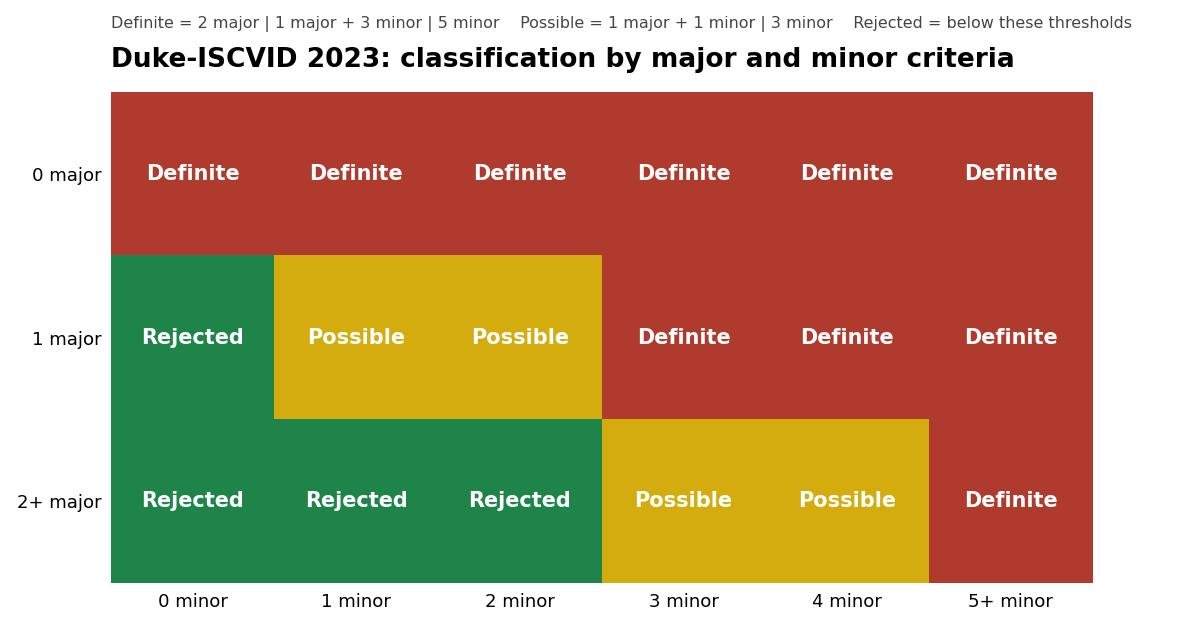
Definite infective endocarditis (2 major criteria, or 1 major plus 3 minor, or 5 minor) means the diagnostic threshold is met. In practice this patient needs urgent management: blood cultures already drawn, early cardiology and infectious diseases or microbiology input, echocardiography completed or repeated, and assessment for complications such as heart failure, uncontrolled infection and embolic events. The European Society of Cardiology endocarditis guidance emphasises team-based care for these patients, and that is the standard to follow for antibiotic regimens and surgical decisions.
Possible infective endocarditis (1 major plus 1 minor, or 3 minor) is the most clinically demanding category. It does not mean the patient probably does not have endocarditis; it means the evidence is not yet conclusive and the case must not be closed. The correct response is more investigation: repeat blood cultures, repeat or upgraded echocardiography (often transoesophageal if only transthoracic has been done), a careful search for vascular and immunologic signs, and, where available, discussion with an endocarditis team. Many possible cases declare themselves as definite or rejected within days as more information arrives.
Rejected means the criteria do not support the diagnosis on current evidence. This is reassuring but not absolute: a firmly rejected classification on day one can change if new features appear, and the clinical picture always governs. If suspicion remains despite a rejected classification, repeat the assessment rather than discarding the diagnosis, especially if antibiotics were given before cultures or the echocardiogram was technically limited.
Limitations of the Duke criteria
The criteria are a diagnostic framework, not a perfect test. They were validated against clinical diagnosis and expert review rather than a single gold standard, because no perfect gold standard exists for endocarditis: even pathologic examination is only available for operated patients. Their performance is best in straightforward native-valve endocarditis and weakest in the difficult groups, prosthetic valve endocarditis, device-related infection, and blood-culture-negative disease, which is precisely where the 2023 update aimed to improve.
Prior antibiotics are the great confounder. They suppress blood cultures, which removes the microbiologic criterion, and can partially treat the infection while leaving the valve damaged. A patient who received several days of antibiotics before cultures may have a rejected classification and still have endocarditis. The criteria assume an adequate diagnostic workup: without enough blood cultures and without echocardiography, they cannot function, and a classification based on an incomplete workup is unreliable.
The criteria also do not measure severity or prognosis. Two patients can both be definite endocarditis with very different risk: one with a small vegetation and no complications, another with a perivalvular abscess and heart failure. Prognostic assessment and decisions about surgery follow separate clinical pathways, including cardiology and cardiac surgery input, once the diagnosis is established.
When to refer and red flags
Suspected infective endocarditis should be taken seriously from the first suspicion. Any patient with persistent fever and a predisposing heart condition, any patient with Staphylococcus aureus bacteraemia (which carries a meaningful risk of endocarditis), and any patient with a new regurgitant murmur plus fever should be assessed promptly with blood cultures and echocardiography. Do not wait for the full criterion set to accumulate before starting the workup.
Red flags demanding urgent senior review include signs of heart failure (breathlessness, pulmonary oedema), new conduction abnormalities or persistent fever on treatment (suggesting perivalvular abscess), neurologic symptoms (suggesting cerebral emboli or mycotic aneurysm), and septic shock. These features indicate complications that change management, often toward urgent surgery, and they should trigger immediate escalation regardless of the Duke classification. The European Society of Cardiology endocarditis guidance sets out the indications and timing for surgery in detail; local heart-team discussion is the mechanism for applying it.
This calculator supports the diagnostic assessment; it does not set treatment. Antibiotic choice, duration, the need for surgery, and follow-up imaging are decisions for the responsible clinical team, guided by current infectious diseases and cardiology guidance and local microbiology advice.
Key takeaways
- The Duke criteria are the standard diagnostic framework for infective endocarditis.
- Definite infective endocarditis requires 2 major criteria, or 1 major plus 3 minor criteria, or 5 minor criteria.
- The microbiologic major criterion is met by a typical infective-endocarditis microorganism (such as Staphylococcus aureus, viridans group streptococci, the Streptococcus gallolyticus/bovis group, HACEK organisms or Coxiella burnetii) from 2 separate blood culture sets; by persistently positive cultures, that is 3 or a majority of 4 or more separate sets with other microorganisms; or by a single positive Coxiella burnetii culture or an anti-phase I IgG titre above 1:800.
- Yes.
Frequently asked questions
What are the Duke criteria for infective endocarditis?
The Duke criteria are the standard diagnostic framework for infective endocarditis. They combine major criteria (microbiologic evidence from blood cultures, imaging evidence such as vegetations or abscesses, and surgical or pathologic findings) with minor criteria (predisposing heart disease or injection drug use, fever above 38 degrees Celsius, vascular phenomena, immunologic phenomena, and lesser microbiologic or imaging evidence). The current version is the 2023 Duke-ISCVID update published by Fowler and colleagues in Clinical Infectious Diseases (DOI 10.1093/cid/ciad271).
How many criteria are needed for definite infective endocarditis?
Definite infective endocarditis requires 2 major criteria, or 1 major plus 3 minor criteria, or 5 minor criteria. Possible infective endocarditis is 1 major plus 1 minor, or 3 minor criteria. Anything less is classified as rejected. These cut-offs come from the Duke-ISCVID 2023 criteria.
What counts as a major blood culture criterion?
The microbiologic major criterion is met by a typical infective-endocarditis microorganism (such as Staphylococcus aureus, viridans group streptococci, the Streptococcus gallolyticus/bovis group, HACEK organisms or Coxiella burnetii) from 2 separate blood culture sets; by persistently positive cultures, that is 3 or a majority of 4 or more separate sets with other microorganisms; or by a single positive Coxiella burnetii culture or an anti-phase I IgG titre above 1:800.
Can endocarditis be diagnosed with a negative blood culture?
Yes. The Duke criteria classify endocarditis on the combination of all criteria, and imaging findings can supply the major criterion instead: a vegetation, abscess, pseudoaneurysm, intracardiac fistula or new valvular regurgitation on echocardiography, or a surgical major criterion from operative or pathologic findings. Blood-culture-negative endocarditis is a recognised entity, often linked to prior antibiotics or fastidious organisms.
What changed in the 2023 Duke-ISCVID update?
The 2023 update by Fowler and colleagues modernised the modified Duke criteria for current practice: it widened the list of typical microorganisms, added cardiac CT and metabolic imaging findings to the imaging major criterion, and introduced a surgical major criterion for new valvular regurgitation found at operation or pathologic evidence of endocarditis. The classification cut-offs of definite, possible and rejected remain unchanged.
Do the Duke criteria replace clinical judgement?
No. The criteria are a standardised diagnostic framework, not a substitute for clinical assessment. Possible or rejected classifications still require clinical judgement, repeat blood cultures, repeat echocardiography and, where appropriate, referral to an endocarditis team. The criteria were validated for diagnosis and research definitions; treatment decisions always rest with the responsible clinician.
Medical disclaimer
This calculator is for educational and informational purposes only. It is not medical advice, does not diagnose any condition and does not recommend any treatment. The Duke criteria are a diagnostic aid and must be applied and interpreted by a qualified clinician as part of a full clinical assessment. If you or someone you care for has fever with a heart condition, a new murmur, or other symptoms that could suggest infective endocarditis, please seek professional medical care promptly.
Sources
- Fowler VG, Durack DT, Selton-Suty C, et al. The 2023 Duke-ISCVID criteria for infective endocarditis: updating the modified Duke criteria. Clin Infect Dis. 2023;76(7):1142-1151. doi:10.1093/cid/ciad271. (Source of the major and minor criterion definitions and the definite/possible/rejected classification used in this calculator.)
- Li JS, Sexton DJ, Mick N, et al. Proposed modifications to the Duke criteria for the diagnosis of infective endocarditis. Clin Infect Dis. 2000;30(4):633-638. (The modified Duke criteria that the 2023 update revises.)
- Durack DT, Lukes AS, Bright DK. New criteria for diagnosis of infective endocarditis: utilization of specific echocardiographic findings. Am J Med. 1994;96(3):200-209. (The original Duke criteria.)
- Delgado V, Ajmone Marsan N, de Waha S, et al. 2023 ESC Guidelines for the management of endocarditis. Eur Heart J. 2023. (European guidance on the management of endocarditis, including the role of the endocarditis team, indications and timing of surgery.)