Why necrotising soft tissue infection needs an early warning
Necrotising soft tissue infection. Most often called necrotising fasciitis. Is an uncommon but devastating infection that spreads rapidly along fascial planes and destroys skin, subcutaneous tissue and fascia. Early on it can look like ordinary cellulitis: redness, swelling, warmth and pain. The classic distinguishing feature is pain that is out of proportion to the visible findings, but by the time the textbook signs appear. Dusky or purplish skin, blisters and bullae, crepitus from gas-forming organisms, numbness over the area and frank systemic toxicity. The infection is already advanced, and every hour of delay in surgical debridement worsens the outcome. The clinical dilemma is that the definitive diagnosis is made in the operating theatre, yet the decision to go to theatre must often be made before the diagnosis is certain.
That gap is where laboratory markers earn their place. A single abnormal blood result rarely settles anything, but the pattern of routine laboratory abnormalities in necrotising infection differs from that of uncomplicated cellulitis in a reasonably consistent way: a vigorous inflammatory response, developing anaemia, dilutional hyponatraemia, early renal impairment and stress hyperglycaemia. The Laboratory Risk Indicator for Necrotising Fasciitis (LRINEC) was designed to convert that pattern into a reproducible number that a clinician can place alongside the bedside findings.
What the LRINEC score is
The LRINEC score was published by Wong and colleagues in 2004 in Critical Care Medicine (Wong CH et al., Crit Care Med. 2004;32(7):1535-1541; doi: 10.1097/01.ccm.0000129486.35458.7d). The authors retrospectively compared 89 patients with necrotising fasciitis against 225 patients with severe cellulitis or abscesses, all treated at a single centre in Singapore, and used multivariate analysis to identify six routine laboratory parameters that independently distinguished the two groups. Each parameter was assigned points in proportion to its statistical strength, producing a weighted score with a maximum of 13.
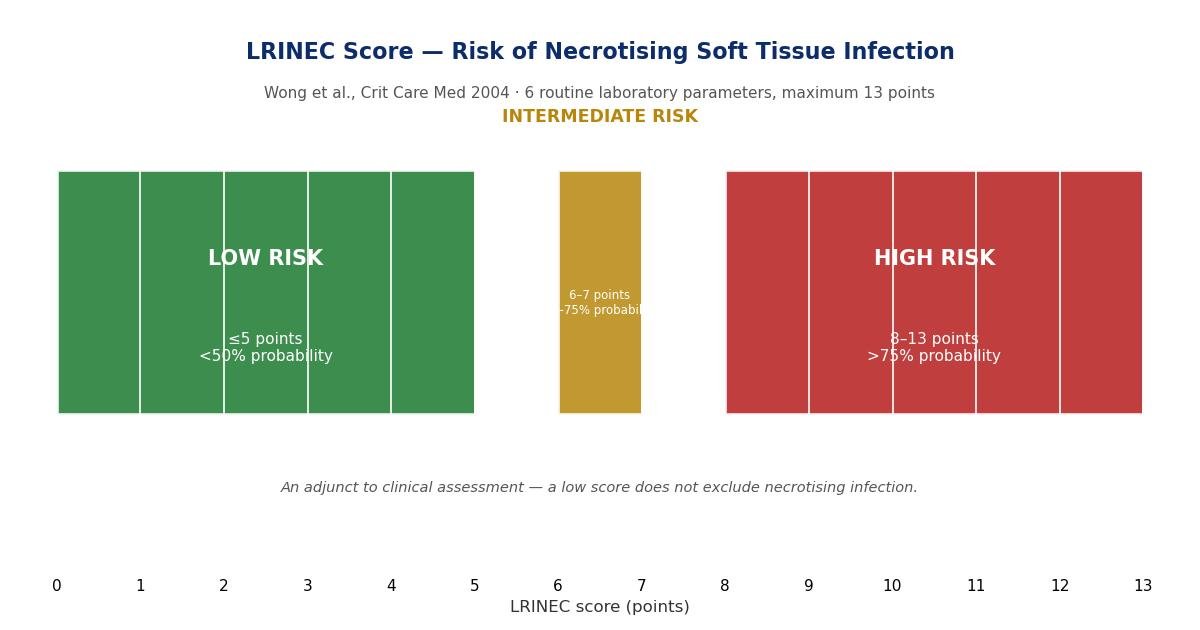
In the original derivation cohort, a score of 6 or more was reported to carry a positive predictive value above 75 percent and a negative predictive value of approximately 96 percent. In other words, the score was most useful for making necrotising infection less likely when it was low, rather than proving it when it was high. The authors proposed three risk bands that this calculator follows: 5 or less (low risk, under 50 percent probability), 6 to 7 (intermediate risk, 50 to 75 percent) and 8 or more (high risk, above 75 percent).
The six parameters and how they are scored
Every parameter in the score is a test that is already part of the standard workup of a serious soft tissue infection, so no special or send-away testing is required. The points are assigned as follows:
| Parameter | Threshold | Points |
|---|---|---|
| C-reactive protein | ≥150 mg/L (≥15 mg/dL) | 4 |
| White cell count | 15 to 25 ×10⁹/L | 1 |
| White cell count | >25 ×10⁹/L | 2 |
| Haemoglobin | 11 to 13.5 g/dL (110 to 135 g/L) | 1 |
| Haemoglobin | <11 g/dL (<110 g/L) | 2 |
| Sodium | <135 mmol/L | 2 |
| Creatinine | >141 µmol/L (>1.6 mg/dL) | 2 |
| Glucose | >10 mmol/L (>180 mg/dL) | 1 |
The score is the sum of the points, from 0 to a maximum of 13. Note the deliberate asymmetry built into the weights: a markedly raised CRP alone contributes 4 of the 13 points, reflecting its status as the single strongest discriminator in the derivation study, while the hyperglycaemia component contributes only 1 point, because stress hyperglycaemia is common to many severe illnesses and is less specific.
What each laboratory value is telling you
Each of the six components reflects a different facet of the systemic response to tissue necrosis. CRP is an acute-phase protein synthesised by the liver in response to interleukin-6; very high levels, above 150 mg/L, signal a major inflammatory stimulus of the kind that a large burden of dying tissue produces. The white cell count captures the mobilisation of neutrophils. Moderate leukocytosis earns 1 point, while a very high count above 25 ×10⁹/L earns 2, reflecting the intensity of the host response.
The haemoglobin component is counterintuitive at first glance: anaemia is more often a marker of chronic disease than of acute infection. In necrotising infection, however, several mechanisms lower haemoglobin quickly. Haemolysis from bacterial toxins, sequestration of red cells in the affected limb, and the dilutional effect of aggressive intravenous fluid resuscitation. Hyponatraemia below 135 mmol/L is similarly multifactorial: the syndrome of inappropriate antidiuretic hormone secretion in severe infection, third-spacing of fluid into the necrotic tissue bed, and dilution from resuscitation fluids all drive sodium down.
A raised creatinine above 141 µmol/L (1.6 mg/dL) indicates that the kidneys are already feeling the effects of hypoperfusion, toxin-mediated injury or sepsis-related acute kidney injury. A sign that the infection is no longer local. Finally, glucose above 10 mmol/L (180 mg/dL) reflects the stress response: catecholamines and cortisol drive hepatic glucose output up, and the threshold is set high enough that ordinary post-prandial variation rarely crosses it. Diabetes does not exclude anyone from scoring. Hyperglycaemia from known diabetes still contributes the point, which is one reason the score is interpreted in context rather than blindly.
How to use this calculator
Enter all six laboratory values in the fields above. Where your laboratory reports in alternative units, choose the matching option from the dropdown: CRP in mg/L or mg/dL, white cells in ×10⁹/L or ×10³/µL (numerically identical), haemoglobin in g/dL or g/L, creatinine in µmol/L or mg/dL, and glucose in mmol/L or mg/dL. The calculator converts everything to the score's canonical units using the exact factors. Creatinine: 1 mg/dL = 88.4 µmol/L; glucose: 1 mmol/L = 18 mg/dL. And scores the converted values, so there is no need to convert by hand and no rounding ambiguity at the thresholds.
The calculator validates every entry before scoring: missing or non-numeric values produce a named error telling you exactly which field needs attention, and negative values are rejected. Press Calculate to see the total score out of 13, the risk band with its meaning, and the list of parameters that contributed points. Which is as important as the total, because it shows you whether the score is being driven by inflammation, by developing organ dysfunction, or by a mixture of both.
Interpreting the risk bands
A score of 5 or less is the low-risk band. In the original derivation cohort, fewer than half of the patients in this band had necrotising infection, and the reported negative predictive value of approximately 96 percent at the cutoff of 6 or more means that a low score makes necrotising infection substantially less likely. "Less likely" is not the same as excluded. The limitations section below explains why a low score never overrules a worrying examination.
A score of 6 or 7 is the intermediate band, carrying a 50 to 75 percent probability in the derivation cohort. This is the most difficult zone in practice: the score is saying that the laboratory pattern is genuinely concerning but not decisive. An intermediate score in a patient with a compatible clinical picture should lower the threshold for senior review, serial re-examination, cross-sectional imaging and early surgical consultation. It is a reason to escalate attention, not a reason to wait.
A score of 8 or more is the high-risk band, with a probability above 75 percent in the derivation cohort. A high score does not confirm necrotising fasciitis. Only direct inspection of the tissue can do that. But it should prompt urgent escalation: senior and surgical review, broad-spectrum antibiotics if not already given, resuscitation, and preparation for the operating theatre. The score is never a reason to delay any of these steps; its purpose is to add weight to the decision to move quickly.
Limitations you must respect
LRINEC is an adjunct, and the literature published since 2004 has clarified its limits. Several validation studies have found that the score's sensitivity is imperfect, particularly when it is applied early in the course of illness before the full laboratory pattern has declared itself. A patient presenting within the first hours can have a falsely reassuring score that rises on repeat testing. This is the single most important caveat: the score performs best as a snapshot of established laboratory derangement, and a low score in an early or evolving presentation must not reassure anyone into inaction.
The score was derived in adults, and its thresholds are calibrated on adult physiology; it should not be relied upon in children. Conditions that independently distort the component values. Pre-existing chronic kidney disease affecting creatinine, known diabetes driving glucose, chronic anaemia, hyponatraemia from other causes. Reduce the score's specificity, and the components should be interpreted with those confounders in mind. The derivation was also a single-centre retrospective study, which is a weaker evidentiary basis than a prospective multicentre validation.
Most fundamentally, no blood-based score can replace the bedside examination and operative findings. Necrotising infection is a surgical emergency diagnosed at the bedside and in the operating theatre: pain out of proportion to the findings, rapid progression, dusky or bullous skin changes, crepitus, and systemic toxicity are the findings that mandate action, whatever the number. A low LRINEC score does not exclude necrotising infection, and a high score does not, on its own, mandate an operation. Both must be interpreted by the treating team in the full clinical context.
References
- Wong CH, Khin LW, Heng KS, Tan KC, Low CO. The LRINEC (Laboratory Risk Indicator for Necrotising Fasciitis) score: a tool for distinguishing necrotising fasciitis from other soft tissue infections. Crit Care Med. 2004;32(7):1535-1541. doi: 10.1097/01.ccm.0000129486.35458.7d.
- Infectious Diseases Society of America
- World Health Organization
Key takeaways
- A score of 8 or more is the high-risk band: in the original derivation cohort the probability of necrotising soft tissue infection was above 75 percent.
- No.
- Six routine tests: C-reactive protein (CRP), white cell count, haemoglobin, serum sodium, serum creatinine and blood glucose.
- The score was derived and validated in adults, and its thresholds were calibrated on adult physiology.
Frequently asked questions
What does an LRINEC score of 8 or more mean?
A score of 8 or more is the high-risk band: in the original derivation cohort the probability of necrotising soft tissue infection was above 75 percent. It should prompt urgent senior and surgical review, but it does not by itself confirm the diagnosis. The final decision rests on the clinical examination and operative findings.
Does a low LRINEC score rule out necrotising soft tissue infection?
No. A low score of 5 or less means the laboratory pattern is not strongly suggestive, but the score has recognised limitations. Including imperfect sensitivity when applied early in the illness. And a low score never excludes necrotising infection. If the clinical picture suggests necrotising infection (pain out of proportion, rapid spread, bullae, crepitus, systemic toxicity), act on the clinical findings regardless of the score.
Which laboratory tests do I need to calculate the LRINEC score?
Six routine tests: C-reactive protein (CRP), white cell count, haemoglobin, serum sodium, serum creatinine and blood glucose. All six are part of the score, so all six values are required; this calculator supports both common unit systems for CRP, haemoglobin, creatinine and glucose and converts them with the standard factors.
Can the LRINEC score be used in children?
The score was derived and validated in adults, and its thresholds were calibrated on adult physiology. Paediatric necrotising infections are rare and present differently, so the LRINEC score should not be relied upon in children. A paediatric surgeon and paediatric infectious-disease input is the standard approach.
How quickly should the LRINEC result be acted on?
Necrotising soft tissue infection is a surgical emergency: mortality rises steeply when debridement is delayed, so a high or intermediate score in a patient with a compatible clinical picture should trigger urgent surgical review, broad-spectrum antibiotics and resuscitation immediately. The score adds to that urgency; it never justifies watching and waiting when the bedside picture is worrying.
Does the LRINEC score replace surgical judgement or imaging?
No. LRINEC is an adjunct built from routine bloods. It does not replace the physical examination, surgical exploration, CT or MRI findings, or clinical judgement. A high score supports rapid escalation, but operative decisions are made by the treating surgical team using the full clinical picture, and a negative score must not delay surgery when the examination suggests necrosis.