NEWS2 Score Calculator
In short: Calculate the National Early Warning Score 2 (NEWS2) from vital signs. Includes SpO2 Scale 1 and Scale 2, RED-score flagging, response thresholds and interpretation per the Royal College of Physicians NEWS2 report (December 2017). Use the calculator above, then read the guide below to interpret your result and its limitations.
National Early Warning Score 2 (NEWS2). Royal College of Physicians, December 2017. Enter the seven observations; the calculator scores each parameter 0 to 3 and aggregates them into the standard NEWS2 total with the low / medium / high bands, RED-score flagging, and the recommended clinical response.
Calculate your NEWS2
| Parameter | Value | Points |
|---|
What is NEWS2?
The National Early Warning Score 2 (NEWS2) is the standardised early warning scoring system for detecting and responding to clinical deterioration in adult patients in acute care settings in England and Wales. It was published by the Royal College of Physicians (RCP) in December 2017 as an update to the original NEWS, which had been introduced in 2012. The score distils seven routine physiological measurements into a single aggregate number, giving ward teams, rapid-response teams, and receiving clinicians a common language for describing how sick a patient is and how urgently they need review.
The idea behind NEWS2 is simple and deliberately pragmatic. Abnormal vital signs usually precede catastrophic events such as cardiac arrest, unplanned intensive-care admission, or death. But on busy wards, subtle drift in observations is easy to miss or easy to describe inconsistently. By assigning every parameter a score of 0, 1, 2, or 3 according to how far it deviates from normal, and by summing those into one total, NEWS2 makes deterioration visible, comparable between observers, and tied to a clear set of response thresholds. The RCP designed it to be used alongside clinical judgement, never as a substitute for it: concern about a patient should always trigger escalation, whatever the score says.
NEWS2 updated the original NEWS in two important ways. First, it introduced a second oxygen-saturation scale (SpO2 Scale 2) for patients with hypercapnic respiratory failure, who have a prescribed target saturation range of 88 to 92%. Second, it added new confusion, disorientation, or agitation as a scored item under consciousness. The so-called NEWconfusion. Reflecting the recognition that acute delirium is a cardinal sign of deterioration, especially in older adults. The rest of the parameters and the aggregate bands were carried over from the original NEWS.
The seven NEWS2 parameters
NEWS2 scores seven observations. Six are measured numerically; the seventh is the patient's level of consciousness, assessed clinically:
- Respiratory rate. 3 points at 8 or fewer breaths per minute; 1 point at 9 to 11; 0 points at 12 to 20; 2 points at 21 to 24; 3 points at 25 or more.
- Oxygen saturation (SpO2). Scored on Scale 1 for most patients or Scale 2 for patients with a prescribed 88 to 92% target (see below).
- Supplemental oxygen. 2 points on SpO2 Scale 1 if the patient is receiving any supplemental oxygen; 0 on Scale 2.
- Temperature. 3 points at 35.0 °C or below; 1 point at 35.1 to 36.0 °C; 0 points at 36.1 to 38.0 °C; 1 point at 38.1 to 39.0 °C; 2 points at 39.1 °C or above.
- Systolic blood pressure. 3 points at 90 mmHg or below; 2 points at 91 to 100; 1 point at 101 to 110; 0 points at 111 to 219; 3 points at 220 or above.
- Heart rate. 3 points at 40 or below; 1 point at 41 to 50; 0 points at 51 to 90; 1 point at 91 to 110; 2 points at 111 to 130; 3 points at 131 or above.
- Level of consciousness. 0 points if Alert; 3 points if there is new confusion, disorientation, or agitation (C), or if the patient responds only to voice (V), pain (P), or is unresponsive (U).
The scores are added together to give an aggregate NEWS2 total from 0 to 20. Note that the bands are deliberately asymmetric: some parameters, such as a very low respiratory rate or very low systolic pressure, earn the maximum 3 points because they signal particularly dangerous physiology.
SpO2 Scale 1 versus Scale 2
Oxygen saturation is the one parameter with two scoring scales, and choosing the right one matters because the scores differ substantially. SpO2 Scale 1 is the default for nearly every patient: 3 points at 91% or below, 2 points at 92 to 93%, 1 point at 94 to 95%, and 0 points at 96% or above, with an additional 2 points if the patient is receiving any supplemental oxygen. The oxygen penalty exists because a normal saturation achieved only with the help of extra oxygen is not a normal physiological state.
SpO2 Scale 2 is reserved for patients with hypercapnic respiratory failure. Most commonly people with chronic obstructive pulmonary disease (COPD). Who have a prescribed target oxygen saturation range of 88 to 92%. In these patients, high oxygen levels can worsen carbon dioxide retention, so a saturation of 96% is not reassuring: it is a sign the target is being overshot. The Scale 2 bands reflect this: 3 points at 83% or below, 2 points at 84 to 85%, 1 point at 86 to 87%, 0 points at 88 to 92% (the target range), 1 point at 93 to 94% on air, 2 points at 95 to 96% on air, and 3 points at 97% or above on air. On Scale 2, supplemental oxygen does not add points; the saturation bands themselves do the work.
The RCP NEWS2 report is clear that the decision to use Scale 2 must be made by a competent clinical decision-maker. It is a prescribed target, not something to choose casually. Using Scale 2 on a patient without hypercapnic respiratory failure risks masking genuine hypoxia, because saturations in the low 90s would score 0 instead of 2 or 3. The calculator above includes the scale toggle and the air/oxygen flag so that both conventions are applied exactly as the RCP chart defines them.
NEWconfusion: why new confusion scores 3 points
One of the headline changes in NEWS2 was the addition of new confusion, disorientation, or agitation to the consciousness parameter. Under the original NEWS, only a frank drop in consciousness (voice, pain, unresponsive) earned 3 points; a patient who had suddenly become confused but was still awake and talking scored nothing for consciousness. The NEWS2 working group judged this a gap, because acute confusion. Delirium. Is one of the most common presentations of serious illness in older adults and frequently accompanies sepsis, hypoxia, hypotension, and metabolic derangement.
In NEWS2, any new confusion or agitation is recorded as "C" and scores the full 3 points, the same as responding only to voice. The RCP guidance aligns this assessment with the 4AT rapid clinical test for delirium, which assesses alertness, abbreviated mental test items, attention, and acute change or fluctuating course. Crucially, the "C" is for new confusion: a patient with long-standing dementia or a chronic confusional state at their baseline does not score points for being at baseline. What is being detected is change. The acute deviation from what is normal for that person.
This is also why NEWS2 performs best when whoever records the observations knows the patient. A nurse or carer who recognises that today's confusion is not this patient's usual state is capturing exactly the signal the score was designed to amplify. When the baseline is uncertain, the RCP advises caution and clinical assessment rather than mechanical scoring.
How to interpret the NEWS2 score
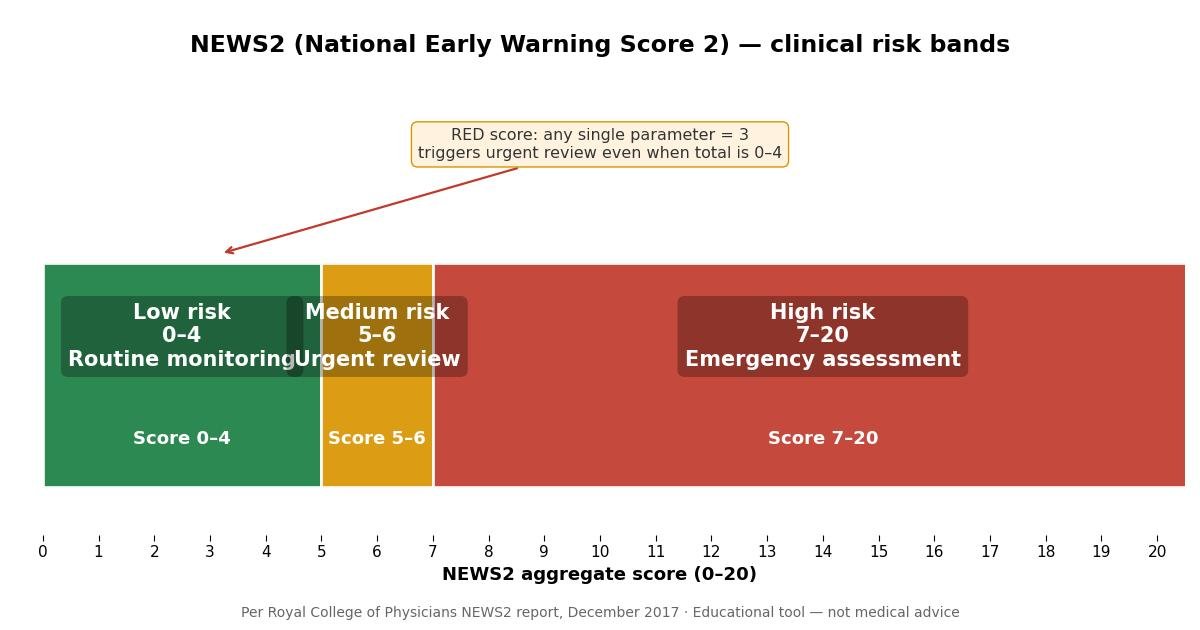
The aggregate score maps to three clinical risk bands, each with a recommended minimum response and monitoring frequency set out in the RCP report:
| Score | Risk band | Recommended response (minimum) | Minimum monitoring frequency |
|---|---|---|---|
| 0 | Low | Continue routine monitoring; clinical judgement decides any action | At least 12-hourly |
| 1 to 4 | Low | Assessment by a nurse or doctor, who decides on increased surveillance and whether a care plan review is needed | At least 4 to 6 hourly |
| 3 in any single parameter (aggregate 0 to 4) | Low with RED score | Urgent review by a clinician with core competencies in the assessment of acute illness; decide on escalation to a higher level of care | At least hourly |
| 5 to 6 | Medium | Urgent review by a medical team with competence in the assessment and treatment of acutely ill patients; urgent decision on escalation | At least hourly |
| 7 or more | High | Emergency assessment by a team or clinician with critical care skills; assess airway, breathing and circulation; consider transfer to a higher-dependency care area; review treatment escalation plans | Continuous monitoring |
The RED score rule deserves emphasis because it is the most commonly misunderstood part of NEWS2. A patient can have a reassuring-looking total of 2 or 3 and still be in serious trouble if that total is driven by a single extreme value. For example, a respiratory rate of 28 (3 points) with everything else normal. The RCP deliberately built the RED rule into the low band so that a single score of 3 is never dismissed as "only a 3". In the calculator above, the RED flag is shown explicitly whenever any one parameter scores 3, even when the aggregate falls in the low range.
Two further rules from the RCP guidance are worth knowing. First, when a patient scores in the medium or high range, the response should include a review of the patient's treatment escalation plan. Including resuscitation status. So that decisions made in a crisis reflect the patient's wishes and prognosis rather than being improvised at the bedside. Second, the score should be recalculated after any intervention, and the trend over time matters as much as any single value: a patient climbing from 1 to 3 to 5 is deteriorating even if 5 alone is "only" the bottom of the medium band.
When to use NEWS2
NEWS2 is designed for adult patients in acute hospital settings and in pre-hospital assessment. Emergency departments, acute medical units, surgical wards, and ambulance services. It is the system recommended for standardising the assessment of acute-illness severity across the NHS in England and Wales, and it is embedded in many clinical pathways, including the early recognition of sepsis, where a high NEWS2 is one of the triggers for urgent sepsis screening.
It is not designed for every population. NEWS2 is not validated for children. Paediatric early warning scores exist for that purpose. It should not be used in pregnancy without considering pregnancy-specific physiology, and it performs poorly in patients whose baseline physiology sits permanently outside the normal bands: for example, someone with chronically low blood pressure from autonomic failure, a resting heart rate in the 40s in a highly trained athlete, or chronic confusion. In such cases the RCP advises that the score be interpreted against the patient's known baseline and that clinical judgement takes precedence.
There are also situations where NEWS2 adds little because the diagnosis is already clear and the response is already maximal. A patient already in intensive care on full monitoring, for instance. NEWS2 earns its place in the large middle ground of hospital care: the apparently stable ward patient whose observations are drifting, the patient whose deterioration is recognised by the score before it is obvious at the bedside, and the handover between teams, where a single number communicates acuity more reliably than a paragraph of description.
Limitations of NEWS2
NEWS2 is a physiological snapshot, and snapshots have blind spots. It does not capture pain, urine output, or biochemical markers; it says nothing about the trajectory of a chronic disease; and it can be misleading in patients with abnormal baselines, as described above. The score is also only as good as the observations behind it: a respiratory rate counted over fifteen seconds and multiplied by four, a saturation probe on a cold finger, or a temperature taken with a faulty thermometer will all produce a confidently wrong number.
There are also well-recognised clinical scenarios where NEWS2 underestimates risk. Patients on high-flow oxygen can maintain normal saturations and a normal score while being critically ill. The score sees the saturation, not the amount of support required to achieve it. Patients with severe sepsis can present with a deceptively normal score early in their illness. And NEWS2 is not a prognostic score for chronic disease: it estimates the urgency of the current physiological state, not life expectancy or the likelihood of benefit from intensive care.
Finally, NEWS2 is a tool for prompting action, not for making diagnoses. A score of 9 tells you the patient needs an emergency assessment; it does not tell you whether the cause is sepsis, pulmonary embolism, or anaphylaxis. The response it triggers. Urgent senior review, assessment of airway, breathing and circulation, consideration of escalation. Is deliberately generic, because the point of an early warning score is to make sure the right people arrive quickly enough to work out what is happening.
Source: Royal College of Physicians. National Early Warning Score (NEWS) 2: Standardising the assessment of acute-illness severity in the NHS. Updated report of a working party. London: RCP, December 2017.
Key takeaways
- NEWS2 (National Early Warning Score 2) is a standardised early warning scoring system published by the Royal College of Physicians in December 2017.
- SpO2 Scale 2 is for patients with hypercapnic respiratory failure.
- A RED score means any single physiological parameter scored 3 points while the aggregate total is still 0 to 4 (the low range).
- A score of 7 or more is the high-risk band.
Frequently asked questions
What is NEWS2?
NEWS2 (National Early Warning Score 2) is a standardised early warning scoring system published by the Royal College of Physicians in December 2017. It assigns 0 to 3 points to each of seven physiological measurements. Respiratory rate, oxygen saturation, supplemental oxygen, temperature, systolic blood pressure, heart rate and level of consciousness. And adds them into a single aggregate score that guides how urgently a patient needs review.
When should I use SpO2 Scale 2 instead of Scale 1?
SpO2 Scale 2 is for patients with hypercapnic respiratory failure. Most commonly COPD. Who have a prescribed target oxygen saturation range of 88 to 92%. The decision to use Scale 2 rests with a competent clinical decision-maker. All other patients are scored on Scale 1, where receiving any supplemental oxygen adds 2 points.
What does a RED score mean in NEWS2?
A RED score means any single parameter scored 3 points while the aggregate total is still in the low range (0 to 4). It calls for an urgent review by a clinician with core competencies in the assessment of acutely ill patients, with a decision on escalation. It should not be dismissed just because the total looks low.
What does a NEWS2 score of 7 or more mean?
Seven or more is the high-risk band: emergency assessment by a team or clinician with critical care skills, assessment of airway, breathing and circulation, consideration of transfer to a higher-dependency area, review of treatment escalation plans, and continuous monitoring of vital signs.
How often should NEWS2 observations be repeated?
The RCP recommends minimum frequencies of: at least 12-hourly for a score of 0; at least 4 to 6 hourly for 1 to 4; at least hourly for a RED score or 5 to 6; and continuous monitoring for 7 or more. Local protocols may require more frequent observation.
Can NEWS2 replace clinical judgement?
No. The RCP is explicit that NEWS2 supports but never replaces clinical judgement. Concern about a patient should always prompt escalation regardless of the score, particularly in patients whose baseline physiology is chronically abnormal.