DAPT Score Calculator
An interactive implementation of the Yeh et al. DAPT score (JAMA 2016): nine patient and procedure variables, scored from -2 to 10, to weigh the ischaemic benefit of continuing dual antiplatelet therapy beyond 12 months against the bleeding risk, after drug-eluting-stent PCI.
In short: An interactive implementation of the Yeh et al. DAPT score (JAMA 2016): nine patient and procedure variables, scored from -2 to 10, to weigh the ischaemic benefit of continuing dual antiplatelet therapy beyond 12 months against the bleeding risk, after drug-eluting-stent PCI. Use the calculator above, then read the guide below to interpret your result and its limitations.
What is the DAPT score?
Dual antiplatelet therapy, usually shortened to DAPT, means treatment with two medicines that stop blood platelets from clumping together: aspirin plus a P2Y12 inhibitor such as clopidogrel, prasugrel, or ticagrelor. After a coronary stent is placed during percutaneous coronary intervention (PCI), DAPT is the standard way to prevent stent thrombosis, a sudden clot forming inside the stent that can cause a heart attack or death. The difficult question has always been how long the second drug should be continued.
The DAPT score is a clinical decision tool published by Yeh and colleagues in the Journal of the American Medical Association in 2016. It was developed to answer exactly that question: after 12 months of DAPT following drug-eluting-stent placement, who benefits from continuing and who is better off stopping? The score combines nine patient and procedure characteristics into a single number from -2 to 10. It is not a pure risk score. It was built by predicting two separate outcomes between 12 and 30 months after PCI, ischaemic events (myocardial infarction or stent thrombosis) and bleeding events (moderate or severe), and then subtracting the predicted increase in bleeding from the predicted reduction in ischaemia. The result is a point rule that estimates the net treatment effect of continuing thienopyridine therapy beyond one year.
The derivation used 11,648 patients randomized in the DAPT Study across 11 countries. In that derivation cohort, ischaemia occurred in 348 patients (3.0 percent) and bleeding in 215 patients (1.8 percent). The models predicting ischaemia and bleeding had c statistics of 0.70 and 0.68 respectively, which indicates modest discrimination. The rule was then validated externally in 8,136 patients from 36 countries randomized in the PROTECT trial. Both the derivation and validation support the same practical cut point: scores of 2 or higher identify patients whose ischaemic benefit from continued therapy outweighs the bleeding risk, while scores below 2 identify patients in whom the bleeding risk outweighs the ischaemic benefit.
Who the score applies to
An essential point that is easy to overlook: the DAPT score applies only to patients who look like the patients who were randomized in the DAPT Study. Those patients had already tolerated 12 months of dual antiplatelet therapy after drug-eluting-stent PCI without a major ischaemic event and without a major bleed. Specifically, to be randomized they had to be free of death, stroke, myocardial infarction, repeat revascularization, definite or probable stent thrombosis, and major bleeding (Bleeding Academic Research Consortium type 3 or 5) during the first year, and they had to have adhered to their antiplatelet treatment.
This means the score should not be applied to patients who suffered an ischaemic or bleeding event during the first 12 months, to patients who could not tolerate DAPT, or to patients whose clinical picture differs substantially from the trial population. Yeh and colleagues explicitly cautioned that the score had not been prospectively validated and was applicable only to patients similar to those randomized in the DAPT Study. In other words, the calculator below assumes a patient who has already completed an uneventful first year of DAPT. A patient with a major bleed at month six, or a stent thrombosis at month nine, needs an individualized cardiology decision, not a score.
The nine variables and their points
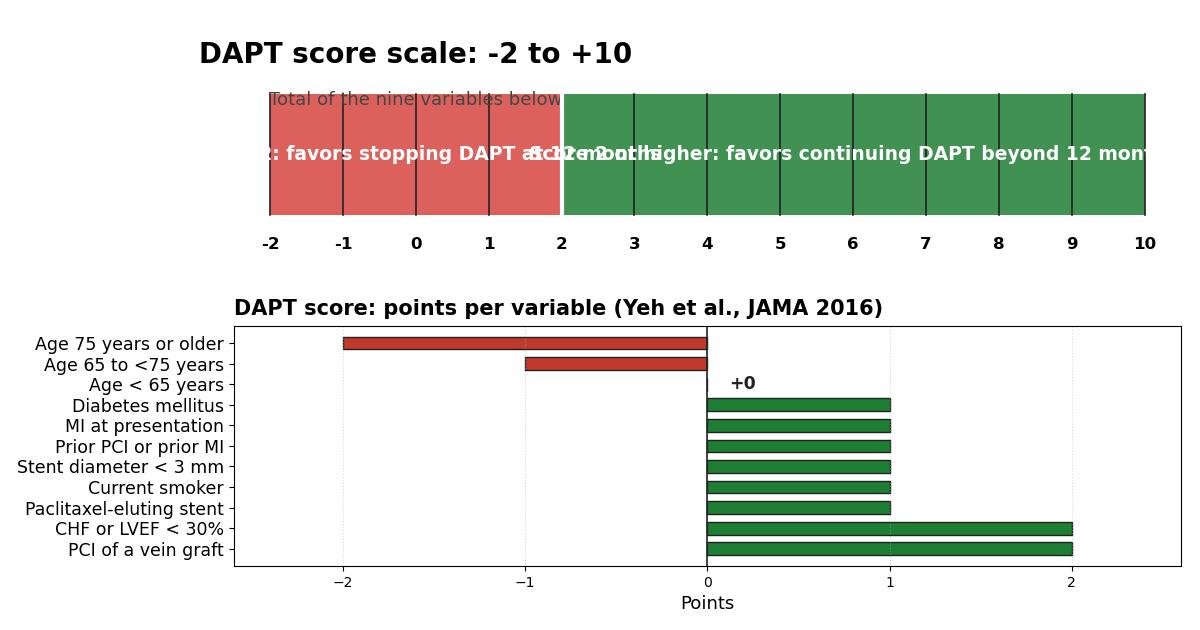
Each characteristic below contributes the listed number of points. Note that age is the only variable with a negative contribution, which reflects that older age was the strongest independent predictor of bleeding, while most of the other variables predicted ischaemic risk. Hypertension, peripheral artery disease, and renal insufficiency were independent predictors of both outcomes and were deliberately left out of the score because they did not change the net treatment effect.
| Variable | Points |
|---|---|
| Age 75 years or older | -2 |
| Age 65 to younger than 75 years | -1 |
| Age under 65 years | 0 |
| Diabetes mellitus | +1 |
| Current smoker | +1 |
| Prior MI or prior PCI | +1 |
| MI at presentation | +1 |
| Stent diameter under 3 mm | +1 |
| Paclitaxel-eluting stent | +1 |
| Congestive heart failure or LVEF under 30% | +2 |
| PCI of a vein graft | +2 |
The lowest possible total is -2 (a patient aged 75 or older with none of the other risk factors) and the highest possible total is 10 (a patient under 65 with every other risk factor present). Worked example: a 60 year old with an MI at presentation, a prior MI, and heart failure with low ejection fraction scores 0 + 1 + 1 + 2 = 4. Another example: a 70 year old with diabetes who smokes scores -1 + 1 + 1 = 1.
How to interpret the score
The score divides patients into two groups at a cut point of 2. A score of 2 or higher favors continuing dual antiplatelet therapy beyond 12 months: in this group, continued therapy was more than eight times more likely to prevent a myocardial infarction than to cause a bleed. A score below 2 favors stopping DAPT at 12 months: in this group, continued therapy was more than twice as likely to cause a bleed than to prevent a myocardial infarction or stent thrombosis. These groups correspond to the score quartiles in the derivation study, where the first and second quartiles scored below 2 and the third and fourth quartiles scored 2 or above.
The gradient behind the cut point matters as much as the cut point itself. As the DAPT score rises, the observed reduction in stent thrombosis and myocardial infarction with continued therapy grows, while the adverse impact on bleeding shrinks. Notably, the increase in mortality associated with continued therapy was isolated to the low score groups. The score therefore does not simply say high versus low risk; it describes a continuous shift in the balance of benefit and harm.
Even so, the cut point is a guide, not a rule that replaces judgment. Medication adherence, bleeding events or ischaemic events during the first year, frailty, planned surgery, the need for oral anticoagulation, and patient preference all belong in the decision. The score supports the conversation between the patient and the treating cardiologist; it does not end it.
Why DAPT duration matters
After a stent is placed, two opposing dangers compete. Stop antiplatelet therapy too early and the patient risks stent thrombosis or a new myocardial infarction. Continue it too long and the patient risks bleeding, which can itself be fatal or force treatment interruption. The original DAPT Study, published in the New England Journal of Medicine in 2014, randomized patients who had completed 12 months of DAPT to continue thienopyridine therapy to 30 months or to switch to placebo, with everyone continuing aspirin. Continued therapy significantly reduced stent thrombosis and major adverse cardiovascular and cerebrovascular events, but it increased bleeding.
A risk benefit analysis of the longer durations quantified the trade-off per 1,000 patients per year of extended therapy: three fewer stent thromboses (95 percent confidence interval 2 to 5), six fewer myocardial infarctions (95 percent confidence interval 2 to 11), and five more major bleeds (95 percent confidence interval 3 to 9), with no significant difference in all-cause death. Averaged across everyone, the benefit and harm look finely balanced, which is precisely why a tool that separates patients into likely winners and likely losers from extended therapy is valuable. Contemporary guidance recommends individualizing DAPT duration: prolonged therapy for patients with high ischaemic risk who have tolerated treatment without bleeding, shorter therapy for patients with high bleeding risk. The DAPT score is one of the instruments guidelines point to for making that individualization concrete.
The DAPT score is not a bleeding risk score
It is worth being explicit about what this score is and is not. The DAPT score is a net-benefit instrument: it weighs the predicted ischaemic gain against the predicted bleeding cost of continuing therapy. It is not a bleeding-risk score. Scores designed purely for bleeding prediction, such as PRECISE-DAPT, answer a different question, namely how likely a patient is to bleed in the year after PCI. A patient can have a high bleeding risk and still, in theory, have a DAPT score that favors continuation, because the two scores measure different things.
In practice the tools complement each other. A bleeding-risk assessment helps identify patients for whom prolonged DAPT is unsafe regardless of ischaemic considerations, while the DAPT score helps identify, among patients who have tolerated the first year, those whose ischaemic risk is high enough that the benefit of continuing outweighs the bleeding cost. Using both keeps the two sides of the decision visible instead of letting one dominate.
Limitations
The DAPT score has real and acknowledged limitations. First, discrimination is modest: c statistics of 0.70 for ischaemia and 0.68 for bleeding mean the models separate events from non-events only moderately well. Second, the score has not been prospectively validated as a decision rule; Yeh and colleagues presented it as a step forward that still required caution. Third, generalizability beyond the DAPT Study population is questionable. A large external validation in a nationwide Swedish registry of unselected contemporary stent patients found that the DAPT score did not discriminate bleeding risk and had poor discrimination for ischaemic risk, with the relationship between score and ischaemic risk not matching the suggested decision rule. Fatal and major bleeding rates in that registry were also substantially lower than in the DAPT Study. The implication is that the score and its cut point may not behave the same way in real-world populations, where bleeding rates are lower and case mix differs.
Fourth, interventional cardiology has moved on since the trial era. Paclitaxel-eluting stents, which contribute one point to the score, are now largely historical, and contemporary drug-eluting stents have lower thrombosis rates than the devices used when the trial was conducted. A variable that was common in 2009 to 2014 may misclassify a modern patient. Finally, the score says nothing about adherence, about events during the first year, or about competing risks such as planned non-cardiac surgery or the need for anticoagulation. All of these can override what the number suggests, which is why the final decision rests with the treating cardiologist.
References
- Yeh RW, Secemsky EA, Kereiakes DJ, et al. Development and Validation of a Prediction Rule for Benefit and Harm of Dual Antiplatelet Therapy Beyond 1 Year After Percutaneous Coronary Intervention. JAMA. 2016;315(16):1735-1749.
- Mauri L, Kereiakes DJ, Yeh RW, et al. Twelve or 30 Months of Dual Antiplatelet Therapy after Drug-Eluting Stents. N Engl J Med. 2014;371(23):2155-2166.
- Yoshikawa Y, Shiomi H, Watanabe H, et al. Validating Utility of Dual Antiplatelet Therapy Score in a Large Pooled Cohort From 3 Japanese Percutaneous Coronary Intervention Studies. Circulation. 2018;137:551-562.
- External validation of the DAPT score in a nationwide Swedish population. J Am Coll Cardiol. 2018. doi:10.1016/j.jacc.2018.06.023.
- ESC Clinical Practice Guidelines
- American College of Cardiology
Key takeaways
- The DAPT score helps clinicians decide whether to continue dual antiplatelet therapy beyond 12 months or stop at 12 months after drug-eluting-stent PCI.
- A score of 2 or higher favors continuing DAPT beyond 12 months, because in that group continued therapy was more than eight times more likely to prevent a myocardial infarction than to cause a bleed.
- The score applies only to patients similar to those randomized in the DAPT Study: people who completed 12 months of DAPT after drug-eluting-stent PCI without a major ischaemic event (death, stroke, myocardial infarction, revascularization, or stent thrombosis) and without a major bleed.
- Points are assigned for nine variables: age 75 years or older scores -2, age 65 to under 75 scores -1, age under 65 scores 0; diabetes mellitus, current smoking, prior myocardial infarction or PCI, myocardial infarction at presentation, stent diameter under 3 mm, and paclitaxel-eluting stent each score +1; congestive heart failure or left ventricular ejection fraction under 30 percent, and PCI of a vein graft, each score +2.
Frequently asked questions
What is the DAPT score used for?
The DAPT score helps clinicians decide whether to continue dual antiplatelet therapy beyond 12 months or stop at 12 months after drug-eluting-stent PCI. It was derived from the DAPT Study randomized trial and combines nine patient and procedure characteristics into a score from -2 to 10 that predicts the net balance between ischaemic benefit and bleeding harm of prolonged therapy.
What do the DAPT score cutoffs mean?
A score of 2 or higher favors continuing DAPT beyond 12 months, because in that group continued therapy was more than eight times more likely to prevent a myocardial infarction than to cause a bleed. A score below 2 favors stopping DAPT at 12 months, because in that group continued therapy was more than twice as likely to cause a bleed than to prevent a myocardial infarction or stent thrombosis.
Who can the DAPT score be applied to?
The score applies only to patients similar to those randomized in the DAPT Study: people who completed 12 months of DAPT after drug-eluting-stent PCI without a major ischaemic event (death, stroke, myocardial infarction, revascularization, or stent thrombosis) and without a major bleed. It should not be applied to patients who had ischaemic or bleeding events during the first year, or to patients outside this trial population.
How is the DAPT score calculated?
Points are assigned for nine variables: age 75 years or older scores -2, age 65 to under 75 scores -1, age under 65 scores 0; diabetes mellitus, current smoking, prior myocardial infarction or PCI, myocardial infarction at presentation, stent diameter under 3 mm, and paclitaxel-eluting stent each score +1; congestive heart failure or left ventricular ejection fraction under 30 percent, and PCI of a vein graft, each score +2. The points are added for a total from -2 to 10.
Is the DAPT score a bleeding risk score?
No. The DAPT score is a net-benefit tool: it simultaneously predicts ischaemic risk and bleeding risk and subtracts the predicted increase in bleeding from the predicted reduction in ischaemia to estimate the net effect of continued therapy. Dedicated bleeding-risk scores such as PRECISE-DAPT predict bleeding risk only and answer a different clinical question, although they can complement the DAPT score in decision making.
What are the limitations of the DAPT score?
The models behind the score showed only modest discrimination, with c statistics of 0.70 for ischaemia and 0.68 for bleeding. The score has not been prospectively validated, and it applies only to DAPT Study-like patients, not to unselected real-world populations: a large Swedish registry study found it did not discriminate bleeding risk and had poor discrimination for ischaemic risk. Stent technology has also moved on since the trial, so the paclitaxel-eluting stent variable is largely historical.