H2FPEF Score Calculator
Diagnostic aid for suspected heart failure with preserved ejection fraction (HFpEF): six items, total 0 to 9, low, intermediate, and high probability bands per Reddy et al., Circulation. 2018;137(12):e1114-e1122.
In short: Diagnostic aid for suspected heart failure with preserved ejection fraction (HFpEF): six items, total 0 to 9, low, intermediate, and high probability bands per Reddy et al., Circulation. 2018;137(12):e1114-e1122. Use the calculator above, then read the guide below to interpret your result and its limitations.
What this score is for
Heart failure with preserved ejection fraction, usually shortened to HFpEF, is a form of heart failure in which the left ventricle pumps a normal proportion of blood with each beat but fills abnormally, so pressures inside the heart rise. It is one of the most common explanations for unexplained breathlessness in older adults, especially those with obesity, hypertension, and atrial fibrillation. Yet it is notoriously hard to diagnose. At rest, the echocardiogram and even the natriuretic peptide blood tests can look nearly normal, while the abnormal filling pressures only reveal themselves during exercise, when the heart has to work harder.
The H2FPEF score was created to bring order to this diagnostic uncertainty. It is a simple, evidence based tool that combines four clinical observations with two echocardiographic measurements to estimate the probability that HFpEF, rather than a non-cardiac cause such as lung disease, deconditioning, or anaemia, explains a patient's unexplained dyspnoea. The score was developed by Reddy and colleagues and published in Circulation in 2018. Since then it has become one of the two standard diagnostic frameworks for HFpEF worldwide, alongside the European Society of Cardiology HFA-PEFF algorithm.
A crucial point, stated plainly: the H2FPEF score is a diagnostic aid for patients in whom HFpEF is already suspected. It is not a screening tool for the general population. Every performance figure quoted for it, the accuracy, the low and high probability thresholds, was measured in dyspnoea referral cohorts, meaning groups of patients who had already been sent for specialist evaluation of breathlessness. Using the score on unselected people, or on patients whose breathlessness has an obvious other explanation, stretches it beyond the evidence that supports it.
The six components
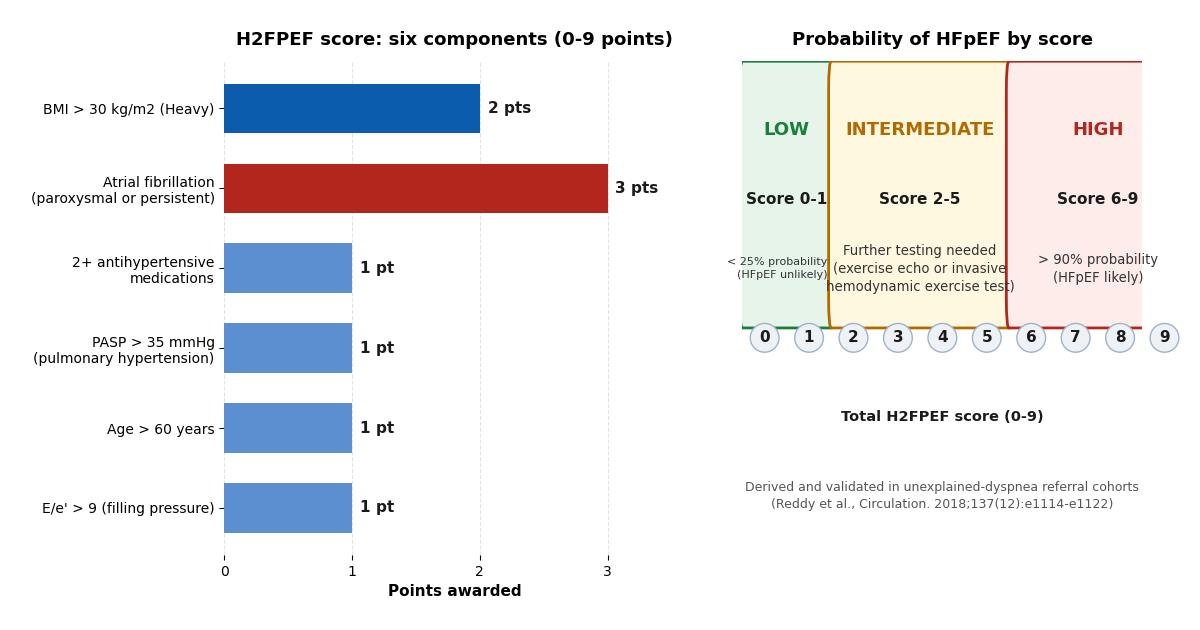
The mnemonic H2FPEF encodes the six items. Each letter contributes a fixed number of points, and the total runs from 0 to 9. All cut-offs use strict inequality, which matters at the boundaries: a BMI of exactly 30 does not score, nor does an age of exactly 60, a pulmonary artery systolic pressure of exactly 35 mmHg, or an E/e' ratio of exactly 9. Only values strictly above the cut-off earn the points.
| Letter | Component | Cut-off | Points |
|---|---|---|---|
| H | Heavy | BMI above 30 kg/m2 | 2 |
| H | Hypertensive | On 2 or more antihypertensive medications | 1 |
| F | Atrial fibrillation | Paroxysmal or persistent, current or prior | 3 |
| P | Pulmonary hypertension | Doppler PASP above 35 mmHg | 1 |
| E | Elder | Age above 60 years | 1 |
| F | Filling pressure | Doppler E/e' ratio above 9 | 1 |
Obesity carries 2 points because it emerged as one of the strongest independent predictors of HFpEF in the derivation data. Atrial fibrillation carries the maximum 3 points: in the original cohort it was by far the single strongest discriminator between HFpEF and non-cardiac dyspnoea, which makes physiological sense because chronic atrial fibrillation both results from and worsens the atrial and ventricular stiffness that characterise HFpEF. The medication count criterion is a pragmatic marker of treatment resistant hypertension, a well established HFpEF risk factor, and it avoids relying on a single clinic blood pressure reading, which can mislead. The two echocardiographic items capture the haemodynamic signature of the disease directly: raised pulmonary pressures downstream of a stiff left heart, and an elevated E/e' ratio reflecting raised left ventricular filling pressure.
How the score was developed and validated
Reddy and colleagues derived the score from 414 consecutive patients with unexplained dyspnoea who had been referred for invasive haemodynamic exercise testing at a specialist centre. Invasive exercise testing, which measures pressures inside the heart at rest and during effort through a catheter, served as the reference standard: 267 patients (64 percent) met haemodynamic criteria for HFpEF and 147 had non-cardiac dyspnoea. Logistic regression identified the six variables above as the final predictive set, and the weighted score was built from them.
The discrimination was strong. The odds of HFpEF roughly doubled with each one point increase in the score, an odds ratio of 1.98 with a 95 percent confidence interval of 1.74 to 2.30 and a p value below 0.0001. The area under the receiver operating characteristic curve was 0.841, again with a p value below 0.0001, and the score outperformed a then current expert consensus algorithm, improving the area under the curve by 0.169 (95 percent confidence interval 0.120 to 0.217, p below 0.0001). Crucially, the investigators did not stop at derivation: they validated the score in a separate test cohort of 100 consecutive patients, 61 of whom had HFpEF, and performance was maintained with an area under the curve of 0.886.
Independent validation followed. In a 2022 study published in JAMA Cardiology, Reddy and co-authors applied the H2FPEF score to a new cohort of patients with unexplained dyspnoea and found an area under the curve of 0.845, essentially identical to the original derivation value of 0.841, demonstrating robust reproducibility. In that same study the score outperformed the HFA-PEFF algorithm, which achieved an area under the curve of 0.710, a difference the authors attributed partly to the inclusion of clinical comorbidity information such as obesity and atrial fibrillation, which provides information that echocardiography alone can miss.
Interpreting the result: the three probability bands
The total score maps to three probability bands that guide what happens next. A score of 0 to 1 indicates a low probability of HFpEF. In the validation work this band corresponded to a probability below 25 percent, which for practical purposes rules HFpEF out, so the clinician's attention can turn to non-cardiac explanations for the breathlessness. A score of 6 to 9 indicates a high probability of HFpEF, reported as above 90 percent, which effectively rules the diagnosis in, allowing treatment and management planning to proceed.
A score of 2 to 5 is intermediate. The score has done its job by placing the patient in the genuinely uncertain zone, but it cannot resolve the diagnosis there. This intermediate band is large by design: many real patients fall into it, and the correct response is further testing rather than either dismissal or premature labelling. The score's developers explicitly framed it as a tool to guide the need for additional diagnostic testing in patients with unexplained exertional dyspnoea, and the intermediate band is where that guidance matters most.
A diagnostic aid, not a screening test
It is worth repeating because the distinction has practical consequences. The H2FPEF score answers the question, given that this breathless patient is already being evaluated for HFpEF, how likely is HFpEF the cause. It does not answer the question, does this person in the general population have undiagnosed heart failure. The derivation and validation cohorts were dyspnoea referral populations with an HFpEF prevalence above 60 percent. In an unselected population the prevalence of HFpEF is far lower, and any probability attached to a score would need recalibration before it meant anything.
The research community has recognised this gap and begun to fill it with purpose built screening tools. In 2024, Reddy and colleagues published the HFpEF-ABA score in Nature Medicine, an evidence based screening tool that uses only age, body mass index, and history of atrial fibrillation, deliberately designed for the screening use case that H2FPEF was never meant to serve. That tool's existence is itself confirmation that H2FPEF occupies the diagnostic, not the screening, lane. This calculator implements H2FPEF for its intended purpose: aiding diagnosis in suspected cases.
What happens after an intermediate score
When the score lands in the intermediate band of 2 to 5, guidelines and the score's developers recommend exercise testing to reveal filling pressures that are normal at rest but rise abnormally with effort. The most widely available option is exercise echocardiography, often called diastolic stress testing, in which the echocardiographic markers of filling pressure, including the E/e' ratio and the tricuspid regurgitation velocity used to estimate pulmonary pressures, are measured during or immediately after exercise.
Where available, invasive haemodynamic exercise testing remains the reference standard: pressures are measured directly with a catheter while the patient exercises, and HFpEF is confirmed by a pulmonary capillary wedge pressure that rises excessively. This was the reference method used to derive the H2FPEF score itself. In practice the choice between non-invasive exercise echocardiography and invasive testing depends on local availability, the patient's ability to exercise, comorbidities, and how strongly the diagnosis is still suspected after the score. Either way, an intermediate score is a prompt for action, not a shrug.
H2FPEF versus HFA-PEFF
The other major framework is the HFA-PEFF score from the European Society of Cardiology, published in 2019. It is a more complex algorithm, scored from 0 to 6, built from echocardiographic functional and morphological domains plus natriuretic peptide biomarkers, with a score of 5 or 6 considered diagnostic. Unlike H2FPEF, it was constructed by expert consensus rather than derived empirically from a referral cohort, and it leans entirely on cardiac imaging and biomarkers without the clinical comorbidity items.
Head to head comparisons have generally favoured H2FPEF for discrimination. In the 2022 JAMA Cardiology validation the areas under the curve were 0.845 for H2FPEF versus 0.710 for HFA-PEFF, and the authors noted that echocardiographic and natriuretic peptide abnormalities are informative when present but have poor sensitivity for HFpEF, so adding orthogonal clinical information such as obesity and atrial fibrillation explains part of the advantage. HFA-PEFF nevertheless remains the guideline endorsed framework in Europe, and many centres use the two scores as complementary rather than competing tools.
Limitations to keep in mind
No score replaces clinical judgement, and H2FPEF has recognised limits. First, it was derived from a single centre cohort of patients referred for invasive exercise testing, a selected population with a high pre-test probability of HFpEF, so its performance in lower prevalence settings such as primary care is less certain. Second, the score can be skewed by individual items: a patient with longstanding atrial fibrillation and no other features scores 3, landing in the intermediate band on one item alone, which is why the result must be read alongside the full clinical picture. Third, some established HFpEF risk factors, such as left atrial enlargement and female sex, did not contribute significantly in the derivation data and so do not appear in the score; their absence from the arithmetic does not mean they are clinically irrelevant.
Fourth, the echocardiographic inputs depend on measurement quality. The E/e' ratio and the Doppler estimate of pulmonary artery systolic pressure require adequate acoustic windows and correct technique; a technically limited study can misclassify both. Finally, the score was designed around the haemodynamic definition of HFpEF used in 2018, and definitions and diagnostic pathways continue to evolve, so the score should be interpreted within current guideline context rather than as a frozen verdict.
How to use this calculator
Enter the six items above. Body mass index can be typed directly if known; the number of antihypertensive medications is a simple count of current prescriptions for blood pressure; atrial fibrillation is a yes or no answer covering paroxysmal or persistent forms, including a documented history; pulmonary artery systolic pressure and the E/e' ratio come from the Doppler echocardiography report; age is in years. Press the calculate button to see the item by item breakdown, the total from 0 to 9, and the probability band with its recommended next step. The calculator applies the strict cut-offs exactly as published: values equal to a threshold, such as a BMI of exactly 30, do not earn points.
References
- Reddy YNV, Carter RE, Obokata M, et al. A simple, evidence-based approach to help guide diagnosis of heart failure with preserved ejection fraction. Circulation. 2018;137(12):e1114-e1122. The original derivation (n = 414) and validation (n = 100) study: six items, score 0 to 9, odds ratio 1.98 per point, area under the curve 0.841 in derivation and 0.886 in the test cohort.
- Reddy YNV, Kaye DM, Handoko ML, et al. Diagnosis of heart failure with preserved ejection fraction among patients with unexplained dyspnea. JAMA Cardiol. 2022. Independent validation with an area under the curve of 0.845 for H2FPEF versus 0.710 for HFA-PEFF; low scores (0 to 1) below 25 percent probability and high scores (6 to 9) above 90 percent; intermediate scores require additional exercise testing.
- Pieske B, Tschope C, de Boer RA, et al. How to diagnose heart failure with preserved ejection fraction: the HFA-PEFF diagnostic process. Eur Heart J. 2019;40(40):3297-3317. The European Society of Cardiology expert consensus algorithm, score 0 to 6, used as the comparator in validation studies.
- Reddy YNV, Carter RE, Sundaram V, et al. An evidence-based screening tool for heart failure with preserved ejection fraction: the HFpEF-ABA score. Nat Med. 2024. The purpose built screening tool using age, body mass index, and atrial fibrillation, distinct from the diagnostic H2FPEF score.
- ESC Clinical Practice Guidelines
- American College of Cardiology
Key takeaways
- The H2FPEF score is a diagnostic aid for patients with suspected heart failure with preserved ejection fraction (HFpEF), typically people with unexplained dyspnoea and a normal or preserved left ventricular ejection fraction.
- Add the points for each of the six items.
- A score of 0 to 1 indicates a low probability of HFpEF, reported in the validation work as below 25 percent, which effectively rules HFpEF out.
- An intermediate score of 2 to 5 should trigger further diagnostic testing rather than a final verdict.
Frequently asked questions
What is the H2FPEF score used for?
The H2FPEF score is a diagnostic aid for patients with suspected heart failure with preserved ejection fraction (HFpEF), typically people with unexplained dyspnoea and a normal or preserved left ventricular ejection fraction. It combines six clinical and echocardiographic items into a 0 to 9 score that estimates how likely HFpEF is the cause of the breathlessness. It is not a screening tool for the general population: it was derived and validated in dyspnoea referral cohorts, and it only applies to patients in whom HFpEF is already being considered.
How do you calculate the H2FPEF score?
Add the points for each of the six items. Heavy (BMI above 30 kg per square metre) counts 2 points, hypertensive (on 2 or more antihypertensive medications) counts 1 point, paroxysmal or persistent atrial fibrillation counts 3 points, pulmonary hypertension (Doppler pulmonary artery systolic pressure above 35 mmHg) counts 1 point, elder (age above 60 years) counts 1 point, and filling pressure (Doppler E to e prime ratio above 9) counts 1 point. The total ranges from 0 to 9.
What do the H2FPEF probability bands mean?
A score of 0 to 1 indicates a low probability of HFpEF, reported in the validation work as below 25 percent, which effectively rules HFpEF out. A score of 2 to 5 is intermediate: the diagnosis is neither confirmed nor excluded, and further testing is needed. A score of 6 to 9 indicates a high probability of HFpEF, reported as above 90 percent, which effectively rules the diagnosis in.
What should happen after an intermediate H2FPEF score?
An intermediate score of 2 to 5 should trigger further diagnostic testing rather than a final verdict. The recommended next step is exercise testing to unmask raised filling pressures that are only abnormal during effort, most commonly exercise echocardiography (diastolic stress testing) or, where available, invasive haemodynamic exercise testing. The choice of test depends on local availability, the patient's ability to exercise, and clinician judgement.
Is the H2FPEF score a screening test for heart failure?
No. The H2FPEF score was developed to separate HFpEF from non-cardiac causes of breathlessness in patients already referred for evaluation of unexplained dyspnoea, and its performance figures come from those referral populations. Applying it as a population screening tool would misuse it: the underlying prevalence of HFpEF in unselected people is far lower, so the same score would not carry the same meaning. For screening, purpose-built tools such as the HFpEF-ABA score have since been developed.
How does H2FPEF differ from the HFA-PEFF score?
Both estimate the probability of HFpEF, but they differ in design. H2FPEF is a simple six-item clinical and echocardiographic score (0 to 9) derived empirically from dyspnoea referral data, and it uses clinical comorbidities such as obesity and atrial fibrillation alongside echocardiography. HFA-PEFF is the European Society of Cardiology expert-consensus algorithm: a more complex 0 to 6 score built from echocardiographic functional and morphological domains plus natriuretic peptides. In head-to-head validation, H2FPEF showed stronger overall discrimination, while HFA-PEFF remains the guideline-endorsed framework in Europe.