PRECISE-DAPT Bleeding Risk Score Calculator
Estimate 12-month out-of-hospital bleeding risk after percutaneous coronary intervention (PCI) to guide how long dual antiplatelet therapy (DAPT) should continue.
In short: Estimate 12-month out-of-hospital bleeding risk after percutaneous coronary intervention (PCI) to guide how long dual antiplatelet therapy (DAPT) should continue. Use the calculator above, then read the guide below to interpret your result and its limitations.
Calculate the PRECISE-DAPT score
| Variable | Your value | Points |
|---|
What the PRECISE-DAPT score measures
Dual antiplatelet therapy (DAPT), usually aspirin plus a P2Y12 inhibitor such as clopidogrel, ticagrelor, or prasugrel, is the cornerstone of treatment after coronary stenting. It prevents stent thrombosis and recurrent ischaemic events, but every additional month of treatment adds bleeding risk. Choosing how long to continue DAPT is therefore one of the most consequential decisions in post-PCI care, and for many years it rested largely on clinical gestalt. The PRECISE-DAPT score, short for Predicting bleeding complications in patients undergoing stent implantation and subsequent dual antiplatelet therapy, was developed to put a number on the bleeding side of that trade-off.
Published by Costa and colleagues in The Lancet in 2017, the score predicts out-of-hospital bleeding during the 12 months after percutaneous coronary intervention (PCI) in patients treated with DAPT. Out-of-hospital has a precise meaning here: bleeding events classified as TIMI major or minor that occur at least 7 days after the stenting procedure. The score therefore captures the bleeds that happen while the patient is on maintenance DAPT, rather than bleeds related to the procedure itself.
The score was derived from pooled individual-patient data from 14,963 patients treated with DAPT after coronary stenting in eight randomized trials. Over a median follow-up of 552 days, the primary bleeding outcome occurred in 218 patients, corresponding to a 1-year incidence of 12.5 per 1000 patients. From dozens of candidate predictors, five variables survived into the final multivariable model, and each was assigned points on a bedside nomogram according to the strength of its association with bleeding. Adding the points gives a score from 0 to 100, with 25 or higher marking high bleeding risk.
The five variables and how the points work
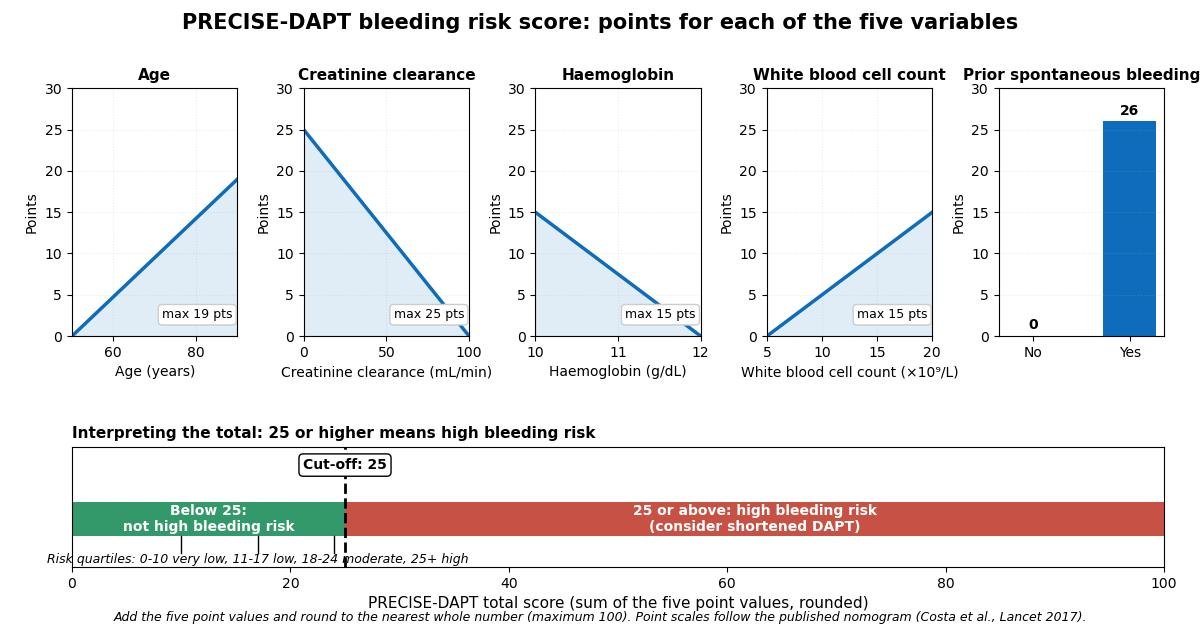
The five inputs are all routinely available at the time of PCI: age in years, creatinine clearance in mL/min, haemoglobin in g/dL, white blood cell count in x10^9/L, and prior spontaneous bleeding (yes or no). The nomogram converts each value into points. Values beyond the validated range are truncated at the nearest boundary rather than extrapolated, so extreme laboratory values cannot inflate the score without limit.
| Variable | Validated range | Points |
|---|---|---|
| Age | 50 to 90 years (below 50 counts as 50; above 90 counts as 90) | 0 to 19 |
| Creatinine clearance | 0 to 100 mL/min (above 100 counts as 100) | 25 down to 0 (lower clearance earns more points) |
| Haemoglobin | 10 to 12 g/dL (above 12 counts as 12; below 10 counts as 10) | 15 down to 0 (lower haemoglobin earns more points) |
| White blood cell count | 5 to 20 x10^9/L (outside this range counts at the boundary) | 0 to 15 |
| Prior spontaneous bleeding | No / Yes | 0 / 26 |
The maximum possible total is exactly 100 points (26 plus 25 plus 19 plus 15 plus 15). The directions of the point scales mirror the multivariable hazard ratios from the derivation study. Prior spontaneous bleeding was by far the strongest predictor, with a hazard ratio of 4.14. Each 10-year increase in age carried a hazard ratio of 1.34, and each increase of 10^3 white cells per microliter carried a hazard ratio of 1.06. Conversely, higher haemoglobin (hazard ratio 0.67 per g/dL) and higher creatinine clearance (hazard ratio 0.90 per 10 mL/min) were protective, which is why low values of these two variables earn points while high values earn none.
Two subtleties deserve emphasis. First, the white blood cell count contributes in the same direction as the other risk factors: a higher count adds points, reflecting the link between inflammation and bleeding risk in the model. Second, the score uses creatinine clearance, a kidney function estimate that accounts for age, weight, and sex (usually via the Cockcroft-Gault equation), not the raw serum creatinine value. Enter the clearance in mL/min, not the creatinine concentration.
Worked example
Consider a 75-year-old patient with a creatinine clearance of 30 mL/min, haemoglobin of 11.1 g/dL, a white blood cell count of 5 x10^9/L, and no prior spontaneous bleeding. The nomogram assigns about 11.9 points for age 75, 17.5 points for the reduced creatinine clearance, 6.8 points for the haemoglobin of 11.1, 0 points for the white cell count, and 0 points for no prior bleeding, for a total of 36.1, rounded to 36. Because 36 exceeds the 25-point threshold, this patient is at high bleeding risk, and a shortened DAPT course would be worth discussing provided the ischaemic risk is acceptable. This is the same illustrative patient used when the score was introduced, where the three contributing values were reported as 12, 18, and 6 points, totalling 36.
Interpreting your result
Score below 25: not high bleeding risk. A standard duration of DAPT, typically 12 months after PCI in contemporary practice, is reasonable, and prolongation beyond 12 months can be considered when the ischaemic risk is high. The bleeding risk is not zero, so usual vigilance still applies.
Score 25 or above: high bleeding risk. Consider a shortened DAPT course, typically 3 to 6 months followed by single antiplatelet therapy, provided the ischaemic risk is not prohibitive. This is also the moment to address reversible contributors: correct anaemia where possible, review concomitant anticoagulants, NSAIDs, and other antithrombotics, and consider gastrointestinal protection in patients at risk of gastrointestinal bleeding. Reassess the score if renal function, haemoglobin, or clinical status changes.
The original paper also reported bleeding rates by score quartile: 10 or below (very low risk), 11 to 17 (low risk), 18 to 24 (moderate risk), and 25 or above (high risk), with the bleeding curves separating cleanly across the four groups. The 25-point cut-off is the validated decision threshold, but risk rises continuously with the score: a score of 40 carries more bleeding risk than a score of 26. Avoid treating 24 versus 25 as a cliff edge; use the number as one input among many in the overall assessment.
PRECISE-DAPT complements the DAPT score
Clinicians sometimes ask whether they need both the PRECISE-DAPT score and the DAPT score. The two answer different questions at different moments, so they are complementary rather than interchangeable, and the score complements ischaemic risk tools instead of replacing them.
The DAPT score was designed to be calculated only after a patient has completed 12 months of dual antiplatelet therapy without a bleeding or ischaemic event. It estimates the ischaemic benefit of continuing DAPT beyond a year: patients with higher DAPT scores stand to gain more ischaemic protection from prolonged therapy. PRECISE-DAPT works at the opposite end of the timeline. It is calculated at the time of coronary stenting from baseline variables, and it estimates bleeding risk during the coming year of DAPT. It does not predict ischaemic events, just as the DAPT score does not predict bleeding.
In practice the two scores frame a two-dimensional decision. A patient with a high PRECISE-DAPT score (25 or above) and a low ischaemic risk profile is a natural candidate for shortened DAPT. A patient with a low PRECISE-DAPT score and a high ischaemic risk profile may reasonably continue DAPT for the standard duration or longer. When both risks are high, the decision is genuinely difficult and belongs in shared decision-making with the patient, weighing the consequences of a bleed against those of stent thrombosis or myocardial infarction. Contemporary European and American guidance endorses exactly this individualized balancing of ischaemic and bleeding risk when choosing DAPT duration.
Derivation and validation
The derivation pooled individual-patient data from eight randomized trials totalling 14,963 patients treated with DAPT after coronary stenting. Discrimination, measured by the c-index, was 0.73 (95% CI 0.61 to 0.85) for out-of-hospital TIMI major or minor bleeding and 0.71 (95% CI 0.57 to 0.85) for TIMI major bleeding within 12 months.
The score was then validated in two independent cohorts. In the PLATO trial, 8,595 PCI patients were followed, and TIMI major or minor bleeding occurred in 145 of them (1.69%); the c-index was 0.70 (95% CI 0.65 to 0.74). In the BernPCI registry of 6,172 participants, 94 (1.52%) had TIMI major or minor bleeding, with a c-index of 0.66 (95% CI 0.61 to 0.71). Calibration was good in the BernPCI cohort, with a slight underestimation of bleeding risk in the PLATO cohort. The investigators also tested a simplified four-item version omitting the white blood cell count; it performed slightly worse, confirming that all five variables earn their place.
Real-world performance has since been tested at scale. In the SWEDEHEART registry, 66,295 patients with myocardial infarction treated with PCI and subsequent DAPT were followed for major bleeding. Major bleeding occurred in 3.9% of patients scoring 25 or higher compared with 1.8% of those scoring below 25, a hazard ratio of 2.2 (95% CI 2.0 to 2.5), with a c-statistic of 0.64. At the 25-point cut-off, the positive predictive value for major bleeding was 3.8% and the negative predictive value 98.3%. In the validation cohorts the score also improved reclassification over the older PARIS bleeding score, supporting its adoption in practice.
Limitations
First, discrimination is modest. A c-index in the range of 0.64 to 0.73 means the score separates higher-risk from lower-risk patients usefully but far from perfectly. Most patients with high scores will not bleed, and some patients with low scores will. The score stratifies risk; it does not predict any individual's fate.
Second, age dominates the total. Because age 75 alone contributes 12 points, the great majority of elderly patients cross the 25-point threshold: in one series of elderly patients with myocardial infarction, 92.6% scored 25 or higher. In very old patients the binary cut-off therefore discriminates poorly, and the absolute score, together with frailty and comorbidity, matters more than the high versus not-high label.
Third, the score requires a white blood cell count, which is not always at hand. Where it is unavailable, the validated four-item alternative can be used, accepting slightly lower discrimination.
Fourth, the derivation population consisted of trial patients undergoing coronary stenting and treated with DAPT. Performance is less certain in patients on triple therapy (DAPT plus oral anticoagulation), in patients managed without stenting, and in populations far removed from the trial setting.
Finally, kidney function, haemoglobin, and clinical status change over time. A score calculated on the day of PCI should be revisited if renal function deteriorates, anaemia develops, a bleed occurs, or the antithrombotic regimen changes. Treat the score as a living assessment, not a once-only label.
Medical disclaimer
This calculator is an educational tool for clinicians and informed patients. It does not provide medical advice, establish a diagnosis, or replace the judgment of a qualified cardiologist. Risk scores support, but never substitute for, individualized clinical assessment. Always verify the input values and confirm the units (years for age, mL/min for creatinine clearance, g/dL for haemoglobin, x10^9/L for white blood cell count) before acting on the result, and interpret the score alongside ischaemic risk, frailty, comorbidity, and patient preference. If you are a patient, discuss any question about the duration of your antiplatelet medicines with your cardiologist; do not stop or shorten dual antiplatelet therapy on the basis of a score alone.
Key takeaways
- The PRECISE-DAPT score predicts the risk of out-of-hospital bleeding, defined as TIMI major or minor bleeding occurring at least 7 days after coronary stenting, during the 12 months after percutaneous coronary intervention (PCI) in patients treated with dual antiplatelet therapy (DAPT).
- A score of 25 or higher is considered high bleeding risk, and a score below 25 is not high bleeding risk.
- The score is designed to be calculated at the time of coronary stenting, using the patient's age, baseline creatinine clearance, haemoglobin, white blood cell count, and history of prior spontaneous bleeding.
- The five variables are age in years, creatinine clearance in mL/min, haemoglobin in g/dL, white blood cell count in x10^9/L, and prior spontaneous bleeding (yes or no).
Frequently asked questions
What does the PRECISE-DAPT score predict?
The PRECISE-DAPT score predicts the risk of out-of-hospital bleeding, defined as TIMI major or minor bleeding occurring at least 7 days after coronary stenting, during the 12 months after percutaneous coronary intervention (PCI) in patients treated with dual antiplatelet therapy (DAPT). It was derived from 14,963 patients in eight randomized trials (Costa et al., Lancet 2017).
What PRECISE-DAPT score counts as high bleeding risk?
A score of 25 or higher is considered high bleeding risk, and a score below 25 is not high bleeding risk. In the derivation study, bleeding rates separated clearly across score quartiles: 10 or below (very low risk), 11 to 17 (low risk), 18 to 24 (moderate risk), and 25 or above (high risk). Patients with a score of 25 or higher may be considered for a shortened course of DAPT, typically 3 to 6 months followed by single antiplatelet therapy, when their ischaemic risk allows.
When should the PRECISE-DAPT score be calculated?
The score is designed to be calculated at the time of coronary stenting, using the patient's age, baseline creatinine clearance, haemoglobin, white blood cell count, and history of prior spontaneous bleeding. This is a key difference from the DAPT score, which is calculated only after a patient has completed 12 months of dual antiplatelet therapy without a bleeding or ischaemic event, to decide about prolonging treatment.
Which five variables make up the PRECISE-DAPT score?
The five variables are age in years, creatinine clearance in mL/min, haemoglobin in g/dL, white blood cell count in x10^9/L, and prior spontaneous bleeding (yes or no). Points are assigned from a published nomogram: up to 19 points for age 90 or above, up to 25 points for creatinine clearance of 0, up to 15 points for haemoglobin of 10 g/dL, up to 15 points for a white blood cell count of 20 x10^9/L, and 26 points for prior spontaneous bleeding, for a maximum total of 100.
Does a high PRECISE-DAPT score mean DAPT must be stopped early?
No. The score informs shared decision-making; it does not dictate treatment on its own. A score of 25 or higher suggests considering a shorter DAPT course (3 to 6 months) followed by single antiplatelet therapy, but only when the patient's ischaemic risk is acceptable. Always weigh bleeding risk against ischaemic risk, stent type, and clinical presentation, address reversible bleeding risks such as anaemia, and individualize the decision with the treating cardiologist.
How accurate is the PRECISE-DAPT score?
Discrimination is modest: the c-index was 0.73 in the derivation cohort, 0.70 in the PLATO validation cohort of 8,595 patients, and 0.66 in the BernPCI registry of 6,172 patients (Costa et al., Lancet 2017). In the SWEDEHEART registry of 66,295 real-world patients, the c-statistic was 0.64, with major bleeding in 3.9% of patients scoring 25 or higher versus 1.8% of those scoring below 25. The score is a useful risk-stratification aid, not a perfect predictor, and should be combined with clinical judgment.
References
- Costa F, van Klaveren D, James S, et al. Derivation and validation of the predicting bleeding complications in patients undergoing stent implantation and subsequent dual antiplatelet therapy (PRECISE-DAPT) score: a pooled analysis of individual-patient datasets from clinical trials. Lancet. 2017;389(10080):1025-1034.
- MDCalc. PRECISE-DAPT Score Calculator: estimates out-of-hospital bleeding risk in patients treated with dual antiplatelet therapy after PCI; management guidance for scores of 25 or higher. https://www.mdcalc.com/calc/10641/precise-dapt-score
- Johnson Francis. PRECISE-DAPT score: nomogram point maxima (prior bleeding 26, creatinine clearance 0 gives 25, haemoglobin 10 g/dL gives 15, white cell count 20,000 gives 15, age 90 or above gives 19; total maximum 100) and truncation ranges for out-of-range values. https://johnsonfrancis.org/professional/precise-dapt-score/
- Capodanno D, Angiolillo DJ. Tailoring dual antiplatelet therapy after coronary stenting: the PRECISE-DAPT score versus the DAPT score (worked example: age 75, creatinine clearance 30 mL/min, haemoglobin 11.1 g/dL giving 12, 18, and 6 points, total 36).
- Validation of the 4-item PRECISE-DAPT score: a SWEDEHEART study (66,295 patients; 3.9% versus 1.8% major bleeding for scores 25 or higher versus below 25; hazard ratio 2.2; c-statistic 0.64). https://pmc.ncbi.nlm.nih.gov/articles/PMC8751860/
- Applicability of the PRECISE-DAPT score in elderly patients with myocardial infarction (age 75 years equals 12 points; 92.6% of the elderly series scored 25 or higher). https://pmc.ncbi.nlm.nih.gov/articles/PMC6330266/
- Medscape. Simple, five-item risk score may predict early post-PCI bleeding risk: derivation cohort details (14,963 patients, eight trials, 218 primary outcome events, median follow-up 552 days, 1-year incidence 12.5 per 1000) and multivariable hazard ratios. https://www.medscape.com/viewarticle/877139
- ESC Clinical Practice Guidelines
- American College of Cardiology