Barthel Index Calculator: ADL Independence Score
In short: Barthel Index calculator: score 10 activities of daily living from 0 to 100, find the dependence band, and read clear guidance for carers and clinicians. Use the calculator above, then read the guide below to interpret your result and its limitations.
The Barthel Index scores ten activities of daily living from 0 to 100, giving a quick, standard measure of how independently someone manages everyday life. Answer each question below, then press Calculate to see the total score and the dependence band.
Barthel Index tool
Rate what the person actually does, not what they could do. Each answer carries a fixed number of points.
What the Barthel Index measures
The Barthel Index is a ten-item rating scale that measures independence in basic activities of daily living, the everyday physical tasks that a person must manage to look after themselves. It was developed in 1965 by Florence I. Mahoney and Dorothea W. Barthel, a physician and a physiotherapist, and published as "Functional evaluation: the Barthel Index" in the Maryland State Medical Journal (1965;14:61-65, PMID 14258950). It is one of the earliest contributions to the functional status literature, and it remains one of the most widely used functional scales in rehabilitation medicine, geriatrics, neurology, and nursing care.
The scale rates ten activities: feeding, bathing, grooming, dressing, bowel control, bladder control, toilet use, transfers between bed and chair, mobility on level surfaces, and stair climbing. Each item is scored according to the amount of help the person needs: generally 0 for unable or dependent, 5 or 10 for needing help, and 10 or 15 for independent. The item scores are weighted to reflect the amount of nursing time and assistance each activity typically requires, so transfers and mobility carry up to 15 points each while bathing and grooming carry up to 5. The ten scores are added together for a total between 0 and 100. A score of 100 means the person is independent in all ten rated activities; lower scores indicate increasing disability. The maximum of 100 does not mean full health or a normal life: it means normality in the ten basic activities the index covers.
The Barthel Index is an observer-rated scale. It is completed by a nurse, physiotherapist, doctor, or trained observer from direct observation or from medical and nursing records, and it usually takes two to five minutes. It is not a self-report questionnaire and it is not a test of ability under ideal conditions. The central rule, set out in the usage guidelines that follow the original paper, is to record what the patient actually does, not what they could do. If the person can feed themselves at home but refuses in the ward, the ward behavior is what gets scored. This emphasis on real-world performance is what makes the index useful for discharge planning and care needs assessment.
How the ten items are scored
Each item has two to four defined levels. The calculator above uses the standard Collin and Wade (1988) definitions of the item levels, which are widely used in clinical practice. The item weights are fixed: feeding 0, 5, or 10; bathing 0 or 5; grooming 0 or 5; dressing 0, 5, or 10; bowel control 0, 5, or 10; bladder control 0, 5, or 10; toilet use 0, 5, or 10; transfers 0, 5, 10, or 15; mobility 0, 5, 10, or 15; stairs 0, 5, or 10. These maxima sum to exactly 100.
Feeding (0, 5, 10)
Independent feeding means eating from a prepared tray or table without another person present: the person can put food within reach, cut food, use salt and pepper, spread butter, and manage assistive devices if needed. Needing help cutting food, spreading butter, opening a milk carton, or requiring a modified diet scores 5. Unable means the person cannot feed themselves at all, which scores 0. A telling detail from the original definitions is that if food needs to be cut up by someone else, that counts as needing help, not as independence.
Bathing (0, 5)
Bathing is the simplest item: 5 for independent bathing or showering, 0 for dependent. It is an all-or-nothing item because it stands in for overall self-care ability with relatively little nursing time involved compared with feeding or dressing. Getting into and out of the bath or shower safely is part of what independence here means.
Grooming (0, 5)
Grooming covers personal toilet: washing the face, combing hair, shaving, and cleaning teeth, with implements provided. Independent grooming scores 5; needing help with personal care scores 0. Like bathing, it is a compact indicator of whether the person can manage personal care without supervision or physical help.
Dressing (0, 5, 10)
Dressing includes tying shoes and fastening buttons, zips, and other fasteners. Independent dressing scores 10. Needing help but able to do about half unaided scores 5, and total dependence scores 0. Setting out clothes in advance, or laying them within reach, does not reduce the score: a person can still score at the top level if the clothes are simply placed where they can reach them. Anti-embolic stockings are not counted as part of dressing.
Bowel control (0, 5, 10)
Continent scores 10. An occasional accident scores 5, which recognises that occasional incontinence needs some nursing attention but not the full management of a totally incontinent patient. Incontinent, or needing to be given enemas, scores 0. Bowel continence can be assessed from nursing notes and observation over the rating period.
Bladder control (0, 5, 10)
The same three levels apply: continent is 10, an occasional accident is 5, and incontinent, or catheterised and unable to manage alone, is 0. A person managing their own catheter independently can score at the top level, because the index rewards what the person does for themselves. In bladder assessment, an external device such as condom drainage has its own handling in the detailed guidelines.
Toilet use (0, 5, 10)
This item covers getting on and off the toilet, handling clothes, wiping, and flushing. Independent scores 10, needing some help but able to do something alone scores 5, and dependent scores 0. It is distinct from continence: a person can be continent yet need help transferring onto the toilet, and the two items capture those different problems separately.
Transfers, bed to chair and back (0, 5, 10, 15)
Transfers are weighted up to 15 because moving safely between bed and chair, including sitting up in bed, is one of the most assistance-intensive activities in nursing care. Independent transfer scores 15. Minor help, verbal or physical, scores 10. Major help, one or two people physically assisting a person who can sit, scores 5. Unable, with no sitting balance, scores 0. Because transfers sit at the boundary between self-care and mobility, this item often determines whether a person can be managed with supervision alone.
Mobility on level surfaces (0, 5, 10, 15)
Mobility is assessed by observation, physiotherapy consultation, or notes, and it is also weighted to 15. Independent walking over 50 yards, with any aid such as a stick, scores 15. Walking with the help of one person, verbal or physical, over 50 yards scores 10. Wheelchair independence, including corners, over 50 yards scores 5. Immobile, or unable to cover 50 yards, scores 0. If the person cannot walk at all, wheelchair propulsion is rated instead; the walking device should be within the person's reach when mobility is assessed.
Stairs (0, 5, 10)
In practice this is the ability to go up and down about three steps. Independent stair use scores 10, needing help, whether verbal, physical, or carrying the aid, scores 5, and unable scores 0. Stairs matter disproportionately for discharge planning: a person can be fully independent indoors yet unable to return home if the entrance has steps they cannot manage.
Interpreting the score: dependence bands and care implications
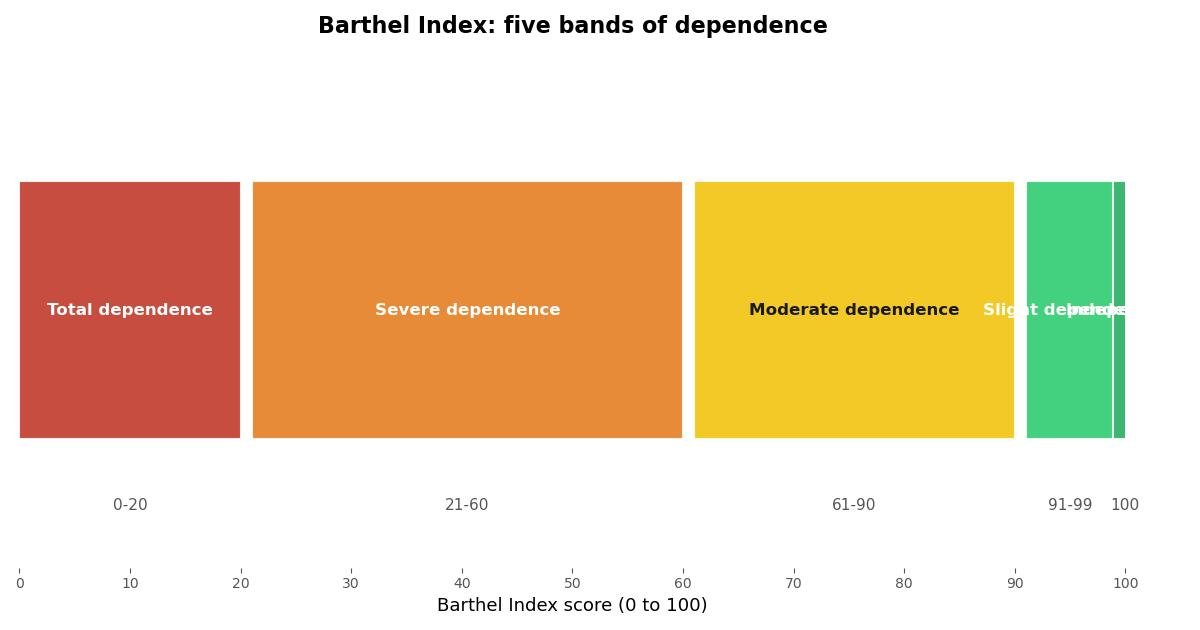
The widely used interpretation bands group the 0 to 100 total into five levels of dependence: 0 to 20 means total dependence, 21 to 60 severe dependence, 61 to 90 moderate dependence, 91 to 99 slight dependence, and 100 independence. These cut points come from the stroke rehabilitation literature and are reported consistently across studies, including Shah and colleagues' work on sensitivity for stroke rehabilitation and the scoring guidelines reproduced in many clinical references.
The bands have practical care implications. A score of 100 suggests the person can manage the ten basic activities without help, though it says nothing about cooking, shopping, finances, or medication management, so community support may still be needed. Scores of 91 to 99 indicate slight dependence: the person is nearly independent but needs some help, often with one or two activities such as stairs or bathing, and targeted help or minor adaptations may be enough. Scores of 61 to 90 indicate moderate dependence with a regular need for assistance across several activities, and this is the range where home care packages, rehabilitation goals, and equipment provision become central.
Scores of 21 to 60 indicate severe dependence: the person needs substantial help with most activities and usually requires daily carer support or residential care. A score of 60 to 61 is widely treated as a pivotal cut point where patients move from dependency toward assisted independence, and most studies apply the 60/61 boundary when they dichotomise outcomes. Scores below 40 are associated with a low likelihood of returning home, since the person is dependent in both mobility and self-care. Scores above 85 are often compatible with discharge to community living, provided the person is independent in transfers and can walk or use a wheelchair independently. Scores of 0 to 20 indicate total dependence: the person needs help with essentially everything, and full-time care, whether at home with carers or in a residential setting, is required.
These implications are rules of thumb, not predictions. The original guidance explicitly notes that the Barthel Index should not be used alone for predicting outcomes. A score of 70 in a person with a supportive family, a step-free home, and intact cognition means something very different from 70 in a person living alone with stairs and early dementia. Always combine the score with the clinical picture.
| Score | Band | Typical care implication |
|---|---|---|
| 100 | Independent | Independent in basic ADLs; check instrumental tasks |
| 91-99 | Slight dependence | Help with one or two activities, adaptations may suffice |
| 61-90 | Moderate dependence | Regular assistance, rehabilitation goals, equipment |
| 21-60 | Severe dependence | Daily carer support; 60/61 is the pivotal cut point |
| 0-20 | Total dependence | Full-time care needed |
How to administer the index correctly
Correct administration follows a short set of guidelines that were summarised from Collin and Wade (1988) and the original paper. Use the index as a record of what the patient does, not what the patient could do. The aim is to establish the degree of independence from any help, physical or verbal, however minor and for whatever reason. The need for supervision alone renders the patient not independent on that item. Usually the performance over the preceding 24 to 72 hours is what matters, though occasionally longer periods are relevant. Unconscious patients score 0 throughout, even if not yet incontinent.
Middle categories imply that the patient supplies more than half of the effort. Use of devices to achieve independence is allowed: a walking stick, a raised toilet seat, or a long-handled shoehorn does not prevent a top score. Set-up is not counted against the person: food placed on a tray within reach, or clothes laid out, still allows independence-level scores. If the patient refuses to undertake an activity, score 0 and record the refusal on the score sheet rather than guessing. Bowel and bladder continence can be assessed from nursing notes or observation, and mobility should be assessed by observation, physiotherapy consultation, or notes rather than by asking the patient alone.
Reliability and validity
The Barthel Index has been studied extensively since 1965 and has demonstrated strong measurement properties. It has shown high inter-rater reliability (reported around 0.95) and test-retest reliability (around 0.89), with high correlations (0.74 to 0.80) with other measures of physical disability. Internal consistency is typically reported with Cronbach's alpha between 0.86 and 0.92 for the original version. The index has been applied across at least 16 major diagnostic conditions and in settings from acute wards to nursing homes and community care, with satisfactory reliability and validity. Barthel scores correlate with discharge destination, length of hospital stay, and long-term functional outcomes, which is why the scale is embedded in stroke trials, rehabilitation audit, and geriatric assessment worldwide.
Limitations: what the Barthel Index does not do
The most important limitation is the ceiling effect. Many people reach the maximum of 100 while still having real difficulties, and the scale cannot register improvement once the ceiling is reached. A person recovering from stroke can make meaningful gains in speed, safety, or confidence that leave the score unchanged at 100. Related to this, the index is insensitive to small but clinically important changes, because each item jumps in steps of 5, 10, or 15 points.
The second limitation is scope. The Barthel Index measures basic physical self-care only. It does not assess cognition, mood, speech, vision, or pain, and it does not cover instrumental activities of daily living such as cooking, shopping, housework, laundry, managing money, or managing medications. A person can score 100 and still be unsafe living alone because of memory problems, depression, or an inability to manage their tablets. It should be paired with a cognitive screen and a medication review whenever independence at home is the question.
Third, the items are not equally relevant to every setting. Stairs matter little for a ground-floor flat; grooming matters less in intensive care. The index also records dependence without explaining its cause: a score of 5 on mobility could reflect weakness, fear of falling, pain, or breathlessness, and the rehabilitation plan differs for each. For these reasons the index is best used as a standardised summary of physical dependence, repeated over time to track change, rather than as a complete functional assessment.
To address the sensitivity problem, Shah, Vanclay, and Cooper (1989) proposed a modified Barthel Index with a five-point scale for each item, which increases the ability to detect small changes, particularly in stroke rehabilitation. Collin and colleagues (1988) also proposed a version scoring each domain in one-point increments to a total of 20, arguing that the original 5-point steps gave an exaggerated impression of precision. These modified versions exist alongside the original 0 to 100 scale, so when comparing scores across studies or services, always check which version was used.
When to repeat the Barthel Index
A single score is a snapshot; repeated scores are a trend. Re-score on admission and discharge, after a new event such as a stroke, fracture, or fall, at rehabilitation review points, and during recovery at home when the care package is reassessed. A falling score is an early warning that something has changed: a new medical problem, increasing frailty, depression, or a carer who can no longer cope. A rising score shows rehabilitation is working and can justify continued therapy or a step down in care support. Because the scale takes only a few minutes, there is little cost to repeating it, and the trend line it produces is often more informative than any single number.
Related tools on Doctor With Data
Functional assessment rarely stops at one scale. If delirium may be affecting the score, the 4AT delirium screening tool gives a rapid bedside screen for delirium and cognitive impairment. If frailty is the concern, the FRAIL scale offers a five-item screen for frailty status in older adults. Used together, a physical dependence score, a delirium screen, and a frailty screen give a much fuller picture of an older person's needs than the Barthel Index alone.
Sources
1. Mahoney FI, Barthel DW. Functional evaluation: the Barthel Index. Md State Med J. 1965;14:61-65. PMID 14258950. PubMed record
2. Collin C, Wade DT, Davies S, Horne V. The Barthel ADL Index: a reliability study. Int Disabil Stud. 1988;10(2):61-63. doi: 10.3109/09638288809164103
3. Shah S, Vanclay F, Cooper B. Improving the sensitivity of the Barthel Index for stroke rehabilitation. J Clin Epidemiol. 1989;42:703-709.
4. Quinn TJ, Langhorne P, Stott DJ. Barthel Index for stroke trials: development, properties, and application. Stroke. 2011;42(4):1146-1151. doi: 10.1161/STROKEAHA.110.598540
5. Strokengine. Barthel Index (BI): assessment summary. strokengine.ca
The Maryland State Medical Society holds the copyright for the Barthel Index. It may be used freely for noncommercial purposes with the primary reference cited: Mahoney FI, Barthel DW. Functional evaluation: the Barthel Index. Md State Med J. 1965;14:61-65.
References and further reading
Key takeaways
- The Barthel Index measures how independently a person performs ten basic activities of daily living: feeding, bathing, grooming, dressing, bowel control, bladder control, toilet use, transfers between bed and chair, mobility on level surfaces, and stair climbing.
- A score of 100 means the person is independent in the ten rated activities.
- It can inform, but should not decide, discharge planning on its own.
- The main limitations are a ceiling effect, insensitivity to small changes, and a narrow scope.
Frequently asked questions
What does the Barthel Index measure?
The Barthel Index measures how independently a person performs ten basic activities of daily living: feeding, bathing, grooming, dressing, bowel control, bladder control, toilet use, transfers between bed and chair, mobility on level surfaces, and stair climbing. Each item is scored 0, 5, 10, or 15 according to the amount of help needed, and the ten item scores are summed to a total from 0 (totally dependent) to 100 (fully independent).
What is a good Barthel Index score?
A score of 100 means the person is independent in the ten rated activities. Scores of 91 to 99 indicate slight dependence, 61 to 90 moderate dependence, 21 to 60 severe dependence, and 0 to 20 total dependence. In practice, many clinicians treat 60 to 61 as a pivotal cut point: above it, a person usually moves from dependency toward assisted independence, and above 85, discharge to community living is often feasible.
Can the Barthel Index be used to predict discharge after stroke?
It can inform, but should not decide, discharge planning on its own. Barthel scores correlate with discharge destination, length of stay, and long-term outcomes, and scores below 40 are associated with a low likelihood of returning home while scores above 85 often support community discharge. The original guidance notes that the index should not be used alone for predicting outcomes, because home layout, cognition, carer support, and medical stability matter as much as physical function.
What are the main limitations of the Barthel Index?
The main limitations are a ceiling effect, insensitivity to small changes, and a narrow scope. Many people hit the maximum of 100 while still having meaningful difficulties, so the scale cannot show improvement at the top end. It does not assess cognition, mood, speech, or instrumental activities such as cooking, shopping, and managing money, so a person can score 100 and still be unable to live alone. For finer discrimination, the modified Barthel Index by Shah and colleagues (1989) uses a five-point scale per item.
How is the Barthel Index administered correctly?
Record what the patient actually does, not what they could do, usually over the preceding 24 to 72 hours. Rate each item from direct observation or nursing records, and the need for supervision alone means the patient is not independent on that item. Middle categories imply the patient supplies more than half of the effort, use of aids such as a walking stick is allowed for independence, and unconscious patients score 0 on every item. If a patient refuses an activity, score 0 and record the refusal.
How often should the Barthel Index be repeated?
Repeat it whenever functional status may have changed: on admission and discharge, after a new stroke or fall, at rehabilitation review points, and during recovery at home. Regular re-scoring turns the index into a trend line that shows whether rehabilitation is working, whether a new problem has appeared, and whether the level of care support still matches the person's needs.