GDS Short Form: 15-Item Geriatric Depression Scale
Answer the 15 yes/no questions about how you felt over the past week. Your score is calculated instantly using the original Yesavage and Sheikh scoring, with plain-language interpretation.
In short: Answer the 15 yes/no questions about how you felt over the past week. Your score is calculated instantly using the original Yesavage and Sheikh scoring, with plain-language interpretation. Use the calculator above, then read the guide below to interpret your result and its limitations.
What the GDS short form is
The Geriatric Depression Scale, usually shortened to GDS, is one of the most widely used screening tools for depression in older adults. The full version was published by Jerome Yesavage and colleagues in 1982-83 and contained thirty simple yes/no questions. A few years later, Sheikh and Yesavage developed a shorter fifteen-item version by selecting the items that correlated most strongly with the full scale, and that short form, the GDS-15, is the version used in most clinics, research studies, and community screening programs today (Sheikh JI, Yesavage JA. Geriatric Depression Scale (GDS): recent evidence and development of a shorter version. Clinical Gerontologist. 1986;5(1-2):165-173).
The reason a special scale exists for older adults is straightforward. Depression in later life can look different from depression in younger adults, and it is easy to miss. Many of the questions on general depression questionnaires ask about sleep problems, appetite changes, low energy, or reduced activity, yet these same complaints are common in older people for purely physical reasons: arthritis, heart disease, medication side effects, or simple deconditioning. An older adult with a painful knee and a sleep-disrupting bladder may score highly on a questionnaire that counts those symptoms as depression, even when their mood is fine. The GDS was designed to sidestep this problem by focusing almost entirely on psychological and emotional symptoms: satisfaction with life, feelings of emptiness and boredom, hopefulness, happiness, worthlessness, and fear. Physical symptoms such as pain, fatigue, or sleep disturbance are deliberately left out, so the scale measures mood rather than bodily complaints (Yesavage JA, Brink TL, Rose TL, et al. Development and validation of a geriatric depression screening scale: a preliminary report. Journal of Psychiatric Research. 1982-83;17(1):37-49).
Each question on the GDS-15 asks about the past week, and each is answered with a simple yes or no. The simplicity is intentional. The scale was built for people who may have limited formal education, mild memory problems, poor eyesight, or short attention spans, so reading demands are kept minimal. Scoring is equally simple: one point is added for every answer that points toward depression, and the total ranges from 0 to 15. The fifteen items are deliberately mixed so that five of them are phrased positively and ten negatively. This mixing reduces the tendency to fall into a pattern of answering yes to everything without reading, a response habit that researchers call acquiescence bias.
How to take the questionnaire
The calculator above contains the full fifteen-item scale. Read each question and think about the past week, not just today. Choose the answer that best describes how you have felt most of the time. There is no time limit, and most people finish in two to three minutes. Answer honestly rather than choosing what you think sounds healthy: the tool only helps if the answers reflect your real feelings.
The GDS-15 is a self-report scale, which means it is designed for the older adult to answer about their own experience. If someone you care for has difficulty reading the questions, perhaps because of poor vision or limited literacy, you can read the questions aloud and mark their answers for them. What matters is that the answers reflect the older person's own feelings, not your impression of how they seem. If the person has significant memory loss or confusion, the scale becomes less reliable, because it depends on the ability to recall and summarize the past week. In that situation clinicians often turn to observational or caregiver-rated tools instead, and a score obtained under those conditions should be interpreted with extra caution.
Understanding your score
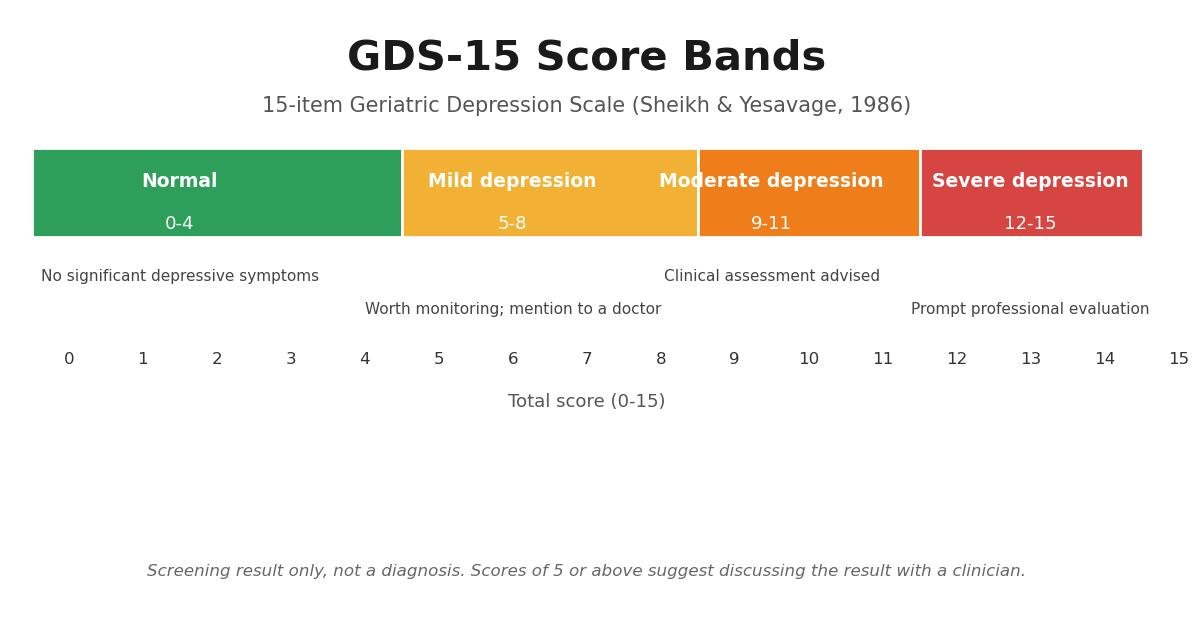
Each depressive answer contributes one point, so the total score runs from 0 to 15. In the original validation work, Sheikh and Yesavage proposed that a score of 5 or above is suggestive of depression, while a score of 10 or above almost always indicates depression. Over the years, clinicians and researchers have also used a finer four-band grouping that the calculator above follows: 0 to 4 is considered the normal range, 5 to 8 indicates mild depression, 9 to 11 indicates moderate depression, and 12 to 15 indicates severe depression. This four-band grouping is a commonly used clinical convention rather than a rigid diagnostic rule, and different clinics may apply slightly different cut points depending on their population and purpose. What matters most is the general principle: higher scores mean more depressive symptoms and a greater need for follow-up.
A score of 0 to 4 suggests that, at least over the past week, the person is not showing a meaningful pattern of depressive symptoms. A score of 5 to 8 falls in the mild range. Many people in this range are not clinically depressed but are experiencing enough symptoms that it is worth watching and worth mentioning at the next medical visit. Lifestyle factors often play a role here: loneliness, recent bereavement, reduced mobility, or loss of routine can all push a score into the mild range, and addressing those factors can bring it back down.
Scores of 9 to 11, the moderate range, should be taken seriously. This level of symptom burden rarely resolves on its own, and a clinical assessment is advisable. Scores of 12 to 15, the severe range, call for prompt professional evaluation. Severe scores do not automatically mean severe clinical depression, since questionnaires cannot capture context, but they do mean the person is endorsing a large number of depressive symptoms and should not be left to cope alone.
It is also important to understand what the score does not tell you. It does not identify the cause of the symptoms. A high score could reflect true clinical depression, but it could also reflect grief after the loss of a spouse, an undiagnosed thyroid problem, a medication side effect, vitamin B12 deficiency, or the social isolation that followed a move into residential care. The questionnaire cannot distinguish between these, which is why a score is always the start of a conversation with a clinician rather than the end of one.
The reverse-scored items explained
Five of the fifteen questions are phrased positively: being basically satisfied with life (question 1), being in good spirits most of the time (question 5), feeling happy most of the time (question 7), thinking it is wonderful to be alive now (question 11), and feeling full of energy (question 13). On these items it is the answer no, not yes, that points toward depression, so the scoring is reversed: a no adds one point, a yes adds none. This is why the calculator cannot simply count yes answers. It follows the original scoring key exactly, checking each answer against the correct direction for that item.
This design has a practical consequence for anyone checking the tool's arithmetic by hand. If you count only yes answers, you will undercount whenever the person answered no to one of the five positive items. That is expected and correct. The reverse scoring is documented in the original 1986 publication and in every subsequent scoring guide, so the calculator's behavior matches the published instrument.
Depression in older adults: why screening matters
Depression is one of the most common mental health conditions in later life, yet it is also one of the most under-recognized. Older adults are less likely than younger people to describe themselves as feeling depressed. Many grew up in a time when emotional difficulties were rarely discussed, so they are more likely to report the consequences of low mood: withdrawing from activities, losing interest in hobbies, feeling that life is empty, or dwelling on whether they are a burden. The GDS questions were chosen partly because they use the language older adults actually use when they are struggling, which is one reason the scale has remained in use for more than forty years.
Risk factors for depression in older age are well documented. Bereavement, particularly the loss of a spouse or close friends, is a major trigger. So are chronic illness and chronic pain, which can erode independence and shrink the world a person lives in. Social isolation is another powerful risk factor: retirement, giving up driving, children moving away, and friends passing on can leave an older person with very few daily contacts. Financial worries, fear of becoming a burden, and the cumulative effect of several small losses at once also contribute. None of these make depression inevitable, but they explain why regular screening is sensible in primary care, community health programs, and residential care settings.
There is another reason screening matters specifically in older adults: the overlap with cognitive problems. Depression in later life can cause noticeable difficulties with concentration and memory, sometimes called depressive pseudodementia. An older person may complain that their memory is failing, perform poorly on a brief cognitive test, and yet have no underlying dementia at all. Treating the depression can restore their cognitive performance. Question 10 of the GDS-15 asks directly about memory complaints for this reason. If memory problems improve when mood lifts, the cause was probably depressive; if they persist after mood improves, further cognitive evaluation is warranted. This is one more reason a screening score should be handed to a clinician rather than filed away.
Limitations of the scale
The GDS-15 is a screening instrument, not a diagnostic tool. Screening tools are designed to catch as many true cases as possible, which means they will also flag some people who are not actually depressed. A positive screen is a signal to look closer, not a diagnosis. Only a clinician who takes a full history, reviews medications and medical conditions, and applies diagnostic criteria can determine whether someone has major depression, a milder depressive condition, grief, or something else entirely.
The scale also has specific blind spots. Because it deliberately excludes physical symptoms, it can miss depression that presents mainly through bodily complaints, although that is uncommon. Because it asks about the past week, it reflects a snapshot in time: a person in the middle of a bad week after a fall or a hospital stay may score high without having an ongoing depressive illness. Repeating the scale after a few weeks can be informative. The scale is less accurate in people with moderate to severe dementia, who may not reliably recall the past week or understand the questions. It can also be influenced by language and culture: concepts like feeling empty or feeling worthless may not translate cleanly, and published validations exist for many translated versions but not for every language.
What to do with your result
If your score falls in the normal range, treat the questionnaire as a baseline. Mood changes over time, and repeating the scale every few months, or sooner if life circumstances change, gives you a way to notice a drift early. If your score is in the mild range, consider the context. Are there obvious reasons, such as loneliness, a recent loss, or a health setback? Addressing the underlying cause, reconnecting socially, staying physically active within your limits, and keeping a regular daily routine can all help. Mention the score at your next medical appointment so it is on record.
If your score is in the moderate or severe range, the most important step is to book an appointment with your doctor or a mental health professional and bring the score with you. Effective treatments exist for depression in older adults, including talking therapies adapted for later life and medications that can be used safely with attention to other prescriptions. Treatment works: studies consistently show that older adults respond to depression treatment at least as well as younger adults. If you ever feel that life is not worth living, or you have thoughts of harming yourself, seek help immediately: contact your local emergency number, a crisis helpline, or go to your nearest emergency department. Depression is a treatable medical condition, and asking for help is the strongest step you can take.
Key takeaways
- No.
- In the original validation work by Sheikh and Yesavage (1986), a score of 5 or higher was proposed as suggestive of depression, with 10 or higher almost always indicating depression.
- Five of the fifteen items are worded positively (for example, feeling happy, being satisfied with life, feeling full of energy).
- The GDS-15 is designed as a self-report questionnaire, meaning the older adult answers about their own feelings.
Frequently asked questions
Is the GDS short form a diagnosis of depression?
No. The 15-item Geriatric Depression Scale is a screening instrument, not a diagnostic test. It flags people who are likely to benefit from a fuller clinical assessment. A diagnosis of depression requires a face-to-face evaluation by a qualified clinician, who will take a history, consider medical and medication causes, and apply diagnostic criteria.
What score on the GDS-15 means depression?
In the original validation work by Sheikh and Yesavage (1986), a score of 5 or higher was proposed as suggestive of depression, with 10 or higher almost always indicating depression. A commonly used finer grouping is: 0 to 4 normal, 5 to 8 mild depression, 9 to 11 moderate depression, and 12 to 15 severe depression. Cutoffs can vary between clinical settings, so always follow your own clinician's guidance.
Why do some questions score a point for No and others for Yes?
Five of the fifteen items are worded positively (for example, feeling happy, being satisfied with life, feeling full of energy). On these items, answering No points toward depression, so they are reverse scored. The other ten items are worded negatively, so answering Yes points toward depression. Mixing positive and negative wording reduces the tendency to answer Yes to everything without reading.
Can someone else fill in the GDS-15 for an older adult?
The GDS-15 is designed as a self-report questionnaire, meaning the older adult answers about their own feelings. If memory or language problems make self-completion unreliable, a caregiver can read the questions aloud and record the answers, but answers should still reflect the older person's own feelings over the past week, not the caregiver's impression. In people with significant cognitive impairment, the scale's accuracy falls and informant-based or observational tools may be preferred by clinicians.
How long does the GDS short form take to complete?
Most people finish the fifteen yes/no questions in two to three minutes. The questions ask about how you felt over the past week, and there are no right or wrong answers beyond answering honestly. It can be completed on paper or online, and the scoring adds up to a total between 0 and 15.
What is the difference between the GDS-15 and the 30-item GDS?
The 30-item Geriatric Depression Scale is the original full version published by Yesavage and colleagues in 1982-83. The 15-item short form was developed by Sheikh and Yesavage in 1986 by selecting the items that correlated most strongly with the full version. The short form takes about half the time and keeps most of the accuracy, which is why it is the version most often used in clinics and research. Both use simple yes/no answers and the same reverse-scoring idea.
References and further reading
Sources
- Sheikh JI, Yesavage JA. Geriatric Depression Scale (GDS): recent evidence and development of a shorter version. Clinical Gerontologist. 1986;5(1-2):165-173.
- Yesavage JA, Brink TL, Rose TL, Lum O, Huang V, Adey M, Leirer VO. Development and validation of a geriatric depression screening scale: a preliminary report. Journal of Psychiatric Research. 1982-83;17(1):37-49.
- Page reviewed for medical accuracy by Dr. Taimoor Asghar, physician and community medicine researcher.