Katz Index of Independence in Activities of Daily Living
In short: Katz ADL index calculator: score independence in bathing, dressing, toileting, transferring, continence and feeding, 0 to 6, with interpretation bands. Use the calculator above, then read the guide below to interpret your result and its limitations.
Rate independence in the six Katz activities of daily living. For each activity, select whether the person is independent or dependent. The score ranges from 0 to 6, with interpretation bands below.
How scoring works
| Response | Points |
|---|---|
| Independent in the activity | 1 |
| Dependent in the activity | 0 |
Add the points for the six activities. The total ranges from 0 to 6. This calculator uses the classic binary scoring of the original 1963 index.
Interpretation
| Score | Interpretation | What it means |
|---|---|---|
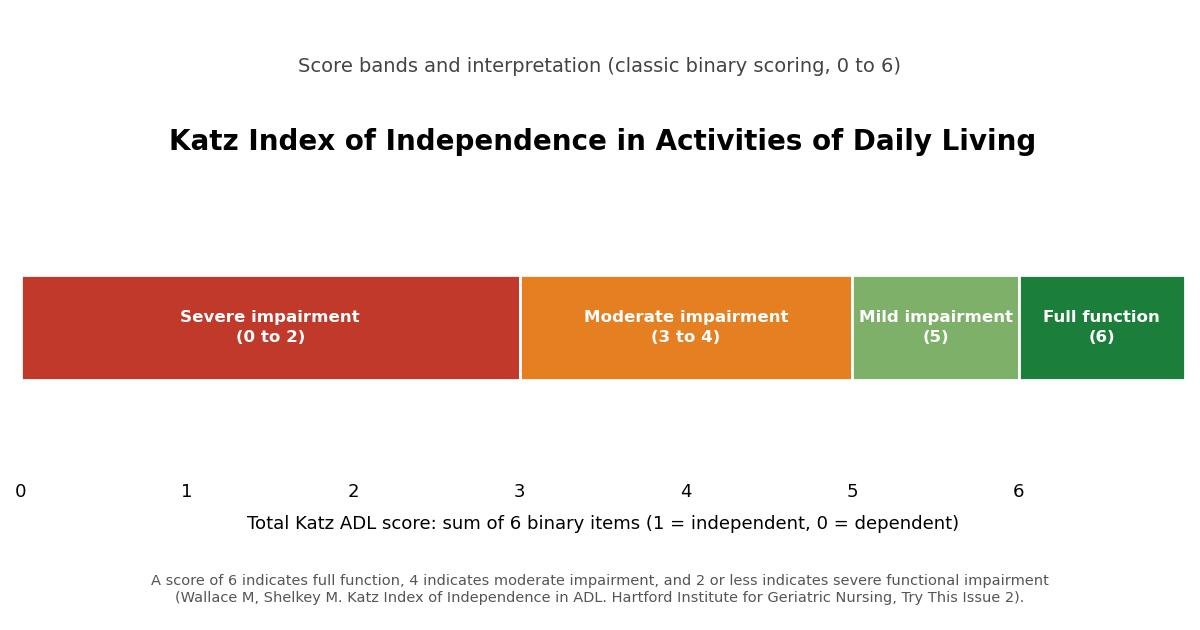
| 6 | Full function | Independent in all six basic activities. No assistance needed with basic self-care. |
| 5 | Mild impairment | Dependent in one activity. Targeted help or rehabilitation for that activity. |
| 3 to 4 | Moderate impairment | Dependent in two or three activities. Structured care planning is usually needed. |
| 0 to 2 | Severe impairment | Dependent in most basic activities. Comprehensive assessment and daily support indicated. |
Cut-points follow Wallace and Shelkey: a score of 6 indicates full function, 4 indicates moderate impairment, and 2 or less indicates severe functional impairment.
References
- Katz S, Ford AB, Moskowitz RW, Jackson BA, Jaffe MW. Studies of illness in the aged: the index of ADL: a standardized measure of biological and psychosocial function. JAMA. 1963;185(12):914-919.
- Wallace M, Shelkey M. Katz Index of Independence in Activities of Daily Living (ADL). Try This: Best Practices in Nursing Care to Older Adults, Issue Number 2. Hartford Institute for Geriatric Nursing, New York University; revised 2012. Hartford Institute PDF
- American Geriatrics Society
- NICE Guidance
About the Katz Index of ADL
The Katz Index of Independence in Activities of Daily Living is one of the oldest and most widely used functional assessment instruments in geriatric medicine. It was developed by Sidney Katz and colleagues at the Benjamin Rose Hospital in Cleveland and published in 1963 in the Journal of the American Medical Association. The original purpose was practical: to give rehabilitation teams a standardised way to measure how illness and ageing affect an older person's ability to care for themselves, and to track whether treatment and rehabilitation were restoring that ability over time.
At its heart, the index is deliberately simple. It looks at six basic self-care activities: bathing, dressing, toileting, transferring, continence, and feeding. For each activity, the person is rated as either independent or dependent. Independence earns one point, dependence earns zero, and the points are added to give a total score between 0 and 6. A score of 6 means full function, while lower scores signal increasing levels of functional impairment. Clinicians value this simplicity because the index can be completed in a few minutes by a nurse, therapist, physician, or trained caregiver, and because the resulting number is easy to compare across visits, settings, and studies.
One of the most influential observations in the original work was that these functions tend to be lost in a roughly predictable order and regained in the reverse order during recovery. Bathing, which requires the most complex sequence of movements, is typically the first ability to go and the last to return, while feeding, which is the simplest, is usually the last to be lost. This hierarchical pattern means that the total score carries more information than a simple count: a person scoring 5 is very likely to need help specifically with bathing, for example. Care planners use this property to anticipate needs and target rehabilitation where it will matter most.
In the decades since 1963, the instrument has been adapted, translated, and built into countless assessment protocols in hospitals, home care, nursing homes, and research. Although some later versions use three-level scoring (independent, needs assistance, dependent), the classic binary version scored 0 to 6 remains the reference standard, and it is the version this calculator implements. The Hartford Institute for Geriatric Nursing recommends it as the preferred tool for assessing functional status in older adults, noting that a score of 6 indicates full function, 4 indicates moderate impairment, and 2 or less indicates severe functional impairment.
The six activities, explained
Each of the six activities has a standard operational definition. These definitions matter because consistent interpretation is what makes scores comparable between different assessors and different visits.
Bathing. Bathing covers washing the whole body, either in a shower, a bath, or by sponge bath. A person is rated independent if they bathe themselves completely or need help with only a single part of the body, such as the back, the genital area, or a disabled limb. Needing help with more than one part of the body counts as dependent. Because bathing involves balance, reaching, bending, and managing water safely, it is usually the first activity to become difficult.
Dressing. Dressing means getting clothes from closets and drawers and putting on clothes and outer garments completely. The standard definition allows one exception: needing help with tying shoes still counts as independent. Anything beyond that, such as needing help with buttons, zips, or staying partly undressed, counts as dependent. Dressing tests fine motor control, balance while standing, and the cognitive sequencing of a multi-step task.
Toileting. Toileting includes getting to the toilet, getting on and off, arranging clothes, and cleaning the genital area. Independence requires managing all of these steps without help. This activity is a frequent early indicator of problems because it combines mobility, balance, and continence management, often under time pressure.
Transferring. Transferring means moving in and out of bed and in and out of a chair. A person is independent if they can do this without another person's assistance; using a mechanical aid, such as a transfer board or a grab rail, is acceptable and still counts as independent. Transferring ability is closely linked to lower-body strength and is a strong predictor of fall risk and the need for supervision.
Continence. Continence is rated independent only when the person has complete self-control over both urination and defecation. Partial or total incontinence counts as dependent. Continence problems often have treatable medical causes, from urinary tract infections to medication side effects, so a new loss of continence should always prompt a medical review rather than being accepted as normal ageing.
Feeding. Feeding means getting food from the plate into the mouth. Having someone else prepare or cut up the food still counts as independent, as does eating with adapted cutlery. Needing to be fed by another person, or not eating at all, counts as dependent. Because feeding is usually the last ability lost, dependence in feeding almost always accompanies dependence in several other activities and signals severe impairment.
How the score is calculated
The calculation follows the classic binary scoring described in the original 1963 publication. Each of the six activities contributes exactly one point if the person is independent and zero points if the person is dependent. The six contributions are summed, giving a whole-number total between 0 and 6. There is no weighting: bathing counts the same as feeding, and continence counts the same as dressing. The score is a count of independent functions, nothing more and nothing less.
This calculator requires an answer for all six activities before it will produce a score. If any activity is left unanswered, it shows an error naming the missing activity instead of guessing. This strictness is intentional: a score based on five activities would not be a valid Katz score, and silently imputing a value would mislead care decisions. Answer each item as honestly as possible, based on what the person actually does day to day rather than what they could do on their best day.
Understanding your score in detail
6 (full function). The person is independent in all six basic activities. This is the normal, expected result for a healthy adult. It does not guarantee that more complex tasks are unaffected, but basic self-care is intact. Repeating the assessment periodically provides a baseline against which future change can be detected.
5 (mild impairment). The person is dependent in exactly one activity, most often bathing. This is an early warning sign rather than a crisis. The sensible response is to investigate the single limitation: would a shower chair, grab rails, or a short course of physiotherapy restore independence? A score of 5 should trigger closer follow-up because it often marks the beginning of a decline that can still be slowed or reversed.
3 to 4 (moderate impairment). The person needs help with two or three basic activities. At this level, structured care planning is usually needed: scheduled home help, assistive devices, home safety adaptations, and a review of medical causes and medications. The published cut-point describes a score of 4 as moderate impairment; a score of 3 sits between moderate and severe and deserves the same serious attention.
0 to 2 (severe impairment). The person is dependent in most basic activities of daily living. This level of impairment requires comprehensive assessment and daily care support, whether from family caregivers, home care services, or a residential setting. A medical review is important to identify reversible contributors, such as depression, untreated pain, medication effects, or an acute illness, before concluding that the impairment is permanent.
Whatever the score, the most valuable use of the index is comparison over time. A drop from 6 to 4 over a few months tells a very different story from a stable score of 4 measured a year apart. The first suggests an active problem that needs urgent investigation; the second describes a stable situation that needs ongoing support. This is why geriatric guidelines emphasise taking a baseline measurement while the person is well and re-measuring after any significant health event.
What the Katz index does not measure
The Katz index covers only basic activities of daily living: the fundamental self-care tasks. It does not assess instrumental activities of daily living (IADL), the more complex tasks needed for independent community life, such as cooking, shopping, housework, doing laundry, using the telephone, taking medications correctly, managing money, and using transport. These were described separately by Lawton and Brody. In practice, people usually begin to struggle with instrumental activities before basic ones, so someone can score 6 on the Katz index and still need substantial help at home. A full functional assessment therefore pairs the Katz index with an IADL scale.
The index also does not measure cognition, mood, vision, hearing, or the quality with which an activity is performed. A person with early dementia may still bathe and dress independently and score 6, even though supervision is becoming necessary for safety. Similarly, the index records whether help is needed, not why: a low score caused by a fractured hip has very different implications from the same score caused by advanced dementia. The score is a flag that points toward the need for deeper assessment, not a substitute for it.
Finally, the Katz index is less granular than some alternatives. The Barthel Index, for example, scores ten activities with partial credit on a 0 to 100 scale and can detect smaller changes during rehabilitation. The trade-off is speed and simplicity: the Katz index takes minutes and needs no special training, which is why it remains the first-line functional screen in so many settings.
When clinicians use the index
Clinicians reach for the Katz index whenever functional status matters to a decision. In hospitals, it is part of admission and discharge assessment: knowing that a patient was independent in all six activities before admission but is now dependent in three changes the discharge plan completely, from the equipment ordered to the home care arranged. In primary care, it is used during comprehensive geriatric assessments and annual reviews of older patients, where a new dependency can be the first sign of an undiagnosed condition.
In rehabilitation, the index tracks progress: regaining independence in dressing or transferring is a concrete, meaningful outcome for both the patient and the therapy team. In long-term care and home care services, scores inform care plans and staffing decisions, and in research they serve as a standardised outcome measure for trials in older populations. Eligibility assessments for certain support services also use ADL scores as part of their criteria, though the exact thresholds vary by country and programme.
The index is most powerful when used as a trend rather than a snapshot. The Hartford Institute guidance behind this tool stresses exactly this: take the baseline when the person is well, then compare periodic measurements against it. A single score answers "how is this person doing today"; a series of scores answers "is this person getting better, staying the same, or declining", which is usually the question that matters.
Limitations to keep in mind
- The binary scoring is coarse. A person who needs a little help with bathing and a person who cannot bathe at all both score 0 for that item, so small but meaningful changes can be missed. More granular scales exist for tracking fine-grained progress.
- The score depends on honest observation. People may overstate their independence, and caregivers may either over-help or under-report. The assessment should reflect what the person actually does in daily life, ideally observed rather than assumed.
- Environment and equipment change scores. A person who is dependent getting in and out of a deep bathtub may be independent with a walk-in shower and grab rails. Score the person in their actual, equipped environment, and note what aids were in use.
- The index has ceiling and floor effects. Healthy adults cluster at 6, so it cannot distinguish levels of fitness above full independence; people with profound impairment cluster at 0, where further decline is invisible to the scale.
- A low score is not a diagnosis. Dependence in daily activities can stem from musculoskeletal problems, neurological disease, depression, sensory loss, medication effects, or acute illness, and each demands a different response. The score should always lead to a clinical evaluation, not replace one.
- Cultural and gender norms can influence ratings, particularly for dressing and food preparation expectations in some settings. Assessors should apply the standard definitions consistently rather than adjusting for household roles.
Key takeaways
- A score of 6 is the normal, expected result: it means full function, independence in all six activities (bathing, dressing, toileting, transferring, continence, and feeding).
- The index is used mainly by clinicians, nurses, occupational therapists, and caregivers assessing older adults or people with chronic illness, in homes, clinics, hospitals, and long-term care.
- It is most useful when a baseline measurement is taken while the person is well and then compared with periodic re-measurements, for example after an illness, a hospital stay, or a fall.
- The Katz index measures basic activities of daily living: the six self-care tasks of bathing, dressing, toileting, transferring, continence, and feeding.
Frequently asked questions
What is a normal Katz ADL score?
A score of 6 is the normal, expected result: it means full function, independence in all six activities (bathing, dressing, toileting, transferring, continence, and feeding). Anything below 6 means at least one basic activity needs assistance, and the lower the score, the greater the impairment.
Who should use the Katz index?
The index is used mainly by clinicians, nurses, occupational therapists, and caregivers assessing older adults or people with chronic illness, in homes, clinics, hospitals, and long-term care. Older adults or family members can also complete it as a self-check, but any change in care should be decided with a clinician.
How often should the Katz index be repeated?
It is most useful when a baseline measurement is taken while the person is well and then compared with periodic re-measurements, for example after an illness, a hospital stay, or a fall. Regular comparison is what turns a single score into a picture of decline, stability, or recovery.
What is the difference between the Katz ADL and IADL scales?
The Katz index measures basic activities of daily living: the six self-care tasks of bathing, dressing, toileting, transferring, continence, and feeding. Instrumental activities of daily living (IADL), described by Lawton and Brody, cover more complex household and community tasks such as cooking, shopping, managing money, and taking medications. People usually lose IADL abilities before basic ADLs.
Can a low Katz score improve with rehabilitation?
Yes. Katz and colleagues observed that lost functions can be regained during recovery, often in the reverse of the order in which they were lost. Rehabilitation, assistive devices, and home adaptations can restore independence in individual activities, which is why re-measuring the score over time matters.
Is the Katz ADL suitable for self-assessment at home?
It can be used as a structured self-check because the six questions are simple, but it was designed for observation by a clinician or caregiver. Be honest about help received: using a walker or grab rail usually still counts as independent, while needing another person counts as dependent. Treat the result as information to discuss with a clinician, not a diagnosis.
This calculator is for educational and informational purposes only. It is not a substitute for professional medical advice, diagnosis, or treatment. A Katz ADL score is a functional screening aid, not a diagnosis; discuss the result with a qualified clinician before making any care decisions. If you notice a sudden loss of independence in daily activities, seek medical attention promptly, as it can signal an acute illness.