What is frailty?
Frailty is a clinical syndrome in which the body's physiological reserve declines across multiple organ systems, leaving a person more vulnerable to stressors that a robust person would recover from easily. A minor infection, a fall, a new medication or a short hospital stay can trigger a cascade of decline in someone who is frail: loss of independence, prolonged recovery, new disability or even death. Frailty is not simply getting older, and it is not the same as having one or more chronic diseases. Two people of the same age with the same diagnoses can differ enormously in their resilience, and it is that resilience that frailty tries to capture.
Geriatricians think of frailty as a state of increased vulnerability resulting from the accumulation of small deficits in strength, endurance, energy, mobility and nutrition. It develops gradually, often silently, and it is partly reversible: muscle strength can be rebuilt, nutritional gaps can be corrected, medications that sap energy can be reviewed, and the social and physical environment can be adapted. That reversibility is exactly why screening matters. A short, practical screen such as the FRAIL scale exists so that frailty can be detected early in a busy clinic, or even at home, while something can still be done about it.
Why screen for frailty with the FRAIL scale?
The FRAIL scale was developed by John E. Morley, Theodore K. Malmstrom and Douglas K. Miller and published in the Journal of Nutrition, Health and Aging in 2012. It was proposed through the International Association of Nutrition and Aging as a simple questionnaire that clinicians could use without any equipment, physical measurements or laboratory tests. The idea was deliberate: many frailty assessments require grip-strength dynamometers, timed walking tests or long deficit checklists, which makes them hard to use in routine practice. The FRAIL scale needs none of that. It asks five questions, takes about a minute, and can be completed by the patient, a family member or a clinician.
The validation study followed a representative sample of African Americans aged 49 to 65 in the community for nine years. Participants who scored in the pre-frail range at baseline were significantly more likely to develop difficulties with activities of daily living, to perform worse on the one-leg stand test and to die during follow-up. Those who scored in the frail range were significantly more likely to develop difficulties with both basic and instrumental activities of daily living and to die. In other words, the five quick questions genuinely predicted who would lose independence and who would not, years before it happened. That predictive power is what turned a simple questionnaire into a widely used screening instrument.
Screening is not about labelling people. It is about finding the window where intervention works best. Someone who is pre-frail today may become frail in a few years, but that trajectory is not fixed. Progressive resistance exercise, adequate protein intake, vitamin D repletion where deficient, review of sedating or blood-pressure-lowering medicines, treatment of depression and attention to vision, hearing and footwear all modify the very domains the FRAIL scale measures. A screening score is therefore best understood as the start of a conversation with a clinician, not the end of one.
The five FRAIL items explained
F: Fatigue
Fatigue is measured with a single question: "How much of the time during the past 4 weeks did you feel tired?" The five answer options run from "all of the time" to "none of the time". Only the two most severe answers, "all of the time" or "most of the time", score one point; anything milder scores zero. Fatigue is one of the most common and most dismissed symptoms in older adults. It can reflect anaemia, heart failure, depression, sleep apnoea, hypothyroidism, chronic inflammation or simply deconditioning, so a positive answer deserves a clinical look rather than being written off as normal ageing. In the calculator above, choose the option that best matches the last four weeks.
R: Resistance
Resistance asks about stair climbing: "By yourself and not using aids, do you have any difficulty walking up 10 steps without resting?" Answering yes scores one point. The question is carefully worded. "By yourself" removes help from another person, "not using aids" removes walking sticks and frames, and "without resting" removes the strategy of stopping halfway. What remains is a pure test of lower-limb strength and cardiorespiratory fitness. Difficulty with stairs is often the first functional loss people notice, and it tracks closely with quadriceps strength and with the ability to recover from illness without prolonged bed rest.
A: Ambulation
Ambulation asks: "By yourself and not using aids, do you have any difficulty walking several hundred yards?" Again, a yes answer scores one point. Several hundred yards is roughly the distance of a few street blocks: far enough to require sustained walking but short enough that most independent adults manage it routinely. Losing this distance is a meaningful threshold because it is about the distance needed for everyday community life, such as reaching a bus stop, walking through a supermarket or visiting a neighbour. When walking distance shrinks, people go out less, which accelerates muscle loss and social isolation, which in turn worsens frailty.
I: Illnesses
The illnesses item lists 11 conditions: hypertension, diabetes, cancer (other than a minor skin cancer), chronic lung disease, heart attack, congestive heart failure, angina, asthma, arthritis, stroke and kidney disease. The question is whether a doctor has ever told you that you have each one. If you have five or more of the eleven, the item scores one point; four or fewer scores zero. This item captures multimorbidity, the accumulation of chronic diseases that interact with each other and with their treatments. It is not a general health rating: someone with two well-controlled conditions scores zero here even if they feel unwell, while someone with six diagnoses scores one point even if they currently feel fine. Tick each condition honestly in the calculator, or tick "None of the above" if none apply.
L: Loss of weight
Loss of weight compares your weight one year ago with your current weight. The percent change is calculated as (weight one year ago minus current weight) divided by weight one year ago, multiplied by 100. A loss of more than 5 percent scores one point; a loss of 5 percent or less scores zero. Unintentional weight loss in older adults is a red flag for underlying disease, poor appetite, chewing or swallowing problems, depression, poverty or the early stages of sarcopenia, the age-related loss of muscle mass. Note that the item measures loss, not gain: if you have gained weight, the percent change is negative and the item scores zero. Enter both weights in the same unit and the calculator does the arithmetic for you.
How the FRAIL scale is scored
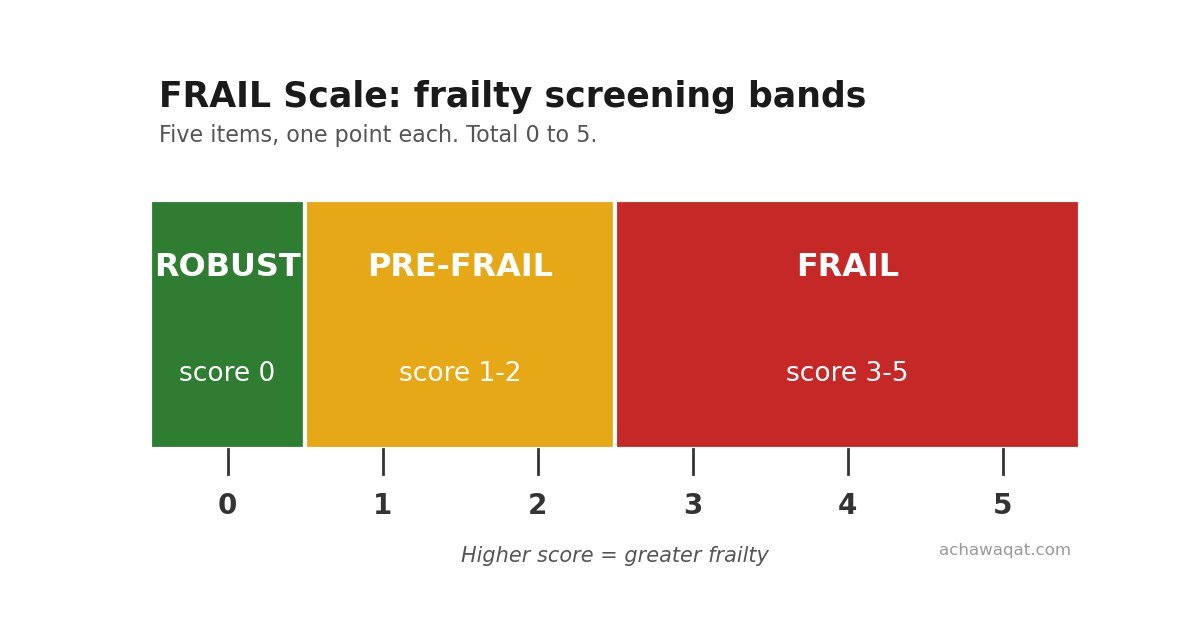
Each of the five items contributes exactly one point, so the total ranges from 0 to 5. A score of 0 is classified as robust. Scores of 1 or 2 are classified as pre-frail. Scores of 3, 4 or 5 are classified as frail. There are no half points and no weighting: fatigue counts exactly as much as weight loss. The scoring is intentionally simple so that the scale can be used at the bedside, in the clinic or at home without a scoring manual. The chart above the article shows the three bands and where each total score falls.
Two boundary details matter for anyone implementing the scale. First, the fatigue item only counts the two most severe responses: "some of the time", "a little of the time" and "none of the time" all score zero. Second, the weight loss item uses a strict greater-than cut-off: a loss of exactly 5 percent scores zero, and only losses above 5 percent score one point. The calculator above applies both rules exactly as published in the original paper.
Interpreting your result and what to do next
Score 0: robust
A robust result means none of the five frailty indicators is present. This is good news, and the sensible next step is to keep it that way. Regular physical activity that includes resistance exercise, adequate protein with meals, maintaining social contact and keeping up with preventive care such as vaccinations and blood pressure checks all protect against future frailty. Because frailty can develop over a few years, repeating the screen annually is a reasonable habit, especially after any hospital admission or major illness.
Scores 1 to 2: pre-frail
Pre-frail means one or two frailty indicators are present. This is the most useful result the scale can give, because pre-frailty is the stage where targeted action has the best chance of reversing the trajectory. Look at which items scored points and treat each as a lead. Fatigue points toward a medical review for anaemia, thyroid problems, sleep disorders and depression. Resistance or ambulation problems point toward physiotherapy and a progressive walking and strength programme. Weight loss points toward a dietitian review, dental or swallowing assessment and a check of who is actually preparing and eating meals. Bring the result to your next appointment and ask specifically what can be done about each positive item.
Scores 3 to 5: frail
A frail result means three or more indicators are present and a proper clinical assessment is warranted. Ask your doctor about a comprehensive geriatric assessment, a structured review of all medications including over-the-counter and herbal products, a falls risk assessment of the home, and screening for cognitive impairment and depression, which commonly travel with frailty. Practical supports matter as much as medical ones: grab rails, good lighting, a personal alarm, help with shopping and cooking, and a plan for who to call in a crisis. Many people who score in the frail range stabilise or improve once the reversible contributors are addressed, so the score should motivate action rather than resignation.
Limitations of the FRAIL scale
The FRAIL scale is a screening tool, not a diagnosis. A score in the frail range does not mean you have a disease called frailty in the way a blood test diagnoses diabetes; it means you have enough risk indicators to justify a fuller assessment. Equally, a robust score does not guarantee that nothing is wrong. The scale does not measure cognition, mood, vision, hearing, balance or social vulnerability, and all of these influence outcomes in older adults.
All five items are self-reported, which brings the usual limits of self-report. People differ in what they consider "difficulty", fatigue is subjective, and recalling weight from a year ago is approximate. The validation study was conducted in middle-aged African Americans in one American city, and although the scale has since been used in many populations, performance can vary with culture, language and setting. Finally, frailty is not the same as disability or comorbidity. Disability means difficulty or dependence in daily activities; comorbidity means having multiple diseases. The three overlap heavily but they are distinct concepts, and the FRAIL scale measures frailty specifically, mixing one comorbidity item with four functional and symptom items.
The FRAIL scale compared with other frailty tools
The best-known alternative is the frailty phenotype developed by Linda Fried and colleagues, which also has five criteria: unintentional weight loss, weakness measured by grip strength, slowness measured by walking speed, self-reported exhaustion and low physical activity. Like the FRAIL scale it classifies 0 as robust, 1 to 2 as pre-frail and 3 or more as frail, but two of its criteria require equipment and timed measurements. The Clinical Frailty Scale, widely used in hospitals, is a nine-point judgement scale from very fit to terminally ill based on a clinician's overall impression. The Edmonton Frail Scale adds cognitive and social items. For a quick first screen that anyone can complete in a minute, the FRAIL scale remains the most practical choice, with the more detailed instruments reserved for people the screen flags.
Related tools
Frailty often travels with other geriatric syndromes. If you are screening an older adult, you may also want to check for delirium with the 4AT delirium screening tool, which detects acute confusion in a couple of minutes, and to measure day-to-day independence with the Barthel Index, which scores performance in ten basic activities of daily living. Together, a frailty screen, a delirium screen and a disability measure give a rounded picture of an older person's current state and risks.
References
- Morley JE, Malmstrom TK, Miller DK. A simple frailty questionnaire (FRAIL) predicts outcomes in middle aged African Americans. J Nutr Health Aging. 2012;16(7):601-608. DOI: 10.1007/s12603-012-0084-2. PMID: 22836700.
- Woo J, Leung J, Morley JE. Comparison of frailty indicators based on clinical phenotype and the multiple deficit approach in predicting mortality and physical function. J Am Geriatr Soc. 2012;60(8):1478-1486.
- Woo J, Yu R, Wong M, et al. Frailty screening in the community using the FRAIL scale. J Am Med Dir Assoc. 2015;16(5):412-419.
- Fried LP, Tangen CM, Walston J, et al. Frailty in older adults: evidence for a phenotype. J Gerontol A Biol Sci Med Sci. 2001;56(3):M146-M156.
- Fried LP, Ferrucci L, Darer J, Williamson J, Anderson G. Untangling the concepts of disability, frailty, and comorbidity: implications for improved targeting and care. J Gerontol A Biol Sci Med Sci. 2004;59(3):255-263.
Key takeaways
- The FRAIL scale is a short screening questionnaire that estimates a person's level of frailty.
- A score of 0 means robust health status, a score of 1 to 2 means pre-frail, and a score of 3 to 5 means frail.
- The FRAIL scale lists 11 illnesses: hypertension, diabetes, cancer (other than a minor skin cancer), chronic lung disease, heart attack, congestive heart failure, angina, asthma, arthritis, stroke and kidney disease.
- Weight loss is scored by comparing your weight one year ago with your current weight.
Frequently asked questions
What does the FRAIL scale measure?
The FRAIL scale is a short screening questionnaire that estimates a person's level of frailty. It asks five questions about fatigue, resistance (climbing stairs), ambulation (walking distance), the number of chronic illnesses, and recent weight loss. Each item scores one point, giving a total from 0 to 5, which places the person in the robust, pre-frail or frail category.
What do the FRAIL scale scores mean: robust, pre-frail and frail?
A score of 0 means robust health status, a score of 1 to 2 means pre-frail, and a score of 3 to 5 means frail. These cut-offs come from the original validation study by Morley, Malmstrom and Miller, published in the Journal of Nutrition, Health and Aging in 2012. The pre-frail band is the best window for preventive action, because many contributors to frailty are modifiable when they are found early.
Which illnesses count in the FRAIL scale illnesses question?
The FRAIL scale lists 11 illnesses: hypertension, diabetes, cancer (other than a minor skin cancer), chronic lung disease, heart attack, congestive heart failure, angina, asthma, arthritis, stroke and kidney disease. You score one point on this item if you have five or more of them; fewer than five scores zero.
How is the weight loss item of the FRAIL scale calculated?
Weight loss is scored by comparing your weight one year ago with your current weight. The percent change is calculated as (weight one year ago minus current weight) divided by weight one year ago, multiplied by 100. If the loss is more than 5 percent, the item scores one point; a loss of 5 percent or less scores zero.
Can the FRAIL scale diagnose frailty?
No. The FRAIL scale is a screening tool, not a diagnostic test. It flags people who are likely to benefit from a fuller clinical assessment, but only a clinician who examines you and reviews your history can diagnose frailty and plan care.
What should I do if my FRAIL scale score is in the frail range?
Treat the result as a prompt to talk to your doctor, not as a verdict. Ask about a medication review, strength and balance exercise, adequate protein intake, falls risk assessment, and screening for depression and cognitive problems. Many contributors to frailty respond to treatment when they are identified.
Further reading
Medically reviewed by Dr. Taimoor Asghar.