Lawton IADL Scale Calculator
In short: Free Lawton IADL calculator: score the 8 instrumental activities of daily living, 0 to 8 for women and 0 to 5 for men. Educational tool, not medical advice. Use the calculator above, then read the guide below to interpret your result and its limitations.
Score the eight instrumental activities of daily living: 0 to 8 for women and 0 to 5 for men under the original convention, or all eight domains for everyone in the modern version. Higher totals mean greater independence.
The calculator
Result
Not yet calculated
Select one option for each domain
Why instrumental activities matter
When clinicians assess an older person, they distinguish two layers of function. Basic activities of daily living, the Katz ADLs, cover self-care: bathing, dressing, toileting, moving, continence, and feeding. Instrumental activities are the more complex tasks that make independent community living possible: cooking a meal, doing the shopping, managing money, taking the right pills at the right time. These fail first. A person in the early stages of dementia can usually still dress and feed themselves long after they have stopped being able to manage their finances or medications safely. That is why the Lawton scale is one of the most sensitive early functional markers in geriatrics: it detects the layer of independence that erodes earliest.
Lawton and Brody developed the scale at the Philadelphia Geriatric Center and published it in 1969. Their insight was that independence is hierarchical: people lose complex community tasks before they lose basic self-care, and regain them in the reverse order during recovery. The eight domains were chosen to span the practical demands of living alone in a community, from the telephone to the bank.
The eight domains
| Domain | Scores 1 (independent) | Scores 0 (needs help) |
|---|---|---|
| Telephone | Operates telephone independently | Needs help or cannot use it |
| Shopping | Takes care of shopping independently | Needs help or cannot shop |
| Food preparation | Plans and prepares meals independently | Needs help or cannot prepare food |
| Housekeeping | Maintains house independently | Needs help or cannot keep house |
| Laundry | Does laundry independently | Needs help or cannot do laundry |
| Transportation | Travels independently | Needs help or cannot travel alone |
| Medications | Takes medications independently | Needs help or cannot manage them |
| Finances | Manages finances independently | Needs help or cannot manage them |
The sex-specific scoring, honestly explained
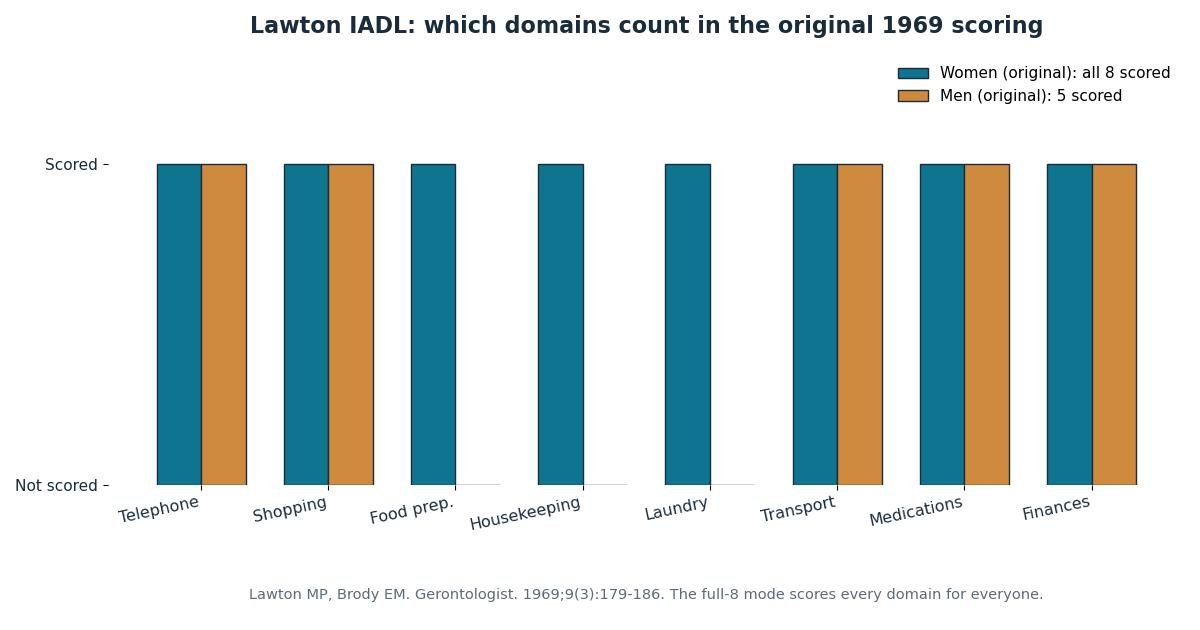
The original instrument scores women on all eight domains but men on only five, excluding food preparation, housekeeping, and laundry. This was not a clinical finding. It reflected the gendered division of household labour in the 1960s: the authors assumed many men of that generation had never performed those tasks, so scoring them on it would measure biography rather than ability. Today the convention looks dated, and many clinicians simply score all eight domains for everyone, which this calculator offers as the full-8 mode. When comparing scores across studies, it matters which convention was used: a man's 5 out of 5 on the original scale and a woman's 5 out of 8 describe very different levels of function.
Reading the total
The Lawton scale has no formally validated cutoffs the way a diagnostic test does; it is a descriptive instrument, and the total is read as a gradient. A maximum score means full independence in the scored domains. Each point lost names a specific domain where help is needed, which is arguably more useful than the number itself: the pattern tells the care team exactly what support to arrange, whether that is a medication organiser, a shopping service, or help with finances. A falling total over time is often the trigger for deeper assessment, including cognitive testing, medication review, and a look at the home environment.
Using the scale over time
One of the Lawton scale's greatest strengths is as a repeated measure. A single score is a snapshot, but scores taken every few months draw a trajectory, and the trajectory is what drives decisions. A stable 6 out of 8 over two years tells a very different story from a 6 that was 8 six months ago. The declining pattern prompts the questions that matter: is this a reversible cause such as depression, polypharmacy, or a sensory deficit, or is it the steady functional slide of a neurodegenerative disease? Geriatric teams often pair the Lawton with the Katz basic ADL scale so they can see both layers at once: IADL loss with preserved basic ADLs points toward early cognitive or complex-task difficulty, while loss in both layers suggests more advanced impairment or an acute medical problem. The scale also gives families a shared language. Saying "she has lost two IADL points since spring, both in medications and finances" is concrete in a way that "she seems worse" is not, and it focuses the care-planning conversation on exactly which supports would restore safety.
Common pitfalls
The most important is confusing inability with lack of opportunity. A person who has never cooked because a spouse always did is not necessarily impaired in the clinical sense, though the practical consequence, they cannot safely feed themselves alone, is the same. Assessors should also consider temporary versus persistent loss: a broken wrist impairs cooking for weeks, dementia impairs it permanently, and the care plan differs completely. Finally, the scale measures what the person actually does, not what they could do in theory, so it should reflect the real week, not the best day.
What does the Lawton IADL scale measure?
The Lawton Instrumental Activities of Daily Living scale measures a person's ability to live independently in the community. It covers eight domains: using the telephone, shopping, preparing food, housekeeping, doing laundry, using transportation, taking medications, and handling finances. Each domain scores 1 if the person manages it independently and 0 if they need help, so higher totals mean greater independence.
Why is the Lawton IADL scored differently for men and women?
In the original 1969 instrument, women are scored on all eight domains (0 to 8) while men are scored on five (0 to 5), excluding food preparation, housekeeping, and laundry. This reflected the household roles of the 1960s, not any clinical rationale. Many modern clinicians score all eight domains for everyone and note the convention; this calculator offers both the original sex-specific scoring and the full 8-domain version.
What is the difference between ADL and IADL?
Basic ADLs are self-care tasks: bathing, dressing, toileting, transferring, continence, and feeding, usually measured with the Katz index. Instrumental ADLs are the more complex tasks needed to live independently in the community, such as cooking, shopping, and managing money, measured with the Lawton scale. IADLs are typically affected earlier in cognitive decline, which makes the Lawton scale useful for detecting early functional impairment.
Where does the Lawton IADL scale come from?
The scale was introduced by M. Powell Lawton and Elaine M. Brody in a 1969 paper in The Gerontologist, developed at the Philadelphia Geriatric Center. It was one of the first instruments to separate the complex community-living tasks from basic self-care, and it remains among the most widely used functional assessments in geriatrics.
What does a low Lawton IADL score mean?
A low score means the person needs help with everyday community tasks and may need support services, home adaptations, or a higher level of care. Because IADLs decline early in dementia, a falling score can also prompt cognitive assessment. The score describes function; it does not diagnose the cause, which needs proper clinical evaluation.
Can I use this scale to assess a family member?
You can use it to organise your observations before speaking to a clinician, but a proper assessment should be done by a health professional who can distinguish inability from lack of opportunity, for example someone who never cooked is not necessarily impaired. This calculator is educational and cannot assess anyone.
Key takeaways
- The Lawton Instrumental Activities of Daily Living scale measures a person's ability to live independently in the community.
- In the original 1969 instrument, women are scored on all eight domains (0 to 8) while men are scored on five (0 to 5), excluding food preparation, housekeeping, and laundry.
- Basic ADLs are self-care tasks: bathing, dressing, toileting, transferring, continence, and feeding, usually measured with the Katz index.
- The scale was introduced by M.
References and further reading
Medical disclaimer
This calculator is an educational aid only. It does not assess anyone's fitness to live independently and does not advise on care arrangements. Functional assessment should be done by a qualified clinician who can interpret the pattern of impairment in the context of the person's health, cognition, and circumstances. If you are concerned about an older person's ability to manage at home, discuss it with their doctor or a social care professional.