Clinical Frailty Scale Calculator
In short: Free Clinical Frailty Scale calculator: the 9-point Rockwood frailty scale with plain-language descriptors, the frailty threshold at 5, and the honest scoring rules. Educational tool, not medical advice. Use the calculator above, then read the guide below to interpret your result and its limitations.
Score frailty with the 9-point Rockwood Clinical Frailty Scale. Read the nine levels, pick the one that best fits the person's baseline from two weeks ago, and see the plain-language interpretation. Level 5 and above is the commonly used frailty threshold.
The calculator
Clinical Frailty Scale: Not yet calculated
Interpretation: Select the level that fits best
Please note: level 4 is not yet frail, but it is the recognised pre-frail risk group. People at this level often move toward frailty after an illness or a fall, so it is the group where prevention matters most.
Please note: levels 5 and above meet the commonly used frailty threshold. This is a clinical judgement aid, not a treatment decision: the score informs the conversation about goals, support and reversibility, but it never decides care on its own.
Please note: level 9 is not a frailty grade. It applies to people approaching the end of life with a life expectancy under 6 months who are not otherwise evidently frail, so it sits outside the 1 to 8 fit-to-frail spectrum.
Please note: score the baseline from two weeks before the current assessment, not the acute illness. This is an educational aid; it does not diagnose frailty and does not advise on treatment.
What frailty is
Frailty is the state in which an older person has less reserve to cope with stress. A fit older adult can weather a urinary infection, a fall, or a change of medication and bounce back. A frail older adult faces the same trigger and may lose independence, end up in hospital, or never fully recover. It is not simply getting older, and it is not the same as having a disease: two people of the same age with the same diagnosis can differ completely in frailty. What matters is the accumulation of small losses across systems, physical, cognitive, and social, until the margin for coping is thin.
Geriatricians describe this as reduced physiological reserve. Practically, it shows up as slowness, weakness, exhaustion, and a shrinking world: first the long walks go, then shopping alone, then managing the stairs, then the help needed starts to touch personal care. Frailty is common. Estimates vary with the definition used, but somewhere around one in ten community-dwelling older adults meets a working definition, rising steeply with age. Because frailty predicts falls, hospitalisation, institutionalisation and death better than age alone, identifying it early matters. That is the job the Clinical Frailty Scale was built to do, quickly and at the bedside.
The Rockwood Clinical Frailty Scale
The scale was introduced by Rockwood, Song, MacKnight, Bergman, Hogan, McDowell and Mitnitski in a 2005 paper in the Canadian Medical Association Journal, as part of the Canadian Study of Health and Aging (doi: 10.1503/cmaj.050051). The idea was disarmingly simple. Instead of counting dozens of deficits or administering a test battery, the authors asked whether a clinician's overall judgement, structured into a short descriptive scale, could grade frailty well enough to be useful. The answer was yes. The scale proved reliable between raters and predicted outcomes, and it has since become one of the most widely used frailty instruments in the world, appearing in emergency departments, surgical pre-assessment clinics, primary care, intensive care units and frailty research.
The scale has nine levels. Levels 1 to 3 describe people who are not frail, in decreasing order of fitness. Level 4 describes people who are not dependent on others but are showing the early signs. Levels 5 to 8 describe graded frailty, from mild through very severe. Level 9 is a special category for people approaching the end of life who are not otherwise evidently frail. A revised version of the scale, CFS 2.0, clarified the wording, most visibly renaming level 4 from "Vulnerable" to "Living with Very Mild Frailty", and sharpened the guidance on scoring people with dementia, but the nine levels and their order did not change. This page follows the current wording.
The nine levels
Each level comes with a short descriptor. The table below gives them in order; read them as a ladder, and place the person at the level that best matches their baseline.
| Level | Name | Descriptor |
|---|---|---|
| 1 | Very Fit | Robust, active, energetic and motivated. These people commonly exercise regularly and are among the fittest for their age. |
| 2 | Well | Without active disease symptoms, but less fit than level 1. Often they exercise or are very active occasionally, for example seasonally. |
| 3 | Managing Well | Medical problems are well controlled, but the person is often not regularly active beyond routine walking. |
| 4 | Living with Very Mild Frailty | Not dependent on others for daily help, but symptoms limit activities. A common complaint is being "slowed up" or tired during the day. |
| 5 | Living with Mild Frailty | More evident slowing, and needs help with higher order instrumental activities of daily living: finances, transportation, heavy housework, medications. Typically, shopping and walking outside alone, meal preparation and housework become progressively impaired. |
| 6 | Living with Moderate Frailty | Needs help with all outside activities and with keeping house. Inside, often has problems with stairs and needs help with bathing, and might need minimal assistance such as cuing or standby with dressing. |
| 7 | Living with Severe Frailty | Completely dependent for personal care, from whatever cause, physical or cognitive. Even so, the person seems stable and is not at high risk of dying within about 6 months. |
| 8 | Living with Very Severe Frailty | Completely dependent and approaching the end of life. Typically, the person could not recover even from a minor illness. |
| 9 | Terminally Ill | Approaching the end of life. This category applies to people with a life expectancy under 6 months who are not otherwise evidently frail. |
The frailty threshold and the four bands
In practice the nine levels are grouped into four bands, and this calculator shows the band for the selected level.
| Band | Levels | What it usually means |
|---|---|---|
| Fit: not frail | 1 to 3 | No frailty. The person manages independently; medical problems, where present, are controlled. |
| Vulnerable: pre-frail | 4 | Not yet frail, but a recognised risk group. Early slowing and fatigue; the group where prevention and rehabilitation matter most. |
| Frail | 5 to 8 | Frailty, graded mild, moderate, severe and very severe. Support needs rise steeply across these levels. |
| Terminally ill | 9 | A special category outside the frailty grading: life expectancy under 6 months in someone not otherwise evidently frail. |
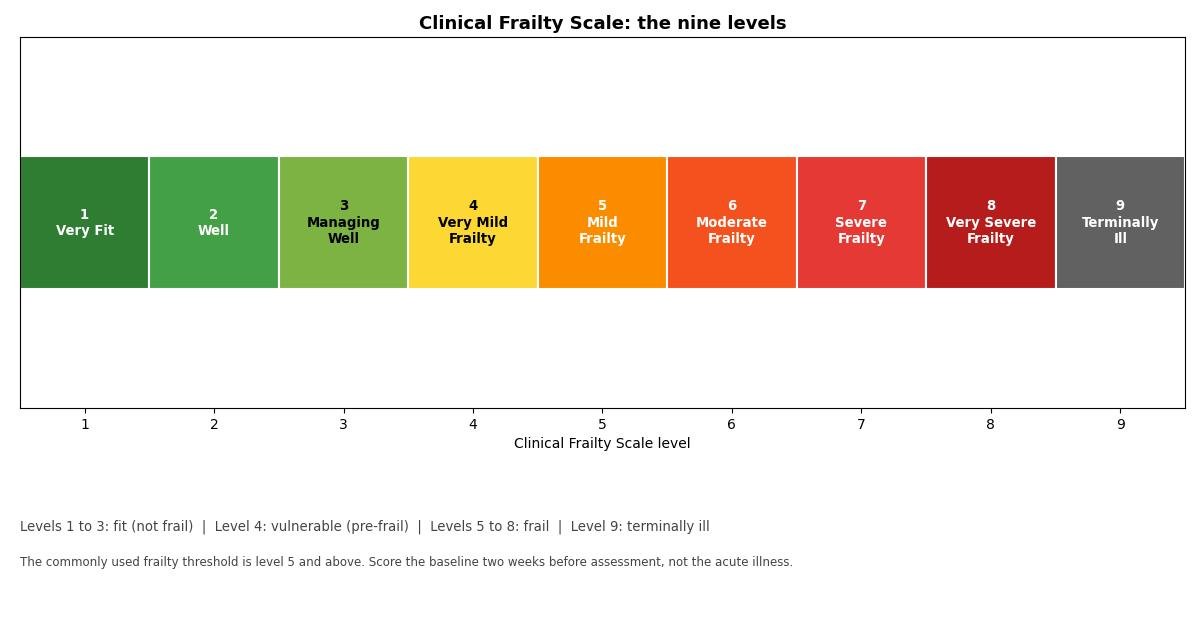
A score of 5 or more is the threshold commonly used to define frailty in research and in clinical communication. It is worth being honest that this is a convention, a useful one, rather than a biological boundary: nothing magical changes between level 4 and level 5 in the body. The threshold exists so that studies can compare groups and clinicians can speak a shared language. What gives the threshold its weight is that outcomes do separate around it: people scoring 5 and above have clearly higher rates of falls, hospital admission, loss of independence and death than those below it, even after accounting for age and diagnoses.
Level 4 deserves its own attention. It is easy to dismiss because it is "not frail", but it is the group where intervention has the most to gain. Strength training, nutrition, medication review and treatment of underlying contributors can still reverse the trajectory at level 4 in a way that is much harder at level 7. Some services now screen specifically for level 4 so they can act before the first serious fall or admission.
How to score honestly
The most important rule in the scale's manual is the baseline rule: score the person as they were two weeks before the current assessment, not as they appear today. Acute illness distorts everything. A previously fit 78-year-old with pneumonia, delirium and three days without food can look like level 7 in the emergency department; score that picture and you have labelled a reversible state as frailty. The manual is explicit that this is an error. If you do not know the person's usual state, ask someone who does: a family member, a carer, the home-care notes. Concrete questions work best. Could they walk outside alone two weeks ago? Did they manage their own medications and finances? Were they shopping and cooking? The answers place them on the ladder far more reliably than an impression formed at the bedside.
The second rule concerns dementia. The scale's guidance is that the degree of frailty corresponds to the degree of dementia: mild dementia maps to level 5, moderate dementia to level 6, and severe dementia, with complete dependence for personal care, to level 7. This reflects the scale's origins, where cognitive impairment was part of the frailty construct, and it keeps physical and cognitive decline on the same nine rungs instead of forcing a choice between two separate scales.
The third point is that judgement is the instrument. The scale does not ask you to time a walk or measure grip strength. It asks for an overall clinical impression informed by the descriptors. That is its speed and also its weakness: two clinicians can place the same person on adjacent levels, particularly around the middle of the scale. Studies of interrater reliability are generally reassuring but not perfect, which is why the descriptors should be read carefully rather than scored from memory.
Worked examples
A few examples show how the scoring works in practice.
Example one. Mrs A is 76, walks three miles most mornings, manages her own finances and medications, and her hypertension is well controlled. She exercises less than she did at 60 but is otherwise independent. That is level 2, Well: no active disease symptoms, but less fit than the fittest for her age. Band: fit, not frail.
Example two. Mr B is 84. Two weeks ago he was shopping with a list, cooking simple meals, and taking the bus to see his grandchildren. He says he has "slowed up" and feels tired by the afternoon, and his daughter has started helping with the heavier housework, but he needs no help with dressing, bathing or the stairs. That is level 5, Living with Mild Frailty: evident slowing with help needed for higher order instrumental activities. Band: frail, at the threshold.
Example three. Mrs C is 89 with moderate dementia. She needs help with all outside activities and with keeping house, has problems with stairs, needs help with bathing, and needs cuing to dress. That is level 6, Living with Moderate Frailty, and it is also consistent with the dementia guidance, where moderate dementia maps to level 6. Band: frail.
Example four. Mr D is 71 with metastatic cancer, a life expectancy estimated at four months, and until recently he was working part time and fully independent. He is not evidently frail, but he is approaching the end of life. That is level 9, Terminally Ill: the special category, not a frailty grade.
What the score predicts
The reason the scale spread so widely is that the number carries genuine prognostic information. A scoping review by Church, Rogers, Rockwood and Theou in BMC Geriatrics in 2020 pulled together the evidence base and found the scale predicts mortality, and in various settings also institutionalisation, falls, hospitalisation and functional decline, with higher scores consistently tracking worse outcomes. In surgical pre-assessment, higher CFS scores are associated with more postoperative complications and longer recovery. In emergency departments, the score helps identify older patients who need a geriatric assessment rather than a fast-track discharge. In intensive care, it is one of the factors clinicians weigh when judging whether the burdens of critical care are likely to be survivable and worthwhile for the individual.
It is worth stating plainly what prediction is not. A score of 6 does not say this person will die; it says that people at level 6, as a group, have higher rates of adverse outcomes. Individual trajectories vary enormously, and frailty is not fixed: rehabilitation, nutrition, deprescribing and treatment of contributors such as anaemia, heart failure or depression can move people down the scale. The score is a starting point for planning, not a verdict.
Where the scale is used, and the controversy
The scale is used across primary care, emergency medicine, surgery, oncology and critical care, often as a common language between teams. A CFS of 6 in a referral letter tells the receiving team immediately that this is a person who needs help with stairs and bathing, in a way that a list of diagnoses does not. Some health systems have built it into routine admission documentation for older patients.
There is also a controversy that an honest page should not skip. During the COVID-19 pandemic, some guidance proposed using the Clinical Frailty Scale to help prioritise intensive care admission when resources were scarce. This drew strong criticism from geriatricians, disability advocates and the scale's own authors: the scale was designed to inform holistic assessment, not to ration care, and using it as a triage cutoff risked discriminating against older and disabled people. Rockwood and Theou addressed this directly in the Canadian Geriatrics Journal in 2020, stressing that the scale supports clinical judgement and does not replace it. The lesson stands beyond the pandemic: the CFS informs decisions; it never makes them.
What the scale cannot do
The scale has real limits, and they should be stated. It does not diagnose frailty in the formal sense; it grades a clinical impression. It does not replace a comprehensive geriatric assessment, which examines medical, functional, cognitive, nutritional, social and medication domains in depth and produces a plan. It can be confounded by lifelong disability: a person who has used a wheelchair for decades because of an old spinal injury may score as dependent for reasons that have nothing to do with frailty, and the scale needs interpreting with that history in mind. It is less well studied in younger adults and in some cultural contexts, and self-rating tends to be optimistic compared with clinician rating. Finally, it is a snapshot: re-scoring after rehabilitation or after a change in support can and should give a different number.
Key takeaways
- The Clinical Frailty Scale is a 9-point clinical judgement scale developed by Rockwood and colleagues, first published in the Canadian Medical Association Journal in 2005.
- Many frailty instruments count deficits across dozens of items, such as the frailty index, or run through a fixed set of physical tests, such as the Fried phenotype with its grip strength and walking speed.
- A score of 5 or more on the Clinical Frailty Scale is the threshold commonly used to define frailty.
- You should score the baseline: how the person was two weeks before the current assessment, not how they look right now.
Frequently asked questions
What is the Clinical Frailty Scale?
The Clinical Frailty Scale is a 9-point clinical judgement scale developed by Rockwood and colleagues, first published in the Canadian Medical Association Journal in 2005. It asks a clinician to place a person on one level from 1 (Very Fit) to 9 (Terminally Ill), based on what they were like in the two weeks before the current assessment. It is meant to be scored from a short history and observation, not from a battery of tests, and it is now one of the most widely used frailty measures in hospitals, primary care and research.
How is the CFS different from other frailty measures?
Many frailty instruments count deficits across dozens of items, such as the frailty index, or run through a fixed set of physical tests, such as the Fried phenotype with its grip strength and walking speed. The Clinical Frailty Scale takes a different route: it synthesises the whole picture into a single level chosen by clinical judgement. That makes it fast, roughly a minute once you know the person, and usable without equipment. The trade off is that it depends on the judgement of the person scoring, and it cannot replace a full comprehensive geriatric assessment.
At what score is someone considered frail?
A score of 5 or more on the Clinical Frailty Scale is the threshold commonly used to define frailty. Levels 1 to 3 (Very Fit, Well, Managing Well) are not frail, level 4 (Living with Very Mild Frailty, previously called Vulnerable) is a pre-frail risk group, and levels 5 through 8 are graded as mild, moderate, severe and very severe frailty. Level 9, Terminally Ill, is a special category for people with a life expectancy under six months who are not otherwise evidently frail, rather than a frailty grade.
Should I score how the person is today, or how they were before?
You should score the baseline: how the person was two weeks before the current assessment, not how they look right now. This is one of the most important rules in the scale's manual. Acute illness, delirium, a fall or a hospital stay can make a fit person look temporarily frail, and scoring that acute picture would mislabel them. If you do not know the person's usual state, ask a family member or carer what they were doing two weeks ago: shopping alone, managing medications, walking outside, needing help with stairs.
How does the Clinical Frailty Scale handle dementia?
The scale's guidance is that the degree of frailty corresponds to the degree of dementia. Mild dementia maps to level 5, moderate dementia to level 6, and severe dementia to level 7: someone whose dementia leaves them completely dependent for personal care but otherwise stable scores 7, matching Living with Severe Frailty. This reflects the original study design, in which cognitive impairment was one of the domains behind the scale, and it keeps physical and cognitive decline on the same nine levels.
Can the Clinical Frailty Scale decide treatment?
No. The scale is a communication and risk-assessment aid, not a treatment algorithm. A CFS score never justifies withholding care on its own, and it was controversially debated when some settings proposed using it for ICU triage during the COVID-19 pandemic. Treatment decisions must weigh the score alongside the person's goals, preferences, the reversibility of the acute problem, and a fuller clinical assessment. This page is educational and does not advise on any individual person's care.
References and further reading
Medical disclaimer
This calculator is an educational aid only. It does not diagnose frailty, does not replace clinical judgement, and does not advise on treatment. The Clinical Frailty Scale is one instrument among many that clinicians use, and its result must be interpreted by a qualified clinician in the context of the person's full history, examination and circumstances. If you are concerned about frailty, falls or loss of independence in yourself or someone you care for, seek medical advice. Never start, stop or change any care plan on the basis of a score alone.