4AT Delirium Screening Test Calculator
Score the 4AT delirium screening items, alertness, AMT4, attention, and acute change, for a total of 0 to 12, and see the interpretation band: delirium unlikely, possible cognitive impairment, or possible delirium. For educational use only.
In short: Score the 4AT delirium screening items, alertness, AMT4, attention, and acute change, for a total of 0 to 12, and see the interpretation band: delirium unlikely, possible cognitive impairment, or possible delirium. For educational use only. Use the calculator above, then read the guide below to interpret your result and its limitations.
Delirium is a medical emergency. If someone has suddenly become confused, drowsy, or agitated, get urgent medical help now, do not wait for a test result. This calculator is educational and never replaces urgent clinical assessment.
The calculator
Answer all four 4AT items below as they apply to the person being assessed, then press the button. Item 1 is rated by observation during the interview; items 2 and 3 are brief questions; item 4 is answered from carer report or the medical record.
What the 4AT is and what it screens for
Delirium is an acute confusional state: a sudden disturbance of attention, awareness, and cognition that develops over hours to days and tends to fluctuate, worse at some times of day than others. It is different from dementia, which develops gradually over months or years. Delirium is not simply forgetfulness; a person with delirium may be drowsy and hard to rouse, or restless and agitated, may not recognise where they are or why, may see or hear things that are not there, and may swing between these states within a single day. It almost always signals an underlying medical problem that needs to be found and treated.
The 4AT, the 4 A's Test, is a rapid bedside screening tool built to detect delirium and flag possible cognitive impairment in routine clinical care. It was developed in 2011 by Professor Alasdair MacLullich with Dr Tracy Ryan and Dr Helen Cash of NHS Lothian in Edinburgh, Scotland, and published freely on the official website the4at.com (revised to version 1.2 in 2014). It is free to use, with no registration or permissions needed, which helped it spread internationally into emergency departments, acute medical wards, stroke units, geriatric wards, rehabilitation settings, and hospices.
The 4AT was designed to solve a specific practical problem. Earlier tools such as the Confusion Assessment Method take 5 to 10 minutes and require formal training, which makes them hard to use in a busy ward or emergency department. The 4AT takes under 2 minutes, needs no special training, and is scored by simple addition. It also solves the problem of the untestable patient: someone too drowsy or agitated to answer questions still receives a clinically informative score instead of an "unable to assess" label, because impaired alertness itself scores points.
Two things the 4AT is not. It is not a dementia test on its own: scores of 1 to 3 flag possible cognitive impairment of any cause, and sorting out dementia from other causes needs a fuller assessment. And it is not a diagnosis: a positive screen means delirium is possible and must be assessed clinically, usually against the DSM diagnostic criteria, not that delirium is confirmed.
Why a rapid delirium test matters
Delirium is dangerous precisely because it is easy to miss. In a busy emergency department or medical ward, a quiet, withdrawn older patient may be assumed to have dementia or to simply be tired, while a restless patient may be treated as difficult rather than ill. Every hour of unrecognised delirium is an hour when the underlying cause, often an infection, dehydration, a medication effect, constipation, urinary retention, an electrolyte disturbance, pain, or low oxygen, goes untreated. Delirium is a medical emergency because the brain is signalling that the body is in trouble.
The stakes are measurable. In a two-centre study of 82,770 emergency admissions of older adults, patients with a 4AT score of 4 or more had a 30-day mortality 5.5 times higher than those scoring 0 in one centre (adjusted odds ratio 5.53, 95% CI 4.99-6.13) and 3.4 times higher in the other (adjusted odds ratio 3.39, 95% CI 2.98-3.87), and their length of stay was more than double (Penfold et al., Age Ageing, 2022; PMID 35292792). These figures describe association, not proof that the score causes harm, but they show why clinicians take a high 4AT score seriously: it marks patients at real risk.
That is why guidelines and quality standards push for routine delirium screening of older inpatients, and why the screening tool has to be fast. A test that takes 10 minutes and a trained rater will not happen at 2 a.m. in the emergency department; a test that takes under 2 minutes and any member of staff can do, will. The 4AT was built for exactly that setting, and its accuracy has held up: a systematic review and meta-analysis of 17 studies with 3,702 observations found a pooled sensitivity of 0.88 and specificity of 0.88 for delirium detection (Tieges et al., Age Ageing, 2021; doi: 10.1093/ageing/afaa224). The original validation study, in 234 hospitalised older people, first established that the brief tool could do this job (Bellelli et al., Age Ageing, 2014; doi: 10.1093/ageing/afu021).
The four items, explained
Each of the four items begins with an "A": Alertness, AMT4, Attention, and Acute change. The scoring is deliberately uneven, because the items carry different clinical weight.
1. Alertness (0 or 4)
Alertness is rated by observation throughout the interview, not by asking a question. A person who is fully alert scores 0, and so does someone who is only mildly sleepy and returns to normal within seconds of waking. Clearly abnormal alertness scores 4: the person is drowsy and hard to rouse, agitated, or drifts in and out of awareness. This is the heaviest single item because abnormal alertness is one of the strongest clinical signs of delirium, and it lets the test produce a meaningful result even when the person cannot answer a single question. A patient who is too drowsy to be tested will score at least 4 from this item alone, which is exactly where the clinical concern should be.
2. AMT4: Abbreviated Mental Test 4 (0, 1, or 2)
The AMT4 asks four orientation questions: What is your age? What is your date of birth? What is the name of this place (the hospital or ward)? What is the current year? No mistakes scores 0, one mistake scores 1, two or more mistakes scores 2, and a person who cannot attempt the questions at all, because of severe drowsiness, inattention, or agitation, also scores 2. This item tests basic orientation and memory. Errors here can reflect delirium, background cognitive impairment, or both, which is why the item is graded rather than all-or-nothing: it contributes to the cognitive-impairment signal in the 1 to 3 band as well as to delirium detection.
3. Attention: months of the year backwards (0, 1, or 2)
Ask the person to say the months of the year backwards, starting with December. Seven or more correct months in a row, December, November, October, September, August, July, June, scores 0. Starting but getting fewer than 7 correct, or refusing to start, scores 1. Being unable to start at all because of severe drowsiness, inattention, or agitation scores 2. Inattention is the core feature of delirium: the person cannot focus, sustain, or shift attention, which is what this task exposes. A practical tip for testers: reassure the person that this task is difficult for many healthy people, and stop if it causes real distress. Note that hearing problems, language barriers, and low education can affect performance, so a poor result on this item alone should never be over-interpreted.
4. Acute change or fluctuating course (0 or 4)
This is the item that separates delirium from dementia. Ask a carer, family member, or nurse, or check the medical record: has there been a sudden change, or fluctuation, in alertness, cognition, or other mental function, for example new paranoia or hallucinations? No scores 0; yes scores 4. Dementia develops gradually, so a person with long-standing stable impairment and no recent change scores 0 here even if they fail the cognitive items. Delirium is defined by newness and fluctuation, so a positive answer here is powerful evidence. Families are often the best source for this item, because they know what the person was like last week. When a carer says "this is not how she was yesterday," believe the collateral history and act on it.
How scoring works and what the total means
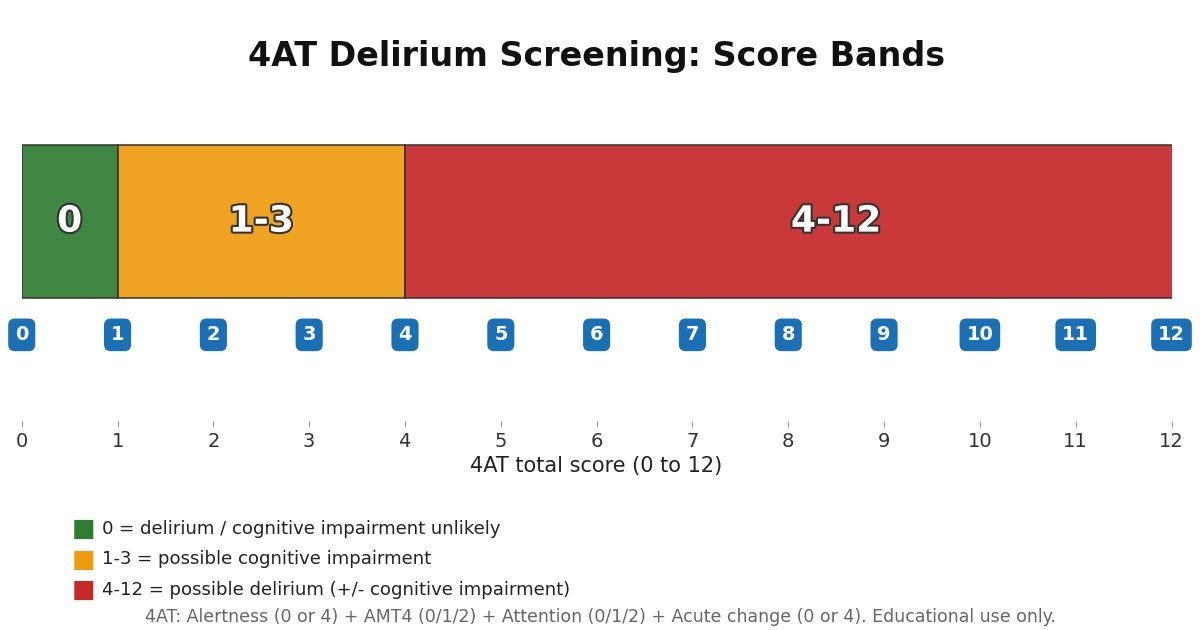
The four item scores are added together for a total from 0 to 12. The uneven weights mean the total is not just a count of wrong answers. Alertness and acute change are scored 0 or 4 because each is a strong standalone signal: either one being positive pushes the total to 4, the delirium threshold, on its own. The cognitive items, AMT4 and attention, are graded 0, 1, or 2, so that milder impairment contributes to the 1 to 3 band without automatically triggering a delirium alert. The interpretation bands, from the original tool publication, are:
| Score | Band | What it means |
|---|---|---|
| 0 | Delirium and cognitive impairment unlikely | No abnormal findings on this screen at this moment. |
| 1 to 3 | Possible cognitive impairment | Cognitive testing showed errors but no delirium signal; arrange routine medical follow-up and fuller assessment. |
| 4 to 12 | Possible delirium, with or without cognitive impairment | Treat as a possible medical emergency; seek urgent medical assessment to find and treat the cause. |
Three worked examples show how the bands behave in practice. First, an older patient in clinic: alertness normal (0), AMT4 with one mistake (1), months backwards with five correct (1), no acute change (0). Total 2, possible cognitive impairment. Nothing here suggests an acute emergency, but the errors deserve attention: this person should be referred for routine medical review and a fuller cognitive assessment, and carers should be asked whether the difficulties are new.
Second, a patient brought to the emergency department overnight: alertness normal between drowsy spells is still rated on the worst observed, so say clearly abnormal is not present (0); AMT4 with two mistakes (2); months backwards with four correct (1); family report that she was fine yesterday and is now confused and seeing things (4). Total 7, possible delirium. This is the urgent scenario: the acute change item dominates, and the correct response is immediate medical assessment, starting with a search for infection, dehydration, medication effects, and other common triggers.
Third, the untestable patient: a man found barely rousable, alertness clearly abnormal (4), AMT4 untestable (2), attention untestable (2), and no carer available so acute change unknown, scored as no evidence (0). Total 8, possible delirium. The design works as intended here: even with no answers at all, the test flags the danger. Note the conservative choice in this example, scoring acute change as 0 without evidence; in real practice, "unknown" should prompt urgent efforts to get collateral history, not a reassuring assumption.
What to do with the result
A score of 4 or more is the action threshold. Get urgent medical help: contact the GP urgently, attend the emergency department, or call the local emergency number if the person is rapidly worsening, very drowsy, or agitated and unsafe. Tell the clinicians exactly what changed and when, because the timeline is the most useful diagnostic information you can give. In hospital, a score in this range should trigger the delirium pathway: a search for the underlying cause, which most often includes urinary or chest infection, dehydration, new or stopped medications, constipation, urinary retention, electrolyte disturbance, pain, low oxygen levels, or the after-effects of surgery or anaesthesia. Delirium itself is treated by treating its cause, plus supportive care: reorientation, glasses and hearing aids in place, good hydration and nutrition, normal sleep patterns, and avoiding sedating drugs where possible.
A score of 1 to 3 calls for routine, not emergency, follow-up, with one important exception: if there are acute features that the test somehow missed, or the person's state is changing while you watch, treat it as urgent anyway. Otherwise, book a medical review: the errors suggest possible cognitive impairment that needs a fuller assessment, which may lead to a diagnosis of mild cognitive impairment or dementia, or may turn out to be reversible, for example depression, thyroid problems, vitamin B12 deficiency, or medication effects. Bring a carer who knows the person well, and bring a list of all medications.
A score of 0 is reassuring but not a clean bill of health for all time. Delirium fluctuates, so a person can screen normally at 10 a.m. and be delirious by evening. If the clinical concern persists, repeat the test later, especially in the evening or night when delirium often worsens, a pattern sometimes called sundowning. And a normal 4AT never rules out other medical problems: it screens for delirium and cognitive impairment only.
Limitations: when not to rely on it
The 4AT is a screening tool, not a diagnosis, and that distinction matters most at the top of the range. A score of 4 or more means delirium is possible and must be assessed, not that delirium is confirmed. Formal diagnosis needs a clinical interview against the DSM criteria by a qualified clinician, and there will be false positives: for example, a person with advanced dementia and a coincidental poor attention score can cross the threshold without being delirious. The screen errs on the side of flagging, which is the right bias for an emergency, but the flag is the start of assessment, not the end.
Scores of 1 to 3 are the least specific part of the test. They indicate that something is off cognitively but say nothing about the cause: it could be early dementia, long-standing low cognitive reserve, depression, poor hearing, limited education, or testing in an unfamiliar language. A single low score in this band should never be presented to a patient or family as a diagnosis of anything. It is a prompt for proper assessment, nothing more.
The "untestable" scores deserve care too. Scoring 2 for an untestable AMT4 or attention item reflects inability to complete the task, which may be caused by delirium, but also by severe illness, exhaustion, pain, or distress. The total still points in the right direction clinically, because a person that ill needs urgent assessment regardless, but the number should not be quoted as a precise measure of cognition.
Practical factors can distort individual items. Hearing impairment, limited English, low literacy, and unfamiliarity with the months-backwards task can all produce errors that have nothing to do with the brain. Testers should make sure glasses and hearing aids are in place, speak clearly, and interpret borderline results in context. Delirium can also coexist with dementia, which is common and especially dangerous: a high 4AT score in a person known to have dementia still needs a full delirium workup, because the acute change may be riding on top of the chronic condition. Finally, the 4AT screens the brain, not the body: finding the cause of delirium still requires history, examination, and investigations directed by a clinician.
Related geriatrics assessments
Delirium screening is one part of assessing an older person. The Barthel Index measures independence in basic activities of daily living, which often falls during a delirium episode and recovers, partially or fully, as the delirium resolves, so tracking it alongside the 4AT shows the functional impact. The FRAIL scale screens for frailty, and frail patients are more vulnerable to delirium and recover from it more slowly. Used together, the three tools give a rounded picture: acute brain dysfunction, daily functioning, and underlying vulnerability. The official 4AT form and guidance are freely available at the4at.com, the website of the tool's developers.
Key takeaways
- The 4AT (4 'A's Test) is a rapid bedside screening tool for delirium and cognitive impairment, published in 2011 by MacLullich, Ryan and Cash and made freely available at the4at.com.
- A 4AT score of 4 or more means possible delirium, with or without cognitive impairment.
- Scores of 1 to 3 indicate possible cognitive impairment without strong evidence of delirium, and usually call for routine medical follow-up and fuller cognitive assessment.
- In clinical practice the 4AT typically takes under 2 minutes.
Frequently asked questions
What is the 4AT test for delirium?
The 4AT (4 A's Test) is a rapid bedside screening tool for delirium and cognitive impairment, published in 2011 by MacLullich, Ryan and Cash and made freely available at the4at.com. It has four items: Alertness, AMT4 (age, date of birth, place, current year), Attention (months of the year backwards), and Acute change or fluctuating course. It takes under 2 minutes, needs no special training, and produces a score from 0 to 12.
What does a 4AT score of 4 mean?
A 4AT score of 4 or more means possible delirium, with or without cognitive impairment. Delirium is a medical emergency, and a score in this range should prompt urgent medical assessment to look for the underlying cause, such as infection, dehydration, or medication effects. A single item, clearly abnormal alertness or an acute change, is enough on its own to reach 4.
What is the difference between a 4AT score of 1 to 3 and 4 or more?
Scores of 1 to 3 indicate possible cognitive impairment without strong evidence of delirium, and usually call for routine medical follow-up and fuller cognitive assessment. Scores of 4 or more indicate possible delirium, an acute and urgent condition, and call for prompt medical assessment. The acute change item (4 points) is the main divider: it captures the sudden onset or fluctuation that characterises delirium rather than chronic impairment such as dementia.
How long does the 4AT take to complete?
In clinical practice the 4AT typically takes under 2 minutes. The alertness item is rated by observation during the interview, the AMT4 and months-backwards items are brief questions, and the acute change item is answered from carer report or the medical record. It was designed specifically so that non-specialist staff can use it in routine care.
Can the 4AT diagnose delirium on its own?
No. The 4AT is a screening tool, not a diagnostic test. A formal diagnosis of delirium requires clinical assessment, usually against the DSM diagnostic criteria, by a qualified clinician. A systematic review and meta-analysis of 17 studies found pooled sensitivity of 0.88 and specificity of 0.88 for delirium detection (Tieges et al., Age Ageing, 2021), which is strong for a screening test but still leaves room for false positives and false negatives.
Can family members use the 4AT at home?
The 4AT was designed for clinical use, and families can use this calculator to structure their observations, especially the acute change question, which is often clearest to someone who knows the person well. However, a home score is not a diagnosis: if you notice a sudden change in alertness, attention, or behaviour in an older person, seek medical advice promptly rather than relying on a home test result.
References
- MacLullich A, Ryan T, Cash H. The 4 'A's Test (4AT). 2011; revised 2014 (version 1.2). Official website and free tool: https://www.the4at.com/. The original publication of the instrument, its items, and its scoring bands (0 unlikely; 1-3 possible cognitive impairment; 4 or more possible delirium).
- Bellelli G, Morandi A, Davis DHJ, et al. Validation of the 4AT, a new instrument for rapid delirium screening: a study in 234 hospitalised older people. Age and Ageing. 2014;43(4):496-502. doi: 10.1093/ageing/afu021. PMID: 24590568. The first published validation study.
- Tieges Z, MacLullich AMJ, Anand A, et al. Diagnostic accuracy of the 4AT for delirium detection in older adults: systematic review and meta-analysis. Age and Ageing. 2021;50(3):733-743. doi: 10.1093/ageing/afaa224. Seventeen studies, 3,702 observations; pooled sensitivity 0.88 and specificity 0.88.
- Penfold RS, Bowman E, Vardy ERLC, et al. Positive scores on the 4AT delirium assessment tool at hospital admission are linked to mortality, length of stay and home time: two-centre study of 82,770 emergency admissions. Age and Ageing. 2022;afac051. doi: 10.1093/ageing/afac051. PMID: 35292792. 4AT of 4 or more linked to markedly higher 30-day mortality and longer stays.
- MacLullich AMJ, Shenkin SD, Goodacre S, et al. The 4 'A's test for detecting delirium in acute medical patients: a diagnostic accuracy study. Health Technology Assessment. 2019;23(40):1-194. doi: 10.3310/hta23400. Large multicentre diagnostic accuracy study in acute medical patients.
- American Geriatrics Society
- NICE Guidance
Medical disclaimer
This 4AT delirium screening calculator is for informational and educational purposes only. It is not a medical diagnosis, not a substitute for professional clinical assessment, and must never delay urgent care. Delirium is a medical emergency: if someone has suddenly become confused, drowsy, or agitated, seek urgent medical help immediately. Assessment and treatment decisions should be made by a qualified health professional who can examine the person and consider the full clinical picture.