Body metrics in intensive care: what the numbers mean
Why body weight is not one number in intensive care
On a general ward, one body weight is usually enough: the number on the scale. In intensive care that single number is rarely enough, because the same patient can legitimately have several different clinically useful weights. The actual body weight is what the scale says today. The ideal body weight is a height and sex based reference value that estimates what the patient would weigh with a normal body composition. The adjusted body weight sits between the two and is used when actual weight would lead to excessive drug doses in obesity. Each of these feeds different decisions: fluid and nutrition planning tend to use actual weight, ventilator tidal volumes use predicted or ideal body weight, and several drug dosing decisions use ideal or adjusted weight depending on the drug.
The reason dosing weight matters is pharmacology, not arithmetic. Drugs that dissolve well in fat (lipophilic drugs) distribute into adipose tissue, so a larger fat mass genuinely needs a larger dose. Drugs that dissolve mainly in water (hydrophilic drugs) distribute mostly into lean tissue and body water, so dosing them on total body weight in severe obesity can produce an overdose. That is why intensive care drug dosing protocols distinguish between actual, ideal and adjusted body weight, and why the choice of dosing weight is written into prescribing guidance rather than left to bedside guesswork. This calculator computes all four metrics, BMI, body surface area, ideal body weight and adjusted body weight, from the same inputs, so the relationships between them are visible in one place.
Body mass index (BMI)
Body mass index is the simplest body metric: weight divided by the square of height. The formula, with weight in kilograms and height in metres, is:
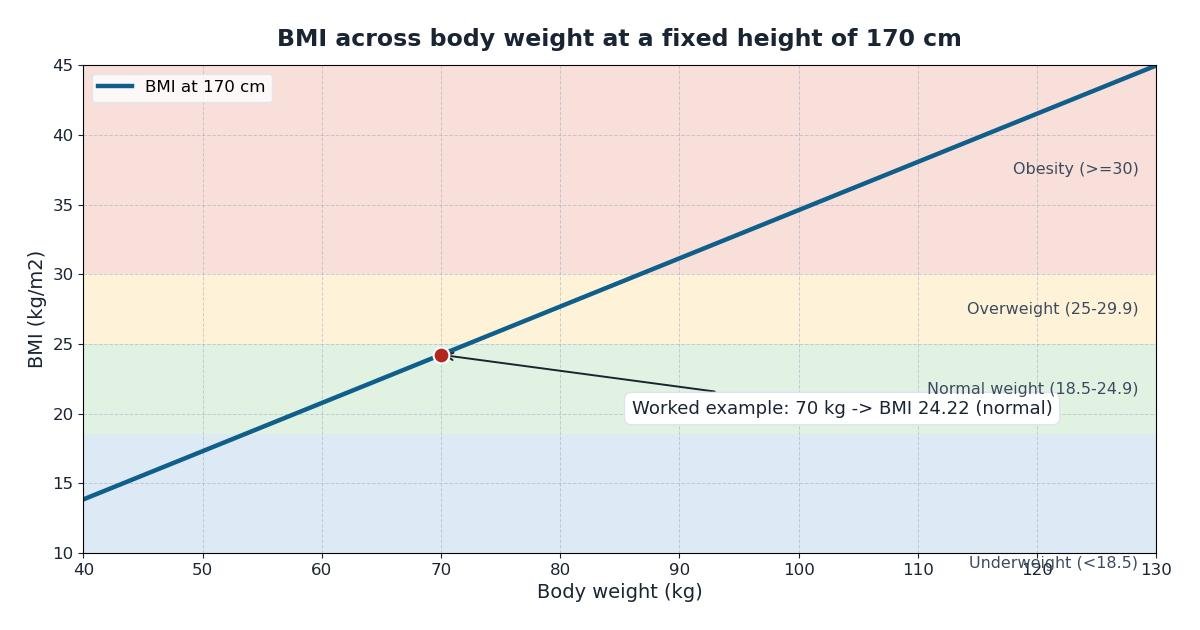
The World Health Organization classifies adult BMI into the following categories, which this calculator applies:
| BMI (kg/m2) | WHO category |
|---|---|
| Below 18.5 | Underweight |
| 18.5 to 24.9 | Normal weight |
| 25.0 to 29.9 | Overweight |
| 30.0 to 34.9 | Obesity class I |
| 35.0 to 39.9 | Obesity class II |
| 40.0 and above | Obesity class III |
A worked example ties the arithmetic together. A patient weighing 70 kg at a height of 170 cm has a BMI of 70 divided by 1.70 squared, which is 70 divided by 2.89, giving 24.22. That falls in the WHO normal range of 18.5 to 24.9. The boundaries matter in practice: a BMI of 25.0 is classified as overweight, not normal, and a BMI of 30.0 is obesity class I, not overweight. This calculator applies the cut points exactly, so borderline values land in the correct category.
BMI has well known limitations, and they are sharper in critical illness than anywhere else. BMI uses total body weight, but in the ICU total body weight is routinely distorted by fluid shifts. Several litres of resuscitation fluid, peripheral oedema, ascites and fluid sequestered in tissues (third spacing) all add kilograms that are water, not body tissue. A patient can therefore move from a normal BMI into the overweight range during a resuscitation phase without gaining any fat. In the other direction, prolonged critical illness causes rapid loss of muscle mass, so weight falls while the BMI number gives no hint that the loss is lean tissue rather than fat. BMI also cannot distinguish fat mass from lean mass in any setting: a muscular patient and a patient with the same weight carried as fat receive the same BMI. For these reasons, BMI in the ICU is best treated as a rough screening number, interpreted alongside bedside assessment, trends over the admission, and, where it matters for therapy, the more specific metrics below.
Body surface area (BSA)
Body surface area estimates the external surface of the body in square metres. It is used for normalising physiological measurements, most notably the cardiac index, which is cardiac output divided by body surface area, and for dosing a number of drugs in oncology and critical care where the dose scales with surface area rather than weight alone. The standard formula is the Du Bois formula, published by Du Bois and Du Bois in the Archives of Internal Medicine in 1916:
For the worked example of 70 kg and 170 cm, the Du Bois equation gives 0.007184 times 70 to the power 0.425 times 170 to the power 0.725, which is approximately 1.81 m2. A simpler alternative that is common in intensive care is the Mosteller formula, published by Mosteller in the New England Journal of Medicine in 1987:
For the same 70 kg and 170 cm, Mosteller gives the square root of (170 times 70 divided by 3600), which is approximately 1.82 m2. The two formulas agree closely across the usual adult range, and this calculator shows both so the small difference is transparent. The Mosteller version is popular at the bedside precisely because it can be estimated with a pocket calculator, while Du Bois remains the historical reference standard. Like BMI, body surface area is an estimate derived from height and weight, not a measurement of the skin, and it inherits the same fluid shift caveats in critically ill patients: a few litres of oedema raise the weight input and therefore the BSA output, even though the true surface area has barely changed.
Ideal body weight (IBW)
Ideal body weight is a reference weight derived from height and sex. The formula in clinical use is the Devine formula, published by Devine in 1974 in the context of gentamicin dosing:
Female IBW (kg) = 45.5 + 0.91 x (height (cm) - 152.4)
The formula applies to heights above 152.4 cm, which is 5 feet; below that height the equation is not defined, and this calculator says so rather than returning a misleading number. For a height of 170 cm, the male IBW is 50 plus 0.91 times 17.6, which is 66.02 kg, and the female IBW is 45.5 plus 0.91 times 17.6, which is 61.52 kg. Devine developed the equation to guide dosing of gentamicin, an aminoglycoside antibiotic, in obese patients, because these hydrophilic drugs distribute mainly into lean tissue and dosing on actual body weight in obesity risks toxicity. That original purpose still describes the main ICU role of IBW: it is the dosing weight of choice for drugs whose distribution is limited to lean body mass.
IBW has a second, equally important critical care role that uses the very same arithmetic. Lung protective mechanical ventilation targets a tidal volume of about 6 mL per kilogram of predicted body weight, and the ARDSNet predicted body weight equations are male: 50 + 0.91 x (cm - 152.4), female: 45.5 + 0.91 x (cm - 152.4), numerically identical to the Devine IBW equations this calculator uses. Using actual body weight for tidal volumes in obesity would deliver excessive volumes to the lungs, so predicted or ideal body weight is the standard. A 170 cm male therefore has a predicted body weight of 66.02 kg for ventilator purposes, giving a lung protective tidal volume target of about 396 mL, which is 6 times 66.02.
Adjusted body weight (ABW)
Adjusted body weight, also called dosing weight, is used for drug dosing in obesity when actual body weight would give too large a dose but ideal body weight would give too small one. Some drug distributes partly into adipose tissue, and the adjusted weight adds a fraction of the excess weight back to the ideal weight. The standard equation uses a correction factor of 0.4:
The correction factor of 0.4 reflects the observation that roughly 40 percent of the excess weight behaves like lean tissue for the distribution of hydrophilic drugs; it is a convention used in dosing guidance rather than a measured property of any single patient. For a worked example, take a male patient 170 cm tall with an actual weight of 100 kg. His IBW is 66.02 kg, so the excess is 33.98 kg, and 40 percent of that is 13.59 kg, giving an adjusted body weight of 79.61 kg. This calculator shows adjusted body weight only when the actual weight exceeds the ideal weight; when the patient weighs less than ideal, the adjusted weight has no role and the field is left blank.
Metric and imperial units
Intensive care teams work in both systems, so this calculator accepts either. The exact conversion factors applied are 1 pound = 0.45359237 kilograms and 1 inch = 2.54 centimetres. In imperial mode, enter the weight in pounds and the height in total inches, so 5 feet 7 inches is entered as 67. Converting 154 lb and 67 in gives 69.85 kg and 170.18 cm, and the resulting BMI is 24.12, very close to the metric worked example of 24.22, with the small difference coming from rounding in the original imperial numbers. One practical caution: BMI depends on the square of height, so small errors in height measurement move the result more than small errors in weight. In the ICU, where height is often estimated rather than measured, a 2 cm error in height changes the BMI of a 70 kg patient by about 0.6 units, enough to cross a category boundary near a cut point.
Limitations and safe use
Every number on this page is computed from two inputs, height and weight, and no formula can recover information those inputs do not contain. The calculator cannot see oedema, ascites, amputations, pregnancy, muscular build or the fluid balance chart, and in critical illness these factors frequently dominate the raw numbers. Dosing weight is a prescribing decision: whether a particular drug in a particular patient should be dosed on actual, ideal or adjusted body weight is determined by the drug's prescribing information, the local protocol and the clinical pharmacist, not by a web calculator. Treat these results as a starting point for that conversation, recheck the inputs, and confirm the dosing weight with the team before prescribing or setting a ventilator.
References
- World Health Organization. Obesity: preventing and managing the global epidemic. WHO Technical Report Series 894. Geneva: WHO; 2000. (BMI classification cut points: 18.5, 25.0, 30.0, 35.0, 40.0 kg/m2.)
- Du Bois D, Du Bois EF. A formula to estimate the approximate surface area if height and weight be known. Arch Intern Med. 1916;17(6):863-871. (BSA = 0.007184 x W^0.425 x H^0.725.)
- Mosteller RD. Simplified calculation of body-surface area. N Engl J Med. 1987;317(17):1098. (BSA = square root of (H x W / 3600).)
- Devine BJ. Gentamicin therapy. Drug Intell Clin Pharm. 1974;8:650-655. (IBW: male 50 + 0.91 x (cm - 152.4); female 45.5 + 0.91 x (cm - 152.4).)
- The Acute Respiratory Distress Syndrome Network. Ventilation with lower tidal volumes as compared with traditional tidal volumes for acute lung injury and the acute respiratory distress syndrome. N Engl J Med. 2000;342(18):1301-1308. (Predicted body weight equations; 6 mL/kg tidal volume target.)
- Society of Critical Care Medicine
- Intensive Care Society