What mean arterial pressure is
Mean arterial pressure, usually shortened to MAP, is the average pressure in the arteries over one full cardiac cycle. Blood pressure is not constant through the cycle: it rises to a peak with each heartbeat (the systolic pressure, SBP) and falls to a trough between beats (the diastolic pressure, DBP). MAP blends both into a single number that represents the driving pressure available to push blood through the organs. Clinicians value it because organs care less about the peak of the wave and more about the sustained pressure behind it.
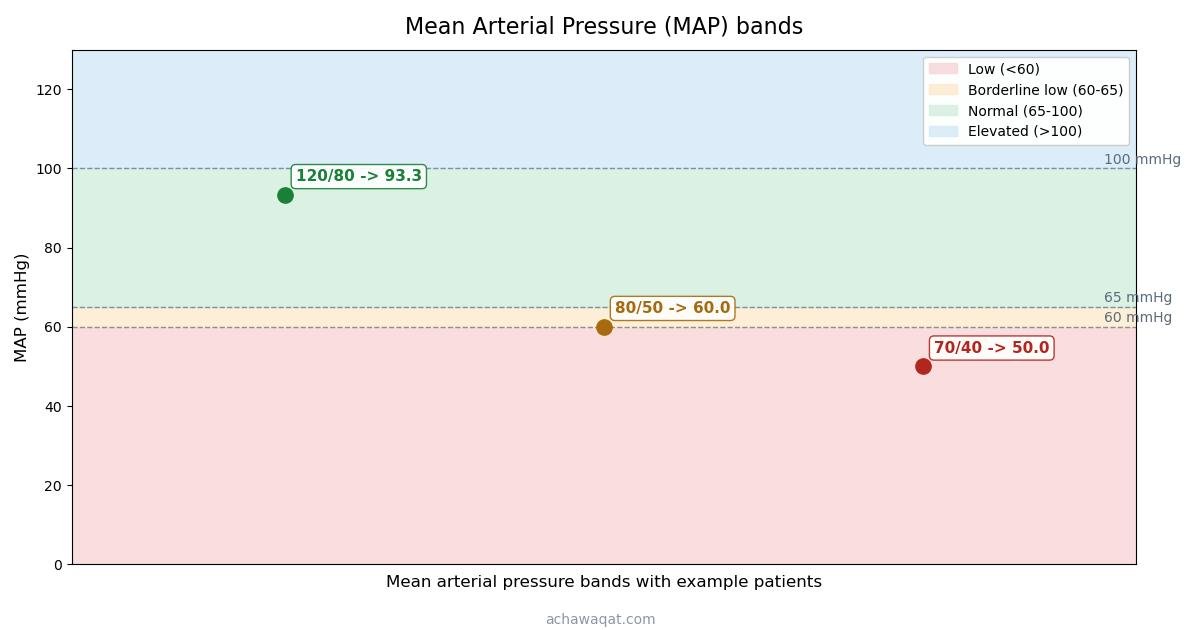
The standard bedside formula weights the diastolic pressure more heavily, because the heart spends roughly two thirds of each cycle in diastole. The formula is: MAP = DBP + (SBP - DBP) / 3, which is algebraically identical to MAP = (SBP + 2 x DBP) / 3. For a blood pressure of 120/80 mmHg, the pulse pressure (SBP minus DBP) is 40 mmHg, one third of that is about 13.3, and the MAP is 80 + 13.3 = 93.3 mmHg. Using the equivalent form: (120 + 160) / 3 = 93.3 mmHg. Note that MAP is not simply the midpoint between systolic and diastolic pressure; the midpoint of 120 and 80 would be 100, which overestimates the true average because diastole lasts longer than systole.
Why MAP matters: organ perfusion
Every organ depends on a steady flow of oxygenated blood, and that flow depends on a pressure gradient. MAP is the upstream side of that gradient. When MAP falls too low, blood no longer reaches tissues with enough force to keep cells alive, and organ injury follows: kidneys stop making urine, the brain becomes confused, and the heart itself can suffer because coronary arteries fill mainly during diastole. This is why MAP is monitored continuously in intensive care units, operating theatres, and emergency departments, and why resuscitation guidelines for shock anchor their targets to it.
The most widely cited MAP target comes from the Surviving Sepsis Campaign, an international guideline for managing sepsis and septic shock. It recommends an initial MAP target of at least 65 mmHg in adults with septic shock, using vasopressors when fluid resuscitation alone does not reach it (Evans L et al., Critical Care Medicine 2021). This threshold is not arbitrary: it sits near the lower limit of the range over which vital organs can still regulate their own blood flow, which is why many clinicians treat 65 mmHg as the floor below which perfusion becomes unreliable.
Normal and abnormal MAP ranges
In a healthy resting adult, MAP is usually quoted as about 70 to 100 mmHg. The bands used by this calculator are set honestly from that convention and from the sepsis guideline:
| MAP (mmHg) | Band | Usual interpretation |
|---|---|---|
| Below 60 | Low | Inadequate organ perfusion is likely; this needs urgent assessment. |
| 60 to below 65 | Borderline low | Perfusion is at risk; monitor closely and recheck. |
| 65 to 100 | Normal | Adequate for organ perfusion in most adults at rest. |
| Above 100 | Elevated | Consider context: chronic hypertension, acute symptoms, pain, or stress. |
Ranges are guides, not diagnoses. A single MAP of 62 mmHg in a young, warm, alert person with normal kidney output is interpreted very differently from the same number in someone with cold hands, new confusion, and falling urine output. Clinicians always combine the number with the patient in front of them.
Autoregulation: how organs protect themselves
Several organs can keep their blood flow almost constant even as MAP drifts up or down, a property called autoregulation. Cerebral autoregulation is the classic example: in healthy adults, brain blood flow is usually held steady across a MAP range of roughly 60 to 150 mmHg, with small arteries dilating as pressure falls and constricting as it rises. That is the physiological reason 60 mmHg appears so often as a danger threshold: below it, the brain can no longer compensate, and flow starts to fall with pressure. Chronic hypertension shifts the autoregulation curve to the right, so someone who has lived for years with high blood pressure may start to lose adequate organ flow at a MAP that a normotensive person tolerates, another reason numbers are never read in isolation.
The kidneys and the heart have their own versions of the same trick, which is why falling urine output is one of the earliest bedside clues that MAP has become inadequate. When autoregulation is overwhelmed, for example in severe sepsis, after a stroke, or under deep anaesthesia, the organs lose their safety margin and become directly dependent on whatever MAP the circulation provides. That fragility is exactly what intensive care monitoring is trying to detect early.
MAP versus systolic and diastolic targets
Hypertension management in the clinic is usually built around systolic and diastolic numbers, for example the common target of below 130/80 mmHg in many guidelines. MAP enters the picture mainly in acute and critical care, where a single continuous number is more practical to steer by. In septic shock, titrating vasopressors to a MAP of at least 65 mmHg has become standard practice after the Surviving Sepsis Campaign recommendation. Some trials have tested higher targets, such as 80 to 85 mmHg, in patients with chronic hypertension, with mixed results: one well-known trial (the SEPSISPAM trial) found no overall mortality difference between higher and lower MAP targets, but did see less need for renal replacement therapy among patients with chronic hypertension randomised to the higher target. The practical lesson is that the 65 mmHg target is a starting point, adjusted upward for people whose usual pressures run high.
In the operating theatre, anaesthetists similarly keep MAP within a band that is safe for the individual, often expressed relative to the patient's baseline rather than a universal number. After surgery, a MAP that is 20 percent or more below a patient's usual baseline is commonly regarded as hypotension worth treating, because organ injury tracks with the depth and duration of the dip relative to what that person's organs are used to.
What causes low MAP
MAP is the product of cardiac output and systemic vascular resistance, with central venous pressure subtracted, so a low MAP always traces back to one or more of those parts. Low cardiac output can come from a weak pump (heart failure, heart attack), an empty tank (bleeding, dehydration, severe burns), or an obstruction (a blood clot in the lungs, or fluid compressing the heart). Low vascular resistance can come from blood vessels relaxing inappropriately, which is what happens in sepsis, anaphylaxis, and after certain anaesthetic drugs. Some blood pressure medicines, especially when combined, can push MAP down as an intended or side effect.
Treatment follows the cause: fluids for an empty circulation, blood for bleeding, vasopressors to tighten vessels that have lost their tone, and medicines or procedures that strengthen the pump. Because this calculator cannot see the cause, it cannot suggest treatment; it can only tell you which band the number sits in. A persistent MAP below 60 mmHg, or symptoms such as fainting, chest pain, confusion, or new shortness of breath, should be assessed urgently by a clinician.
What causes high MAP
An elevated MAP above about 100 mmHg usually reflects one of two things: chronic hypertension, where the whole blood pressure profile runs high over years, or an acute cause such as pain, anxiety, cold, exercise, or stimulant medicines and recreational substances. In a crisis, a very high MAP combined with symptoms such as severe headache, chest pain, visual changes, or breathlessness is treated as an emergency, regardless of the exact number. Long term, sustained high MAP is one of the drivers of heart disease, stroke, and kidney damage, which is why hypertension treatment ultimately aims to bring the whole pressure profile, MAP included, into a safer range.
How MAP is measured
There are two everyday ways MAP reaches a screen. Automated cuffs, the kind used in clinics and on wards, actually detect MAP first: the oscillometric method senses the point of maximum pressure oscillation during cuff deflation, and that point corresponds to MAP. The cuff's systolic and diastolic readings are then estimated from the shape of the oscillation curve using proprietary algorithms. Manual cuffs with a stethoscope work the other way round: the clinician hears systolic and diastolic sounds directly and calculates MAP from the formula.
In intensive care, an arterial line gives the gold standard: a thin catheter sits in an artery and transduces pressure beat by beat, displaying the true MAP continuously. Because cuffs estimate rather than measure, a single surprising reading should always be repeated, with the correct cuff size on a supported arm at heart level, after a few minutes of rest. Caffeine, recent exercise, a full bladder, and talking during the measurement can all raise the reading, which is why home readings taken casually are often higher than careful repeat measurements.
MAP alone does not diagnose anything
A MAP value is one variable in a living system, not a diagnosis. Two people can share the same MAP while one is perfectly well and the other is in shock, because what matters is whether each person's organs are receiving enough flow at that pressure. Trends matter more than snapshots: a MAP drifting downward over an hour tells a story that a single value cannot. Clinicians interpret MAP alongside heart rate, rhythm, oxygen levels, urine output, mental state, skin temperature, and laboratory markers such as lactate, which signals that tissues are resorting to anaerobic metabolism.
Used correctly, MAP is a tripwire and a steering wheel: it alerts you when perfusion may be failing, and it gives clinicians a concrete number to steer resuscitation by. Used alone, it is just arithmetic. If you are monitoring blood pressure at home, keep a log of readings with dates, times, and symptoms, and review it with your clinician rather than acting on any single calculation from this page.
Key takeaways
- Mean arterial pressure is the average pressure in the arteries during one cardiac cycle.
- A normal resting MAP is usually quoted as about 70 to 100 mmHg.
- The Surviving Sepsis Campaign recommends an initial MAP target of at least 65 mmHg in adults with septic shock, using vasopressors when fluids alone do not achieve it (Evans L et al., Critical Care Medicine 2021).
- Low MAP can result from low cardiac output (for example heart failure or blood loss), low systemic vascular resistance (for example sepsis or anaphylaxis), low blood volume, or certain medicines.
Frequently asked questions
What is mean arterial pressure (MAP)?
MAP is the average arterial pressure over one cardiac cycle, calculated as DBP + (SBP - DBP)/3, or equivalently (SBP + 2 x DBP)/3. It represents the driving pressure that delivers blood to the organs.
What is a normal MAP?
Resting MAP is usually about 70 to 100 mmHg, and at least 65 mmHg is considered adequate for organ perfusion in adults, per the Surviving Sepsis Campaign guidance for septic shock.
Why is MAP 65 mmHg important in sepsis?
The Surviving Sepsis Campaign recommends an initial MAP target of at least 65 mmHg in septic shock (Evans L et al., Critical Care Medicine 2021), because below this range organ perfusion becomes unreliable.
What causes low MAP?
Common causes include blood loss, dehydration, heart failure, sepsis, anaphylaxis, and some blood pressure medicines. Clinicians treat the cause, not the number alone.
How is MAP measured in practice?
Automated cuffs estimate MAP from pressure oscillations and derive systolic and diastolic values, while arterial lines measure it continuously and directly. Single cuff readings should be confirmed before acting.
Can MAP be too high?
Yes. A MAP above about 100 mmHg is elevated and may reflect chronic hypertension or acute stress; very high MAP with symptoms such as chest pain or visual changes needs urgent care.
References and further reading
Sources
- Evans L, Rhodes A, Alhazzani W, et al. Surviving Sepsis Campaign: International Guidelines for Management of Sepsis and Septic Shock 2021. Critical Care Medicine. 2021;49(11):e1063-e1143. Recommends an initial MAP target of at least 65 mmHg in adults with septic shock.
- Asfar P, Meziani F, Hamel JF, et al. High versus low blood-pressure target in patients with septic shock. New England Journal of Medicine. 2014;370:1583-1593. The SEPSISPAM trial comparing MAP targets of 80-85 mmHg versus 65-70 mmHg.
- Standard physiology references describe cerebral autoregulation maintaining brain blood flow across a MAP range of roughly 60 to 150 mmHg in healthy adults.