ICU Nutrition Estimator: Calorie, Protein and Fluid Targets
In short: Estimate daily calorie, protein and fluid targets for critically ill adults using ASPEN/SCCM and ESPEN guideline ranges, with BMI-based dosing weight selection and Devine ideal body weight. Use the calculator above, then read the guide below to interpret your result and its limitations.
Estimate guideline-based daily calorie, protein and free-water targets for a critically ill adult. The calculator selects a dosing weight from the patient's BMI using ASPEN 2016 obese adult guidance, then applies the ASPEN/SCCM and ESPEN per-kilogram ranges.
Estimated daily targets
| Parameter | Value |
|---|---|
| Body mass index (BMI) | |
| Ideal body weight (IBW, Devine) | |
| Dosing weight used | |
| Calorie target | |
| Protein target | |
| Fluid / free-water (rough) |
Why ICU nutrition targets are harder than they look
Critical illness changes the body's metabolism in ways that make nutrition both more important and harder to get right. A patient with sepsis, major trauma, or respiratory failure is in a catabolic state: stress hormones and inflammatory mediators break down muscle protein to supply amino acids for immune function and wound repair. Without adequate nutrition support, lean body mass falls quickly, and muscle loss in the ICU is linked to weaker recovery, longer ventilation, and longer hospital stays. At the same time, feeding a critically ill patient is not as simple as feeding a healthy person more food. Gut function may be impaired, blood sugar swings wildly with insulin resistance, and excess calories can cause hyperglycaemia, liver fat accumulation, and excess carbon dioxide production that makes it harder to wean a patient off a ventilator. This is why ICU nutrition is managed with calculated targets rather than guesswork, and why those targets are expressed as ranges that clinicians adjust day by day.
The two main international guideline bodies for nutrition in critical illness are ASPEN (the American Society for Parenteral and Enteral Nutrition), working with the Society of Critical Care Medicine (SCCM), and ESPEN (the European Society for Clinical Nutrition and Metabolism). The ASPEN/SCCM guideline (McClave SA et al., published in the Journal of Parenteral and Enteral Nutrition, 2016, volume 40, pages 159-211) remains the most widely cited framework, and the ESPEN guideline (Singer P et al., Clinical Nutrition, 2019, volume 38, pages 48-79) provides a complementary European view. Both agree on the broad picture but differ slightly on numbers, which is why this calculator presents ranges rather than a single figure. An important point to understand before using any ICU nutrition calculator: these numbers are guideline-based estimates, not a validated clinical score with one derivation paper. They translate the published per-kilogram ranges into daily totals for a specific patient. The clinical judgement of the treating team, including a dietitian, always takes precedence.
How this calculator chooses a dosing weight
The central decision in ICU nutrition math is which body weight to multiply the per-kilogram targets by. For a patient with a body mass index below 30, the answer is straightforward: use actual body weight. Adipose tissue is not the main driver of metabolic demand, but at BMIs below 30 the guideline committees found no evidence that using actual body weight leads to harmful overfeeding, so the simple approach stands. For patients with obesity, the picture changes. Fat tissue contributes proportionally less to resting energy expenditure, so dosing calories on actual body weight would overestimate needs and risk the complications of overfeeding. The ASPEN 2016 guideline therefore recommends a different strategy for obese adults, and this calculator follows it exactly.
For a BMI between 30 and 50, the guideline suggests a hypocaloric, high-protein approach: 11 to 14 kcal per kilogram of actual body weight per day for energy, with protein at 2.0 grams per kilogram of ideal body weight per day. The logic is that the body can draw on fat stores for energy during critical illness, but it cannot manufacture protein, so calories can be restricted while protein must be protected to limit muscle loss. For a BMI above 50, the guideline shifts to dosing both energy and protein on ideal body weight: 22 to 25 kcal per kilogram of ideal body weight per day and 2.5 grams of protein per kilogram of ideal body weight per day. Ideal body weight is calculated here with the Devine formula, the method referenced in the ASPEN guidance: for men, 50 plus 0.91 times height in centimetres minus 152.4; for women, 45.5 plus 0.91 times height in centimetres minus 152.4. The calculator shows the dosing weight basis it used for every result, so you can always see which weight drove the numbers.
Body mass index itself is calculated in the standard way: weight in kilograms divided by height in metres squared. The cut points the calculator uses, 30 and 50, are exactly the thresholds in the ASPEN 2016 obese adult guidance. A BMI of exactly 30 falls into the 30 to 50 band, and a BMI of exactly 50 stays in that band too; only values strictly above 50 trigger the ideal body weight calorie path. These boundary rules are deterministic and identical for every calculation.
What the calorie and protein ranges mean
For patients with a BMI below 30, the calculator reports 25 to 30 kcal per kilogram of actual body weight per day. This is the ASPEN/SCCM target for the phase of critical illness after the first few days, when the initial shock is resolving and the patient can tolerate more feeding. In the very early acute phase, guidelines and practice commonly start lower, sometimes around trophic or permissive underfeeding levels, and advance toward the target over several days as the gut tolerates feeds and metabolic stability returns. The calculator therefore describes its output as a target range to be worked toward, not a day-one prescription. Protein in this group is reported at 1.2 to 2.0 grams per kilogram of actual body weight per day, following ASPEN/SCCM. ESPEN suggests a protein target of about 1.3 g/kg/day, delivered progressively, which sits comfortably inside the ASPEN/SCCM band; the calculator's range covers both guidelines.
Protein deserves special attention because it is the nutrient most consistently under-delivered in ICUs worldwide. Standard enteral feeds are often calorie-dense but protein-light, so patients can meet their calorie target while falling well short on protein. The guideline bands of 1.2 to 2.0 g/kg/day (and higher on ideal body weight in obesity) reflect the evidence that adequate protein blunts the loss of muscle mass during critical illness. In obesity, where the calculator switches protein dosing to ideal body weight, the absolute grams can look surprisingly high, for example around 165 g per day for a 180 kg patient at 170 cm. That figure follows directly from the ASPEN recommendation of 2.5 g per kilogram of ideal body weight per day for BMI above 50, and it exists precisely because protein needs scale with lean mass, which ideal body weight approximates better than actual weight in severe obesity.
For the BMI 30 to 50 group, the single protein value of 2.0 g per kilogram of ideal body weight is displayed as one number rather than a range, because the guideline gives a single rate for this band. The calorie range of 11 to 14 kcal per kilogram of actual body weight reflects the hypocaloric strategy: energy comes partly from endogenous fat stores, which is acceptable in the short term for patients with large reserves, while protein is kept high to protect muscle. This combination only applies to critically ill obese adults and should never be extrapolated to non-obese patients, for whom 11 to 14 kcal/kg would be dangerous underfeeding.
Fluid targets: the roughest numbers on this page
The calculator also reports a fluid or free-water estimate of 30 to 35 mL per kilogram of actual body weight per day. Treat this as the roughest output on the page. Fluid management in the ICU is dynamic and individual: a patient in septic shock may receive litres of resuscitation fluid in the first hours, while a patient with heart failure, kidney injury, or fluid overload may be on a strict restriction. Fever, drains, diarrhoea, and diuretics all shift the balance further. The 30 to 35 mL/kg figure is a maintenance-style starting estimate that the treating team must adjust daily against clinical signs, urine output, electrolytes, and organ function. The calculator labels this output as rough in the results table itself. If an age of 65 or older is entered, a renal caution note appears, because older patients more often have reduced kidney reserve and need their fluid plan reviewed before these numbers are used.
How to use the outputs at the bedside
These targets are meant to support, not replace, the nutrition plan written by the clinical team. A practical way to use them is as a starting point for the dietitian's assessment: enter the patient's sex, weight and height, note the dosing weight basis and the BMI band the patient falls into, and compare the ranges with what the current feeding regimen actually delivers. Feeding is then typically started cautiously, especially in the first 48 to 72 hours, and advanced toward the target while monitoring blood glucose, phosphate, potassium and magnesium (refeeding risk), triglycerides, liver function, and signs of intolerance such as high gastric residual volumes or diarrhoea. Targets are reassessed when weight changes significantly, when the clinical phase changes, or when renal replacement therapy or other interventions alter needs. If the numbers from this calculator ever conflict with the plan documented by the treating team, the team's plan governs.
Limitations
Every number on this page comes from published guideline ranges applied to simple arithmetic, which is both the strength and the limit of this tool. The calculator does not account for the phase of critical illness beyond noting that early feeding is usually started lower. It does not adjust for renal failure, liver failure, burns, pregnancy, or refeeding syndrome risk, all of which change protein, calorie, fluid and electrolyte handling in ways that require specialist input. Ideal body weight formulas are approximations, and the Devine formula can underestimate lean mass in very tall or muscular people and misrepresent body composition in the elderly. The fluid estimate is deliberately coarse and is the least reliable output. Finally, the guideline ranges themselves evolve: this calculator reflects ASPEN/SCCM 2016 and ESPEN 2019, and newer evidence or future guideline updates may revise the per-kilogram targets. Check the references below and the date of this page, and treat the outputs as educational estimates rather than a clinical order.
Worked example
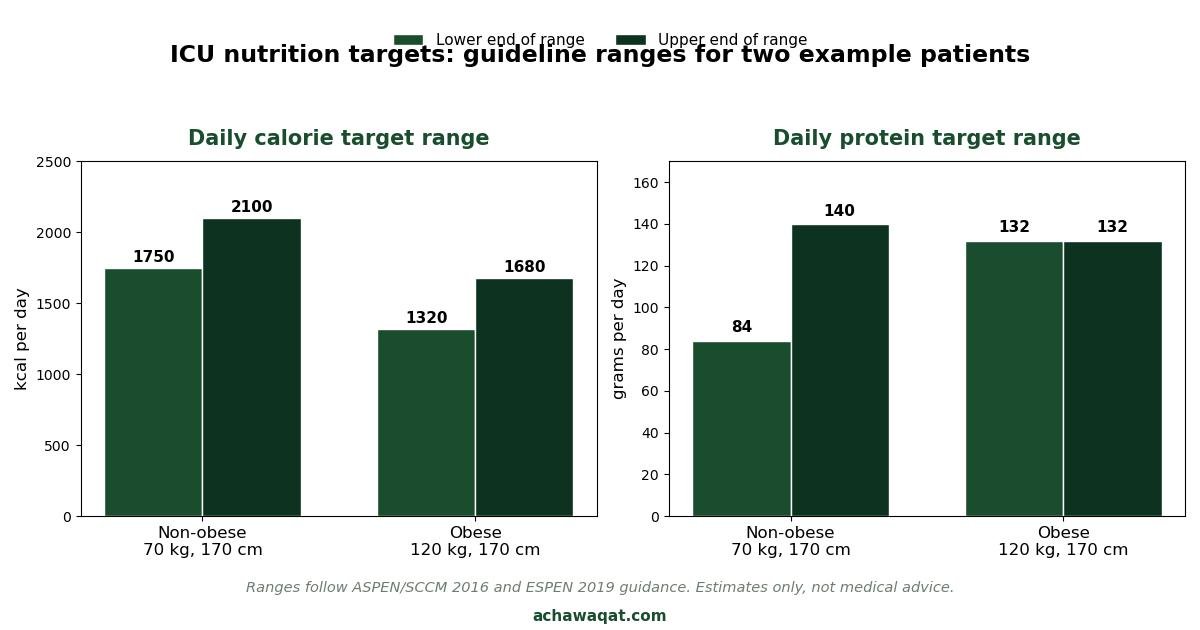
Take a 70 kg man who is 170 cm tall. His BMI is 70 divided by 1.7 squared, which is 24.22, so actual body weight is the dosing weight. His calorie target is 25 to 30 times 70, or 1,750 to 2,100 kcal per day. His protein target is 1.2 to 2.0 times 70, or 84 to 140 g per day. His fluid estimate is 30 to 35 times 70, or 2,100 to 2,450 mL per day, rough. Now take a 120 kg man of the same height. His BMI is 120 divided by 1.7 squared, which is 41.52, placing him in the BMI 30 to 50 band. His ideal body weight by the Devine formula is 50 plus 0.91 times (170 minus 152.4), which is 66.02 kg. His calorie target is 11 to 14 times 120, or 1,320 to 1,680 kcal per day, and his protein target is 2.0 times 66.02, or about 132 g per day.
References
- McClave SA, Taylor BE, Martindale RG, et al. Guidelines for the Provision and Assessment of Nutrition Support Therapy in the Adult Critically Ill Patient: Society of Critical Care Medicine (SCCM) and American Society for Parenteral and Enteral Nutrition (A.S.P.E.N.). JPEN J Parenter Enteral Nutr. 2016;40(2):159-211.
- Singer P, Blaser AR, Berger MM, et al. ESPEN guideline on clinical nutrition and hydration in geriatrics. Clin Nutr. 2019;38(1):48-79. (ICU protein target of 1.3 g/kg/day, delivered progressively.)
- Devine BJ. Gentamicin therapy. Drug Intell Clin Pharm. 1974;8:650-655. (Devine ideal body weight formula.)
- Society of Critical Care Medicine
- Intensive Care Society
Key takeaways
- Guidelines suggest 25 to 30 kcal per kilogram of dosing weight per day for critically ill adults once the early acute phase has passed (McClave SA et al., JPEN 2016;40(2):159-211).
- Guidelines recommend 1.2 to 2.0 g of protein per kilogram of body weight per day in critical illness (McClave SA et al., JPEN 2016;40(2):159-211), while ESPEN suggests a protein target around 1.3 g/kg/day, delivered progressively (Singer P et al., Clin Nutr 2019;38(1):48-79).
- The dosing weight is the body weight value used to multiply the guideline's per-kilogram targets.
- This calculator uses the Devine formula: for men, IBW = 50 + 0.91 x (height in cm minus 152.4); for women, IBW = 45.5 + 0.91 x (height in cm minus 152.4).