Glasgow Coma Scale (GCS) Calculator
Score eye, verbal and motor responses on the standard 3 to 15 scale. Built for students, clinicians and caregivers who need a reliable bedside reference.
In short: Score eye, verbal and motor responses on the standard 3 to 15 scale. Built for students, clinicians and caregivers who need a reliable bedside reference. Use the calculator above, then read the guide below to interpret your result and its limitations.
Glasgow Coma Scale calculator
Select the best response you observe for each component, then calculate. Tick the intubation box when a breathing tube makes the verbal component untestable.
What the Glasgow Coma Scale measures
The Glasgow Coma Scale is a standardised bedside tool for describing a person's level of consciousness after brain injury or during any acute illness that impairs awareness. It was introduced in 1974 by Graham Teasdale and Bryan Jennett, neurosurgeons at the University of Glasgow, who needed a practical way for clinicians to record and communicate the depth of coma in a consistent language [1].
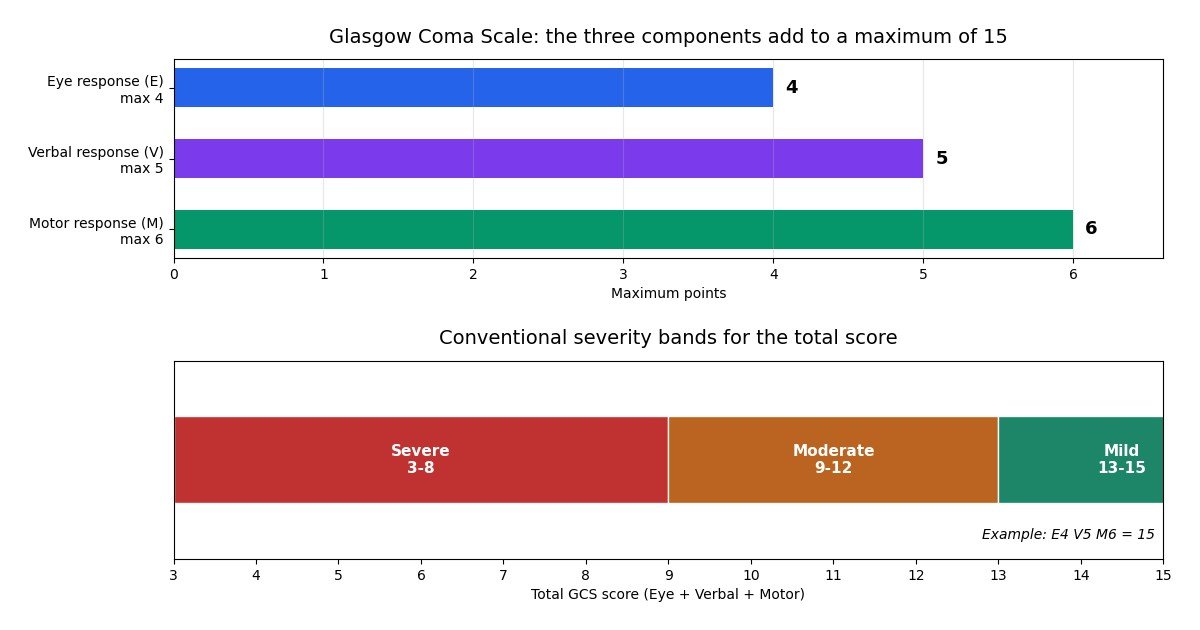
The scale does not diagnose a condition, and it does not explain why consciousness is impaired. Instead, it breaks the clinical examination into three observable behaviours: eye opening, verbal response and motor response. Each behaviour is graded against defined criteria, and the three grades are added together to give a total between 3 and 15. Reporting the score as its components (for example, E4 V5 M6) is considered better practice than reporting the total alone, because two patients can share the same total with very different clinical pictures [3].
Because the GCS describes observed responses, it works in many settings: emergency departments, intensive care units, ambulances and field triage, and repeated bedside monitoring. Its simplicity is its strength. Any trained observer can perform it, and a score recorded in one hospital can be understood immediately in another.
How the assessment is performed
The GCS is assessed by watching and stimulating the patient in a defined order, starting with the least invasive stimulus. Begin by observing: does the patient open their eyes spontaneously? Do they speak? Do they move? If there is no spontaneous response, increase the stimulus step by step: first speak to the patient, then apply firm pressure, while observing the eye, verbal and motor responses at each stage [4].
Each component is scored once, using the best response observed. For the motor component, if the limbs respond differently, record the best limb response [4]. The assessment should reflect the patient's best function at the time of examination, not a single disappointing attempt.
Timing matters. The GCS is most informative when performed repeatedly and trended over time, because a falling score is often the earliest sign of a deteriorating brain injury. A single isolated score is less useful than the direction of change across serial examinations [2].
Assessors should also record anything that interferes with the examination. Eyes swollen shut, an endotracheal tube, heavy sedation, intoxication and spinal injury can all distort individual components without reflecting the true state of the brain. These confounders should be documented alongside the score so that later readers do not misinterpret it [3][4].
Scoring each component
| Component | Score | Criterion |
|---|---|---|
| Eye (E) | 4 | Opens eyes spontaneously |
| Eye (E) | 3 | Opens eyes to speech |
| Eye (E) | 2 | Opens eyes to pressure |
| Eye (E) | 1 | No eye opening |
| Verbal (V) | 5 | Oriented conversation |
| Verbal (V) | 4 | Confused conversation |
| Verbal (V) | 3 | Inappropriate words |
| Verbal (V) | 2 | Incomprehensible sounds |
| Verbal (V) | 1 | No verbal response (or intubated, recorded as V1T) |
| Motor (M) | 6 | Obeys commands |
| Motor (M) | 5 | Localises to pain |
| Motor (M) | 4 | Withdraws from pain (normal flexion) |
| Motor (M) | 3 | Abnormal flexion to pain (decorticate posturing) |
| Motor (M) | 2 | Extension to pain (decerebrate posturing) |
| Motor (M) | 1 | No motor response |
The total is the sum of the three components, ranging from 3 (no response in any component) to 15 (fully awake and oriented). A patient who opens eyes spontaneously (E4), converses normally (V5) and obeys commands (M6) scores 15. A patient with no eye opening (E1), no sounds (V1) and no movement (M1) scores 3.
The distinction between normal withdrawal (M4) and abnormal flexion (M3) matters clinically. Withdrawal is a purposeful, normal flexion that pulls the limb away from the painful stimulus, while abnormal flexion is a slow, stereotyped decorticate posture with adduction of the arm and flexion at the elbow and wrist. Extension (M2) is decerebrate posturing with internal rotation and extension of the limbs. These posturing responses suggest deeper dysfunction than purposeful responses [1][3].
Interpreting the total score
Conventionally, total scores are grouped into three bands [3]:
- 13 to 15: mild brain injury
- 9 to 12: moderate brain injury
- 3 to 8: severe brain injury
These bands guide urgency rather than destiny. A mild score does not guarantee a good outcome, and a severe score does not guarantee a poor one; they describe the depth of impaired consciousness at the moment of assessment. Guidelines for the management of severe traumatic brain injury use the 3 to 8 range to define the severe category [6].
A low score should always prompt the question of reversibility. Low blood sugar, low oxygen, low blood pressure, low body temperature, intoxication and the period after a seizure can all depress the GCS and may be rapidly correctable. The score describes what is observed; the clinician's job is to find out why [3].
The intubated patient and the T convention
When a patient has an endotracheal tube in place, the verbal component cannot be tested: the patient physically cannot speak. The standard convention, used in trauma registries and critical care documentation, is to record the verbal score as 1 and append the letter T, for example E4 V1T M6, giving a total of 11T [5]. This calculator follows that convention: tick the intubation box and the verbal component is recorded as 1 with the T flag shown in the notation.
The T flag is important because it tells the reader that the low verbal score is a mechanical artefact, not evidence of brain dysfunction. A total of 11T is not directly comparable to a total of 11 in a non-intubated patient, and published analyses often handle intubated patients separately or estimate the verbal component from the eye and motor scores [5].
Serial measurements: why trends matter more than single scores
A single GCS is a snapshot; serial GCS is a film. In acute brain injury, the brain can deteriorate hours after the initial insult as swelling, bleeding or reduced blood flow evolve. Repeating the GCS at regular intervals creates a trend, and a drop of even a few points can be the first objective sign that something is going wrong [2].
For trends to be meaningful, every assessment should be performed the same way and confounders should be noted each time. A patient whose score falls from 14 to 11 because sedation was started is a different story from one whose score falls from 14 to 11 spontaneously. Document the stimulus used, the best limb assessed and any factor (sedation, paralysis, intubation, intoxication) that limits the examination [4].
Modern practice also records the three components separately over time rather than only the total, because a change in one component can be masked when totals are compared. A patient moving from E4 V5 M6 (15) to E2 V4 M6 (12) has lost eye and verbal responses while motor function is preserved, information that the two totals alone partly conceal [3].
Limitations and confounders
The GCS has well-known limitations, and honest use requires knowing them [3][4]:
- Sedation, anaesthesia and neuromuscular blockade suppress responses. A pharmacologically paralysed patient scores M1 regardless of brain function.
- Intoxication with alcohol or drugs depresses consciousness and can mimic brain injury.
- Facial and eye injuries may prevent eye opening or speech for mechanical reasons.
- Spinal cord injury can abolish limb responses below the lesion while the brain is intact.
- Aphasia or a language barrier can lower the verbal score without any change in consciousness.
- The scale was designed for traumatic brain injury and is less informative in non-traumatic coma, although it is still widely used there.
- Observers can disagree with each other, particularly when distinguishing normal withdrawal from abnormal flexion; structured training reduces this variation [4].
Because of these limits, the GCS should never be the sole basis for major decisions such as withdrawing life support. It is one part of a full neurological assessment that includes the pupils, vital signs, imaging and the clinical story.
Children and the paediatric GCS
The adult GCS assumes a patient who can speak and follow commands, so it does not fit infants and preverbal children. Paediatric adaptations exist that modify the verbal and motor criteria for the child's developmental stage, for example scoring a young child's best verbal output against age-appropriate expectations rather than oriented conversation [3]. This calculator implements the standard adult scale. For young children, use a validated paediatric modification and interpret the result in the context of normal development.
The GCS in triage, prognosis and communication
The GCS earns its place in practice because it compresses a complex examination into a compact, unambiguous code. In prehospital triage, the score helps crews decide the destination and urgency of transport. In the emergency department, it is one of the first numbers recorded for any head injury and is repeated to watch for deterioration. In intensive care, it is part of the routine neurological observation set [3].
Prognostically, the early GCS is associated with outcome after head injury: lower scores are, on average, associated with worse outcomes, which is why the scale has been used in outcome prediction research since its early years [2]. But averages are not individuals, and no score can predict a single patient's fate. The scale's primary value remains description and communication: it gives every member of the team the same concise picture of the patient's conscious state.
Worked examples
- A fully alert adult: opens eyes spontaneously (E4), converses normally (V5), obeys commands (M6). Total 15. Notation: E4 V5 M6. Band: mild, at the top of the scale.
- A drowsy patient after a fall: opens eyes to speech (E3), confused conversation (V4), localises to pain (M5). Total 12. Notation: E3 V4 M5. Band: moderate.
- An intubated trauma patient: opens eyes to pressure (E2), intubated (V1T), abnormal flexion to pain (M3). Total 6T. Notation: E2 V1T M3. Band: severe, with the T flag showing the verbal score is mechanical.
- A deeply comatose patient: no eye opening (E1), no verbal response (V1), extension to pain (M2). Total 4. Notation: E1 V1 M2. Band: severe.
Key takeaways
- The Glasgow Coma Scale is a standardised bedside tool that describes a person's level of consciousness by scoring three observable behaviours: eye opening, verbal response and motor response.
- E stands for the eye response (scored 1 to 4), V for the verbal response (scored 1 to 5) and M for the motor response (scored 1 to 6).
- The best possible score is 15 (E4 V5 M6): the person opens their eyes spontaneously, converses normally and obeys commands.
- A total score of 3 to 8 falls in the severe brain injury band.
Frequently asked questions
What is the Glasgow Coma Scale used for?
The Glasgow Coma Scale is a standardised bedside tool that describes a person's level of consciousness by scoring three observable behaviours: eye opening, verbal response and motor response. It is used after head injury and in any acute illness that impairs awareness, to record the examination, track changes over time and communicate findings between clinicians.
What do E, V and M stand for in a GCS score?
E stands for the eye response (scored 1 to 4), V for the verbal response (scored 1 to 5) and M for the motor response (scored 1 to 6). A score is reported as its components, for example E4 V5 M6, and the three numbers are added to give the total, which ranges from 3 to 15.
What is the best and worst possible GCS score?
The best possible score is 15 (E4 V5 M6): the person opens their eyes spontaneously, converses normally and obeys commands. The worst possible score is 3 (E1 V1 M1): no eye opening, no verbal response and no motor response. A score of 3 indicates deep coma, while 15 indicates a fully awake, oriented person.
What does a GCS of 8 or less mean?
A total score of 3 to 8 falls in the severe brain injury band. In emergency practice a widely taught heuristic is that a patient with a GCS of 8 or less may not be able to protect their own airway, so airway protection is considered. The score alone never decides treatment; the full clinical picture does.
How is the GCS scored in an intubated patient?
An intubated patient cannot speak, so the verbal component is recorded as 1 with the letter T appended, for example E4 V1T M6, giving a total such as 11T. The T flag shows the low verbal score is caused by the breathing tube, not by brain dysfunction, so the total is not directly comparable with totals from non-intubated patients.
Can medication or alcohol change the GCS score?
Yes. Sedatives, anaesthetic drugs, alcohol and other intoxicants depress consciousness and lower the score without necessarily reflecting brain injury. Paralysing drugs abolish the motor response entirely. Always record what drugs the patient has received alongside the score so later readers can interpret it correctly.
References
- Teasdale G, Jennett B. Assessment of coma and impaired consciousness. A practical scale. Lancet. 1974;304(7872):81-84.
- Teasdale GM, Jennett B. Assessment and prognosis of coma after head injury. Acta Neurochir (Wien). 1976;34(1-4):45-55.
- Teasdale G, Maas A, Lecky F, Manley G, Stocchetti N, Murray G. The Glasgow Coma Scale at 40 years: standing the test of time. Lancet Neurol. 2014;13(8):844-854.
- Teasdale G, Allen D, Brennan P, McElhinney E, Mackinnon L. The Glasgow Coma Scale: an update after 40 years. Nurs Times. 2014;110(1-3):12-16.
- Meredith W, Rutledge R, Fakhry SM, Rutherford EJ, Clancy TV, Baker CC. The conundrum of the Glasgow Coma Scale in intubated patients: a linear regression prediction of the Glasgow verbal score from the Glasgow eye and motor scores. J Trauma. 1998;44(5):839-844.
- Brain Trauma Foundation. Guidelines for the management of severe traumatic brain injury, 4th edition. Neurosurgery. 2017;80(1):6-15.
- American Academy of Neurology
- MedlinePlus