NIH Stroke Scale (NIHSS) Calculator
Score all 15 items of the National Institutes of Health Stroke Scale and get the total (0 to 42) with the conventional severity band.
In short: Score all 15 items of the National Institutes of Health Stroke Scale and get the total (0 to 42) with the conventional severity band. Use the calculator above, then read the guide below to interpret your result and its limitations.
What the NIH Stroke Scale measures
The National Institutes of Health Stroke Scale (NIHSS) is a standardized neurological examination that quantifies the impairment caused by a stroke. It was developed by Brott and colleagues and published in 1989 as a way to measure the effects of acute cerebral infarction in a consistent, repeatable way, and it was adopted as the assessment tool for the landmark NINDS rt-PA trial of clot-busting treatment. Since then it has become the most widely used stroke severity scale in both clinical practice and research worldwide.
The scale consists of 15 scored items grouped into 11 examination categories: level of consciousness, gaze, vision, facial movement, arm and leg strength, coordination, sensation, language, speech clarity, and attention. Each item is scored from 0 (normal) upward, and the total ranges from 0 to 42. A higher total means more severe neurological impairment. The NIHSS measures impairment, which is what the neurological examination finds, rather than disability, which is how the patient functions in daily life. That distinction matters: a separate scale, the modified Rankin Scale, is the usual measure of functional outcome after stroke.
In the emergency department the NIHSS gives every member of the stroke team a common language. A score documented on arrival can be compared with a repeat score an hour later to detect deterioration or improvement, and baseline scores recorded in trials allow fair comparison between treatment groups. Serial NIHSS assessment is also a core part of monitoring after thrombolysis or thrombectomy, when a sudden worsening may signal bleeding or re-occlusion.
The 15 items of the NIHSS
The examiner works through the items in a fixed order and scores what the patient actually does, not what the examiner thinks the patient could do. The maxima below are exactly as published in the original scale:
| Item | What it tests | Maximum |
|---|---|---|
| 1a. Level of consciousness | Responsiveness to voice, touch, and painful stimulation | 3 |
| 1b. LOC questions | Orientation: the patient states the month and their age | 2 |
| 1c. LOC commands | Following commands: open and close the eyes, grip and release the hand | 2 |
| 2. Best gaze | Horizontal eye movements and forced gaze deviation | 2 |
| 3. Visual fields | Visual field loss by confrontation testing | 3 |
| 4. Facial palsy | Symmetry of facial movement, upper and lower face | 3 |
| 5a. Motor, left arm | Arm drift when held outstretched for 10 seconds | 4 |
| 5b. Motor, right arm | Arm drift when held outstretched for 10 seconds | 4 |
| 6a. Motor, left leg | Leg drift when held elevated for 5 seconds | 4 |
| 6b. Motor, right leg | Leg drift when held elevated for 5 seconds | 4 |
| 7. Limb ataxia | Coordination in the finger-to-nose and heel-to-shin tests | 2 |
| 8. Sensory | Pinprick sensation in the face, arm, and leg | 2 |
| 9. Best language | Aphasia: naming, repetition, and comprehension | 3 |
| 10. Dysarthria | Clarity of speech articulation | 2 |
| 11. Extinction and inattention | Neglect of one side on double simultaneous stimulation | 2 |
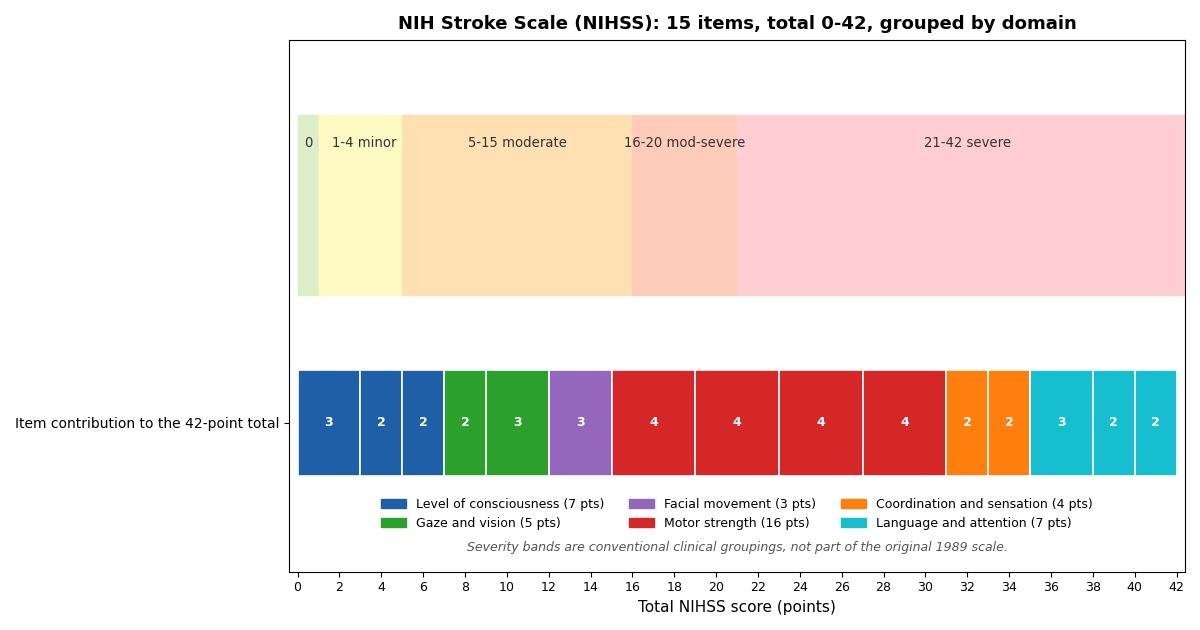
Motor strength carries the most weight: the four limb items contribute up to 16 of the 42 points, which is why a dense hemiplegia drives the score up quickly. Language (item 9) is worth up to 3 points, so dominant-hemisphere strokes that cause aphasia tend to score higher than comparable right-hemisphere strokes. The consciousness items are scored first because a drowsy or unresponsive patient cannot meaningfully attempt the rest of the examination, and several items have default scoring rules for patients who are comatose or intubated.
How the score is calculated and what the bands mean
The total is simply the sum of the 15 item scores, giving a range of 0 to 42. Clinicians conventionally group totals into five severity bands:
| Total score | Conventional band |
|---|---|
| 0 | No stroke symptoms |
| 1 to 4 | Minor stroke |
| 5 to 15 | Moderate stroke |
| 16 to 20 | Moderate to severe stroke |
| 21 to 42 | Severe stroke |
A score of 0 deserves special care. It means the examination found no abnormality, but it does not prove that no stroke occurred. Posterior circulation strokes affecting the brainstem or cerebellum can cause disabling vertigo, double vision, or imbalance while leaving the NIHSS items nearly untouched, so a low score never overrules clinical suspicion or brain imaging.
Role in treatment decisions: thrombolysis and thrombectomy
The NIHSS earned its place in stroke care through the thrombolysis trials. The NINDS rt-PA trial, published in 1995, established that intravenous alteplase given within 3 hours of symptom onset improves the odds of recovery from ischemic stroke, and the NIHSS was the trial's yardstick for measuring deficits and outcomes. The ECASS III trial later extended the alteplase window to between 3 and 4.5 hours. In everyday practice the baseline NIHSS is recorded before treatment and repeated afterward, so that improvement or deterioration is measured rather than guessed.
The score also helps frame eligibility thinking for reperfusion therapy, but it is only one input among many. Decisions about intravenous thrombolysis weigh the time since the patient was last known well, blood pressure, blood glucose, bleeding risk, current medications, and brain imaging, alongside the examination. For mechanical thrombectomy, the landmark trials each set their own minimum deficit: MR CLEAN, published in 2015, enrolled patients with an NIHSS of 2 or higher; DEFUSE 3, published in 2018, required an NIHSS of 6 or higher with treatment possible between 6 and 16 hours; and the DAWN trial, also published in 2018, required an NIHSS of 10 or higher for late-window thrombectomy. These cut-offs were trial entry rules, not universal treatment thresholds, and practice has evolved since.
Minor stroke is another area where the NIHSS shapes research but does not dictate care. The PRISMS trial, published in 2018, studied patients with minor non-disabling deficits, defined as an NIHSS of 0 to 5, comparing alteplase with aspirin. The key message for a lay reader is simpler: no calculator and no single number decides treatment. Time is the decisive factor in stroke, and suspected stroke is an emergency regardless of what any score says.
Limitations of the NIHSS
No scale captures everything, and the NIHSS has well-documented blind spots. The most important is posterior circulation stroke. The scale contains no item for vertigo, nausea, double vision, dysphagia, or gait ataxia of the trunk, so brainstem and cerebellar strokes can be severely disabling while scoring low. Martin-Schild and colleagues showed that a score of zero does not equal the absence of stroke, which is why the scale must never be used to rule stroke out.
The scale is also asymmetric by design. Language items give up to 5 points combined, so left-hemisphere strokes that cause aphasia score higher than anatomically equivalent right-hemisphere strokes, while right-hemisphere neglect is captured by a single 2-point item. This means two patients with the same volume of brain injury can receive quite different totals depending on which hemisphere is affected.
Inter-rater variability is a third limitation. When examiners are trained with the standard video method, agreement is moderate to excellent on most items, but facial palsy and ataxia have repeatedly shown poor agreement between raters. Lyden's 2017 review of the scale's use warns that scores generated casually at the bedside, without proper training in the scoring rules, should not be compared with scores from clinical trials. The NIHSS measures neurological impairment at one moment in time; it does not measure disability, quality of life, or the patient's own experience of the stroke.
Who should perform the NIHSS
The NIHSS is designed for trained healthcare professionals: neurologists, emergency physicians, stroke-unit nurses, and other certified examiners. Reliable scoring requires training in the exact item definitions and scoring rules, which is why formal NIHSS certification courses exist and why trial examiners are trained with standardized videos. The items are administered in a fixed order, and the cardinal rule is to score what the patient does, not what the examiner believes the patient could do. Coaching the patient or repeating an item until a better response appears invalidates the score. This calculator is an educational aid for learning the structure of the scale; it is not a substitute for a trained examiner assessing a real patient.
How to use this calculator
Select one option for each of the 15 items, working from level of consciousness through to extinction and inattention, then press Calculate total. The calculator validates every entry, sums the item scores to a total out of 42, and reports the conventional severity band. Use the Reset button to clear all answers and start over. If an item cannot be tested in a real examination, for example a limb affected by amputation, the original scale has separate untestable codes; this educational calculator assumes all items are testable and does not prorate the total.
Key takeaways
- The NIH Stroke Scale is a standardized neurological examination that quantifies stroke-related impairment.
- A score of 0 means the examination found no stroke symptoms.
- Scores of 21 to 42 are conventionally grouped as severe stroke, 16 to 20 as moderate to severe, 5 to 15 as moderate, 1 to 4 as minor, and 0 as no stroke symptoms.
- No.
Frequently asked questions
What is the NIH Stroke Scale used for?
The NIH Stroke Scale is a standardized neurological examination that quantifies stroke-related impairment. Clinicians use it to document deficits, track change over time, estimate prognosis, and support decisions about treatments such as intravenous thrombolysis and mechanical thrombectomy. The scale was developed for the NINDS rt-PA trial and published by Brott and colleagues in 1989.
What is a normal NIHSS score?
A score of 0 means the examination found no stroke symptoms. It does not rule out a stroke on its own: patients with posterior circulation strokes can have disabling symptoms with a low or even zero score, so clinical judgment and brain imaging remain essential.
What NIHSS score indicates a severe stroke?
Scores of 21 to 42 are conventionally grouped as severe stroke, 16 to 20 as moderate to severe, 5 to 15 as moderate, 1 to 4 as minor, and 0 as no stroke symptoms. These bands are widely used teaching groupings, not part of the original 1989 scale, so clinicians interpret them alongside the full clinical picture.
Can the NIHSS alone decide whether someone receives clot-busting treatment?
No. The NIHSS is one input among many. Treatment decisions also depend on time since symptom onset, brain imaging, blood pressure, glucose, bleeding risk, and the patient's baseline function. Only a trained clinician in an emergency setting can make that decision. If you suspect a stroke, call emergency services immediately.
Who can perform the NIH Stroke Scale?
The scale is designed for trained healthcare professionals, such as neurologists, emergency physicians, stroke nurses, and certified examiners. Reliable scoring requires training, because several items, including facial palsy and ataxia, show lower agreement between examiners. This online calculator is an educational aid, not a substitute for a trained examiner.
What are the limitations of the NIHSS?
The NIHSS under-represents posterior circulation strokes, which can cause disabling vertigo, double vision, or imbalance with low scores. It gives heavy weight to language and neglect items, and scores can vary between examiners, particularly for facial palsy and ataxia. It measures impairment, not disability, and it cannot diagnose a stroke.
References
- Brott T, Adams HP Jr, Olinger CP, et al. Measurements of acute cerebral infarction: a clinical examination scale. Stroke. 1989;20(7):864-870.
- Kasner SE. Clinical interpretation and use of stroke scales. Lancet Neurol. 2006;5(7):603-612.
- Lyden P. Using the National Institutes of Health Stroke Scale: A Cautionary Tale. Stroke. 2017;48(2):513-519.
- The National Institute of Neurological Disorders and Stroke rt-PA Stroke Study Group. Tissue plasminogen activator for acute ischemic stroke. N Engl J Med. 1995;333(24):1581-1587.
- Hacke W, Kaste M, Bluhmki E, et al. Thrombolysis with alteplase 3 to 4.5 hours after acute ischemic stroke. N Engl J Med. 2008;359(13):1317-1329.
- Berkhemer OA, Fransen PSS, Beumer D, et al. A randomized trial of intraarterial treatment for acute ischemic stroke. N Engl J Med. 2015;372(1):11-20.
- Albers GW, Marks MP, Kemp S, et al. Thrombectomy for stroke at 6 to 16 hours with selection by perfusion imaging. N Engl J Med. 2018;378(8):708-718.
- Nogueira RG, Jadhav AP, Haussen DC, et al. Thrombectomy 6 to 24 hours after stroke with a mismatch between deficit and infarct. N Engl J Med. 2018;378(1):11-21.
- Khatri P, Kleindorfer DO, Devlin T, et al. Effect of alteplase vs aspirin on functional outcome for patients with acute ischemic stroke and minor nondisabling neurologic deficits: the PRISMS randomized clinical trial. JAMA. 2018;320(2):156-166.
- Martin-Schild S, Albright KC, Tanksley J, et al. Zero on the NIHSS does not equal the absence of stroke. Ann Emerg Med. 2011;57(1):42-45.
- American Academy of Neurology
- MedlinePlus