FOUR Score Calculator: Full Outline of UnResponsiveness
In short: Free FOUR score calculator: the 16-point coma scale for intubated ICU patients. Score eye, motor, brainstem and respiration responses 0 to 4 each, with interpretation. Educational tool, not medical advice. Use the calculator above, then read the guide below to interpret your result and its limitations.
Score coma depth with the FOUR score: eye response, motor response, brainstem reflexes and respiration, each 0 to 4, for a total of 0 to 16. Designed for intubated ICU patients, where the Glasgow verbal score cannot be tested. A total of 16 means fully alert; lower totals mean deeper coma.
The calculator
FOUR score total: Not yet calculated
Interpretation: Select one option for each of the four components
Please note: a total of 0 means no measurable function on any of the four components. Teaching published with the scale notes that a score of 0 should alert the physician to consider a formal brain death evaluation. That evaluation is a clinical matter for the treating team; this calculator cannot draw that conclusion.
Please note: this is an educational aid for learning the scale. It does not assess any real patient. The FOUR score is a clinical instrument for trained professionals, and any result must be interpreted by the clinical team at the bedside.
What the FOUR score is
In an intensive care unit, few questions matter more than how deeply unconscious a patient is, and whether that depth is changing. Consciousness cannot be measured with a blood test or a scan. It has to be assessed at the bedside, by watching what the patient does in response to voice, touch and pain, and by testing the reflexes that reveal whether the brainstem is still working. A coma scale turns those bedside observations into numbers, so that change over hours can be tracked, teams handing over can speak the same language, and research can compare patients in a standardised way.
The best known coma scale is the Glasgow Coma Scale, described by Teasdale and Jennett in 1974. It scores eye opening, verbal response and motor response for a total of 3 to 15, and it remains the lingua franca of emergency departments and trauma bays worldwide. But it has a structural weakness in the modern ICU: the verbal component cannot be tested in a patient with a breathing tube in place. Clinicians record it as "1T" or simply 1, which means the scale silently loses a large part of its information exactly in the patients who are most deeply ill. The Full Outline of UnResponsiveness, universally known as the FOUR score, was designed at the Mayo Clinic to solve that problem. Wijdicks, Bamlet, Maramattom, Manno and McClelland published and validated it in the Annals of Neurology in 2005, in a study of 120 patients in neurological and neurosurgical intensive care units (doi:10.1002/ana.20611).
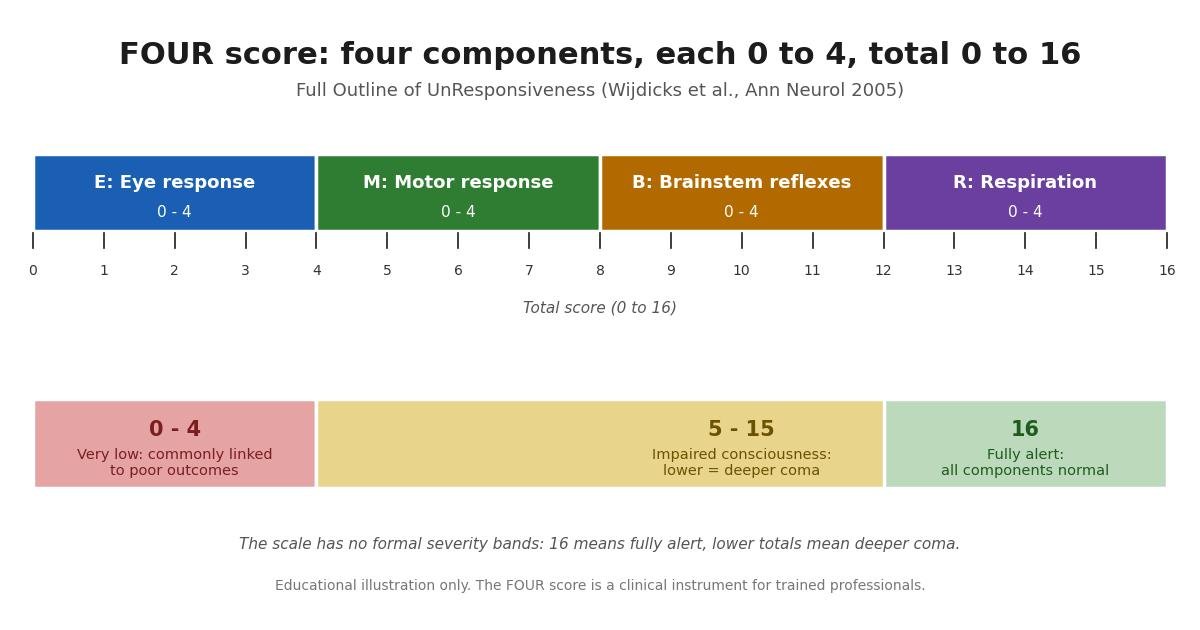
The design is deliberately simple. Four domains, each scored from 0 to 4, where 4 represents normal function and 0 represents absent function: eye response, motor response, brainstem reflexes, and respiration. The total runs from 0 to 16. A total of 16 means a fully alert patient, and lower totals mean deeper coma. There is no verbal component at all, which is why the scale works as well in an intubated patient as in one who is breathing on their own. Two ideas set it apart from its predecessor. The brainstem is examined directly, through pupil, corneal and cough reflexes that map to the midbrain, pons and medulla. And the breathing pattern itself is graded, because how a patient breathes carries information about which parts of the brain are still working.
The four components
Each component is scored from 0 to 4 using the fixed anchors from Wijdicks and colleagues. The table below gives the full scale.
| Score | Eye response (E) | Motor response (M) | Brainstem reflexes (B) | Respiration (R) |
|---|---|---|---|---|
| 4 | Eyelids open or opened, tracking, or blinking to command | Thumbs-up, fist, or peace sign to command | Pupil and corneal reflexes present | Not intubated, regular breathing pattern |
| 3 | Eyelids open but not tracking | Localizing to pain | One pupil wide and fixed | Not intubated, Cheyne-Stokes breathing pattern |
| 2 | Eyelids closed but open to loud voice | Flexion response to pain | Pupil or corneal reflexes absent | Not intubated, irregular breathing pattern |
| 1 | Eyelids closed but open to pain | Extension response to pain | Pupil and corneal reflexes absent | Breathes above ventilator rate |
| 0 | Eyelids remain closed with pain | No response to pain, or generalized myoclonus status | Absent pupil, corneal, and cough reflex | Breathes at ventilator rate or apnea |
Several details in the anchors are doing deliberate work. The eye component tests more than eye opening: it tests tracking and blinking to command, which means it can recognise a patient who is fully paralysed but aware. That is locked-in syndrome, and the Glasgow scale cannot reliably separate it from coma. The motor component is tested preferably at the upper extremities, and its lowest anchor includes generalized myoclonus status, a poor prognostic sign in comatose survivors of cardiac arrest. The brainstem anchors form a gradient of rostrocaudal loss: one pupil wide and fixed points to third nerve compression, often from uncal herniation; absent pupil and corneal reflexes mean deeper loss; absent cough reflex as well means the medulla is involved too. The respiration component is the most original part of the scale. In patients who are not intubated it grades the pattern as regular, Cheyne-Stokes, or irregular, because Cheyne-Stokes breathing suggests bihemispheric dysfunction and irregular breathing suggests lower brainstem dysfunction. In intubated patients it records whether the patient triggers breaths above the set ventilator rate, which shows preserved respiratory drive, or only receives ventilator-delivered breaths, or is apneic. The published instruction guide recommends grading with the ventilator monitor, preferably with carbon dioxide levels within normal limits, and notes that a brief disconnection from the ventilator while providing oxygenation may be needed to assess breathing drive.
Worked examples
A few worked examples show how the four subscores add up and how the interpretation follows.
Example one. A patient opens the eyes and tracks the examiner (eye 4), gives a thumbs-up to command (motor 4), has pupil and corneal reflexes present (brainstem 4), and is not intubated with a regular breathing pattern (respiration 4). The total is 4 plus 4 plus 4 plus 4, which is 16. Fully alert: every component is normal.
Example two. A patient opens the eyes to a loud voice but does not track (eye 2), localizes to pain (motor 3), has pupil and corneal reflexes present (brainstem 4), and is not intubated with Cheyne-Stokes breathing (respiration 3). The total is 2 plus 3 plus 4 plus 3, which is 12. Impaired consciousness: the eyes and breathing show dysfunction while the motor and brainstem components are relatively preserved, a pattern worth noting on handover.
Example three. A patient opens the eyes only to pain (eye 1), shows an extension response to pain (motor 1), has absent pupil and corneal reflexes (brainstem 1), and breathes only at the ventilator rate (respiration 0). The total is 1 plus 1 plus 1 plus 0, which is 3. A very low score, in the range commonly associated with poor outcomes, needing urgent interpretation by the treating team.
Example four shows why the pattern matters as much as the total. Patient A scores eye 3, motor 3, brainstem 3, respiration 3: 3 plus 3 plus 3 plus 3 is 12, with evenly depressed function. Patient B scores eye 4, motor 4, brainstem 4, respiration 0: 4 plus 4 plus 4 plus 0 is also 12, but this patient is awake and following commands while apneic on the ventilator, a completely different clinical situation. The number is the same; the patients are not. Always document the four components, not just the total.
Interpreting the total
The honest first thing to say about interpretation is that the FOUR score has no formal severity bands. Unlike some instruments that carve their range into mild, moderate and severe, the published scale gives only two fixed anchors: 16 means fully alert, and lower totals mean deeper coma. This calculator follows that honesty. It reports the total out of 16, shows which of three descriptive zones the total falls in, and describes what each zone means without pretending the cutoffs are official.
The three zones are straightforward. A total of 16 is fully alert: all four components score 4. Totals from 5 to 15 indicate impaired consciousness, with lower totals meaning deeper coma; within this wide range, the pattern of the four components carries as much meaning as the number itself, as the worked examples show. Totals from 0 to 4 are very low, and in the published literature this range is commonly associated with poor outcomes. That association is qualitative: it describes a tendency seen across studies, not a prediction about any individual patient, and no specific percentages should be attached to it here.
A total of 0 deserves a special note. It means no measurable function on any of the four components: eyes closed to pain, no motor response, absent brainstem reflexes, and no spontaneous breathing. Teaching published with the scale notes that a score of 0 should alert the physician to consider a formal brain death evaluation. That evaluation is a rigorous clinical and legal process with its own criteria, including the apnea test; a coma scale score is never, on its own, a diagnosis of brain death. This calculator flags a total of 0 with that published teaching, and the flag is addressed to clinicians, not to the calculator.
FOUR score versus the Glasgow Coma Scale
The Glasgow Coma Scale will remain the more famous of the two, and any fair comparison should start by saying why. It is simpler to teach, it is known by every paramedic, emergency nurse and junior doctor, and decades of trauma and neurosurgical practice have built an enormous shared understanding of what a GCS of 8 or 13 means. In the emergency department and the trauma bay, where speed and a common language matter most, the GCS is not going anywhere. The FOUR score was never meant to replace it there; it was meant to fix the specific setting where the GCS breaks down, which is the intensive care unit full of intubated patients.
The advantages of the FOUR score in that setting are concrete. First, it has no verbal component, so intubation costs it nothing. A GCS in an intubated patient is really a 10-point scale wearing a 15-point costume, and the missing verbal points are not missing at random: they are missing in the sickest patients. Second, it examines the brainstem directly. The GCS says nothing about pupils or reflexes, yet pupillary asymmetry and lost brainstem reflexes are often the earliest signs of herniation and brainstem injury. The FOUR score builds that examination into the number. Third, it grades respiration, turning the breathing pattern into data rather than leaving it as a bedside impression. Fourth, it can recognise locked-in syndrome, where a patient is aware but almost completely paralysed: the eyes track and blink to command, scoring E4, while the Glasgow eye component sees only that the eyes open. Fifth, it captures generalized myoclonus status after cardiac arrest as the worst motor anchor, folding an important prognostic sign into the score. The weighting is also cleaner: four components of equal weight, each 0 to 4, instead of the GCS mix of 1 to 4, 1 to 5 and 1 to 6.
The evidence base is solid without being overstated. The original 2005 validation studied 120 neurointensive care patients and found the scale predicted mortality and functional outcome. Wolf and colleagues showed in 2007 that intensive care nurses, including those with minimal neuroscience experience, could use it with good to excellent interrater agreement: weighted kappa values of 0.84 for eye, 0.92 for respiration, 0.89 for brainstem, and 0.73 for motor, similar to the GCS in the same study. Iyer and colleagues validated it in the medical intensive care unit in 2009, extending it beyond neurocritical care, and Stead and colleagues validated it in the emergency department the same year. Fischer and colleagues compared interrater reliability of the two scales prospectively in 2010. None of this makes the FOUR score perfect, and its limitations deserve equal space, which the next section gives them.
Limitations and what the score cannot do
Every coma scale measures behaviour and reflexes, not the brain itself, and the FOUR score is no exception. Sedation is the great confounder: a deeply sedated patient scores low because of the drugs, not because of brain injury, and the scale cannot tell the two apart. Neuromuscular blockade abolishes the motor component entirely. Hypothermia, severe metabolic disturbance, and intoxication all depress the score for reasons that may be fully reversible. Scoring should ideally happen with sedation lightened and paralysis worn off, and the conditions of the assessment should be documented alongside the number.
The scale also demands more examiner skill than the Glasgow scale. Testing the corneal reflex and the cough reflex at the bedside is straightforward for an ICU nurse or physician and genuinely unpleasant to contemplate for anyone else, which is one reason this page is an educational aid rather than a do-it-yourself instrument. The eye tracking assessment needs a cooperative moment from a patient who may have none to give, and distinguishing a true flexion response from withdrawal takes practice. The original validation was in adults with acute neurological disease; applying the scale to children needs clinical judgement rather than blind arithmetic.
Finally, the score does not diagnose anything. It does not say why the patient is comatose, it does not replace imaging, electroencephalography, or the clinical examination, and it does not predict any individual patient's outcome with the certainty that families understandably wish for. A low score describes the depth of unresponsiveness now; what happens next depends on the cause, the treatment, and time. Used properly, the FOUR score is a precise, repeatable language for describing coma. Used improperly, as a fortune-telling device or a substitute for clinical judgement, it is just a number.
How brainstem reflexes are assessed
The brainstem component is the part of the FOUR score least familiar to non-neurologists, so it is worth describing what the three reflexes test and roughly how they are tested. All three are performed by the clinician at the bedside, and none of them is a home procedure.
The pupillary light reflex tests the midbrain. A bright light is shone into each eye in turn, and the pupils should constrict briskly and equally. A pupil that is wide and fixed, the B3 anchor, suggests compression of the third cranial nerve, classically from uncal herniation as a mass pushes the temporal lobe against the tentorium. It is a neurosurgical emergency until proven otherwise. The corneal reflex tests the pons. A wisp of cotton, or a drop of sterile saline, touches the edge of the cornea, and both eyes should blink; the sensory limb runs through the trigeminal nerve and the motor limb through the facial nerve, with the reflex arc in the pons. The cough reflex, tested by suctioning the airway in an intubated patient or by stimulating the back of the throat, tests the medulla through the vagus nerve. Losing reflexes in the order pupil, then corneal, then cough mirrors a rostrocaudal wave of brainstem failure from midbrain down to medulla, which is why the B anchors are ordered the way they are.
Two practical points matter. First, drugs confound the examination: opioids constrict the pupils, atropine-like drugs dilate them, and neuromuscular blockers abolish the motor limbs of the reflexes. Second, the brainstem examination is the part of the FOUR score where training shows most clearly, which is consistent with the published reliability data showing the strongest agreement on respiration and brainstem and the weakest on the motor component. None of this is an argument against examining the brainstem. It is an argument for training the examiners.
Using the score in the ICU
The FOUR score earns its keep in daily intensive care practice in three ways: trending, handover, and decision support. Trending is the most important. A single score is a snapshot; a series of scores is a story. A patient whose total falls from 12 to 8 overnight is deteriorating whatever the cause, and the component pattern says where: a falling brainstem component points toward herniation or brainstem ischemia, a falling respiration component toward loss of drive or a ventilator problem, a falling motor component toward a new focal injury or deepening metabolic coma. Scores should be recorded as the four components plus the total, at regular intervals and after any intervention that might change consciousness, such as lightening sedation or treating a seizure.
For handover, the scale gives the night team a compact, unambiguous summary. "FOUR 12, E3 M3 B3 R3" says more in a breath than a paragraph of prose, and because each component has fixed anchors, the incoming team knows exactly what was observed rather than what was inferred. For decision support, the score feeds into the same prognostic conversations as the GCS: very low scores prompt early discussion of goals of care and, where appropriate, formal brain death testing, while improving scores support continued aggressive care. In all three uses, the same cautions apply: note the sedation and ventilation status alongside the score, re-score when conditions change, and never let the number overrule the bedside examination it came from.
Key takeaways
- The FOUR score, short for Full Outline of UnResponsiveness, is a coma scale published by Wijdicks and colleagues at the Mayo Clinic in the Annals of Neurology in 2005.
- The four components are eye response, motor response, brainstem reflexes, and respiration.
- The Glasgow Coma Scale scores eye opening, verbal response, and motor response for a total of 3 to 15, but its verbal component cannot be tested in an intubated patient, so the scale loses information exactly where it is needed most.
- A total of 16 means the patient is fully alert, with all four components scoring 4.
Frequently asked questions
What is the FOUR score?
The FOUR score, short for Full Outline of UnResponsiveness, is a coma scale published by Wijdicks and colleagues at the Mayo Clinic in the Annals of Neurology in 2005. It grades four domains of neurological function, eye response, motor response, brainstem reflexes, and respiration, each from 0 to 4, giving a total from 0 to 16. A total of 16 means a fully alert patient, and lower totals mean deeper coma. It was designed for intensive care patients, including those who are intubated.
What are the four components of the FOUR score?
The four components are eye response, motor response, brainstem reflexes, and respiration. Eye response runs from eyelids open with tracking or blinking to command (4) down to eyelids remaining closed with pain (0). Motor response runs from following commands such as thumbs-up, fist, or peace sign (4) down to no response to pain or generalized myoclonus status (0). Brainstem reflexes run from pupil and corneal reflexes present (4) down to absent pupil, corneal, and cough reflexes (0). Respiration runs from not intubated with a regular breathing pattern (4) down to breathing at the ventilator rate or apnea (0).
How does the FOUR score differ from the Glasgow Coma Scale?
The Glasgow Coma Scale scores eye opening, verbal response, and motor response for a total of 3 to 15, but its verbal component cannot be tested in an intubated patient, so the scale loses information exactly where it is needed most. The FOUR score has no verbal component at all. Instead it adds two things the Glasgow scale lacks: direct testing of brainstem reflexes (pupil, corneal, and cough reflexes, covering the midbrain, pons, and medulla) and grading of the breathing pattern itself. It can also detect locked-in syndrome through eye tracking, and it captures generalized myoclonus status, a poor prognostic sign after cardiac arrest.
What does a FOUR score of 16 mean, and what do low scores mean?
A total of 16 means the patient is fully alert, with all four components scoring 4. The scale has no formal severity bands: lower totals simply mean deeper coma. In the published literature, very low totals, commonly described as the 0 to 4 range, are associated with poor outcomes. A total of 0 means no measurable function on any component, and teaching published with the scale notes that a score of 0 should alert the physician to consider a formal brain death evaluation. Any low score needs interpretation by the treating clinical team.
Can the FOUR score be used in patients who are intubated?
Yes, and that was the main reason the scale was created. Because it has no verbal component, intubation does not distort the total the way it distorts the Glasgow Coma Scale. The respiration component is graded differently depending on intubation status: in patients who are not intubated it grades the breathing pattern (regular, Cheyne-Stokes, or irregular), while in intubated patients it records whether the patient breathes above the ventilator rate or only at the ventilator rate, or is apneic.
Should I use the FOUR score outside a clinical setting?
No. The FOUR score is a clinical instrument for trained professionals. Testing brainstem reflexes and grading responses to pain require bedside skill, and sedation, paralysis, hypothermia, and metabolic disturbance can all confound the result. This page is an educational aid for learning how the scale works. It does not assess any real patient, does not diagnose any condition, and does not guide treatment. Coma assessment belongs to the clinical team at the bedside.
References and further reading
Medical disclaimer
This calculator is an educational aid only. It does not assess any real patient, does not diagnose coma or any neurological condition, does not replace clinical judgement, and does not advise on treatment. The FOUR score is a clinical instrument for trained professionals, and any result must be interpreted by the clinical team at the bedside in the context of the full history, examination and investigations. A coma scale score is never, on its own, a diagnosis of brain death. If someone is unconscious or deteriorating, seek emergency medical help immediately. Never start, stop or change any treatment on the basis of a score alone.