Modified Rankin Scale (mRS) Calculator
Answer a short structured sequence of questions to map post-stroke functional outcome to one of the seven mRS grades, 0 to 6, with the standard van Swieten et al. descriptors.
In short: Answer a short structured sequence of questions to map post-stroke functional outcome to one of the seven mRS grades, 0 to 6, with the standard van Swieten et al. descriptors. Use the calculator above, then read the guide below to interpret your result and its limitations.
mRS questionnaire
Answer each question about the person's current state. The next question appears only when it is needed to choose between grades.
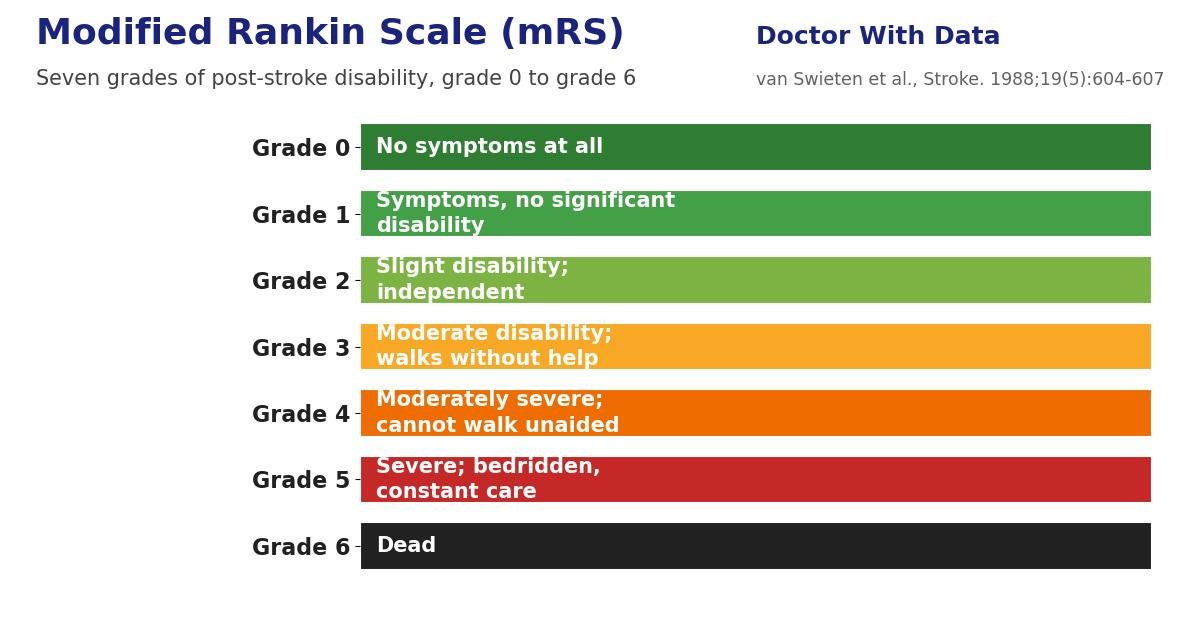
What the Modified Rankin Scale is
The Modified Rankin Scale, usually shortened to mRS, is a seven-level scale that describes how much disability or dependence a person has in daily life after a stroke or another cause of neurological disability. It runs from grade 0, no symptoms at all, to grade 6, dead. The scale is a global outcome measure: it records the person's current functional state rather than measuring the stroke itself or predicting what will happen next.
The mRS has become the most widely used clinical outcome measure in stroke trials. It was introduced in 1957 by Dr John Rankin of Stobhill Hospital in Glasgow as a five-level scale running from 1 to 5. It was modified in the late 1980s, a change described by van Swieten and colleagues in Stroke in 1988, to add grade 0 for patients with no symptoms, and the wording of the definitions was adjusted to cover language and cognitive deficits as well as motor ones. Grade 6, designating patients who had died, was added between 2005 and 2008. The version used today, grades 0 to 6, is therefore sometimes called the "modified" Rankin Scale to distinguish it from Rankin's original.
Because it is an ordinal scale, the numbers carry a rank order but the steps between them are not equal: the real-world difference between grade 1 and grade 2 is not the same as the difference between grade 4 and grade 5. It is also an outcome measure, not a predictor. In stroke trials the mRS is usually recorded about 90 days after the stroke as the primary endpoint; it does not, by itself, predict an individual patient's future recovery.
The seven grades in detail
The table below gives the standard descriptors from van Swieten et al. (Stroke, 1988), with a plain-language explanation of what each grade means in practice.
| Grade | Standard descriptor | What it means in practice |
|---|---|---|
| 0 | No symptoms at all | A complete recovery with no residual symptoms: the person is exactly as they were before the stroke. |
| 1 | No significant disability despite symptoms; able to carry out all usual duties and activities | There are symptoms, but they do not stop the person doing anything they normally did: work, hobbies, driving, and household roles are all intact. |
| 2 | Slight disability; unable to carry out all previous activities, but able to look after own affairs without assistance | Some previous activities are lost or reduced, but the person is fully independent: they can cook, shop, manage money, and travel alone. |
| 3 | Moderate disability; requiring some help, but able to walk without assistance | The person needs help with some tasks, for example shopping or complex household chores, but can walk unaided. This is the most dependent grade at which independent walking is still present. |
| 4 | Moderately severe disability; unable to walk without assistance and unable to attend to own bodily needs without assistance | The person needs help both to walk and with bodily needs such as toileting, dressing, or eating. Walking unaided is the sharp boundary between grades 3 and 4. |
| 5 | Severe disability; bedridden, incontinent, requiring constant nursing care and attention | The person is bedridden and incontinent and needs constant nursing care, whether in a hospital, a care facility, or at home with round-the-clock help. |
| 6 | Dead | Death from any cause. Including death as a grade keeps every randomised trial participant inside the analysis instead of dropping deaths from the scale. |
Two boundaries do most of the work in grading. The boundary between grade 2 and grade 3 is independence in one's own affairs: a person who cannot look after themselves without help is at least grade 3. The boundary between grade 3 and grade 4 is walking without assistance: the moment the person cannot walk unaided, the grade moves to 4 or higher. These two questions, about independence and about walking, are why the questionnaire above asks them in that order.
How the mRS is assessed
The mRS is assigned through an interview with the patient, with a caregiver, or with both, usually by a clinician or trained researcher. Structured interviews, such as the freely available mRS-9Q, ask a fixed sequence of simple questions, which is what this calculator reproduces: first establish whether the person has symptoms at all, then whether they carry out all usual duties, then whether they are independent in their own affairs, then whether they can walk without assistance, then whether they can attend to bodily needs, and finally whether constant nursing care is needed. Each answer narrows the field until only one grade remains.
Assessment is meant to reflect the person's current, usual state, not their best day or worst day. Raters are expected to grade what the person actually does, not what they might theoretically be capable of. In clinical trials the mRS is most commonly assessed at 90 days after the stroke, and sometimes again at one year. The same questionnaire can be used at discharge or in clinic, but the meaning of the grade depends on when it is measured: a grade 3 at discharge is a very different statement from a grade 3 at one year.
Because the scale is based on judgment, reliability matters. In the original van Swieten study, 100 stroke patients were each interviewed by two physicians drawn from a pool of 10 senior neurologists and 24 residents. The two observers agreed on the grade in 65 patients, differed by one grade in 32, and differed by two grades in 3. The unweighted kappa across all pairwise observations was 0.56, rising to 0.91 for the weighted kappa with quadratic disagreement weights. In other words, large disagreements were rare, but exact agreement was far from perfect, which is why stroke trials now train raters and use structured questionnaires to improve consistency.
The favourable or good outcome dichotomy
Most stroke trials do not analyse all seven grades separately. Instead, they dichotomise the scale into a "favourable" or "good" outcome versus the rest, and the cut-off they choose varies by trial. Many trials define a favourable outcome as an mRS of 0 to 1, meaning no symptoms or no significant disability despite symptoms. Others use 0 to 2, which additionally counts slight disability with independence as a good outcome. In thrombectomy practice, 0 to 1 is sometimes labelled "excellent" and 0 to 2 "good": one large clinical-practice cohort found 26 percent of patients at mRS 0 to 1 and 37 percent at mRS 0 to 2 three months after thrombectomy, with 29 percent mortality.
A systematic review of the mRS as a primary outcome in acute ischemic stroke trials found the two cut-offs used in exactly equal numbers of studies: 10 of 42 trials (23.8 percent) defined a favourable outcome as mRS 0 to 1, and 10 of 42 (23.8 percent) used 0 to 2. One further trial used 0 to 3, and three used a sliding dichotomy, where the cut-off shifts depending on how severe the stroke was at baseline. A review of functional outcome assessment in stroke trials notes that the sensible cut-off depends on the population: in a decompressive hemicraniectomy study a good outcome might reasonably be defined as mRS 3 or better, while in a trial of thrombolysis for minor stroke it might be narrowed to mRS 0 to 1.
Because the cut-off is a trial design choice rather than a property of the scale, mRS results cannot be compared across trials without checking the definition each trial used. Many modern trials also analyse the full ordinal scale, for example with shift analysis, instead of dichotomising, because collapsing seven grades into two discards information: an improvement from grade 5 to grade 3 is clinically enormous yet invisible to a 0 to 1 versus 2 to 6 split.
mRS versus other stroke scales
The mRS is often confused with the scales used alongside it, but each measures something different. The NIH Stroke Scale (NIHSS) is a detailed bedside examination of neurological deficits: level of consciousness, gaze, vision, facial palsy, limb strength, language, and so on. It is scored at baseline to describe how severe the stroke is, and it is an impairment scale, not a disability scale. The mRS is the complement: a global measure of disability and dependence in daily life, scored as an outcome, usually at 90 days. A patient can have a high NIHSS and still reach a good mRS if treatment works, which is exactly why trials use one at the start and the other at the end.
The Barthel Index measures independence in ten basic activities of daily living, such as feeding, bathing, and stair climbing, and is more granular than the mRS for physical function. The Glasgow Outcome Scale is a five-point global outcome scale used mainly after traumatic brain injury, and is a cousin of the Rankin rather than a stroke-specific tool. Quality-of-life instruments such as the EQ-5D capture the patient's own view of health, which the mRS, a clinician-rated scale, does not.
Researchers have also tried to weight the grades by what they mean to patients. A utility-weighted mRS derived from time-tradeoff values assigns weights of 1.0 to grade 0, 0.91 to grade 1, 0.76 to grade 2, 0.65 to grade 3, 0.33 to grade 4, and 0 to grades 5 and 6, showing that patients value the step from 4 to 5 far more than the step from 0 to 1. A population-based cohort of 1,607 patients found the same non-linear pattern in hard outcomes: the five-year probability of death, dementia, or institutionalisation was 0.19 at mRS 0, 0.27 at 1, 0.41 at 2, 0.73 at 3, 0.77 at 4, and 0.94 at 5, with estimated five-year quality-adjusted life expectancy falling from 3.88 years at grade 0 to 0.06 years at grade 5. These figures confirm that the grades are uneven steps, not equal units.
Limitations
The mRS is deliberately simple, and its simplicity is also its weakness. With only seven levels, it cannot register improvements or deteriorations that stay within one grade, so meaningful change can go unrecorded. It is a judgment-based scale, and as the van Swieten numbers above show, two trained observers disagree on the exact grade in about one case in three without a structured interview. It focuses on physical disability and dependence, so it under-reports the non-motor consequences of stroke, such as fatigue, depression, anxiety, and cognitive problems, which matter greatly to patients.
The scale's uneven steps cause statistical trouble: treating the grades as if they were evenly spaced numbers, for example by averaging them, is invalid. Analyses that respect the ordinal structure, such as shift analysis or utility-weighted scoring, are preferred in research. Finally, the mRS describes the present; it is an outcome measure, not a prediction model. A grade assigned today says nothing, on its own, about what the grade will be in a year, and it must never be the sole basis for decisions about limiting care.
Medical disclaimer
This calculator is an educational tool. It reproduces the standard modified Rankin Scale descriptors for learning and research communication. It does not diagnose, treat, or predict the course of any condition, and it is not a substitute for clinical assessment by a qualified healthcare professional. Stroke outcomes depend on many factors no questionnaire can capture. If you or someone else may be having a stroke, seek emergency medical care immediately; do not rely on this page.
Key takeaways
- The modified Rankin Scale is a seven-level scale, grades 0 to 6, used to describe how much disability or dependence a person has after a stroke or other cause of neurological disability.
- The calculator works like a structured interview.
- The cut-off for a favourable outcome varies by trial.
- Walking without assistance is the key boundary.
Frequently asked questions
What is the modified Rankin Scale used for?
The modified Rankin Scale is a seven-level scale, grades 0 to 6, used to describe how much disability or dependence a person has after a stroke or other cause of neurological disability. It has become the most widely used clinical outcome measure in stroke trials, where it is usually recorded about 90 days after the stroke. It describes the person's current functional state; it is not a prediction tool and it does not measure the stroke itself.
How does this calculator assign an mRS grade?
The calculator works like a structured interview. It asks a short sequence of yes or no questions: whether the person is alive, whether there are any symptoms, whether all usual duties can be carried out, whether the person can look after their own affairs without help, whether they can walk without assistance, whether they can attend to their own bodily needs without help, and whether they need constant nursing care. Each answer narrows the options until exactly one of the seven grades fits. If you stop early, the calculator cannot finish, because the missing answer is needed to choose between grades.
What counts as a favourable or good outcome on the mRS?
The cut-off for a favourable outcome varies by trial. Many stroke trials define a favourable outcome as an mRS of 0 to 1, meaning no symptoms or no significant disability, while others use 0 to 2, which also includes slight disability with independence. A systematic review of acute ischemic stroke trials found the two cut-offs used in equal numbers of studies. Because the cut-off depends on the population and the treatment being tested, always check which definition a particular trial used before comparing results.
What is the difference between mRS grade 3 and mRS grade 4?
Walking without assistance is the key boundary. Grade 3 means moderate disability: the person needs some help but can walk without assistance. Grade 4 means moderately severe disability: the person cannot walk without assistance and cannot attend to their own bodily needs without assistance. In practice, needing help to walk moves the grade from 3 to 4, and needing constant nursing care with incontinence moves it to 5.
How does the mRS differ from the NIHSS?
The NIH Stroke Scale (NIHSS) and the mRS measure different things. The NIHSS is a detailed bedside examination of neurological deficits, used mainly at baseline to describe how severe the stroke is. The mRS is a global measure of disability and dependence in daily life, used mainly as an outcome at follow-up, usually 90 days after the stroke. In short, the NIHSS describes the neurological injury; the mRS describes how much that injury affects the person's life.
What are the limitations of the modified Rankin Scale?
The mRS is a broad, seven-level scale, so it can miss meaningful changes that fall inside one grade, and it is based on the rater's judgment, which is why agreement between raters is only moderate without a structured interview. In the original van Swieten study, two observers agreed on the grade in 65 of 100 patients and were one grade apart in 32. It also treats the grades as evenly spaced steps when they are not: the real-world difference between grades is uneven. For all these reasons, the mRS is an outcome measure, not a predictor, and it should be interpreted by a clinician, never alone from an online calculator.
References
- Rankin J. Cerebral vascular accidents in patients over the age of 60. Scott Med J. 1957;2:200-215. The original five-level Rankin scale.
- van Swieten JC, Koudstaal PJ, Visser MC, Schouten HJ, van Gijn J. Interobserver agreement for the assessment of handicap in stroke patients. Stroke. 1988;19(5):604-607. Describes the modified scale and reports the reliability study: 100 patients, 10 senior neurologists and 24 residents; agreement on the grade in 65 patients, one grade apart in 32, two grades apart in 3; kappa 0.56, weighted kappa 0.91 with quadratic weights.
- Bonita R, Beaglehole R. Modification of Rankin Scale: recovery of motor function after stroke. Stroke. 1988;19(12):1497-1500.
- Bamford JM, Sandercock PAG, Warlow CP, Slattery J. Interobserver agreement for the assessment of handicap in stroke patients. Stroke. 1989;20(6):828. On the wording changes to grades 1 and 2.
- Analysis of the modified Rankin Scale in randomized controlled trials of acute ischemic stroke: a systematic review. Found mRS alone as the primary outcome in 24 of 42 trials (57.1 percent); favourable outcome defined as 0 to 1 in 10 trials (23.8 percent) and as 0 to 2 in 10 trials (23.8 percent); one trial used 0 to 3; three used a sliding dichotomy.
- Functional assessment for acute stroke trials: properties, analysis, and application. Front Neurol. 2018. Reviews dichotomised cut points, noting the cut-off varies with the population studied (for example, mRS 3 or better after decompressive hemicraniectomy versus mRS 0 to 1 in a minor-stroke thrombolysis trial).
- Saver JL, et al. Adopting a patient-centered approach to primary outcome analysis of acute stroke trials using a utility-weighted modified Rankin Scale. Stroke. Utility weights: mRS 0 to 1.0, 1 to 0.91, 2 to 0.76, 3 to 0.65, 4 to 0.33, 5 to 0, 6 to 0.
- Weights for ordinal analyses of the modified Rankin Scale in stroke trials: a population-based cohort study. EClinicalMedicine. 2020. In 1,607 patients, age and sex adjusted five-year probability of death, dementia, or institutionalisation by three-month mRS: 0 to 0.19, 1 to 0.27, 2 to 0.41, 3 to 0.73, 4 to 0.77, 5 to 0.94 (6 to 1 by definition); estimated five-year quality-adjusted life expectancy: 0 to 3.88, 1 to 3.49, 2 to 3.01, 3 to 1.87, 4 to 1.30, 5 to 0.06, 6 to 0 years.
- Functional outcome following stroke thrombectomy in clinical practice. Stroke. In 2,316 patients with three-month mRS, 26 percent achieved mRS 0 to 1 and 37 percent achieved mRS 0 to 2; mortality was 29 percent.
- American Academy of Neurology
- MedlinePlus