Why cerebral perfusion pressure decides the outcome in severe brain injury
When the brain is injured badly enough to need intensive care, the primary injury is already done: the tissue that was torn, bruised, or starved of oxygen in the first seconds will not recover. Everything that happens next in the neurocritical care unit is about preventing the secondary injury, the wave of damage that unfolds over hours and days as swelling, raised intracranial pressure, falling blood pressure, and impaired blood flow starve still-viable brain tissue of oxygen and fuel. Cerebral perfusion pressure, universally abbreviated CPP, is the bedside number that tracks this fight. It is the pressure driving blood into the brain, and keeping it in range is one of the central therapeutic goals of modern neurocritical care for severe traumatic brain injury.
The intuition behind CPP is simple and physical. Blood reaches the brain only because the pressure in the arteries pushing blood in exceeds the pressure inside the skull pushing back. The skull is a rigid box, so when the injured brain swells, or when blood or cerebrospinal fluid accumulates where it should not, the pressure inside the box rises. That intracranial pressure resists arterial inflow. If systemic blood pressure falls at the same time, as it often does in a multiply injured patient who is bleeding elsewhere, the driving pressure into the brain can collapse even while the familiar cuff blood pressure looks only moderately low. CPP captures both problems in a single subtraction, which is why neurocritical care teams follow it minute by minute rather than watching either component alone.
This dual sensitivity is also what makes CPP a better guide than either of its parents. Mean arterial pressure on its own says nothing about the resistance inside the skull, and intracranial pressure on its own says nothing about the systemic circulation pushing against it. A patient can have a reassuring MAP and a dangerous CPP if the ICP is high, or a concerning MAP and an acceptable CPP if the ICP is low. The subtraction reconciles the two into the quantity that actually matters to the tissue: how much pressure remains to move blood through the brain. Every major severe brain injury protocol therefore treats CPP as a primary monitored variable, with defined targets, alarms, and treatment thresholds built around it.
What cerebral perfusion pressure is
Cerebral perfusion pressure is defined as the mean arterial pressure minus the intracranial pressure:
CPP = MAP - ICP
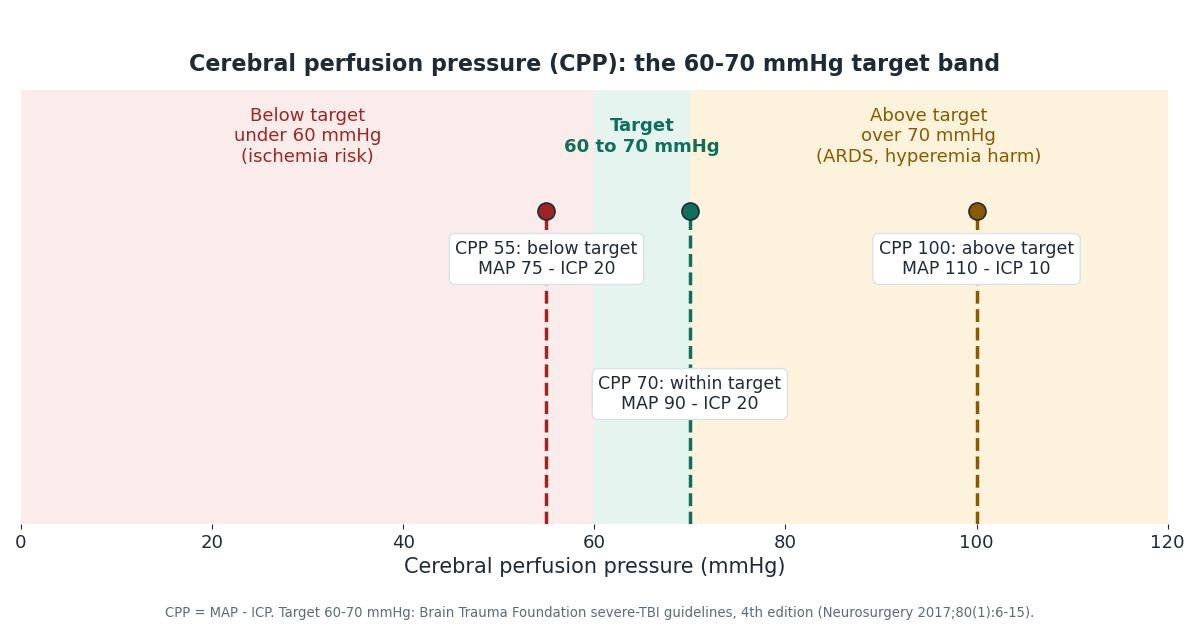
Both are measured in millimetres of mercury (mmHg). The result is an estimate of the pressure gradient available to drive blood through the cerebral circulation. A worked example makes the arithmetic concrete. If a patient's mean arterial pressure is 90 mmHg and the intracranial pressure is 20 mmHg, the cerebral perfusion pressure is 70 mmHg. If the intracranial pressure then rises to 30 mmHg while blood pressure stays the same, CPP falls to 60 mmHg. If the mean arterial pressure instead falls to 75 mmHg with ICP unchanged at 20 mmHg, CPP falls to 55 mmHg. Small movements on either side move the number meaningfully, which is the point of the calculation: the brain feels the difference between 70 and 55 even when the cuff pressure has barely changed.
MAP itself can be entered directly from an arterial line, which is how it is usually obtained in an intensive care unit, or derived from the ordinary systolic and diastolic pressures with the standard formula:
MAP = (SBP + 2 x DBP) / 3
The diastolic pressure is weighted twice because the heart spends roughly twice as much of each cardiac cycle in diastole as in systole. For a blood pressure of 120/80 mmHg, the calculation gives (120 + 160) / 3 = 93.33 mmHg. The calculator above accepts either route: a directly entered MAP, which is the preferred input when an arterial line is in place, or a systolic and diastolic pair from which MAP is derived automatically. Note that the derived value is an estimate of the true mean pressure, not a measurement, and the arterial line reading remains the better input whenever it exists.
A note on normal values helps the numbers land. In a healthy adult, intracranial pressure typically sits between 5 and 15 mmHg. Values above this range are considered raised, and the degree of elevation matters because every millimetre of mercury of ICP is a millimetre of mercury subtracted from CPP. This is the mechanism by which unchecked intracranial hypertension produces brain ischemia even when the systemic circulation looks adequate: the arterial side can be entirely normal while the pressure inside the rigid skull steals the gradient. It is also why ICP monitoring is the gateway to CPP-guided care. Without a measured ICP, the subtraction cannot be performed, and the clinician is left guessing at the very number the guidelines ask them to manage.
The 60 to 70 mmHg target and where it comes from
The target range used by this calculator, 60 to 70 mmHg, comes from the Brain Trauma Foundation "Guidelines for the Management of Severe Traumatic Brain Injury", 4th edition, published in Neurosurgery in 2017 (volume 80, issue 1, pages 6-15). These guidelines are the most widely referenced standard for the neurocritical care of adults with severe traumatic brain injury, and their CPP recommendation is explicit: maintain CPP between 60 and 70 mmHg.
The range reflects a balance of evidence rather than a single experiment. Keeping CPP high enough protects against ischemia, the harm of too little blood flow, while pushing it too high brings its own injuries, which are described below. The guidelines' analysis found that the danger zone for inadequate perfusion sits below about 60 mmHg, and that attempts to push CPP above 70 did not improve outcomes and were associated with harm. The 60 to 70 window is therefore not an arbitrary comfort zone: it is the range where the available evidence suggests perfusion is adequate without incurring the costs of excessive driving pressure. The calculator applies the boundaries exactly as the guideline states them: 60 is within target, 70 is within target, and anything on either side is flagged.
It is worth being clear about the population this target applies to. The Brain Trauma Foundation guidelines address severe traumatic brain injury in adults. The target should not be assumed to apply unchanged to children, to other kinds of brain injury such as stroke or subarachnoid hemorrhage, or to patients managed without intracranial pressure monitoring. Different conditions have different guideline recommendations, and applying a severe-TBI target outside that context would be a category error, not a safety margin. If you are looking at a patient who does not fit the adult severe-TBI picture, the right move is to check the guidance for that condition rather than borrowing this number.
When CPP falls below 60 mmHg
A CPP below 60 mmHg means the brain is receiving less driving pressure than the evidence supports, and the risk is cerebral ischemia: tissue that is alive but under-perfused, progressing toward infarction if the situation is not corrected. Ischemia in the injured brain is not always announced by a dramatic event. It can accumulate quietly as small regions of vulnerable tissue, particularly the areas around existing contusions, slip below the perfusion they need. This is the secondary injury the whole neurocritical care enterprise exists to prevent, and a low CPP is its most direct bedside signal.
In practice, a falling CPP is a signal to look at both components of the subtraction. A low CPP can come from a falling MAP, as in hypovolemia or vasodilation, or from a rising ICP, as in worsening edema or an expanding hematoma, and the correct response depends on which component moved. Raising blood pressure when the problem is a surging ICP, or lowering ICP when the problem is hypotension, can each be the wrong move if chosen blindly. The calculator shows both components next to the result precisely because the number alone does not say what to do about it. Any CPP below target in a real patient needs attention from the treating team, not a number on a screen and not watchful waiting.
| Band | CPP range (mmHg) | Meaning |
|---|---|---|
| Below target | Under 60 | Risk of cerebral ischemia; needs attention |
| Within target | 60 to 70, inclusive | The BTF recommended range for adult severe TBI |
| Above target | Over 70 | Guideline-noted risks of high CPP, including ARDS and hyperemia harm |
When CPP rises above 70 mmHg
It is tempting to think that more perfusion pressure is always safer, but the Brain Trauma Foundation guidelines explicitly warn against that instinct in adult severe-TBI management. Attempts to maintain CPP above 70 mmHg have been associated with harm, including an increased risk of the adult respiratory distress syndrome (ARDS) and the harmful effects of cerebral hyperemia, meaning excessive blood flow to the injured brain. The mechanisms are not mysterious: driving systemic pressures higher typically requires aggressive fluid administration and vasopressor support, which carry their own organ costs, and forcing excess flow through injured, leaky cerebral vessels can worsen edema rather than improve oxygenation. What helps a healthy brain can hurt an injured one, and the injured brain's vessels do not behave like healthy plumbing.
The practical message is that the target has a ceiling as well as a floor. A CPP of 100 mmHg is not twice as good as a CPP of 60 mmHg; it is outside the range the evidence supports, and in the guideline authors' assessment it brings risks without demonstrated benefit. The calculator therefore flags values above 70 as "above target" rather than celebrating them, because the clinical goal is to stay inside the window, not to exceed it. If the instinct is to push pressures ever higher "just to be safe", the guideline evidence points the other way: safety lives inside the band.
What the calculator tells you, and what it cannot
What this calculator does is exact: it performs the subtraction CPP = MAP - ICP, derives MAP from SBP and DBP when asked, and reports where the result sits against the 60 to 70 mmHg target from the Brain Trauma Foundation 4th edition guidelines. The arithmetic is deterministic and the comparison is exact, and the worked examples are checked against hand calculation. Used with real monitor values, it gives you the same number the bedside team is watching, with the same banding.
What it cannot do matters just as much. CPP is a surrogate for brain perfusion, not a direct measurement of it. Two patients with the same CPP can have different actual blood flow to the brain, because flow also depends on the state of the cerebral vessels, the blood's oxygen-carrying capacity, and the metabolic needs of injured tissue. The number does not reveal whether the brain's own blood-flow regulation is intact, and at the high end it cannot distinguish adequate perfusion from the hyperemia the guidelines warn about. It is one variable in a monitored patient, not a diagnosis and not a treatment prescription. Treating the number instead of the patient is a recognized failure mode in intensive care, and no calculator removes that responsibility.
For that reason this tool is an educational calculator, not a substitute for neurocritical care. Intracranial pressure monitoring, arterial pressure management, and the interpretation of CPP trends belong to trained clinicians working with invasive monitors, imaging, and the full clinical picture. No web calculator can reproduce that context, and none of the numbers here should be used to guide the care of a real patient without the treating team. If you are studying these concepts, use the calculator to build intuition about how MAP and ICP interact; if you are caring for a patient, the monitor, the chart, and the team are the authorities.
Limitations
This calculator implements the formula and the target exactly as described, but several limitations deserve stating plainly. First, the 60 to 70 mmHg target comes from adult severe traumatic brain injury guidelines and should not be applied to children or to other neurological conditions without checking the relevant guidance. Second, the MAP-from-SBP/DBP formula is a standard estimate, not a measurement; in an intensive care unit the directly measured MAP from an arterial line is the better input, and the calculator prefers it for that reason. Third, single snapshots mislead: neurocritical care teams manage CPP as a trend, because a stable CPP of 62 may be acceptable while a CPP that has fallen from 85 to 62 over an hour is an emergency. A one-time calculation cannot see a trend, and it cannot tell you whether the number is rising, falling, or stable. Finally, the named validation errors in the calculator, such as flagging ICP values above MAP, exist because a negative CPP is not physiologic; the error is a sanity check on the inputs, not a clinical finding.
Key takeaways
- Cerebral perfusion pressure (CPP) is the pressure gradient that drives blood into the brain.
- The target range is 60 to 70 mmHg for adults with severe traumatic brain injury, as recommended by the Brain Trauma Foundation Guidelines for the Management of Severe Traumatic Brain Injury, 4th edition, published in Neurosurgery in 2017 (volume 80, issue 1, pages 6-15).
- Mean arterial pressure is derived from the systolic and diastolic pressures with the standard formula MAP = (SBP + 2 x DBP) / 3.
- A CPP below 60 mmHg is below the Brain Trauma Foundation target range and signals a risk of cerebral ischemia: living brain tissue receiving less driving pressure than the evidence supports.
Frequently asked questions
What is cerebral perfusion pressure?
Cerebral perfusion pressure (CPP) is the pressure gradient that drives blood into the brain. It is defined as the mean arterial pressure minus the intracranial pressure (CPP = MAP - ICP), measured in mmHg. Because the skull is rigid, rising intracranial pressure resists arterial inflow, so CPP captures both problems, falling blood pressure and rising intracranial pressure, in a single number. Neurocritical care teams follow CPP minute by minute in patients with severe brain injury.
What is the target CPP range?
The target range is 60 to 70 mmHg for adults with severe traumatic brain injury, as recommended by the Brain Trauma Foundation Guidelines for the Management of Severe Traumatic Brain Injury, 4th edition, published in Neurosurgery in 2017 (volume 80, issue 1, pages 6-15). A CPP below 60 mmHg signals a risk of cerebral ischemia, while a CPP above 70 mmHg is flagged as above target because the guidelines note risks of high CPP, including adult respiratory distress syndrome and the harms of hyperemia, in adult severe-TBI management.
How is MAP calculated from SBP and DBP?
Mean arterial pressure is derived from the systolic and diastolic pressures with the standard formula MAP = (SBP + 2 x DBP) / 3. The diastolic pressure is weighted twice because the heart spends roughly twice as much of each cardiac cycle in diastole as in systole. For a blood pressure of 120/80 mmHg, the calculation gives (120 + 160) / 3 = 93.33 mmHg. In an intensive care unit the directly measured MAP from an arterial line is the better input when available.
What does a CPP below 60 mmHg mean?
A CPP below 60 mmHg is below the Brain Trauma Foundation target range and signals a risk of cerebral ischemia: living brain tissue receiving less driving pressure than the evidence supports. It can come from a falling MAP, as in hypovolemia or vasodilation, or from a rising ICP, as in worsening edema, and the correct response depends on which component moved. In a real patient a below-target CPP needs attention from the treating team; it is not something to watch and wait on.
Why is a CPP above 70 mmHg a problem?
More perfusion pressure is not always safer. The Brain Trauma Foundation guidelines explicitly warn against pushing CPP above 70 mmHg in adult severe-TBI management, because higher values have been associated with harm, including an increased risk of adult respiratory distress syndrome (ARDS) and the harmful effects of cerebral hyperemia, or excessive blood flow to the injured brain. Reaching very high pressures usually requires aggressive fluids and vasopressors, which carry their own organ costs, and forcing excess flow through injured, leaky vessels can worsen edema. The clinical goal is to stay inside the 60-70 window, not to exceed it.
What is a normal intracranial pressure?
In a healthy adult, intracranial pressure typically sits between 5 and 15 mmHg. Values above this range are considered raised, and the degree of elevation matters because every millimetre of mercury of ICP is subtracted directly from MAP when computing CPP. This is the mechanism by which unchecked intracranial hypertension produces brain ischemia even when the systemic circulation looks adequate. ICP values used in calculations should come from proper clinical monitoring, and this page is an educational tool, not a substitute for neurocritical care.
Medical disclaimer
This calculator is an educational tool that computes cerebral perfusion pressure as MAP minus ICP and compares it with the 60-70 mmHg target from the Brain Trauma Foundation Guidelines for the Management of Severe Traumatic Brain Injury, 4th edition. It is not medical advice, and it is not a substitute for professional clinical judgment. It does not diagnose, treat, or guide the management of any individual patient. All inputs should come from proper clinical monitoring and be interpreted by a qualified clinician, and any concern about brain injury requires prompt professional medical evaluation.
Sources
- Carney N, Totten AM, O'Reilly C, Ullman JS, Hawryluk GWJ, Bell MJ, Bratton SL, Chesnut R, Harris OA, Kissoon N, Rubiano AM, Shutter L, Tasker RC, Vavilala MS, Wilberger J, Wright DW, Ghajar J. Guidelines for the Management of Severe Traumatic Brain Injury, Fourth Edition. Neurosurgery. 2017;80(1):6-15. doi:10.1227/NEU.0000000000001432