What is social anxiety disorder?
Social anxiety disorder, also called social phobia, is a persistent and intense fear of social situations in which a person might be watched, judged, or evaluated by others. Typical fears include speaking in public, meeting new people, eating or writing in front of others, and any situation where embarrassment or humiliation feels possible. The fear is out of proportion to the actual threat, it lasts for months rather than days, and it interferes with work, study, relationships, or daily routines.
It is useful to separate social anxiety disorder from ordinary shyness. Shyness is a temperament trait: a shy person may feel awkward at first in a new group but usually warms up, keeps their commitments, and does not reorganize their life around avoidance. Social anxiety disorder is different in three ways. First, the physical reaction is stronger: pounding heart, sweating, trembling, blushing, nausea, or a mind that goes blank. Second, the avoidance is systematic: people turn down promotions that require presentations, skip classes with oral exams, or avoid friendships that require initiative. Third, the fear persists even when the person knows it is excessive. Many people with social anxiety disorder can describe exactly why their fear is unreasonable and still cannot switch it off, which is part of what makes the condition so frustrating from the inside.
Clinicians diagnose social anxiety disorder using criteria from manuals such as the DSM or ICD, which require marked fear in social situations, recognition that the fear is excessive, persistent avoidance or endured distress, significant impairment, and exclusion of other causes such as a medical condition or substance use. Questionnaires such as the SPIN cannot perform that clinical work, but they can measure the symptom pattern reliably and flag when a professional conversation is warranted.
What is the SPIN?
The Social Phobia Inventory, universally known as the SPIN, is a 17-item self-report questionnaire published in 2000 by Connor, Davidson, Churchill, Sherwood, Foa, and Weisler in the British Journal of Psychiatry. It was designed as a brief, practical self-rating scale for social anxiety: short enough to complete in a few minutes, structured enough to capture the three core strands of the condition. The full citation is Connor KM, Davidson JRT, Churchill LE, Sherwood A, Foa E, Weisler RH. Psychometric properties of the Social Phobia Inventory (SPIN): new self-rating scale. Br J Psychiatry. 2000;176:379-386. doi:10.1192/bjp.176.4.379.
Each of the 17 items describes a specific fear, avoidance behavior, or bodily symptom, and the respondent rates how much it has bothered them during the past week on a five-point scale: Not at all (0), A little bit (1), Somewhat (2), Very much (3), or Extremely (4). Because every item uses the same anchors, the questionnaire is quick to complete and the scoring is simple addition. The total score ranges from 0 to 68, and no weighting or transformation is needed: a higher total always means more reported social anxiety in the past week.
The SPIN was developed in the late 1990s, a period when researchers were looking for screening tools that patients could complete themselves before a clinic appointment. Existing measures of social anxiety at the time were either long, clinician-administered interviews or scales focused on narrow situations such as public speaking. The SPIN filled the gap between those extremes, and its brevity is why it is still widely used in primary care, research studies, and online screening today. A three-item short form, the mini-SPIN, was later published by Connor and colleagues in 2001 for very brief screening, but the full 17-item SPIN remains the reference version.
How the SPIN is scored
Scoring the SPIN is deliberately simple. Add the 17 item scores together. Because each item ranges from 0 to 4, the total ranges from 0 to 68. There are no reverse-scored items and no subtotals that change the meaning of the total; the published interpretation rests on the single total and the cutoff described below.
Beyond the total, the 17 items are commonly grouped into three subscales, which show where your score comes from. The fear subscale covers six items (items 1, 3, 5, 10, 14, and 15) and has a maximum of 24; it reflects dread of scrutiny, criticism, and social events. The avoidance subscale covers seven items (items 4, 6, 8, 9, 11, 12, and 16) and has a maximum of 28; it reflects the behaviors people use to stay out of feared situations, such as skipping parties or avoiding speeches. The physiological subscale covers four items (items 2, 7, 13, and 17) and has a maximum of 16; it reflects bodily symptoms such as blushing, sweating, heart palpitations, and trembling in front of people. The three maxima add up exactly to the total maximum: 24 plus 28 plus 16 equals 68.
Subscales are most useful as a profile, not as separate diagnoses. Two people can reach the same total in completely different ways: one might score high on avoidance while reporting few bodily symptoms, while another might experience intense physiological symptoms but push through feared situations anyway. Knowing your pattern helps you describe your experience more precisely to a clinician and can guide which coping strategies are most relevant. For example, someone whose score is driven mainly by avoidance may benefit most from gradually facing avoided situations, while someone whose score is driven by physiological symptoms may first want strategies that calm the body's alarm response.
What the cutoff of 19 means
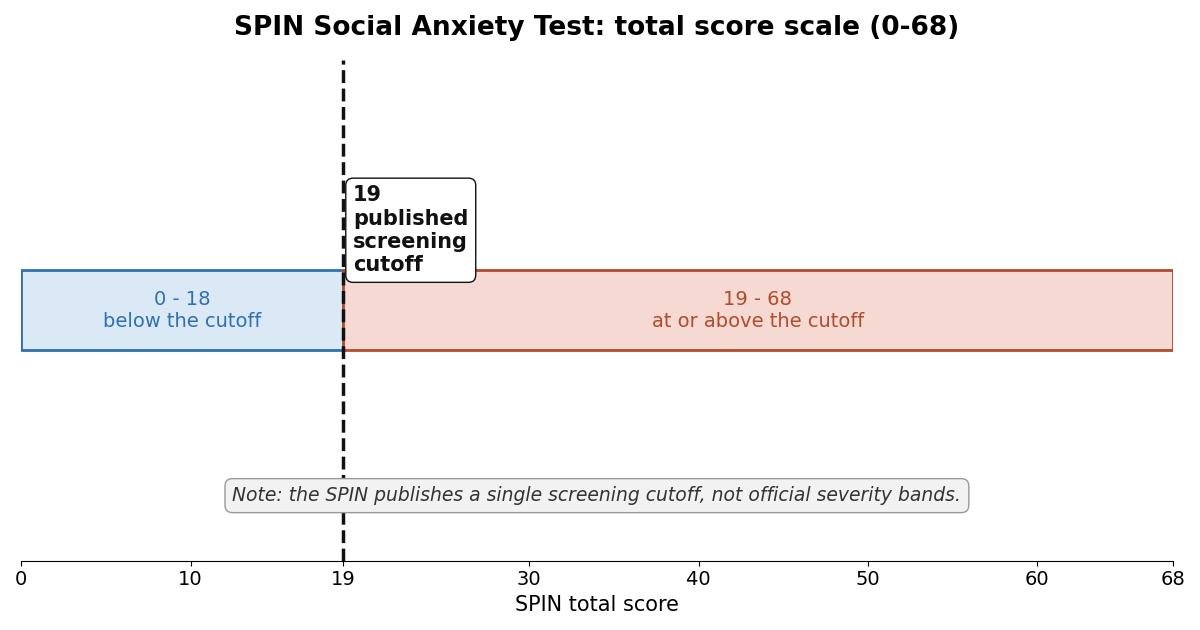
In the original 2000 validation study, Connor and colleagues reported that a SPIN total score of 19 or above suggested social anxiety disorder. That is the published screening cutoff, and it is the only threshold the instrument itself provides. The SPIN does not publish official mild, moderate, or severe bands the way some other questionnaires do, so any severity labels you see attached to SPIN scores come from other sources and are not part of the instrument.
A score at or above 19 means your pattern of answers resembles the pattern reported by people diagnosed with social anxiety disorder in the validation research. It is a prompt to take the possibility seriously and to consider a professional evaluation, not a verdict. A score below 19 means your answers do not reach that screening threshold; it does not certify that you are free of social anxiety, because questionnaires miss things, and it does not mean your distress is unimportant if you are struggling.
It helps to think of the cutoff the way you would think of a smoke alarm. An alarm going off does not prove there is a fire, and silence does not prove there is none, but the alarm exists to make you check. A SPIN score is one structured snapshot of one week. It becomes meaningful when combined with the story only you can tell: how long this has been happening, what you have stopped doing because of it, and what it is costing you.
What the SPIN cannot tell you
Every questionnaire has limits, and the SPIN is no exception. The first limit is that it is self-report. Your score reflects how you perceive and describe your symptoms, which can shift with your mood on the day, how you interpret phrases like "very much," and whether you tend to minimize or magnify difficulties when writing about them. Two people with similar inner experiences can produce different scores for these reasons alone.
The second limit is cultural and personal expression. The bodily symptoms the SPIN asks about, such as blushing or sweating, are noticed and reported differently across cultures, genders, and personalities. In some cultural contexts, deference to authority figures or reluctance to speak up in groups is ordinary social behavior rather than a symptom, and items about authority or strangers can read differently depending on your background. The questionnaire does not adjust for any of this, so the score should always be interpreted by someone who understands your context.
The third limit is time. The SPIN asks about the past week only. A difficult week at work, an upcoming presentation, or a recent embarrassing incident can lift your score temporarily, while a quiet week with few social demands can lower it even if the underlying pattern is unchanged. If you retake the questionnaire, treat each score as a data point in a series rather than a final answer.
Finally, the SPIN cannot distinguish social anxiety from conditions that overlap with it. Depression can produce social withdrawal that looks like avoidance; generalized anxiety can produce the same bodily symptoms in non-social situations; and medical causes such as thyroid problems can produce palpitations or sweating that have nothing to do with anxiety. This is why the instrument is a screening tool and why interpretation belongs with a professional who can consider the alternatives.
What to do after a high score
If your score is at or above 19, or if it is below 19 but you are still struggling, the most useful next step is a conversation with a professional: your general practitioner, a psychologist, a psychiatrist, or a counselor. Bring your score and, if you can, note which subscale was highest and which situations trouble you most. That concrete detail makes the first appointment far more productive than a vague report of "feeling anxious."
Social anxiety disorder is one of the more treatable mental health conditions. The best-supported psychological approach is cognitive behavioral therapy that includes gradual exposure: working step by step through feared situations, starting with manageable ones and building upward, while learning to challenge the predictions that fuel the fear. Medication prescribed by a clinician is another established option, and many people combine medication with therapy. What matters is that the plan is chosen with a professional who knows your history, because treatments that help one person can be wrong for another.
While you arrange professional help, small structured steps can keep you moving. Keep a brief log of feared situations, what you predicted would happen, and what actually happened; predictions in social anxiety are often far worse than reality, and a written record makes that visible. Set one small social goal per week, such as asking a shop assistant a question or joining a group conversation briefly, and repeat it until the alarm fades. If anxiety ever comes with thoughts of harming yourself, treat that as urgent: contact your local emergency services or a crisis helpline immediately rather than waiting for a questionnaire result to guide you.
Related scales
The SPIN is one member of a family of social anxiety measures. The Liebowitz Social Anxiety Scale (LSAS), developed by Michael Liebowitz in 1987, is longer and is usually administered by a clinician; it rates fear and avoidance across 24 social and performance situations and remains a standard outcome measure in treatment research. The Social Interaction Anxiety Scale (SIAS) and the Social Phobia Scale (SPS), both published by Mattick and Clarke in 1998, separate anxiety in social interactions from fear of being observed during routine activities. The Social Phobia and Anxiety Inventory (SPAI) by Turner and colleagues from 1989 is a more detailed self-report covering a wide range of situations.
For broader screening, clinicians often pair the SPIN with general measures. The GAD-7 (Spitzer and colleagues, 2006) screens for generalized anxiety across seven items, and the PHQ-9 (Kroenke and colleagues, 2001) screens for depression across nine items. Because social anxiety frequently coexists with depression and with other anxiety patterns, a fuller picture sometimes requires more than one questionnaire. The SPIN's specific contribution is its focus: it measures social anxiety in particular, not anxiety in general, and that focus is what the cutoff of 19 is calibrated against.
Source: Connor KM, Davidson JRT, Churchill LE, Sherwood A, Foa E, Weisler RH. Psychometric properties of the Social Phobia Inventory (SPIN): new self-rating scale. Br J Psychiatry. 2000;176:379-386. doi:10.1192/bjp.176.4.379