Kt/V Dialysis Adequacy Calculator
In short: Calculate single-pool Kt/V dialysis adequacy with the Daugirdas second-generation equation. Enter pre- and post-dialysis BUN, session length, ultrafiltration and weight, and compare your result with the KDOQI target. Use the calculator above, then read the guide below to interpret your result and its limitations.
This calculator estimates the single-pool Kt/V of a haemodialysis session using the Daugirdas second-generation equation. Enter the pre- and post-dialysis BUN, the session length, the ultrafiltration volume and the post-dialysis weight to get your spKt/V and see how it compares with the KDOQI adequacy target.
| Detail | Value |
|---|---|
| BUN ratio R (post / pre) | |
| Urea reduction ratio (URR) |
What your Kt/V result means
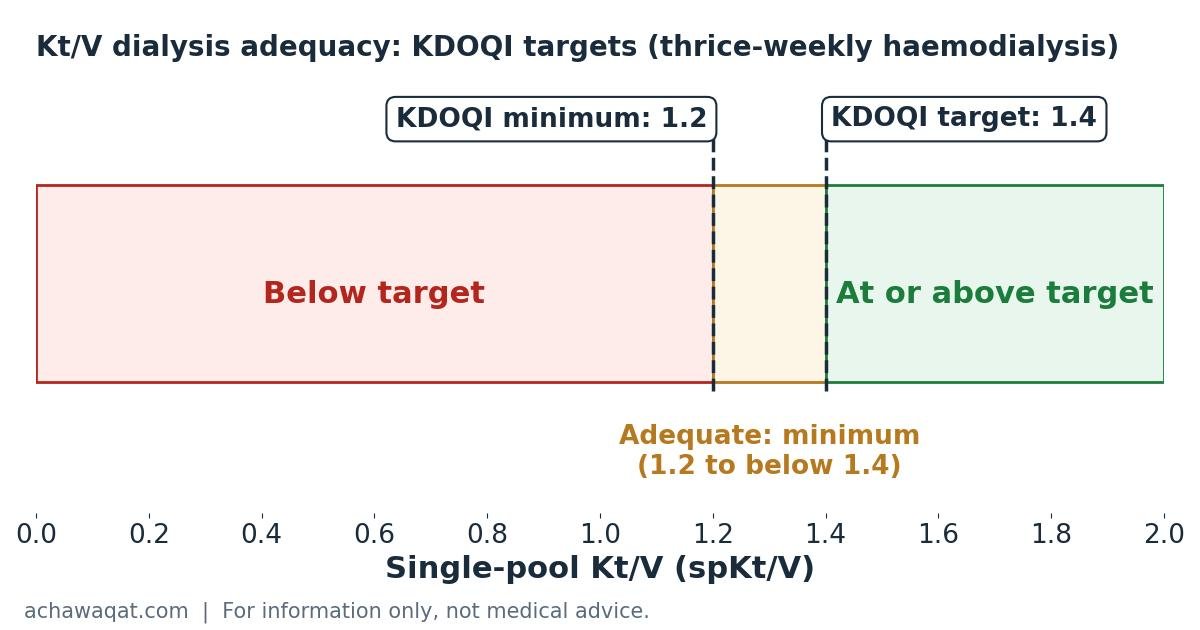
The result above is a single-pool Kt/V (spKt/V): a dimensionless number that summarises how much urea the session removed relative to the body water it was removed from. For adults on thrice-weekly haemodialysis, the KDOQI adequacy guideline recommends a target spKt/V of 1.4 per session, with a minimum delivered dose of 1.2. A result of 1.2 or higher meets the minimum target; a result below 1.2 is below target and is worth discussing with the dialysis team, because consistently under-delivered sessions are associated with worse outcomes in observational studies.
| spKt/V | Interpretation | What it means |
|---|---|---|
| Below 1.2 | Below target | The session delivered less urea clearance than the KDOQI minimum. Ask the dialysis team to review the prescription, the access, and the session length. |
| 1.2 to 1.39 | Adequate: meets the minimum | The KDOQI minimum delivered dose is met. The guideline still recommends aiming for 1.4, because a session that only just reaches 1.2 leaves no margin for variation. |
| 1.4 and above | At or above the KDOQI target | The recommended target is met or exceeded. Higher values within a normal range are generally reassuring for the urea dose. |
These bands apply to the standard thrice-weekly schedule. People on daily, nocturnal or less frequent schedules are judged by different measures, such as standard Kt/V, because the same per-session number means something different when sessions happen more or less often. The calculator also shows the urea reduction ratio (URR), which is simply the percentage fall in BUN across the session. A URR of about 65 percent corresponds roughly to a spKt/V of 1.2 when ultrafiltration is modest, and many clinics track both numbers side by side.
How single-pool Kt/V is calculated
The three letters describe the physics of the session. K is the dialyser's urea clearance, the volume of blood fully cleared of urea per minute. The lowercase t is the session length. V is the urea distribution volume, roughly the body's total water, which dilutes the cleared urea. Multiplying clearance by time and dividing by the volume gives a number with no units: the fraction of the body's urea pool that was effectively cleared, adjusted for the way urea levels fall exponentially rather than linearly during the session.
Measuring K and V directly for every patient would be impractical, so the Daugirdas second-generation equation estimates spKt/V from five routine numbers, and it is the formula this calculator uses:
Here R is the ratio of post-dialysis BUN to pre-dialysis BUN, t is the session length in hours, UF is the ultrafiltration volume in litres, and W is the post-dialysis weight in kilograms. The first term is the logarithmic clearance term: because urea falls exponentially, the natural log of the BUN ratio captures the clearance, while the small 0.008 x t correction accounts for the urea the body keeps generating during the session itself. The second term accounts for convection: removing fluid drags dissolved urea out with it, so sessions with large ultrafiltration volumes deliver extra clearance beyond diffusion alone. Weight stands in for V, since a larger patient has a larger urea distribution volume and needs more absolute clearance to reach the same Kt/V.
A worked example shows how the pieces fit together. Take a pre-dialysis BUN of 60 mg/dL, a post-dialysis BUN of 20 mg/dL, a 4-hour session, 2.5 litres of ultrafiltration, and a post-dialysis weight of 70 kg. The ratio R is 20/60 = 0.333. The logarithmic term is -ln(0.333 - 0.008 x 4) = -ln(0.301) = 1.20. The ultrafiltration term is (4 - 3.5 x 0.333) x 2.5/70 = 2.833 x 0.0357 = 0.10. Adding them gives a spKt/V of 1.30, which meets the KDOQI minimum target of 1.2.
The KDOQI adequacy targets
The numbers this calculator compares against come from the National Kidney Foundation's KDOQI clinical practice guideline for haemodialysis adequacy. For adults dialysing three times per week, the guideline recommends a target spKt/V of 1.4 per treatment and sets 1.2 as the minimum delivered dose that every session should reach. The distinction between target and minimum is deliberate: aiming at 1.4 leaves a safety margin, because real sessions vary, while 1.2 is the floor below which the prescription should be changed.
These targets assume the standard thrice-weekly rhythm. When dialysis happens on a different schedule, the per-session target stops being comparable: six short sessions a week can each show a modest Kt/V yet deliver more total weekly clearance than three long ones. That is why guidelines use standard Kt/V, a weekly measure, for frequent or infrequent schedules, and why this calculator's interpretation is labelled for the thrice-weekly context only. The guideline also recognises residual kidney function: patients who still pass significant urine get extra clearance their kidneys provide, which the Kt/V of the machine session does not include, so the target is applied with clinical judgement rather than as an absolute rule.
Why urea rebound makes single-pool Kt/V an overestimate
The post-dialysis BUN used in the Daugirdas equation is drawn the moment the session ends, but the body's urea is not yet evenly mixed at that point. During dialysis, urea is cleared fastest from well-perfused tissues such as muscle that sits near the bloodstream, while poorly perfused compartments lag behind. After the blood pump stops, urea keeps diffusing out of those slow compartments for 30 to 60 minutes, and the BUN measured an hour later is noticeably higher than the immediate post-dialysis sample. This is urea rebound, and it means the single-pool calculation, which uses the lowest BUN of the day, overstates the true delivered dose.
Equilibrated Kt/V (eKt/V) corrects for this by estimating what the BUN would be after full equilibration, and it is always somewhat lower than the single-pool value. KDOQI treats the equilibrated figure as the truer measure of delivered dose. In practice, few clinics draw a 60-minute post sample, so the single-pool value is what gets reported, with the understanding that a spKt/V sitting exactly on 1.2 is probably delivering slightly less than the minimum once rebound is accounted for. That is one more reason the guideline recommends targeting 1.4 rather than hovering at the floor.
Sampling technique matters for the same reason. If the post-dialysis sample is drawn while blood is still recirculating through the access, or before the dialysate flow is properly stopped, the measured post BUN comes out artificially low and the calculated Kt/V artificially high. Dialysis units use a slow-flow or stop-pump sampling method to avoid this, and a Kt/V that looks surprisingly good alongside a poor clinical picture should prompt a check of how the sample was drawn before anyone celebrates.
What Kt/V does and does not tell you
Kt/V is a measure of small-solute clearance, and urea is its stand-in for the small waste molecules. That is genuinely useful: urea is easy to measure, and the dose-response relationship between delivered Kt/V and outcomes was established in the era when underdialysis was common. But urea itself is only mildly toxic, and a good Kt/V says nothing about several things that determine how well a patient actually does on dialysis.
It says nothing about middle molecules: larger waste products that cross the dialyser membrane slowly and are cleared far less efficiently than urea. It says nothing about fluid management: a patient can have an excellent Kt/V while struggling with high blood pressure, breathlessness or cramps from poor ultrafiltration control, because Kt/V counts litres removed only as a small convection bonus, not as a measure of volume control. It says nothing about anaemia, mineral and bone disorder, nutrition or inflammation, all of which shape outcomes independently. And it does not include residual kidney function, which clears middle molecules and manages salt and water in ways the machine cannot replicate, so two patients with identical Kt/V values can have very different total clearance.
This is why nephrologists treat Kt/V as one instrument on the dashboard rather than the whole dashboard. A value below target reliably signals that the prescription needs attention, but a value above target is not a guarantee of adequate dialysis overall. The number earns its keep as a quality floor for the urea dose, and the rest of dialysis care sits alongside it.
Practical factors that raise or lower Kt/V
When a Kt/V comes back below target, the dialysis team works through the prescription looking for the cause, and the same list helps patients understand what the number responds to. Session length is the most powerful lever: because t multiplies clearance directly, a session cut short by half an hour loses dose that cannot be recovered by any other adjustment that day. Missed or shortened sessions are the commonest reason for a low monthly average, which is why units track attendance as an adequacy issue, not just a scheduling one.
Blood pump speed is next: the dialyser can only clear the blood it is given, so a low blood flow rate caps K regardless of the membrane. Access problems often show up here first, when a fistula or graft that used to support a good pump speed starts alarming and the nurses have to turn it down. Recirculation, where cleaned blood short-circuits back into the arterial needle instead of returning to the body, has the same effect while looking deceptively normal on the machine. Dialyser size matters too: a small membrane has less surface area for diffusion, and a patient whose weight has risen since the prescription was written may simply have outgrown their dialyser, since a larger V needs a larger K x t to reach the same ratio.
Weight changes cut both ways in the formula. Gaining weight enlarges V and lowers Kt/V for the same session, while the ultrafiltration term means that removing more fluid adds a little clearance back. High ultrafiltration goals can still hurt adequacy indirectly, because cramps or low blood pressure may force the session to end early. The practical message is that Kt/V is not a fixed property of the patient: it responds to the prescription, the access, attendance and body composition, and a low value is usually fixable once the cause is found.
Limitations
- This calculator estimates single-pool Kt/V for a thrice-weekly haemodialysis session. It is not valid for daily, nocturnal, short-daily or twice-weekly schedules, which are assessed with standard Kt/V.
- Single-pool Kt/V overstates the delivered dose because of urea rebound; the equilibrated value is lower, so a result exactly at 1.2 is borderline rather than comfortable.
- The result is only as good as the blood samples. A post-dialysis BUN drawn with recirculation or incorrect technique produces a falsely reassuring Kt/V.
- Residual kidney function contributes clearance that this calculation does not include, so the target is applied with clinical judgement in patients who still make urine.
- Kt/V measures urea (small-solute) clearance only. It does not assess middle-molecule clearance, fluid and blood pressure control, anaemia, mineral bone disorder or nutrition.
- This tool gives an adequacy estimate, not a diagnosis, and it does not replace the advice of the nephrologist and dialysis team.
Key takeaways
- Kt/V is a dimensionless number that expresses the dialysis dose: how much urea was cleared relative to the volume it was cleared from.
- For adults on thrice-weekly haemodialysis, KDOQI recommends a target single-pool Kt/V of 1.4 per session, with a minimum delivered dose of 1.2.
- This calculator uses the Daugirdas second-generation logarithmic equation: spKt/V = -ln(R - 0.008 x t) + (4 - 3.5 x R) x UF/W, where R is the ratio of post-dialysis to pre-dialysis BUN, t is the session length in hours, UF is the ultrafiltration volume in litres, and W is the post-dialysis weight in kilograms.
- Common reasons include a shortened or missed session, a low blood pump speed, a dialyser that is too small for the patient, recirculation in the vascular access, poor needle placement, weight gain between sessions that enlarges V, or a very high ultrafiltration goal that forces the session to end early.
Frequently asked questions
What is Kt/V in dialysis?
Kt/V is a dimensionless number that expresses the dialysis dose: how much urea was cleared relative to the volume it was cleared from. K is the dialyser urea clearance, t is the session length, and V is the urea distribution volume, roughly total body water. A higher Kt/V means more urea was removed in the session.
What is a good Kt/V value?
For adults on thrice-weekly haemodialysis, KDOQI recommends a target single-pool Kt/V of 1.4 per session, with a minimum delivered dose of 1.2. A result of 1.2 or higher meets the minimum target. Below 1.2 is below target and should be discussed with the dialysis team.
How is single-pool Kt/V calculated?
This calculator uses the Daugirdas second-generation logarithmic equation: spKt/V = -ln(R - 0.008 x t) + (4 - 3.5 x R) x UF/W, where R is the ratio of post-dialysis to pre-dialysis BUN, t is the session length in hours, UF is the ultrafiltration volume in litres, and W is the post-dialysis weight in kilograms.
Why is my Kt/V low?
Common reasons include a shortened or missed session, a low blood pump speed, a dialyser that is too small for the patient, recirculation in the vascular access, poor needle placement, weight gain between sessions that enlarges V, or a very high ultrafiltration goal that forces the session to end early. The dialysis team investigates low values by checking each of these in turn.
What is the difference between single-pool and equilibrated Kt/V?
Single-pool Kt/V is calculated from a blood sample drawn immediately after dialysis, while equilibrated Kt/V accounts for urea rebound: urea continues to diffuse out of poorly perfused tissues for 30 to 60 minutes after the session ends, so the BUN measured an hour later is higher. Equilibrated Kt/V is therefore lower than single-pool Kt/V, and KDOQI treats it as the truer measure of delivered dose.
Does a Kt/V of 1.2 mean my dialysis is perfect?
No. Kt/V measures small-solute (urea) clearance only. It says nothing about middle-molecule clearance, fluid and blood pressure control, anaemia, mineral bone disorder, nutrition, or the clearance still provided by any residual kidney function. The target is a minimum standard for the urea dose, not a certificate of overall dialysis quality.
Sources
Daugirdas JT. Second generation logarithmic estimates of single-pool variable volume Kt/V: an analysis of error. J Am Soc Nephrol. 1993;4(5):1205-13. DOI: 10.1681/ASN.V451205
National Kidney Foundation. KDOQI Clinical Practice Guideline for Hemodialysis Adequacy: 2015 update. Am J Kidney Dis. 2015;66(5):884-930.