What gentamicin is
Gentamicin is an aminoglycoside antibiotic that kills bacteria by binding to the bacterial ribosome and disrupting protein synthesis. It is bactericidal, meaning it directly kills susceptible organisms rather than merely slowing their growth, and its killing is concentration dependent: higher peak concentrations drive stronger bacterial killing, up to the point where toxicity risk takes over. Clinicians reach for gentamicin mainly against serious Gram-negative infections, including sepsis, urinary tract infections, and neonatal infections, and sometimes in combination regimens against certain Gram-positive organisms. In newborn nurseries and pediatric wards it is one of the most commonly used empiric antibiotics for suspected serious bacterial infection, often paired with ampicillin while culture results are pending.
Because the margin between an effective dose and a toxic dose is narrow, gentamicin is never dosed casually in children. The treating team weighs the child's weight, age, kidney function, the severity of the infection, and how susceptible the organism is, and then adjusts the plan using measured drug levels in the blood. This page explains the label-based dosing bands, the guideline-based once-daily approach, how monitoring works, and the serious warnings that come with every aminoglycoside. It is an educational reference. It does not replace the judgment of the child's care team, and it must never be used to start, change, or stop treatment.
Traditional dosing in children
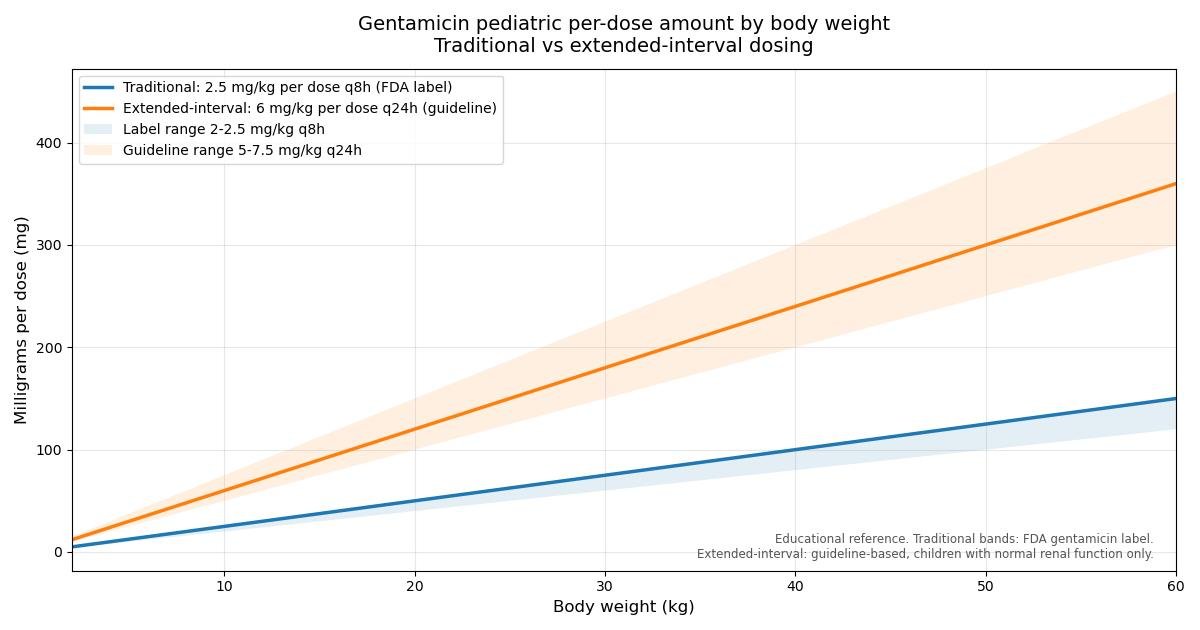
The FDA-approved label for gentamicin injection gives the pediatric schedule plainly. For children, the dose is 6 to 7.5 mg per kg per day, administered as 2 to 2.5 mg per kg every 8 hours. The dose for intravenous and intramuscular administration is identical, and the patient's pretreatment body weight should be obtained so the dose is calculated correctly. For a 10 kg child, that works out to 20 to 25 mg every 8 hours, or 60 to 75 mg across the day. The reference widget above uses 2.5 mg per kg per dose for its calculation, which gives 25 mg every 8 hours for the 10 kg child, and it states the full label range alongside the figure.
Two label details matter in practice. First, in obese patients the dose of an aminoglycoside should be based on an estimate of lean body mass, not total body weight, because gentamicin distributes poorly into fat. Second, the label advises keeping aminoglycoside courses short when possible, with a usual duration of 7 to 10 days; in difficult infections where treatment runs longer, the label specifically recommends monitoring renal, auditory, and vestibular function, because toxicity becomes more likely after 10 days. Dose reduction is appropriate whenever clinical signs point that way.
Extended-interval (once-daily) dosing in children
An important clarification comes first: once-daily gentamicin is not on the FDA label. It is a guideline-based strategy supported by pediatric infectious-disease guidance and hospital protocols, for example pediatric references that cite 4.5 to 7.5 mg per kg once every 24 hours, and the Perth Children's Hospital monograph which uses 7 mg per kg once daily in children from 4 weeks of age. The range most often taught and used is 5 to 7.5 mg per kg given as a single daily dose, and only in children with normal renal function. For a 10 kg child the widget therefore shows 60 mg once every 24 hours, using the midpoint of 6 mg per kg, while stating the full guideline range.
The rationale rests on two pharmacologic properties of aminoglycosides. Killing is concentration dependent, so one large dose achieves the high peak that drives efficacy, and the drugs show a post-antibiotic effect, meaning bacterial growth stays suppressed for a time even after the concentration falls below the inhibitory level. A once-daily schedule then leaves a long drug-free interval at the end of the 24 hours, during which the concentration in the kidney and inner ear falls, which is the theoretical basis for no greater (and possibly lesser) toxicity than divided dosing. Because the whole strategy depends on that drug-free interval actually happening, extended-interval dosing demands careful monitoring: the team confirms that the level drawn just before the next dose is very low, and extends the interval rather than reducing the dose when clearance is slower than expected. This approach is not used for synergy against Gram-positive endocarditis, and it is not applied to neonates, whose immature kidneys clear the drug much more slowly.
Neonatal dosing bands
Neonates handle gentamicin differently from older children because their kidneys are still maturing and clear the drug slowly. The FDA label therefore gives neonates their own bands, and these are reproduced here exactly as the label states them. Infants and neonates receive 7.5 mg per kg per day, given as 2.5 mg per kg every 8 hours. Premature or full-term neonates one week of age or less receive 5 mg per kg per day, given as 2.5 mg per kg every 12 hours. The per-dose amount is 2.5 mg per kg in both bands; what changes with age is the interval, and therefore the daily total.
A note of caution belongs here because some hospital protocols and references (for example Neofax-style tables based on postmenstrual and postnatal age) use longer intervals for very preterm infants, such as every 24 to 48 hours. Those tables are guideline material, not the FDA label. The label itself keeps only the two bands above, and it adds that when drug levels cannot be measured, the stated schedules are guides rather than rigid recommendations. In neonatal practice, levels are almost always measured, and intervals are individualized from the results. Neonatal schedules vary with gestational age, postmenstrual and postnatal age, renal function, indication, local formulary and measured concentrations. For that reason this page does not produce a neonatal dose or interval; use the local neonatal protocol and therapeutic drug monitoring with a neonatal pharmacist or specialist.
Why levels are monitored: peaks and troughs explained
Therapeutic drug monitoring is standard of care with gentamicin in children, and the label itself calls it desirable: it recommends measuring both peak and trough serum concentrations periodically during therapy, when feasible, to assure adequate but not excessive drug levels. A peak is the highest concentration, drawn shortly after the dose (the label describes the expected peak 30 to 60 minutes after an intramuscular injection), and it reflects whether the dose is large enough to kill the organism. A trough is the lowest concentration, drawn just before the next dose, and it reflects whether the drug has cleared enough; a high trough warns that the next dose would stack on top of leftover drug and push the patient toward toxicity.
The label gives concrete targets for traditional dosing. The peak is expected to be in the range of 3 to 5 mcg per mL, and when monitoring peaks the dosage should be adjusted so that prolonged levels above 12 mcg per mL are avoided. When monitoring troughs, the dosage should be adjusted so that levels above 2 mcg per mL are avoided. Whether a particular level is adequate also depends on the susceptibility of the causative organism, the severity of the infection, and the patient's own defenses, which is why a number on a lab slip is always interpreted by the team rather than read in isolation. Patients with extensive burns deserve special mention: altered pharmacokinetics can lower aminoglycoside concentrations, so the label recommends measuring serum levels as the basis for dose adjustment in that group. With extended-interval dosing the monitoring logic shifts, because the goal becomes confirming a high post-infusion peak and a very low pre-dose trough, and the team may lengthen the interval if the trough is not low enough. Either way, the principle is the same: guesswork is replaced by measurement.
Ototoxicity and nephrotoxicity: the boxed warnings
The FDA label carries its strongest warnings, the boxed warnings, for four hazards, and every clinician who orders gentamicin must weigh them. First, ototoxicity: gentamicin can damage both the cochlear branch (hearing) and the vestibular branch (balance) of the eighth cranial nerve, and the damage can be irreversible. The risk climbs with impaired renal function, dehydration, higher doses, and longer courses, and with concurrent or sequential use of other ototoxic drugs, particularly potent diuretics such as furosemide and ethacrynic acid, and other aminoglycosides. Families should report ringing in the ears, hearing changes, dizziness, or unsteadiness at once, and audiologic monitoring is part of longer courses. Second, nephrotoxicity: gentamicin can injure the kidneys, especially when the patient is dehydrated, is receiving high or prolonged doses, has preexisting renal impairment, or is taking other nephrotoxic medicines such as vancomycin. Kidney function is checked before and during therapy, and the dose is reduced or the interval lengthened when creatinine rises.
Third, neuromuscular blockade: aminoglycosides can impair neuromuscular transmission and, in rare cases, cause respiratory paralysis, a risk that rises when they are combined with anesthetics or neuromuscular blocking agents, and calcium salts can reverse the blockade. Fourth, fetal harm: aminoglycosides can cause fetal harm when administered to a pregnant woman, a warning that matters in adolescent practice. Taken together, these warnings explain why gentamicin is a hospital drug, why hydration status and kidney function are checked first, why the medicine list is reviewed for interacting drugs, and why treatment is stopped or changed at the first sign of hearing or kidney trouble.
Administration in children
Gentamicin may be given intramuscularly or intravenously, and the label states that the recommended dosage is identical for both routes. For intermittent intravenous administration, a single dose is diluted in 50 to 200 mL of sterile isotonic saline or 5 percent dextrose in water for adults, with a smaller volume of diluent in infants and children, and infused over one half to two hours. In practice many pediatric teams infuse the dose over 30 to 60 minutes, but the label's stated window is 30 minutes to 2 hours, and the team's own protocol governs. The drug must not be physically premixed with other drugs; it is administered separately according to the recommended route and schedule. As noted above, the usual course is 7 to 10 days, extendable for difficult or complicated infections with intensified monitoring of renal, auditory, and vestibular function, and the dose is reduced whenever clinical judgment calls for it.
Sources
Dosing bands, monitoring targets, infusion instructions, and boxed warnings on this page are taken from the FDA-approved prescribing information for gentamicin injection (DailyMed, U.S. National Library of Medicine; label sections on dosage and administration, warnings, and boxed warnings). The extended-interval range of 5 to 7.5 mg per kg once daily in children with normal renal function is guideline-based rather than label-based; corroborating references include pediatric dosing references citing 4.5 to 7.5 mg per kg every 24 hours (Lexicomp-based pediatric summaries) and the Perth Children's Hospital paediatric gentamicin monograph (7 mg per kg once daily from 4 weeks of age). Neonatal interval practice beyond the label bands follows institutional neonatal references such as Neofax-style postmenstrual-age tables. This page was medically reviewed by Dr. Taimoor Asghar (physician and community medicine researcher).
Key takeaways
- The FDA label for gentamicin injection states 6 to 7.5 mg per kg per day for children, given as 2 to 2.5 mg per kg every 8 hours.
- Infants and neonates receive 7.5 mg per kg per day (2.5 mg per kg every 8 hours).
- Extended-interval dosing gives the whole day's dose at once, typically 5 to 7.5 mg per kg once daily in children with normal renal function.
- The FDA label expects peak concentrations of 3 to 5 mcg per mL measured 30 to 60 minutes after intramuscular injection, advises avoiding prolonged levels above 12 mcg per mL, and advises adjusting dosage so that trough concentrations just before the next dose do not exceed 2 mcg per mL.
Frequently asked questions
What is the standard gentamicin dose for children?
The FDA label states 6 to 7.5 mg per kg per day for children, given as 2 to 2.5 mg per kg every 8 hours, with identical dosing for intravenous and intramuscular routes. The usual treatment duration is 7 to 10 days.
What is the FDA label dose for neonates?
Infants and neonates receive 7.5 mg per kg per day (2.5 mg per kg every 8 hours). Premature or full-term neonates one week of age or less receive 5 mg per kg per day (2.5 mg per kg every 12 hours).
What is once-daily (extended-interval) gentamicin dosing in children?
Extended-interval dosing gives 5 to 7.5 mg per kg as a single daily dose in children with normal renal function. It is guideline-based, not on the FDA label, and it depends on therapeutic drug monitoring to confirm that the level before the next dose falls low enough.
What peak and trough targets are used when monitoring gentamicin?
On traditional dosing the label expects peaks of 3 to 5 mcg per mL, advises avoiding prolonged levels above 12 mcg per mL, and advises keeping troughs just before the next dose at or below 2 mcg per mL.
What are the boxed warnings for gentamicin?
The label carries boxed warnings for ototoxicity (cochlear and vestibular, possibly irreversible), nephrotoxicity, neuromuscular blockade with risk of respiratory paralysis, and fetal harm in pregnancy. Risk rises with renal impairment, dehydration, high or prolonged doses, and concurrent ototoxic or nephrotoxic drugs.
How is gentamicin given intravenously to children?
A single dose is diluted in sterile saline or 5 percent dextrose, using a smaller diluent volume for infants and children than for adults, and infused over one half to two hours per the label. It is never premixed with other drugs and is given separately.