Amoxicillin-Clavulanate Dosage Calculator for Children
In short: Pediatric amoxicillin-clavulanate (co-amoxiclav) dosage calculator: weight-based standard 45 mg/kg/day and high-dose 90 mg/kg/day regimens, mL per dose by suspension strength, clavulanate safety check, and course length by indication. Use the calculator above, then read the guide below to interpret your result and its limitations.
Co-amoxiclav pediatric dose calculator: enter your child's weight, pick the regimen and the suspension strength on your prescription, and get the dose in mg and mL per dose, the daily totals, a clavulanate safety check, and the recommended course length for the indication.
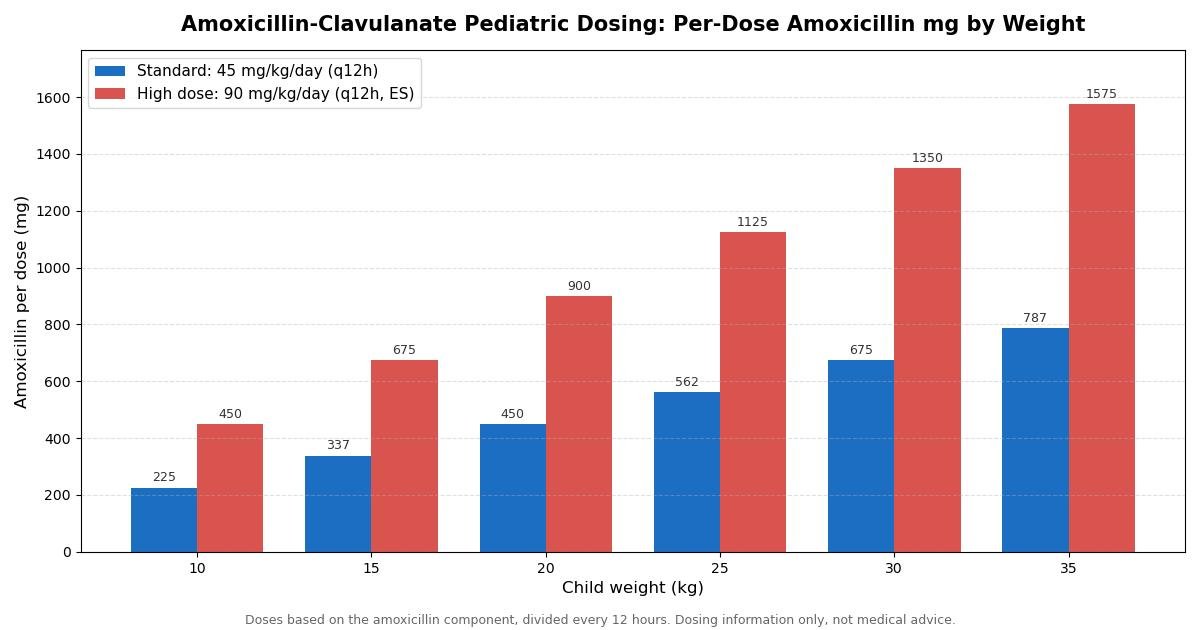
How the calculator works
All pediatric amoxicillin-clavulanate dosing is based on the amoxicillin component, never on the combined weight of the two drugs. The calculator multiplies the regimen dose (45 or 90 mg/kg/day) by the child's weight in kilograms, divides by two daily doses, and then converts milligrams to milliliters using the concentration printed on your bottle. It also works out the clavulanate that comes along with the dose and checks it against the pediatric safety limit of 10 mg of clavulanate per kg per day.
Worked example: 20 kg child, standard regimen
A 20 kg child on the standard 45 mg/kg/day regimen needs 900 mg of amoxicillin per day, which is 450 mg per dose every 12 hours. With a 200/28.5 mg per 5 mL suspension (40 mg of amoxicillin per mL), that is 450 divided by 40 = 11.25 mL per dose, rounded to 11.5 mL for the dosing syringe. The clavulanate in that dose is 64.1 mg, which is 6.4 mg/kg/day, comfortably under the 10 mg/kg/day limit. With the stronger 400/57 mg per 5 mL suspension (80 mg per mL), the same dose measures just 5.5 mL.
Worked example: 20 kg child, high-dose regimen
A 20 kg child on the high-dose 90 mg/kg/day regimen needs 1800 mg of amoxicillin per day, which is 900 mg per dose every 12 hours. With the 600/42.9 mg per 5 mL ES suspension (120 mg of amoxicillin per mL), that is 900 divided by 120 = 7.5 mL per dose. The clavulanate is 64.4 mg per dose, or 6.4 mg/kg/day, under the limit, because the 14:1 ratio keeps clavulanate low while amoxicillin doubles.
Dosing regimens
| Regimen | Amoxicillin dose | Schedule | Formulation to use |
|---|---|---|---|
| Standard | 45 mg/kg/day (label range 25 to 45) | Every 12 hours | 7:1 (200/28.5 or 400/57 per 5 mL) |
| High dose | 90 mg/kg/day | Every 12 hours | 14:1 ES (600/42.9 per 5 mL) |
| Neonates under 12 weeks | 30 mg/kg/day | Every 12 hours | 125/31.25 per 5 mL only |
The standard 45 mg/kg/day divided every 12 hours is the first-line pediatric regimen in the US prescribing information for children 3 months and older. The high-dose 90 mg/kg/day regimen is reserved for acute otitis media that has failed initial therapy, recurrent ear infections, or settings with drug-resistant Streptococcus pneumoniae. Neonates and infants under 12 weeks of age are dosed at 30 mg/kg/day every 12 hours using the 125 mg/5 mL suspension; this calculator is intended for children 3 months and older. Children who weigh 40 kg or more use adult dosing (500 or 875 mg every 12 hours).
Formulation ratios: why they matter
| Ratio | Suspensions | Designed for |
|---|---|---|
| 4:1 | 125/31.25, 250/62.5 per 5 mL | Three-times-daily dosing (20 to 40 mg/kg/day every 8 hours) |
| 7:1 | 200/28.5, 400/57 per 5 mL | Twice-daily dosing at 45 mg/kg/day |
| 14:1 | 600/42.9 per 5 mL (ES) | Twice-daily high-dose at 90 mg/kg/day |
The ratio is amoxicillin to clavulanate. Because clavulanate causes most of the diarrhea and stomach upset, pediatric guidance caps it at 10 mg/kg/day. The math shows why matching formulation to regimen matters: a 20 kg child on standard twice-daily dosing with a 4:1 suspension gets 112.5 mg of clavulanate per dose, which is 11.25 mg/kg/day, over the limit, and the calculator will warn you. The same child with a 7:1 suspension gets 64.1 mg per dose, or 6.4 mg/kg/day, which is safe. Do not simply double the amoxicillin with a standard formulation to reach high-dose levels; that doubles the clavulanate too.
Course length by indication
| Indication | Usual duration | Source |
|---|---|---|
| Acute otitis media | 5 to 10 days (10 days under age 2 or severe; 5 to 7 days for older children with mild to moderate symptoms) | AAP clinical practice guideline, 2013 |
| Acute bacterial sinusitis | 5 to 7 days | IDSA and AAP guidance |
| Community-acquired pneumonia | 7 to 10 days | Standard pediatric practice |
| Skin and soft tissue infection | 7 to 10 days | Standard pediatric practice |
| Urinary tract infection | 7 to 10 days | Standard pediatric practice |
The days shown are the ranges supported by guidelines. Always complete the full course written on the prescription, even if your child feels better after two or three days. Stopping early leaves the hardiest bacteria alive and raises the risk of relapse and resistance.
Practical guidance for parents
Give it with food
Give each dose at the start of a meal, for example with breakfast and dinner for a twice-daily schedule. Food improves clavulanate absorption and meaningfully reduces nausea and stomach cramps. Keep doses about 12 hours apart; set phone alarms so the evening dose is not forgotten.
Diarrhea is common and usually mild
Loose stools affect a noticeable share of children on co-amoxiclav because clavulanate disturbs gut flora. It is usually mild and settles after the course. Offer plenty of fluids. Call the doctor if diarrhea is severe, bloody, or continues more than two days after the course ends, as antibiotic-associated colitis is rare but serious.
Rash versus true allergy
A blotchy, flat, pink, mildly itchy rash appearing a few days into treatment is a common non-allergic amoxicillin rash and is not dangerous by itself, but always report it to the prescriber. A true allergy looks different: hives, swelling of the lips or face, wheeze, or trouble breathing, usually soon after a dose. That is an emergency. A child who has had breathing difficulty or facial swelling with a penicillin must never be given it again without specialist allergy assessment.
Missed dose and storage
If a dose is missed, give it as soon as you remember unless it is nearly time for the next dose; never double up. Shake the bottle well before every dose and measure with the oral syringe supplied, not a kitchen spoon. Store the reconstituted suspension in the refrigerator and discard any remainder after the course (check the bottle for the discard date, usually 10 to 14 days). Keep all medicines out of children's reach.
When to call the doctor
Seek advice if fever persists beyond 48 to 72 hours on treatment, symptoms worsen instead of improving, your child cannot keep the medicine down, a rash appears, or diarrhea becomes severe or bloody. Ear pain that does not improve may need reassessment for the high-dose regimen or a different antibiotic.
Related pediatric dosage calculators
Key takeaways
- The standard pediatric dose is 45 mg/kg/day of the amoxicillin component, divided every 12 hours, using the twice-daily (BID) 7:1 formulations such as 200/28.5 mg or 400/57 mg per 5 mL.
- High-dose therapy, 90 mg/kg/day of the amoxicillin component divided every 12 hours, is used for acute otitis media that has not responded to initial treatment, recurrent ear infections, or where drug-resistant Streptococcus pneumoniae is a concern.
- Clavulanate causes most of the gastrointestinal side effects of co-amoxiclav, especially diarrhea.
- Course length depends on the infection.
Frequently asked questions
What is the standard pediatric dose of amoxicillin-clavulanate?
The standard pediatric dose is 45 mg/kg/day of the amoxicillin component, divided every 12 hours, using the twice-daily (BID) 7:1 formulations such as 200/28.5 mg or 400/57 mg per 5 mL. The US prescribing information gives a range of 25 to 45 mg/kg/day every 12 hours for children 3 months and older who weigh less than 40 kg.
When is high-dose amoxicillin-clavulanate used in children?
High-dose therapy, 90 mg/kg/day of the amoxicillin component divided every 12 hours, is used for acute otitis media that has not responded to initial treatment, recurrent ear infections, or where drug-resistant Streptococcus pneumoniae is a concern. It should be given with the 14:1 ES formulation (600/42.9 mg per 5 mL) so that the extra amoxicillin is not accompanied by extra clavulanate.
Why does the clavulanate dose matter?
Clavulanate causes most of the gastrointestinal side effects of co-amoxiclav, especially diarrhea. Pediatric dosing guidance keeps clavulanate at or below 10 mg/kg/day. Using a 4:1 suspension (for example 125/31.25 mg per 5 mL) on a twice-daily schedule can push clavulanate to about 11.25 mg/kg/day at the standard 45 mg/kg/day amoxicillin dose, which is why 4:1 formulations are labeled for three-times-daily dosing and 7:1 or 14:1 formulations are preferred for twice-daily regimens.
How many days should my child take amoxicillin-clavulanate?
Course length depends on the infection. Acute otitis media is usually treated for 5 to 10 days (10 days for children under 2 years or with severe symptoms, 5 to 7 days for older children with mild to moderate symptoms, per the AAP guideline). Acute bacterial sinusitis is treated for 5 to 7 days per IDSA and AAP guidance. Always follow the duration your prescriber wrote on the prescription.
Should amoxicillin-clavulanate be taken with food?
Yes. Taking amoxicillin-clavulanate at the start of a meal improves absorption of clavulanate and reduces stomach upset, nausea, and diarrhea. Give the dose with breakfast and dinner for a twice-daily schedule, and keep the doses about 12 hours apart.
What is the difference between an amoxicillin rash and a true allergy?
A non-allergic amoxicillin rash is common in children: it is usually a flat, blotchy, mildly itchy pink rash that appears a few days into treatment and fades without danger. A true allergy causes hives, swelling of the lips or face, wheezing, or breathing difficulty, usually soon after a dose, and needs urgent medical care. Only a clinician can tell the difference, so report any rash and never re-challenge a child who had breathing difficulty or facial swelling.
Sources
- Amoxicillin and clavulanate potassium prescribing information (US label): dosage and administration, dosage forms and strengths. DailyMed label (PDF)
- AAP clinical practice guideline: the diagnosis and management of acute otitis media (Pediatrics, 2013).
- IDSA clinical practice guideline for acute bacterial rhinosinusitis in children and adults (2012).
References and further reading
Medical disclaimer: This calculator provides dosing information for educational purposes only and is not medical advice. Antibiotic choice, dose, and duration must be decided by a qualified clinician who has examined your child. Do not start, stop, or change an antibiotic without medical guidance. Dosing reviewed by Dr. Taimoor Asghar, physician and community medicine researcher.