Pediatric Albendazole Dosing Calculator and Dosing Reference
In short: Pediatric albendazole dosing calculator and reference with verified regimens: pinworm, roundworm, hookworm and whipworm single doses, giardiasis 5-day course, neurocysticercosis and hydatid weight-based dosing with the 800 mg/day cap. Worked examples and FAQs. Use the calculator above, then read the guide below to interpret your result and its limitations.
Verified pediatric dosing reference for albendazole, the broad-spectrum benzimidazole anthelmintic used for intestinal worms, giardiasis, neurocysticercosis and hydatid disease. Every regimen on this page was checked against the FDA-approved product label, WHO preventive chemotherapy guidance and a hospital paediatric monograph before publication.
Dose calculator
Enter the child's weight, age band and indication. The calculator returns the dose, the frequency, the daily total and the course length, with the 800 mg per day safety cap applied automatically for neurocysticercosis and hydatid disease.
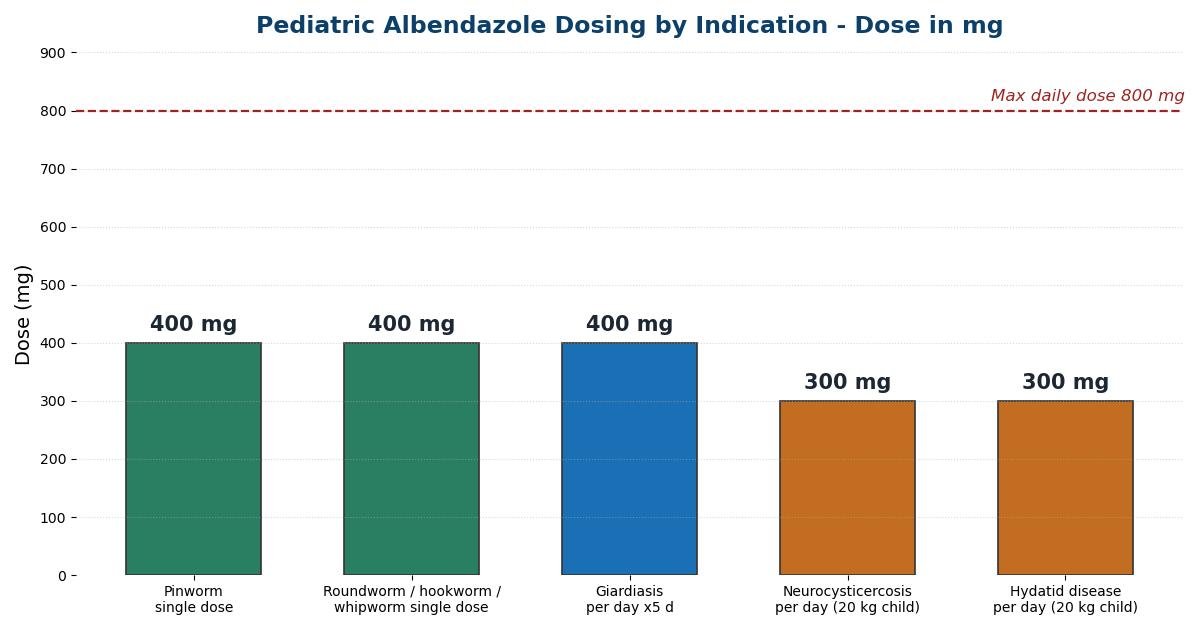
Verified regimen reference table
| Indication | Age band | Dose | Course |
|---|---|---|---|
| Pinworm (enterobiasis) | 1 to under 2 years | 200 mg | Single dose |
| Pinworm (enterobiasis) | 2 years and older | 400 mg | Single dose |
| Roundworm (ascariasis), hookworm, whipworm (trichuriasis) | 1 to under 2 years | 200 mg | Single dose |
| Roundworm (ascariasis), hookworm, whipworm (trichuriasis) | 2 years and older | 400 mg | Single dose |
| Giardiasis | 2 to 12 years | 400 mg once daily | 5 consecutive days |
| Neurocysticercosis | Children under 60 kg | 15 mg/kg/day in 2 divided doses with meals (maximum 800 mg/day) | 8 to 30 days, with corticosteroids and anticonvulsants as required |
| Neurocysticercosis | Children 60 kg or more | 400 mg twice daily with meals | 8 to 30 days, with corticosteroids and anticonvulsants as required |
| Hydatid disease (echinococcosis) | Children under 60 kg | 15 mg/kg/day in 2 divided doses with meals (maximum 800 mg/day) | 28-day cycles with a 14-day drug-free interval, total 3 cycles |
| Hydatid disease (echinococcosis) | Children 60 kg or more | 400 mg twice daily with meals | 28-day cycles with a 14-day drug-free interval, total 3 cycles |
Source: FDA-approved albendazole product label (Dosage and Administration). The neurocysticercosis and hydatid regimens on the label are defined by weight (under 60 kg versus 60 kg or more) and are used in children under specialist care.
How albendazole works
Albendazole belongs to the benzimidazole class of anthelmintics. After swallowing, it is converted in the liver to its active metabolite, albendazole sulfoxide, which binds to the parasite's beta-tubulin and blocks the assembly of microtubules. Without working microtubules the parasite cannot take up glucose, its glycogen stores run down, and the worm is immobilised and dies. The same mechanism acts against the larval stages that cause cystic disease: in neurocysticercosis the drug attacks the cysts of the pork tapeworm (Taenia solium) in the brain, and in hydatid disease it acts on the larval cysts of the dog tapeworm (Echinococcus granulosus) in the liver, lungs or peritoneum. Because killing cysts in the brain or elsewhere provokes an inflammatory reaction, the cystic-disease regimens are always given under specialist supervision, and for neurocysticercosis they are combined with corticosteroids and, where indicated, anticonvulsants.
Mass deworming context: why the single 400 mg dose matters
The 400 mg single dose is one of the most widely administered medicines in the world. Soil-transmitted helminth infections (roundworm, hookworm and whipworm) are among the commonest human infections: roughly 1.7 billion people are infected, and in 2022 about 267 million preschool children and 568 million school-age children living in areas of intense transmission needed preventive treatment, according to WHO figures reported in the medical literature. The World Health Organization's preventive chemotherapy strategy tackles this burden by treating whole at-risk groups without individual diagnosis, usually through school-based and community campaigns. The standard WHO regimen is a single 400 mg albendazole tablet for children aged 2 years and older, reduced to 200 mg for children aged 12 to 23 months, and no treatment for infants under 12 months. Campaigns repeat once a year where community prevalence exceeds 20 percent, and twice a year where it exceeds 50 percent. The aim is not to cure every individual infection but to lower the total worm burden across the population, which is what causes the chronic harm: impaired growth, poor nutritional status and effects on learning in heavily infected children. This page's single-dose calculator logic follows exactly that WHO age split: 200 mg for the 1 to under-2 band, 400 mg from 2 years upward, and a clear refusal for infants under 1 year.
Age bands: why under-2s get less and under-1s get none
The calculator uses three age bands because the evidence and the labels draw the lines there. From 2 years upward, the full 400 mg single dose applies to intestinal worms and pinworm; this is the dose tested in the mass deworming campaigns that have treated hundreds of millions of children. Between 1 and 2 years (12 to 23 months in WHO wording), the dose is halved to 200 mg for single-dose deworming: the smaller child has less body mass, and the 200 mg dose still clears worms effectively in this age group. Below 1 year, albendazole is not recommended: safety data are sparse, the immature liver handles the drug differently, and product information explicitly advises against use under 12 months. For the prolonged cystic-disease regimens, the label works by weight rather than age, but hydatid disease is uncommon in infants and young children and the paediatric monographs frame those regimens from about 6 years of age, always under specialist care. When in doubt about an infant, a clinician or the local deworming programme should decide, not a web page.
How to give albendazole: food, crushing and the suspension
Practical administration makes a real difference with this drug. Albendazole is poorly soluble, so food changes how much of it reaches the bloodstream. For systemic infections (neurocysticercosis, hydatid disease), give each dose with a fatty meal: eggs, peanut butter, whole milk or cooking oil all count, and fat multiplies absorption several-fold, which is exactly what is needed for the drug to reach cysts in the brain or liver. For intestinal worms the opposite applies: on an empty stomach more of the drug stays in the gut lumen, where it meets the worms directly. The tablets may be chewed or crushed and swallowed with a little water, which is how most programmes give them to young children who cannot swallow tablets whole. Where tablets are impractical, many markets supply an oral suspension at 200 mg per 5 mL, so a 400 mg dose is 10 mL and a 200 mg dose is 5 mL; check the bottle's concentration, because it can vary between manufacturers. No fasting or purging is required for any of these regimens.
Contraindications, pregnancy and breastfeeding
Albendazole must not be used in anyone with known hypersensitivity to benzimidazole drugs. It is contraindicated in pregnancy: animal studies showed embryotoxic and teratogenic effects, and the approved product label requires a pregnancy test in females of reproductive potential before starting treatment, particularly for the longer courses. The first trimester carries the greatest concern, and WHO mass-treatment guidance only includes pregnant women from the second trimester onward in high-burden settings. For breastfeeding, data are limited and the decision should rest with the treating clinician. Albendazole is also used cautiously in people with pre-existing liver disease or low white blood cell counts, because the drug can add to both problems during prolonged therapy. These are not reasons to fear a single deworming dose, which has an excellent safety record in campaigns worldwide, but they are reasons why the cystic-disease regimens are specialist territory with scheduled monitoring.
Liver monitoring and blood counts during long courses
The difference between a single deworming dose and a weeks-long cystic-disease course is not just the amount of drug but the amount of surveillance. For treatment courses longer than a few days, the product label directs clinicians to check the blood count and the liver enzymes (transaminases) at the beginning of each 28-day cycle and at least every 2 weeks while the patient is on therapy. The reason is twofold: albendazole can rarely cause bone marrow suppression, including reversible neutropenia, and it can raise liver enzymes, occasionally to the point where treatment must be paused or stopped. Hospital paediatric guidance echoes this, adding that more frequent checks should be considered in children who already have liver disease. A single 400 mg deworming dose does not require any of this monitoring; the testing schedule belongs to the neurocysticercosis and hydatid regimens, where the child is already under specialist follow-up.
Worked examples
Example 1: a 15 kg, 4-year-old with pinworm. Weight 15 kg, age band 2 years and older, indication pinworm: 400 mg as a single dose, chewed or crushed with a little water. Household contacts are treated with the same single dose at the same time.
Example 2: a 20 kg, 6-year-old with neurocysticercosis. Weight 20 kg gives 15 mg per kg per day, which is 300 mg per day, well below the 800 mg per day cap. That is 150 mg twice daily with meals for 8 to 30 days as the specialist prescribes, alongside corticosteroids and anticonvulsants as required, with blood counts and liver enzymes checked during treatment.
Example 3: a 30 kg, 10-year-old with hydatid disease. Weight 30 kg gives 15 mg per kg per day, which is 450 mg per day, split as 225 mg twice daily with meals. The plan is a 28-day cycle followed by a 14-day drug-free interval, repeated for a total of 3 cycles, with monitoring at the start of each cycle and every 2 weeks.
Example 4: a 60 kg adolescent with neurocysticercosis. Weight 60 kg at 15 mg per kg would give 900 mg per day, but the maximum total daily dose is 800 mg, so the calculator caps it: 400 mg twice daily with meals for 8 to 30 days.
Repeat dosing, household treatment and follow-up
Pinworm is a household infection, not an individual one: eggs survive on bedding, towels and dust, and reinfection is the rule rather than the exception if only one person is treated. The standard approach is to treat all household members with the same single dose at the same time, enforce handwashing and short fingernails, and wash bed linen and pyjamas on a hot cycle. Some professional monographs recommend a second 400 mg dose 2 weeks after the first for pinworm, because the first dose does not kill eggs that hatch later. For the other intestinal worms, if the child is not cured after 3 weeks, a second course is indicated on medical advice. After neurocysticercosis or hydatid treatment, follow-up imaging and clinical review decide whether courses are repeated; the hydatid label plan already builds in 3 cycles with drug-free intervals. Any child who vomits the dose within an hour, develops a rash, or shows worsening symptoms should be reviewed by a clinician rather than simply re-dosed at home.
Side effects
The single deworming dose is very well tolerated: the most commonly reported effects are mild and short-lived, such as abdominal discomfort, nausea, headache or dizziness, and large campaign experience shows serious reactions to be rare. Longer courses add the risks discussed above: loss of appetite and constipation are the commoner complaints, while reversible neutropenia and raised liver enzymes are the reasons for the scheduled blood testing. Hair loss and fever have been reported with prolonged use. Any sign of infection during a long course (fever, sore throat) or jaundice, dark urine or unusual tiredness should prompt an urgent clinical review, because these can signal bone marrow or liver effects that need the drug to be paused.
Key takeaways
- In children aged 12 to 23 months, albendazole is used at the reduced 200 mg single dose in WHO mass deworming campaigns, and product information lists the same 200 mg single dose for children aged 1 to 2 years with intestinal worms.
- It depends on the infection.
- For a single-dose regimen there is nothing to catch up: one missed single dose means the child simply has not been treated, and the dose can be given when remembered.
- Yes, this is standard practice.
Frequently asked questions
Is albendazole safe for children under 2 years old?
In children aged 12 to 23 months, albendazole is used at the reduced 200 mg single dose in WHO mass deworming campaigns, and product information lists the same 200 mg single dose for children aged 1 to 2 years with intestinal worms. It is not recommended for infants under 12 months. Dosing a child under 2 years should be directed by a clinician or follow the local deworming programme, and the calculator on this page refuses to calculate for children under 1 year.
Should albendazole be taken with food or on an empty stomach?
It depends on the infection. For systemic infections such as neurocysticercosis and hydatid disease, albendazole should be taken with a fatty meal, because fat markedly increases absorption into the bloodstream and improves the amount of active drug reaching the cysts. For intestinal worm infections, the opposite applies: taking it on an empty stomach keeps more of the drug in the gut, where it acts directly on the worms.
What should I do if my child misses a dose of albendazole?
For a single-dose regimen there is nothing to catch up: one missed single dose means the child simply has not been treated, and the dose can be given when remembered. For multi-day courses (giardiasis) or the twice-daily cystic-disease regimens, give the missed dose as soon as it is remembered unless the next dose is nearly due, then continue on schedule without doubling up. If doses are repeatedly missed, contact the prescribing clinician, because interrupted treatment can reduce cure rates.
Does the whole family need treatment when one child has pinworm?
Yes, this is standard practice. Pinworm eggs spread easily through hands, bedding and dust, so all household members, including adults, are usually treated with the same single dose at the same time, regardless of symptoms. Strict handwashing, short fingernails, morning showering and washing bed linen on a hot wash help prevent reinfection. Some monographs also recommend a second dose 2 weeks after the first for pinworm.
Why does my child need blood tests during long albendazole courses?
Prolonged albendazole treatment can rarely suppress the bone marrow (lowering white blood cells) and can raise liver enzymes. The approved product label directs clinicians to check blood counts and liver function tests at the start of each 28-day treatment cycle and at least every 2 weeks while the child is on therapy. These are safety checks for courses longer than a few days, not for a single deworming dose.
Can albendazole be used during pregnancy or breastfeeding?
Albendazole is contraindicated in pregnancy: animal studies showed embryotoxic and teratogenic effects, and the product label requires a pregnancy test in females of reproductive potential before treatment, especially for longer courses. WHO mass-treatment guidance includes pregnant women only from the second trimester onward in high-burden settings. A clinician should always be consulted before use in pregnancy or while breastfeeding.
References
- FDA-approved albendazole product label, Dosage and Administration (dosing by indication, 800 mg/day maximum, monitoring schedule, pregnancy testing). DailyMed label PDF.
- Albendazole professional monograph: pediatric neurocysticercosis and hydatid dosing, enterobiasis repeat dosing. Drugs.com monograph.
- World Health Organization, Preventive chemotherapy in human helminthiasis: age-banded albendazole dosing for mass drug administration (200 mg for 12 to 23 months, 400 mg for 2 years and older).
- Perth Children's Hospital, ChAMP paediatric albendazole monograph: administration with a fatty meal for systemic infections, empty stomach for intestinal infections, monitoring for courses longer than 3 days.
- American Academy of Pediatrics
- electronic medicines compendium
Related pediatric dosing tools: Acyclovir dosage calculator, Amoxicillin dosage calculator, Azithromycin dosage calculator, Ibuprofen dosage calculator.