Amoxicillin Dosage Calculator for Children
In short: Calculate pediatric amoxicillin doses by weight: standard and high-dose regimens, every-8-hour or every-12-hour schedules, liquid volumes in mL, and built-in safety caps, with pharmacist-style dose rounding. Use the calculator above, then read the guide below to interpret your result and its limitations.
Weight-based pediatric amoxicillin dosing with standard, high-dose, and infant regimens, every-8-hour or every-12-hour schedules, liquid volumes in milliliters, and built-in safety caps.
This pediatric amoxicillin dosage calculator works out the dose from your child's weight. Enter the weight in kilograms, pick the regimen the prescriber ordered (standard 45 mg/kg/day, high-dose 80-90 mg/kg/day for acute otitis media risk factors, or the infant 30 mg/kg/day schedule for babies under 3 months), choose the dosing interval and the suspension strength on the bottle, and you get the milligrams per dose, the milliliters per dose to measure in the oral syringe, the number of daily doses, and the total mg/kg/day achieved. Single doses are capped at 1,000 mg and daily totals at 3,000 mg, with a clear warning whenever a cap binds.
Calculate the amoxicillin dose
Why children's amoxicillin doses are based on weight
Children are not small adults, and they are not all the same size as each other either. A 5 kg infant and a 35 kg schoolchild process medicine very differently: the drug spreads through a larger body volume and is cleared faster as weight and organ maturity change. This is why pediatric dosing is calculated in milligrams per kilogram of body weight per day, rather than as a fixed dose for every child. The same child needs a bigger dose at age eight than at age three, because the kilogram count has changed.
The milligrams-per-kilogram number is set so that the concentration of the drug in the blood and tissues lands in the range that kills the bacteria without causing unnecessary side effects. Amoxicillin is a time-dependent antibiotic: what matters most is keeping the drug concentration above the level that inhibits the bacteria for as much of the day as possible. Getting the weight right is therefore the single most important step in pediatric amoxicillin dosing. Weigh the child on a reliable scale, in light clothing, and use the current weight, not a weight from months ago. For infants, weigh with and without the baby on a home scale and subtract, or use the most recent clinic weight if the baby is growing steadily.
One common mistake is rounding the weight carelessly. A child who weighs 12.4 kg and is dosed as if they weighed 15 kg receives roughly 20 percent more drug than intended. The reverse error, using an old lower weight, gives an underdose that may fail to clear the infection. This calculator accepts decimal weights precisely so that the 12.4 kg child is dosed as a 12.4 kg child.
Standard dosing versus high-dose amoxicillin
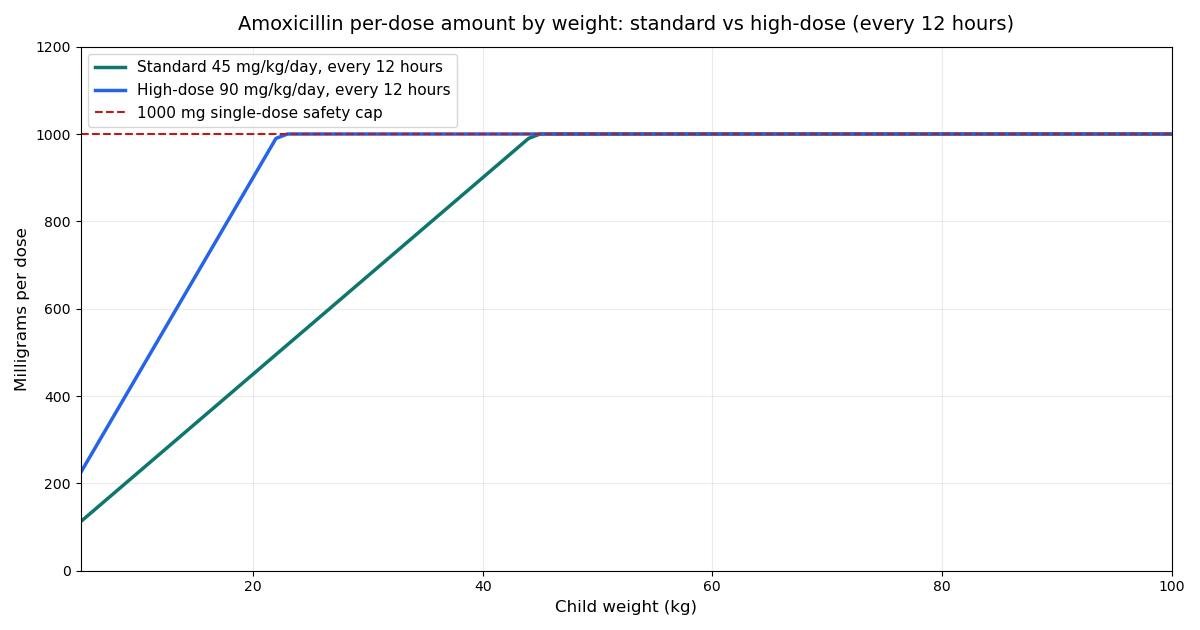
The standard amoxicillin regimen for mild to moderate infections in children (such as streptococcal pharyngitis, uncomplicated sinusitis, and uncomplicated community-acquired pneumonia) is 40 to 50 mg/kg/day. The FDA-approved Amoxil label expresses this as two options: 40 mg/kg/day divided every 8 hours, or 45 mg/kg/day divided every 12 hours. This calculator uses 45 mg/kg/day for the standard regimen, which sits inside the labelled range and matches the twice-daily schedule most families find easiest to follow.
The high-dose regimen, 80 to 90 mg/kg/day, may be prescribed for acute otitis media when amoxicillin itself is appropriate. It must not be selected merely because the child received amoxicillin in the previous 30 days, has concurrent purulent conjunctivitis, or has recurrent acute otitis media unresponsive to amoxicillin. The AAP guideline calls for additional beta-lactamase coverage in those situations, commonly high-dose amoxicillin-clavulanate. This calculator performs arithmetic only for an amoxicillin prescription already chosen by the prescriber.
High-dose amoxicillin is a clinical decision, not an automatic upgrade. It should only be used when the prescriber has identified one of the risk factors above. Using the high dose for every infection exposes the child to more side effects, especially diarrhea and rash, without benefit. The two regimens also differ in what they leave behind: a standard course disturbs the gut flora less than a high-dose course. If you are unsure which regimen your child's prescription follows, check the prescription label or ask the pharmacist before calculating.
Infants under 3 months are a special case. The FDA label gives 30 mg/kg/day divided every 12 hours for this age group, reflecting their immature kidney function and slower drug clearance. This calculator applies the infant regimen automatically when selected and keeps it on the every-12-hour schedule, because that is how the label defines it.
Every 8 hours or every 12 hours
Both schedules are FDA-approved for the standard regimen: 40 mg/kg/day divided every 8 hours, or 45 mg/kg/day divided every 12 hours. The total amount of drug per day is essentially the same; the difference is how it is split. The every-8-hour schedule spreads the drug into three smaller doses, which keeps blood levels steadier across the day. The every-12-hour schedule uses two larger doses, which is often much easier to manage around school, sleep, and childcare.
In practice, adherence usually decides which schedule works better. A dose that is supposed to be given at school but is forgotten does not help the child, while a twice-daily schedule given reliably at breakfast and bedtime does. This is one reason the every-12-hour option has become popular with families and prescribers alike. For the high-dose acute otitis media regimen, the AAP guideline specifies division every 12 hours, so the twice-daily schedule is the standard there.
Timing matters for both schedules. "Every 12 hours" means roughly 12 hours apart, for example 8 in the morning and 8 in the evening, not just "twice sometime during the day." Even spacing keeps the drug concentration from dipping too low between doses. If a dose is late, give it when remembered unless the next dose is nearly due, and never double up. And whichever schedule the prescriber wrote is the one to follow: do not convert a prescription from every 8 hours to every 12 hours on your own, because the per-dose milligrams differ and a self-made conversion is an easy way to overdose or underdose.
Measuring liquid amoxicillin accurately
Amoxicillin for children usually comes as a powder that the pharmacist reconstitutes into a suspension, in strengths of 250 mg, 400 mg, or 600 mg per 5 mL. The calculator converts the milligram dose into the milliliters you actually measure, using the strength printed on your bottle. Always check the bottle: using the volume for the wrong strength is one of the most common dosing errors. A dose calculated for 250 mg/5 mL given from a 400 mg/5 mL bottle delivers 60 percent more drug than intended.
Measure with the oral syringe or dosing cup supplied with the medicine, never a kitchen spoon. Kitchen teaspoons and tablespoons vary widely in volume, and studies of household spoons have repeatedly shown they can deliver anywhere from half to double the intended dose. An oral syringe with milliliter markings removes that guesswork. Shake the bottle well before every dose, because the drug particles settle and the first pour from an unshaken bottle can be too weak while the last is too strong. Measure at eye level on a flat surface, and squirt the liquid slowly toward the inside of the child's cheek, not the back of the throat, to reduce gagging and spitting.
The calculator rounds each per-dose amount to the nearest 5 mg, which is standard pharmacy practice for pediatric liquids: it keeps the dose accurate while matching what can actually be measured. The milliliter result is given to 0.1 mL, which any oral syringe can measure. If the milliliter value falls between the markings on your particular syringe, round to the nearest marking you have, and if in doubt, ask the pharmacist to confirm.
Storage matters too. Reconstituted amoxicillin suspension is typically kept in the refrigerator and discarded after 14 days (check your label, since some formulations differ). Write the date of reconstitution on the bottle. Do not save leftover suspension for a future illness: it will have expired, and the next illness may need a different drug or dose anyway.
Safety limits and red flags
Even a correct weight-based calculation has ceilings. This calculator applies two safety caps used in pediatric practice: a maximum single dose of 1,000 mg and a maximum total of 3,000 mg per day. When a child's weight would push the dose above either ceiling, the calculator limits the dose and shows a clear warning. This typically happens with older, heavier children on the high-dose regimen. A capped dose is a signal to double-check with the prescriber, not to override the cap.
Allergy is the most important safety check, and no calculator can do it for you. Do not give amoxicillin to a child with a known penicillin allergy. Signs of an allergic reaction include rash, hives, itching, swelling of the lips, tongue, or face, wheezing, or difficulty breathing: these need urgent medical care. A mild rash that appeared during a previous amoxicillin course still needs to be reported to the prescriber before any new course, because only a clinician can judge whether it was a true allergy. Tell the prescriber about any drug allergy every time, even if it is already in the records.
Kidney problems change how amoxicillin is cleared, and children with impaired kidney function may need a reduced dose or a longer interval between doses. This calculator does not adjust for kidney impairment: the adjustment depends on the degree of impairment and must come from the child's clinician. The same applies to children with serious liver disease or other complex medical conditions.
Call the prescriber if the child is vomiting and cannot keep the medicine down, develops severe or bloody diarrhea, shows signs of an allergic reaction, or is not improving within 48 to 72 hours. A little loose stool or mild stomach upset is common with amoxicillin and usually settles, but severe diarrhea can signal a Clostridioides difficile infection, which needs medical assessment. Finish the full prescribed course even if the child feels better after a few days: stopping early leaves the hardiest bacteria alive and invites the infection to return.
What this calculator does and does not do
This calculator does the arithmetic: it converts weight, regimen, interval, and bottle strength into a per-dose amount in milligrams and milliliters, shows the total mg/kg/day achieved, and enforces the 1,000 mg single-dose and 3,000 mg daily safety caps with visible warnings. It rounds doses the way a pharmacist would, to the nearest 5 mg, and it keeps the infant regimen on its labelled every-12-hour schedule.
What it does not do is choose the regimen. Standard, high-dose, and infant schedules are clinical decisions that depend on the diagnosis, the child's age and history, local resistance patterns, and allergy status. It also does not replace the prescription label: if the label on your bottle says something different from the calculator result, follow the label and ask the pharmacist or prescriber about the discrepancy. A dosing tool supports the prescription; it never overrides it.
Sources
- U.S. Food and Drug Administration. Amoxil (amoxicillin) prescribing information: pediatric dosing 40 mg/kg/day divided every 8 hours or 45 mg/kg/day divided every 12 hours for mild to moderate infections; 30 mg/kg/day divided every 12 hours for infants under 3 months. Available via DailyMed.
- Lieberthal AS, Carroll AE, Chonmaitree T, et al. The diagnosis and management of acute otitis media. Pediatrics. 2013;131(3):e964-e999. doi:10.1542/peds.2012-3488 (high-dose amoxicillin 80-90 mg/kg/day divided every 12 hours).
Key takeaways
- For most mild to moderate infections in children, the FDA-approved amoxicillin label gives 40 mg per kg per day divided every 8 hours, or 45 mg per kg per day divided every 12 hours.
- High-dose amoxicillin means 80 to 90 mg per kg per day, usually divided every 12 hours.
- Both schedules are FDA-approved for the standard regimen: 40 mg per kg per day divided every 8 hours, or 45 mg per kg per day divided every 12 hours.
- Use the oral syringe or dosing cup that comes with the medicine, never a kitchen spoon.
Frequently asked questions
How much amoxicillin does my child need per kilogram of body weight?
For most mild to moderate infections, the FDA-approved amoxicillin label gives 40 mg per kg per day divided every 8 hours, or 45 mg per kg per day divided every 12 hours. For acute otitis media with risk factors, the American Academy of Pediatrics recommends 80 to 90 mg per kg per day divided every 12 hours. Infants under 3 months receive 30 mg per kg per day divided every 12 hours. Always confirm the regimen with your child's prescriber.
What is high-dose amoxicillin and when is it used?
High-dose amoxicillin means 80 to 90 mg per kg per day, usually divided every 12 hours. Use it only when the prescriber has specifically selected amoxicillin. Recent amoxicillin exposure, purulent conjunctivitis, or recurrent AOM unresponsive to amoxicillin generally calls for additional beta-lactamase coverage rather than amoxicillin alone.
Can I give amoxicillin every 12 hours instead of every 8 hours?
Both schedules are FDA-approved for the standard regimen: 40 mg per kg per day every 8 hours, or 45 mg per kg per day every 12 hours. The twice-daily schedule is often easier and adherence tends to be better. For the high-dose acute otitis media regimen, the AAP guideline specifies every 12 hours. Do not switch schedules on your own; use the schedule your prescriber wrote.
How do I measure the liquid dose accurately?
Use the oral syringe or dosing cup that comes with the medicine, never a kitchen spoon, because household spoons vary widely in volume. Shake the bottle well before each dose, measure at eye level, and give the exact mL shown by the calculator or prescription label. If you lost the syringe, ask the pharmacist for a replacement with milliliter markings.
What should I do if my child misses a dose of amoxicillin?
Give the missed dose as soon as you remember, unless it is almost time for the next dose, in which case skip it and continue the regular schedule. Never double up. Keep giving the antibiotic for the full prescribed course even if your child feels better, because stopping early can let the infection return.
When should I call the doctor about amoxicillin side effects?
Call promptly for signs of an allergic reaction: rash, hives, itching, swelling of the lips or face, wheezing, or trouble breathing, which need urgent care. Also call for severe or bloody diarrhea, vomiting that prevents keeping the medicine down, or no improvement within 48 to 72 hours. Mild loose stools are common and usually settle on their own.
Clinical sources: U.S. Food and Drug Administration, Amoxil (amoxicillin) prescribing information (pediatric dosing, via DailyMed); Lieberthal AS et al. The diagnosis and management of acute otitis media. Pediatrics. 2013;131(3):e964-e999. doi:10.1542/peds.2012-3488