What ibuprofen is and how it works
Ibuprofen is a non-steroidal anti-inflammatory drug (NSAID). It relieves pain and reduces fever by blocking cyclooxygenase (COX) enzymes, which the body uses to make prostaglandins. The signaling molecules that drive inflammation, raise the fever set-point in the brain, and sensitize pain nerves. Less prostaglandin means less fever, less pain, and less swelling at an injury site. Ibuprofen is sold under brand names including Advil and Motrin, and as many generic equivalents; all contain the same active ingredient and work the same way.
Children use ibuprofen for two main purposes: reducing fever and relieving mild to moderate pain, such as earache, sore throat, headache, teething pain, muscle aches, and pain after minor injuries. It is not an antibiotic and does not treat the underlying infection; it manages the symptoms while the child's immune system or other treatment deals with the cause. Because dosing is strictly weight-based, a current weight in kilograms is the single most important input. An age-based guess is only a fallback, and the over-the-counter label instructs caregivers to use weight to dose whenever possible.
The label's pediatric dosing rules
The FDA prescribing label for ibuprofen oral suspension gives separate rules for fever and for pain, and both start at 6 months of age. For reduction of fever in children 6 months up to 2 years of age, the dose is adjusted on the basis of the starting temperature: 5 mg per kilogram of body weight if the baseline temperature is less than 102.5°F, or 10 mg per kilogram if the baseline temperature is 102.5°F or greater. The label notes the duration of fever reduction is generally 6 to 8 hours. For relief of mild to moderate pain in children 6 months up to 2 years of age, the recommended dosage is 10 mg per kilogram every 6 to 8 hours, with doses given so as not to disturb the child's sleep pattern. In both cases the recommended maximum daily dose is 40 mg per kilogram.
The over-the-counter children's ibuprofen label (100 mg per 5 mL suspension) presents the same rules in a weight chart: find the right dose on the chart using weight if possible and otherwise age, repeat every 6 to 8 hours if needed, and do not use more than 4 times a day. A practical consequence: for pain, and for higher fevers, 10 mg/kg is the standard single dose for children of all ages, which is what this page's calculator uses. For a lower-grade fever the label permits the smaller 5 mg/kg dose, and a clinician may choose it when a full dose is not needed.
The 6-month age floor and the under-2 rule
The reason the floor exists is physiological. In the first months of life the kidneys are still maturing, and NSAIDs reduce blood flow to the kidneys by blocking the prostaglandins that keep renal vessels open. A young infant whose kidneys are still developing is more vulnerable to this effect, especially when also dehydrated. The prescription label's pediatric dosing section explicitly covers children 6 months up to 2 years of age, and studies of ibuprofen safety in the 3-to-6-month window have found that short-term use can be acceptable only with medical supervision, special attention to hydration, and dosing based on body weight. A clinical decision, not a home-calculation one.
Between 6 months and 2 years there is a second, softer gate. The over-the-counter children's suspension label lists "under 24 lbs, under 2 years" in its dosing chart with the instruction "ask a doctor." This is why this calculator shows a named soft warning, CONSULT_PHYSICIAN_UNDER_2, for any age below 24 months: the number it computes is the label's own 10 mg/kg dose, but for a child this young the label expects the pediatrician to confirm it. As a general pediatric rule, a fever of 100.4°F (38°C) or higher in a baby under 3 months always warrants a prompt call to the pediatrician, with or without any medicine.
The four common over-the-counter forms and their concentrations
Ibuprofen for children comes in four common forms, and the most dangerous dosing mistake is confusing their concentrations. Infant drops are 50 mg per 1.25 mL, which works out to 40 mg per mL. The most concentrated liquid. Children's suspension (often labeled children's liquid or elixir) is 100 mg per 5 mL, or 20 mg per mL. Exactly half the concentration of the drops. Chewable tablets come in 50 mg and 100 mg strengths; junior-strength products are typically 100 mg per tablet.
Because the drops are twice as concentrated as the suspension, the same milligram dose needs half the millilitres: a 100 mg dose is 2.5 mL of infant drops but 5 mL of children's suspension. Using the suspension's volume with the drops' bottle delivers twice the intended dose, and the reverse delivers half. Always read the concentration printed on the bottle you are holding, use the dropper or dosing cup that came with that bottle, shake the suspension well before using, and never use a kitchen spoon, which can vary by several millilitres.
Reference table: dose by weight
The table below applies the label's 10 mg/kg single dose to round weights, with the corresponding millilitres of infant drops (40 mg/mL) and children's suspension (20 mg/mL), and the tablet count for 100 mg chewables. Millilitres are shown to 0.1 mL; tablet counts to the nearest quarter tablet.
| Weight (kg) | Single dose (10 mg/kg) | Infant drops, mL (50 mg/1.25 mL) | Suspension, mL (100 mg/5 mL) | Chewables, 100 mg tablets |
|---|---|---|---|---|
| 5 | 50 mg | 1.25 mL | 2.5 mL | 0.5 |
| 7 | 70 mg | 1.75 mL | 3.5 mL | 0.75 |
| 10 | 100 mg | 2.5 mL | 5 mL | 1 |
| 12 | 120 mg | 3 mL | 6 mL | 1.25 |
| 15 | 150 mg | 3.75 mL | 7.5 mL | 1.5 |
| 18 | 180 mg | 4.5 mL | 9 mL | 1.75 |
| 20 | 200 mg | 5 mL | 10 mL | 2 |
| 25 | 250 mg | 6.25 mL | 12.5 mL | 2.5 |
| 30 | 300 mg | 7.5 mL | 15 mL | 3 |
| 40 | 400 mg | 10 mL | 20 mL | 4 |
| 50 | 400 mg (capped) | 10 mL | 20 mL | 4 |
| 60 | 400 mg (capped) | 10 mL | 20 mL | 4 |
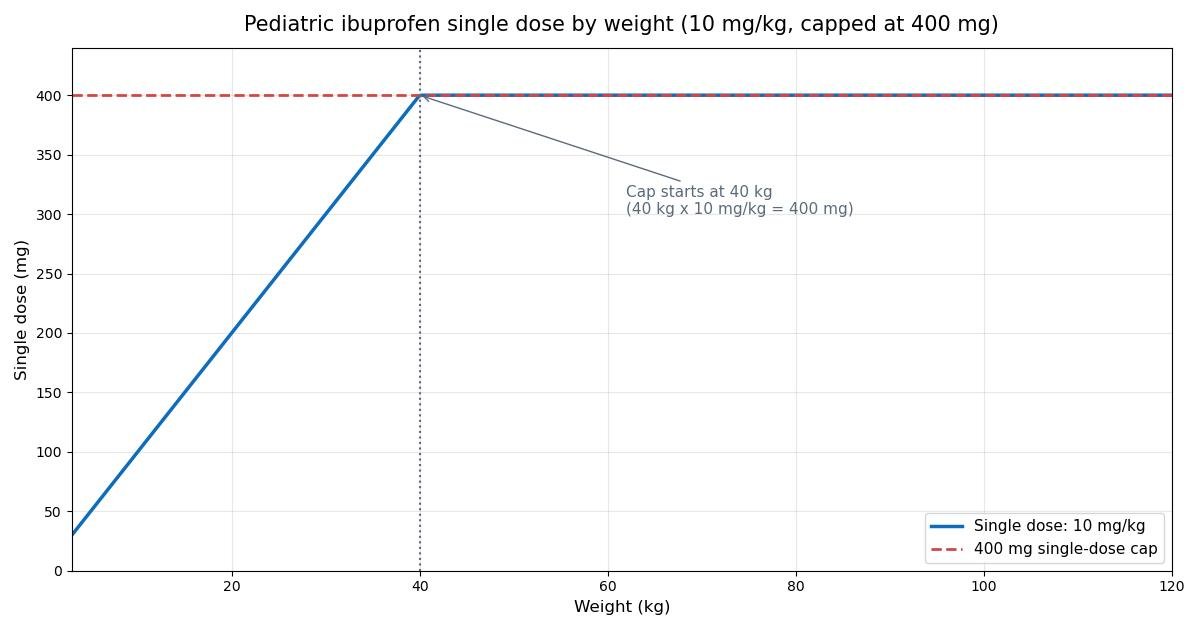
Two rows deserve a second look. At 40 kg the straight 10 mg/kg arithmetic reaches exactly 400 mg; from 40 kg upward the dose stays at 400 mg because of the single-dose cap explained in the next section. The 5 kg row is shown for completeness of the arithmetic, but in practice a 5 kg child is likely under 6 months old, and the calculator will refuse to dose below 6 months.
The two caps: 400 mg per dose and 40 mg/kg per day
The single-dose cap and the daily cap are separate protections. The 400 mg single-dose cap comes from adult dosing: the standard adult single dose of ibuprofen is 200 to 400 mg, and pediatric doses never exceed the adult single dose. The dosing charts on over-the-counter products reflect this. For example, the chart tops out at 4 tablets of 100 mg (400 mg) for the heaviest weight band. So a 60 kg twelve-year-old computes 600 mg at 10 mg/kg, but receives 400 mg, exactly like an adult.
The 40 mg/kg/day daily cap is the label's hard ceiling on total exposure. With the every-6-hours schedule (4 doses per day), a child dosed at 10 mg/kg receives exactly 40 mg/kg over the day. The cap is reached precisely, and no fifth dose is permitted. With the every-8-hours schedule (3 doses per day), the same child receives 30 mg/kg per day, leaving headroom below the cap. This is why the calculator reports the daily-limit status: at the every-6-hours interval the total lands exactly on the 40 mg/kg line, which is safe but means there is no room for an extra dose.
Label safety gates: dehydration, kidneys, asthma, and NSAID sensitivity
The over-the-counter label lists specific situations in which a caregiver must ask a doctor before use, and the calculator surfaces the two most important as named warnings. First, the dehydration and renal gate: ask a doctor before use if the child has not been drinking fluids, has lost a lot of fluid due to vomiting or diarrhea, has kidney disease, has high blood pressure, heart disease, or liver cirrhosis, or is taking a diuretic. NSAIDs constrict blood flow to the kidneys; in a dehydrated child this effect can precipitate acute kidney injury. A child who is vomiting, has diarrhea, or is refusing fluids should be rehydrated and assessed before any NSAID is given. The same caution applies to children under a doctor's care for any serious condition or taking any other drug.
Second, the allergy and asthma gate: do not use if the child has ever had an allergic reaction to ibuprofen or any other pain reliever or fever reducer. Ask a doctor before use if the child has asthma, or has a history of stomach problems such as heartburn, or has had problems or serious side effects from taking pain relievers or fever reducers. A subset of children with asthma are sensitive to NSAIDs and can develop bronchospasm; aspirin-exacerbated respiratory disease is the best-known pattern, but any prior reaction to an NSAID is a reason to keep ibuprofen away from that child entirely.
The label also carries a stomach-bleeding warning that caregivers should know how to recognize. Stop use and ask a doctor if the child experiences any of the following signs of stomach bleeding: feels faint, vomits blood, has bloody or black stools, or has stomach pain that does not get better. Other stop-use signals from the label include symptoms of heart problems or stroke (chest pain, trouble breathing, weakness in one part or side of the body, slurred speech, leg swelling), redness or swelling in the painful area, and any new symptoms. Giving ibuprofen with food or milk if stomach upset occurs is the label's own mitigation for gastric irritation.
Measuring and giving the dose
Accuracy in the millilitres matters more than most caregivers expect, because the therapeutic window is set per kilogram. Shake the suspension well before every use. The drug settles between doses, and an unshaken bottle gives a weak dose from the top and a strong dose from the bottom. Use only the enclosed dosing cup, dropper, or oral syringe that came with the bottle; the label explicitly says not to use any other dosing device. Household teaspoons vary between about 3 and 7 mL, which at 40 mg/mL is a swing of up to 160 mg. More than a full dose for a small child.
Timing follows the label: repeat every 6 to 8 hours if needed, but do not use more than 4 times a day, and give doses so as not to disturb the child's sleep pattern. There is no benefit to waking a sleeping child for a dose if the fever or pain is controlled; conversely, if the fever returns before the interval is up, wait. Do not shorten the interval to chase the temperature. Record each dose and its time on paper or a phone note, especially when two caregivers are sharing the work, because accidental double-dosing is one of the most common causes of exceeding the daily cap. The label also reminds caregivers to check other medicines the child takes: many cold and flu products already contain ibuprofen or acetaminophen, and stacking them double-counts the dose.
When to stop and call the clinician
The over-the-counter label sets two explicit time limits. Stop use and ask a doctor if the child does not get any relief within the first day (24 hours) of treatment, and if fever or pain gets worse or lasts more than 3 days. A fever that persists beyond 3 days despite correct dosing, or pain that is worsening, is a signal that the underlying cause needs evaluation. More ibuprofen will not fix it.
Call the clinician sooner. Without waiting for the 3-day mark. If the child shows signs of dehydration (very few wet diapers or trips to the bathroom, no tears when crying, dry mouth, unusual sleepiness), develops a rash or any sign of allergic reaction, vomits repeatedly, has stomach pain, or develops any new symptom after starting ibuprofen. In case of overdose, the label directs: get medical help or contact a Poison Control Center right away (in the United States, 1-800-222-1222). Keep all ibuprofen products, especially the sweet-tasting liquids and chewables, out of the reach of children.
Common mistakes to avoid
- Mixing up the two liquid concentrations. Infant drops (50 mg/1.25 mL) are twice as strong as children's suspension (100 mg/5 mL). Always match the millilitres to the bottle in your hand, and use that bottle's own dropper or cup.
- Dosing by age instead of weight. The label says to use weight whenever possible. Two children of the same age can need different doses.
- Exceeding 4 doses in 24 hours. The every-6-hours schedule already reaches the 40 mg/kg/day maximum exactly. A fifth dose breaks the cap.
- Dosing a child under 6 months. The label age floor is absolute for home use. This calculator refuses to compute a dose below 6 months.
- Giving ibuprofen to a dehydrated child. Vomiting, diarrhea, or not drinking fluids plus an NSAID is the classic setup for kidney injury. Rehydrate first and ask the doctor.
- Stacking with combination cold medicines. Check the active ingredients of every product; many already contain ibuprofen or acetaminophen.
- Eyeballing with a kitchen spoon. A kitchen teaspoon is not a measuring device. Use the enclosed dosing cup or an oral syringe.
Used correctly. Right child, right weight, right concentration, right interval. Ibuprofen is one of the best-studied medicines in pediatrics. The rules above are not extra caution layered on top of the label; they are the label, applied exactly as written.