Paracetamol (Acetaminophen) Pediatric Dosage Calculator: Weight-Based mg and mL for Children
The standard pediatric dose is 10 to 15 mg/kg per dose every 4 to 6 hours, maximum 5 doses in 24 hours, with a daily ceiling of 75 mg/kg/day. Enter the child's weight and your bottle's formulation to get the per-dose range, the exact mL to 0.1 mL, and the daily maximum with cap warnings.
In short: The standard pediatric dose is 10 to 15 mg/kg per dose every 4 to 6 hours, maximum 5 doses in 24 hours, with a daily ceiling of 75 mg/kg/day. Enter the child's weight and your bottle's formulation to get the per-dose range, the exact mL to 0.1 mL, and the daily maximum with cap warnings. Use the calculator above, then read the guide below to interpret your result and its limitations.
The weight-based dose rules
Children are not scaled-down adults, and nowhere is that clearer than with paracetamol. The dose that matters is milligrams per kilogram of the child's current weight. Not age alone, and never a "spoonful" guessed from memory. Three numbers define safe pediatric paracetamol dosing, and they are worth committing to memory before you ever reach for the bottle.
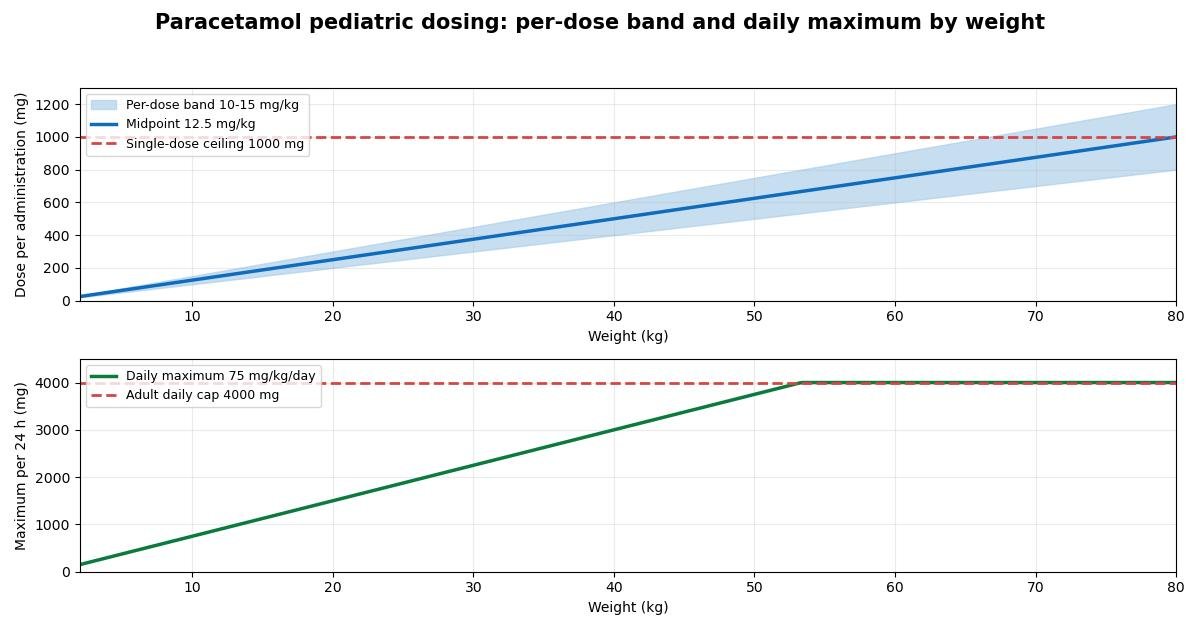
First, the per-dose amount: 10 to 15 mg/kg. This is the range used on both sides of the Atlantic. The British National Formulary for Children (BNFc) and the US acetaminophen label agree on it. A child weighing 10 kg therefore gets 100 to 150 mg per dose; the midpoint, 125 mg (12.5 mg/kg), is the number most dosing charts centre on and the one this calculator uses as its headline figure. A single dose should never exceed the adult single dose of 1000 mg, which becomes relevant for heavier adolescents: at 15 mg/kg, the 1000 mg ceiling is reached at about 67 kg.
Second, the interval: every 4 to 6 hours as needed. Doses must be at least 4 hours apart, and no more than 5 doses may be given in any 24-hour period. The label's "not more than 5 doses in 24 hours" is not a suggestion. Giving a sixth dose, or dosing every 2 to 3 hours "because the fever came back", is one of the commonest routes to accidental overdose. Keep a written log of the time and amount of every dose; with multiple caregivers (parents, grandparents, nursery staff), a shared log prevents the classic error of two adults each giving a full dose.
Third, the daily ceiling: 75 mg/kg/day, never exceeding 4000 mg in 24 hours. For a 30 kg child, 75 mg/kg works out to 2250 mg per day. Comfortably below the adult cap. The 4000 mg adult ceiling only starts to bind above about 53 kg of body weight. Two caveats are worth knowing. Some national labels (India's Crocin products, New Zealand's formulary) quote a more conservative ceiling of 60 mg/kg/day. If your bottle's label says 60 mg/kg/day, follow the label, since this page and its calculator use the 75 mg/kg/day figure standard in the BNFc and US references. And children with chronic malnutrition or significant dehydration are at higher risk of liver injury at standard doses; guidance from paediatric pain teams caps them at about 60 mg/kg/day with review.
Formulations: drops versus suspensions, and why the bottle strength matters
Paracetamol for children comes in several liquid strengths, and confusing them is the single most common cause of dosing errors. Always read the concentration printed on your own bottle and use the measuring device that came with that pack. A kitchen teaspoon can vary from 2 to 10 mL and is never acceptable.
| Formulation | Strength | mg per mL | Typical use |
|---|---|---|---|
| Infant drops | 100 mg/mL (1 mL = 100 mg) | 100 | Infants; small volumes via the pack's dropper (e.g. Crocin Drops) |
| Infant suspension | 120 mg/5 mL | 24 | Children under 6 years (e.g. UK Calpol infant, Crocin 120) |
| Six-plus suspension | 250 mg/5 mL | 50 | Children 6 years and over (UK six-plus, Crocin DS 240 mg/5 mL) |
A worked example shows why this matters. Take the 10 kg child and the 125 mg midpoint dose. With infant drops at 100 mg/mL, the dose is 125 ÷ 100 = 1.25 mL, measured as 1.3 mL. With the 120 mg/5 mL infant suspension, the same 125 mg needs 125 ÷ 24 ≈ 5.2 mL. With the 250 mg/5 mL suspension, it is 2.5 mL. If a caregiver measured 5.2 mL from the drops bottle instead of the suspension bottle, the child would receive more than four times the intended dose. This is exactly the error the "check the concentration" warnings on every label exist to prevent. (In the United States, a children's suspension of 160 mg/5 mL is also common; the same division rule applies. Divide your mg dose by the concentration on your bottle.)
Two practical points complete the picture. Suspensions settle: shake the bottle vigorously for at least 10 seconds before every dose so the measured millilitres actually contain the intended milligrams. And drops are much more concentrated than suspensions, so they must never be measured with a suspension syringe scale or poured into a spoon as if they were the weaker liquid.
Age rules: babies under 3 months
Age is not the basis for the dose. Weight is. But age sets hard boundaries on whether paracetamol should be given at all:
- Under 1 month: not recommended. Product labels (including the Crocin Drops leaflet) state this plainly, and the calculator above refuses to produce a dose for this age.
- 1 to 2 months: paracetamol is not licensed for oral use in the BNFc below 2 months. A feverish baby this young needs assessment, not home dosing.
- Under 3 months generally: treat a temperature of 38 °C or higher as a reason to seek same-day medical advice rather than to dose at home. Product information advises seeking medical advice if fever in an under-3-month baby persists beyond 24 hours (about 4 doses), precisely so that a fever caused by a serious infection is not masked and diagnosed late.
- The one exception. Post-vaccination fever at 2 to 3 months: UK guidance allows one 2.5 mL dose of the 120 mg/5 mL infant suspension for babies aged 2 to 3 months who were born after 37 weeks and weigh over 4 kg, given at or soon after the meningococcal B vaccination; if needed, a second 2.5 mL dose may follow after 4 to 6 hours. And no more than two doses without speaking to a doctor or pharmacist.
- 3 to 6 months: standard weight-based dosing applies (10 to 15 mg/kg), with the usual 4-dose-per-day age-band volumes (2.5 mL of the 120 mg/5 mL suspension) acting as a cross-check.
There is one route worth a brief mention for completeness: paracetamol can also be given rectally. The BNFc lists rectal regimens for children from 1 month (a 30 to 40 mg/kg loading dose in older children, then 15 to 20 mg/kg every 4 to 6 hours, sharing the same 75 mg/kg/day ceiling), and meta-analytic evidence shows oral and rectal doses have comparable antipyretic effects despite the folk belief that suppositories are weaker. In practice, the liquid by mouth is the standard for home use; rectal dosing belongs to hospital or pharmacist-guided settings.
How to measure an accurate dose
Getting the number right is only half the job; measuring it accurately is the other half. The widget above rounds millilitres to 0.1 mL, and that precision is only meaningful if the measurement method matches it:
- Use the device in the pack. The dropper or oral syringe supplied with the bottle is calibrated for that bottle's concentration. Do not mix and match devices between products.
- Measure at eye level. For syringes, draw the plunger to the exact mark and check the meniscus at eye level.
- Shake suspensions. At least 10 seconds of vigorous shaking before every dose; unshaken bottles give weak doses from the top and strong doses from the bottom.
- Do not mix into a full bottle of milk or formula. If the child does not finish the bottle, part of the dose is lost and you cannot know how much was taken.
- Record every dose. Write down the time, the mg, and the mL. Ideally where the medicine is stored, so every caregiver can see it. The paediatric literature singles this out as the key defence against double-dosing.
- As the child grows, recheck. A dose that was correct three months ago may now underdose; weight-based dosing should be recalculated, not carried forward by habit.
Safety: the liver, overdosing, and hidden paracetamol in combination products
Paracetamol is remarkably safe at therapeutic doses. Unlike NSAIDs it has no common side effects at correct doses, and most children tolerate it without any issue. Its danger is almost entirely a dosing danger. In overdose, the liver's glutathione supply is depleted and the toxic metabolite NAPQI accumulates, causing hepatocellular injury. The trap is that early symptoms are mild and non-specific. Nausea, vomiting, loss of appetite, abdominal pain, sometimes sweating or paleness. While serious liver injury may only declare itself 24 to 72 hours later. Any suspected overdose, even if the child looks well, needs urgent same-day medical assessment, because early hospital treatment (including N-acetylcysteine) prevents most harm.
The three errors that cause accidental overdose are worth naming explicitly, because they are all preventable:
- Dosing more often than every 4 hours. The interval is a minimum, not a target. Set a timer; do not re-dose "because the fever is back" after 2 hours.
- Confusing concentrations. Treating drops as if they were suspension (or vice versa) multiplies the dose several-fold in a single stroke.
- Hidden paracetamol in combination products. Many cold-and-flu syrups, cough medicines, and teething products already contain paracetamol. Every product label warns against taking paracetamol from two sources at once. Read the ingredients of everything the child is taking.
Special caution applies to children with liver disease, chronic malnutrition, or significant dehydration, who are more vulnerable to liver injury because of lower glutathione reserves. For them, paediatric guidance recommends the lower end of the dose range (10 mg/kg), longer intervals, and a lower daily ceiling (around 60 mg/kg/day). And the decision should involve the child's doctor or pharmacist. The calculator's checkbox flags this situation. Chronic daily use without a medical reason is also discouraged: paracetamol treats the symptom, and pain or fever persisting beyond 3 days in a child warrants a diagnosis, not another dose.
When paracetamol is not the right choice, and when to seek care
Paracetamol relieves pain and lowers fever; it does not treat infection, inflammation, or the underlying illness. It is the wrong tool when the situation needs a diagnosis rather than symptom relief. Seek prompt medical care if any of the following apply:
- A baby under 3 months with a temperature of 38 °C or higher; a baby aged 3 to 6 months with 39 °C or higher.
- Fever lasting 5 days or more, or fever with a rash.
- The child is unusually drowsy, floppy, difficult to wake, inconsolable, or has a stiff neck, breathing difficulty, or persistent vomiting.
- Signs of dehydration: very dry mouth, no tears when crying, far fewer wet nappies than usual.
- Any suspected overdose, or a child who has swallowed paracetamol tablets (adult 500 mg tablets are a common household hazard).
For straightforward teething pain or post-vaccination fussiness in an otherwise well older infant, paracetamol remains appropriate. But comfort measures matter too: fluids, rest, and not overdressing a feverish child. And if one antipyretic has not helped, guidelines allow trying the other (ibuprofen) an hour later rather than escalating the paracetamol dose. Our ibuprofen pediatric dosage calculator covers weight-based ibuprofen dosing (10 mg/kg per dose, every 6 to 8 hours) for children 3 months and older.
Key takeaways
- The standard pediatric oral dose of paracetamol is 10 to 15 mg per kilogram of body weight per dose, given every 4 to 6 hours, with a maximum of 5 doses in 24 hours.
- Divide the mg dose by the concentration printed on your bottle.
- Paracetamol doses must be at least 4 hours apart.
- Paracetamol is not recommended under 1 month of age, and under 2 months it is not licensed for oral use.
Frequently asked questions
What is the weight-based paracetamol dose for a child?
The standard pediatric oral dose is 10 to 15 mg per kilogram of body weight per dose, given every 4 to 6 hours, with a maximum of 5 doses in 24 hours. The total daily amount must not exceed 75 mg/kg/day, and a single dose should never exceed the adult single dose of 1000 mg. For a 10 kg child, one dose is 100 to 150 mg. Midpoint 125 mg. These figures come from the BNFc and the product labels; some labels (India, New Zealand) quote a more conservative daily ceiling of 60 mg/kg/day, in which case the label governs.
How do I convert my child's mg dose into mL for the bottle I have?
Divide the mg dose by the concentration printed on your bottle. With infant drops at 100 mg/mL, 125 mg is 1.25 mL (measure 1.3 mL). With the 120 mg/5 mL suspension (24 mg/mL), the same 125 mg is about 5.2 mL. With the 250 mg/5 mL suspension (50 mg/mL), it is 2.5 mL. Always use the dropper or syringe that came with that bottle, and double-check you are reading the right strength. Confusing drops for suspension is the classic dosing error.
How often can I give paracetamol, and how many doses per day?
Doses must be at least 4 hours apart. Normally every 4 to 6 hours as needed. And a maximum of 5 doses may be given in 24 hours. Closer dosing does not bring fever down faster; it only increases the risk of liver injury. Keep a written log of the time and amount of every dose so that all caregivers (parents, grandparents, nursery) stay within the limit.
Can I give paracetamol to a baby under 3 months old?
Not on your own initiative. Paracetamol is not recommended under 1 month of age, and it is not licensed for oral use under 2 months. For a baby under 3 months with a temperature of 38 °C or higher, seek same-day medical advice rather than dosing at home. Fever at this age can signal serious infection. The single exception is post-vaccination fever in babies aged 2 to 3 months who were born after 37 weeks and weigh over 4 kg: UK guidance allows one measured 2.5 mL dose of the 120 mg/5 mL infant suspension, repeatable once after 4 to 6 hours, with no more than two doses without medical advice.
What is the maximum daily dose of paracetamol for children and adults?
For children, the daily ceiling is 75 mg/kg of body weight per day. For example 2250 mg for a 30 kg child. And it must never exceed the adult daily maximum of 4000 mg in 24 hours. That adult cap starts to bind above about 53 kg. A single dose should also never exceed the adult single dose of 1000 mg (binding above about 67 kg at the 15 mg/kg end of the range). If your bottle's label quotes 60 mg/kg/day, follow the label.
What are the signs of paracetamol overdose in a child, and what should I do?
Early signs can be deceptively mild: nausea, vomiting, loss of appetite, and stomach pain, sometimes with sweating or paleness. Serious liver injury may only appear 24 to 72 hours after the overdose, so any suspected overdose. Even if the child looks well. Needs urgent same-day medical assessment, because early treatment (including N-acetylcysteine in hospital) prevents most harm. The commonest causes are dosing more often than every 4 hours and giving two products that both contain paracetamol, such as a paracetamol syrup plus a cold-and-flu medicine.
Sources
- British National Formulary for Children. Paracetamol monograph: oral and rectal pediatric dosing, maximum 75 mg/kg/day, adult caps (1000 mg single dose, 4000 mg/day), unlicensed-use age limits: BNFc Paracetamol.
- Crocin Drops product information leaflet (100 mg/mL; each mL contains paracetamol 100 mg): dose 10 to 15 mg/kg per dose, maximum daily 60 mg/kg, not recommended under 1 month, medical advice if fever persists beyond 24 hours under 3 months: Crocin Drops PI.
- Crocin Suspension product information leaflet (120 mg/5 mL and 240 mg/5 mL): 15 mg/kg per dose, maximum 4 doses in 24 hours, minimum 4-hour interval: Crocin Suspension PI.
- UK revised dosing instructions for children's liquid paracetamol (infant suspension 120 mg/5 mL; post-vaccination dosing at 2 to 3 months): UK government dosing instructions (PDF).
- bpac (New Zealand) paracetamol dosing for children: 15 mg/kg per dose to a maximum of 1 g, every 4 to 6 hours, maximum 60 mg/kg/day without exceeding 4 g/day; measuring and caregiver safety guidance: bpac paracetamol dosing (PDF).
Medical disclaimer
This page is for general information only and is not medical advice. Paracetamol dosing for children is weight-based and must follow the product label; the figures here reflect pediatric references current at the time of writing. Do not start, stop, or change any dose on the basis of this page. Do not give paracetamol to a baby under 1 month of age, and seek same-day medical advice for any baby under 3 months with a fever of 38 °C or higher. If you suspect an overdose. Even if the child looks well. Seek urgent medical care immediately.