Azithromycin Dosage Calculator for Children
Weight-based pediatric dosing with maximum-dose caps, suspension volume conversion, and total course dose. Based on the FDA Zithromax prescribing information.
In short: Weight-based pediatric dosing with maximum-dose caps, suspension volume conversion, and total course dose. Based on the FDA Zithromax prescribing information. Use the calculator above, then read the guide below to interpret your result and its limitations.
Why Azithromycin Dosing Is Different
Most antibiotics used in children follow a simple pattern: a fixed mg/kg dose given two or three times a day for a set number of days. Azithromycin breaks that pattern, and the difference comes from its unusual pharmacology. After absorption, azithromycin leaves the bloodstream quickly and concentrates inside cells and tissues, reaching tissue levels far above those in plasma. From those tissue stores it is released very slowly, which is why its elimination half-life in adults is around 68 hours (roughly three days), compared with one to two hours for amoxicillin. This long half-life is documented in the FDA Zithromax prescribing information and it is the single most important fact for understanding the dosing schedules below.
Because the drug lingers, azithromycin keeps killing susceptible bacteria for days after the last tablet or spoonful is taken. Pharmacologists call this a post-antibiotic effect, and it means a short course of therapy behaves like a longer one. That is why pediatric courses are only 3 or 5 days long instead of the 7 to 10 days familiar from penicillin-type antibiotics, and why the drug is given just once daily. A shorter, once-daily course is also easier for families to complete, which matters because finishing the prescribed course is part of how treatment succeeds.
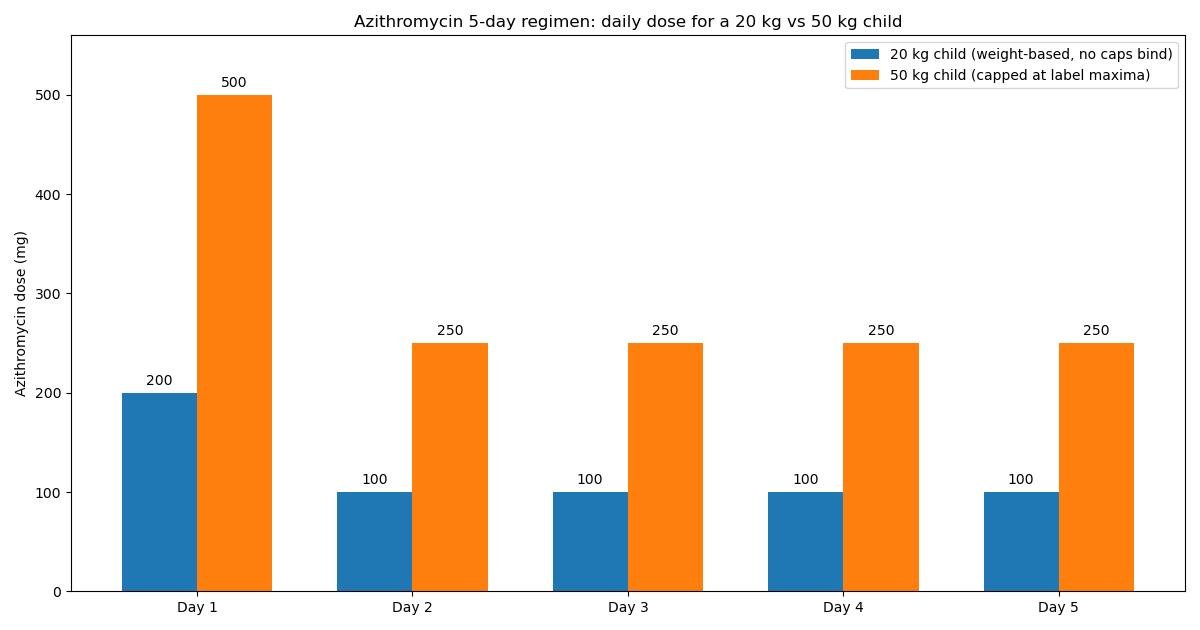
The schedules also use a loading dose: day 1 is larger than the days that follow. On day 1 of the 5-day course a child receives 10 mg/kg, then 5 mg/kg on days 2 through 5. The larger first dose fills the tissue stores quickly so that therapeutic levels are reached on the first day; the smaller follow-on doses simply top up what is being slowly eliminated. This is the same logic behind loading doses in other areas of medicine, adapted here to a drug whose levels are governed more by tissue release than by what was swallowed that morning.
The Four Label-Based Regimens, Explained
The FDA Zithromax label (pediatric use, Dosage and Administration) describes four pediatric regimens, and this calculator offers all four. Each pairs a weight-based mg/kg amount with an absolute maximum single dose, and the maximum always wins when the two disagree. The table below summarizes them; every number is taken from the label.
| Regimen | Day 1 | Days 2 to 5 | Maximum single dose |
|---|---|---|---|
| 5-day course (acute otitis media, community-acquired pneumonia) | 10 mg/kg | 5 mg/kg daily | Day 1: 500 mg; days 2 to 5: 250 mg |
| 3-day course (otitis media alternative) | 10 mg/kg | 10 mg/kg daily on days 2 and 3 | 500 mg per day |
| Single-dose acute otitis media | 30 mg/kg once | Not applicable | 1500 mg |
| Streptococcal pharyngitis / tonsillitis | 12 mg/kg | 6 mg/kg daily | Day 1: 500 mg; days 2 to 5: 250 mg |
The 5-day course is the workhorse. For acute otitis media in children 6 months and older, the label gives the 5-day schedule (10 mg/kg day 1, 5 mg/kg days 2 to 5) alongside two alternatives: the same total amount condensed into a 3-day course (10 mg/kg daily for 3 days) or given as one single 30 mg/kg dose. The single-dose option exists for otitis media because the drug's long tissue persistence makes one large dose behave like several days of therapy; it is convenient, but it delivers the largest single-day amount (up to 1500 mg), so the calculator flags the cap clearly.
The streptococcal pharyngitis regimen is slightly more intensive: 12 mg/kg on day 1 followed by 6 mg/kg on days 2 through 5. The label limits this indication to children 2 years and older and specifies penicillin-allergic patients, because penicillin (or amoxicillin) remains the preferred treatment for strep throat when there is no allergy. The American Academy of Pediatrics Red Book likewise positions azithromycin as the alternative for streptococcal pharyngitis when first-line therapy cannot be used, not as the default choice.
How the Maximum-Dose Caps Work
Every regimen in the label pairs its mg/kg rate with a ceiling, and the ceiling exists because the clinical trials that established safety and efficacy did not test higher single doses in children. For example, on day 1 of the 5-day course the cap is 500 mg (the standard adult single dose), and on days 2 through 5 it is 250 mg (the standard adult maintenance dose). A 50 kg child would need 500 mg on day 1 by the 10 mg/kg calculation (exactly at the cap) and 250 mg on days 2 through 5 by the 5 mg/kg calculation (250 mg, exactly at the cap). A 60 kg child would calculate to 600 mg on day 1, but the label maximum binds and the child receives 500 mg.
This calculator checks the cap for every single day and shows a warning whenever the weight-based amount exceeds the maximum, naming both the calculated amount and the capped dose actually recommended. Caps are not optional rounding: exceeding the studied maximum single dose without clinician direction is outside the label. If a cap binds on several days for a heavier child, that is a prompt to confirm the plan with the prescriber rather than to adjust anything yourself.
Weight matters in the other direction too. The calculator accepts weights from 5 to 100 kg. Below 5 kg (typical for young infants) dosing needs individualized clinician input, and azithromycin carries a specific label note for neonates (see the safety section). Above 100 kg, adult dosing applies and the pediatric regimens in the calculator no longer add value.
Measuring the Suspension Accurately
Azithromycin oral suspension comes in two common strengths: 100 mg per 5 mL and 200 mg per 5 mL (the calculator uses both). To convert a milligram dose to milliliters, divide the dose by the strength: a 200 mg dose using the 200 mg/5 mL suspension is 5 mL, because 200 mg divided by 40 mg per mL equals 5 mL. The same 200 mg dose using the 100 mg/5 mL suspension is 10 mL. The calculator performs this conversion for every day and displays both the exact volume and a practical measure rounded to the nearest 2.5 mL.
The rounding deserves an explanation. Oral syringes are commonly graduated in 0.5 mL or 1 mL steps, but many dosing cups and some syringes mark 2.5 mL increments, and the nearest 2.5 mL is a practical, low-error measure for caregivers. Where the exact and rounded volumes differ, the calculator shows both and advises confirming the measure with the pharmacist. Never use a kitchen or household spoon: studies of household spoons consistently show they deliver the wrong volume, and with a drug dosed by weight that error goes straight into the child.
Shake the bottle well before every dose, because the drug settles between uses. Measure at eye level with the syringe on a flat surface, give the dose, and rinse the syringe with water. Once reconstituted by the pharmacist, the suspension is typically good for 10 days at room temperature; discard any remainder after the course is finished rather than saving it for a future illness.
Safety Notes: Allergy, QT Prolongation, Liver, and Infants
Azithromycin is generally well tolerated in children, with gastrointestinal upset (nausea, vomiting, diarrhea, abdominal pain) as the most common side effects listed in the label. The serious warnings, however, deserve attention before the first dose. Do not give azithromycin to a child with a known allergy to azithromycin, erythromycin, or any macrolide or ketolide antibiotic; allergic reactions including angioedema and anaphylaxis are in the label.
The cardiac warning is the one clinicians ask about most. Azithromycin can prolong the QT interval, and the label warns of a small risk of torsades de pointes, a dangerous heart rhythm. The absolute risk is low, but it rises in children with known QT prolongation, uncorrected low potassium or magnesium, significant bradycardia, or who take other QT-prolonging medicines. A history of fainting, palpitations, or a family history of sudden cardiac death or long QT syndrome should be mentioned to the prescriber before treatment starts.
The liver warning is next. The label reports abnormal liver function, hepatitis, cholestatic jaundice, and rare cases of hepatic necrosis and liver failure, some fatal. Azithromycin should not be restarted in a child who developed jaundice or liver dysfunction on a previous course, and new jaundice, dark urine, or persistent vomiting during treatment warrants prompt medical review. Azithromycin can also exacerbate myasthenia gravis, and the label notes reports of infantile hypertrophic pyloric stenosis following azithromycin exposure in neonates, which is one reason dosing in infants under 6 weeks needs direct clinician supervision.
Two interaction notes from the label are worth knowing. Azithromycin can potentiate the effect of warfarin, so children on anticoagulation need monitoring, and co-administration with nelfinavir raises azithromycin levels (monitor for liver enzyme abnormalities and hearing impairment). As with all prescribing information, this is not exhaustive: the pharmacist's counseling at dispensing is the final safety check.
Resistance and Stewardship: Using Azithromycin Wisely
Azithromycin is one of the most prescribed antibiotics in outpatient pediatrics, and that popularity has a cost. Macrolide resistance in Streptococcus pneumoniae, the leading bacterial cause of otitis media and pneumonia, has risen substantially in many regions, which is why guidelines increasingly reserve azithromycin for situations where it is truly indicated: penicillin allergy, atypical pneumonia, or specific label indications. The CDC's outpatient antibiotic stewardship materials make the same point for clinicians: prescribe the right drug, at the right dose, for the right duration, and only for bacterial infections.
Azithromycin does nothing for viral infections: colds, most sore throats, influenza, and typical viral ear congestion will not improve with it, and unnecessary courses drive resistance without helping the child. When it is prescribed, completing the full course matters even if the child feels better after two days, because the short course was designed with the drug's long persistence in mind and stopping early is not part of the studied regimen. Leftover suspension should be discarded, not saved, and never shared between siblings: the dose was calculated for one child's weight and indication.
Sources
- Zithromax (azithromycin) US Prescribing Information, FDA-approved label: Dosage and Administration (pediatric regimens, maximum doses), Warnings and Precautions (QT prolongation, hepatotoxicity, myasthenia gravis, infantile hypertrophic pyloric stenosis), Adverse Reactions. Available via DailyMed (dailymed.nlm.nih.gov).
- American Academy of Pediatrics, Red Book: 2024-2027 Report of the Committee on Infectious Diseases, 33rd edition: azithromycin dosing and its role as an alternative agent for streptococcal pharyngitis in penicillin-allergic patients.
- Centers for Disease Control and Prevention, Outpatient Antibiotic Stewardship: core elements for appropriate outpatient antibiotic prescribing.
Related tools: Amoxicillin Dosage Calculator for Children and the full calculator index.
Key takeaways
- Pediatric azithromycin is dosed by body weight in milligrams per kilogram (mg/kg), and the exact mg/kg depends on the indication.
- Day 1 uses a loading dose (10 or 12 mg/kg) followed by lower maintenance doses (5 or 6 mg/kg) because azithromycin has an unusually long half-life of about 68 hours and concentrates in tissues.
- Per the FDA label: day 1 of the 5-day or strep regimen is capped at 500 mg; days 2 through 5 are capped at 250 mg; the 3-day course is capped at 500 mg per day; and the single-dose otitis media regimen is capped at 1500 mg.
- No.