Cefdinir Dosage Calculator for Children
Weight-based pediatric cefdinir dosing from the FDA-approved label: 14 mg per kg per day, up to a maximum of 600 mg per day, given once daily or every 12 hours.
In short: Weight-based pediatric cefdinir dosing from the FDA-approved label: 14 mg per kg per day, up to a maximum of 600 mg per day, given once daily or every 12 hours. Use the calculator above, then read the guide below to interpret your result and its limitations.
What is cefdinir?
Cefdinir, sold under the brand name Omnicef, is a third-generation cephalosporin antibiotic taken by mouth. It is approved for children aged 6 months through 12 years for certain bacterial infections of the ears, sinuses, throat, skin, and lungs. Like other cephalosporins, cefdinir works by interfering with the construction of the bacterial cell wall, which causes susceptible bacteria to rupture and die. It is active only against bacteria, so it cannot help viral illnesses such as colds, flu, or most sore throats caused by viruses. Using antibiotics when they are not needed contributes to antibiotic resistance, which is one reason prescribers reserve them for infections where bacteria are the likely cause.
For children, cefdinir is supplied as a powder that the pharmacy reconstitutes into a flavored oral suspension. Two strengths are available: 125 mg per 5 mL and 250 mg per 5 mL. The FDA label states that the suspension may be given without regard to meals, which gives families flexibility about timing. The prescribing information is the single source of truth for dosing, and this calculator implements its rules exactly as written: a total daily dose of 14 mg per kilogram of body weight, up to a maximum of 600 mg per day.
How the pediatric dose is calculated
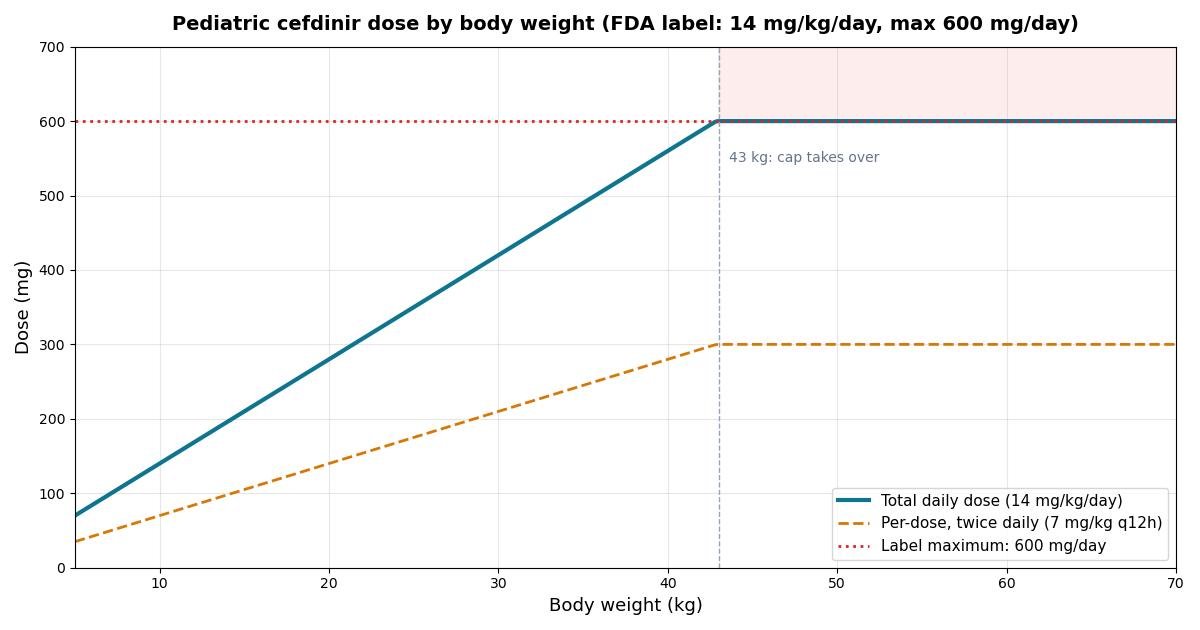
The FDA-approved label gives one simple rule for the pediatric total daily dose: 14 mg per kilogram of body weight per day, for all listed infections, up to a maximum dose of 600 mg per day. That total may be administered as 14 mg/kg once every 24 hours or split into 7 mg/kg every 12 hours, depending on the infection and the prescriber's order. The label adds that pediatric patients who weigh 43 kg or more should receive the maximum daily dose of 600 mg, which is consistent with the cap: 14 mg/kg multiplied by 43 kg is 602 mg, so the 600 mg ceiling takes over at that weight.
A worked example makes the arithmetic concrete. A 20 kg child needs 14 multiplied by 20, which is 280 mg per day. Given once daily, that is one 280 mg dose. With the 250 mg per 5 mL suspension, each mL contains 50 mg, so 280 divided by 50 gives 5.6 mL for the single daily dose. Given twice daily, each dose is half the total, which is 140 mg, or 2.8 mL of the same suspension. This calculator performs exactly these steps, rounds the volume to the nearest 0.1 mL for practical measuring with an oral syringe, and applies the 600 mg ceiling with a visible warning whenever the ceiling changes the result.
Which infections is cefdinir used for in children?
The FDA label lists four infection types for pediatric patients aged 6 months through 12 years, each with its own approved dosing schedule and treatment length. The table below reproduces that information. Note the important exception for skin infections, discussed in the next section.
| Infection | Dosage (pediatric) | Duration |
|---|---|---|
| Acute bacterial otitis media (middle ear infection) | 7 mg/kg every 12 hours, or 14 mg/kg once daily | 5 to 10 days (twice daily) or 10 days (once daily) |
| Acute maxillary sinusitis | 7 mg/kg every 12 hours, or 14 mg/kg once daily | 10 days |
| Pharyngitis / tonsillitis | 7 mg/kg every 12 hours, or 14 mg/kg once daily | 5 to 10 days (twice daily) or 10 days (once daily) |
| Uncomplicated skin and skin structure infections | 7 mg/kg every 12 hours only | 10 days |
Source: FDA-approved Omnicef (cefdinir) prescribing information, Dosage and Administration section.
Once daily versus twice daily: what the evidence says
The label states that once-daily dosing for 10 days is as effective as twice-daily dosing, which is why prescribers often choose the once-daily schedule for ear infections, sinusitis, and strep throat: one dose per day is simply easier for families to complete, and completing the full course matters for cure and for limiting resistance. However, the label also states that once-daily dosing has not been studied in skin infections, and therefore the suspension should be administered twice daily when the infection is a skin infection. This is not a minor footnote; it is the one infection on the list where the prescriber should not choose the once-daily option.
When the prescriber has not specified a schedule and the infection is not a skin infection, either schedule delivers the same total daily amount of medicine. Twice-daily dosing produces smaller individual doses with more even spacing, while once-daily dosing concentrates the same total into a single larger dose. Parents sometimes worry that the once-daily dose looks large on the syringe, but the label's efficacy statement covers that schedule for the listed infections. If you are ever unsure which schedule your child's prescription intends, check the pharmacy label or call the prescriber rather than guessing, because the schedule affects how you measure each dose.
How long should treatment last?
Duration is part of the prescription, not something to adjust at home. The label's durations are summarized here for reference only:
| Infection | Twice-daily schedule | Once-daily schedule |
|---|---|---|
| Acute bacterial otitis media | 5 to 10 days | 10 days |
| Acute maxillary sinusitis | 10 days | 10 days |
| Pharyngitis / tonsillitis | 5 to 10 days | 10 days |
| Uncomplicated skin infections | 10 days | Not studied; use twice daily |
Finishing the full prescribed course is important even when the child feels better after a few days. Stopping early can allow the infection to return and contributes to antibiotic resistance. If doses are missed or vomited, or the child seems worse instead of better after a few days of treatment, contact the prescriber for guidance rather than extending or repeating the course on your own.
How to measure and give the suspension
Accurate measuring is where most home dosing errors happen, so it deserves care. Always shake the bottle well before measuring, because the medicine settles between doses. Use the oral syringe or dosing spoon that comes with the medicine, and measure in milliliters, not kitchen teaspoons, which vary in size and routinely cause under or over dosing. The volumes this calculator reports are rounded to the nearest 0.1 mL, which matches what an oral syringe can measure.
Give doses at evenly spaced times: about the same time each day for once-daily dosing, or roughly 12 hours apart for twice-daily dosing. Cefdinir suspension may be given with or without food. After the pharmacist mixes the powder with water, the suspension is stored at room temperature and any unused portion should be discarded after 10 days, so write the mixing date on the bottle. Keep the bottle out of children's reach, as with all medicines.
Iron, vitamins, antacids, and food
Cefdinir has a well-documented interaction with iron. The FDA label warns that iron supplements reduce the absorption of cefdinir, which means less medicine reaches the bloodstream and the infection may not be treated effectively. Iron-containing products should be separated from cefdinir by at least 2 hours. This includes iron supplements and multivitamins with iron. The label also warns that antacids containing magnesium or aluminum interfere with cefdinir absorption and should be similarly separated. Iron-fortified infant formula, however, does not have a significant effect on cefdinir absorption according to the label, so normal formula feeding can continue.
Parents sometimes notice reddish-colored stools while a child takes cefdinir. The label reports this finding and notes that in many cases the patient was also receiving an iron-containing product. The color comes from a nonabsorbable complex formed between cefdinir or its breakdown products and iron in the gastrointestinal tract. It is listed in the label as a known phenomenon, but any unusual symptom, including stool changes that worry you, is worth mentioning to the prescriber or pharmacist so they can confirm the explanation fits your child's situation.
Safety information: allergies, kidneys, and side effects
Cefdinir is contraindicated in patients with a known allergy to cefdinir or any ingredient in the formulation. Because cefdinir is a cephalosporin, the label urges caution in patients with a history of penicillin allergy, since cross-reactivity between penicillin and cephalosporin antibiotics can occur and serious allergic reactions have been reported. If your child has ever had hives, swelling, wheezing, or trouble breathing with any antibiotic, make sure the prescriber knows before cefdinir is started. Signs of an allergic reaction during treatment, such as rash, itching, swelling of the face or lips, or difficulty breathing, require immediate medical attention.
Kidney function changes the dose. For pediatric patients with a creatinine clearance below 30 mL/min/1.73 m2, the label reduces the dose to 7 mg/kg (up to 300 mg) given once daily. This calculator does not apply that reduction, because kidney impairment needs individual assessment by the prescriber. If your child has known kidney problems, the prescriber must set the dose.
The most common side effects listed in the label include diarrhea, nausea, and headache, with rash also reported. Diarrhea deserves particular attention: like nearly all antibacterial drugs, cefdinir carries a label warning about Clostridioides difficile-associated diarrhea, which can range from mild to severe and can occur during or after treatment. Watery or bloody stools, stomach cramps, or fever during or after the course should be reported to the prescriber promptly.
When to contact your child's clinician
This calculator performs arithmetic; it does not decide whether your child needs an antibiotic or which one. Contact your child's prescriber or pharmacist if any of the following occur: signs of an allergic reaction such as rash, hives, swelling, or breathing difficulty; severe, watery, or bloody diarrhea; vomiting that prevents keeping doses down; no improvement after a few days of treatment; or a fever that worsens. Also check before starting cefdinir if your child takes iron supplements, antacids, or other regular medicines, so the timing can be planned around the 2-hour separation rule.
Key takeaways
- The FDA-approved Omnicef label sets the pediatric total daily dose at 14 mg per kilogram of body weight per day for all listed infections, up to a maximum of 600 mg per day.
- Yes, for most infections.
- 600 mg per day.
- Yes.
Frequently asked questions
How is the cefdinir dose calculated for a child?
The FDA-approved Omnicef label sets the pediatric total daily dose at 14 mg per kilogram of body weight per day for all listed infections, up to a maximum of 600 mg per day. That total can be given once daily (14 mg/kg every 24 hours) or split into two doses (7 mg/kg every 12 hours), depending on the infection being treated and the prescriber's order.
Can cefdinir be given once a day to children?
Yes, for most of the listed infections. The label states that once-daily dosing for 10 days is as effective as twice-daily dosing. The exception is uncomplicated skin and skin structure infections: once-daily dosing has not been studied for skin infections, so the label directs twice-daily dosing there.
What is the maximum cefdinir dose for a child?
600 mg per day. The label states that pediatric patients who weigh 43 kg or more should receive the maximum daily dose of 600 mg. For children with severe renal impairment (creatinine clearance below 30), the label reduces the dose to 7 mg/kg (up to 300 mg) once daily, set by the prescriber.
Does iron affect cefdinir absorption?
Yes. The label warns that iron supplements reduce cefdinir absorption, so iron-containing products should be given at least 2 hours before or after cefdinir. The label also notes reports of reddish stools in patients taking cefdinir with iron-containing products, caused by a nonabsorbable complex formed in the gut.
How long does a child take cefdinir?
It depends on the infection. Per the label: acute bacterial otitis media, 5 to 10 days twice daily or 10 days once daily; acute maxillary sinusitis, 10 days; pharyngitis or tonsillitis, 5 to 10 days twice daily or 10 days once daily; uncomplicated skin infections, 10 days twice daily. Always complete the prescribed course.
What should I do if my child misses a dose of cefdinir?
Give the missed dose as soon as you remember, unless it is almost time for the next dose, in which case skip the missed one and continue the regular schedule. Do not give two doses at once to make up for a missed dose. If you are unsure, ask your child's prescriber or pharmacist.
Sources
- U.S. Food and Drug Administration. Omnicef (cefdinir) prescribing information: dosage and administration, drug interactions, warnings, and adverse reactions. FDA label (PDF)
- DailyMed (U.S. National Library of Medicine). Cefdinir drug label: pediatric dosage chart and renal dosing. Label summary
References and further reading