Budesonide Pediatric Dosing Guide: Asthma, Croup, and Crohn's Dose Lookup
In short: Label-verified pediatric dosing for budesonide: inhalation suspension for asthma maintenance (12 months to 8 years), the single 2 mg nebulized dose for croup, and Entocort EC for Crohn's disease (ages 8+). Free dose lookup by indication and age, plus nebulizer technique, safety, and growth monitoring. Use the calculator above, then read the guide below to interpret your result and its limitations.
Label-verified dosing for the three pediatric uses of budesonide: inhalation suspension for asthma maintenance (ages 12 months to 8 years), the single 2 mg nebulized dose for croup, and extended-release capsules for Crohn's disease (ages 8 and older). Use the lookup below, then read the full guide. Medically reviewed by Dr. Taimoor Asghar.
Dose lookup: labeled dose by indication and age
Reference only. Every number comes from the FDA prescribing information for budesonide inhalation suspension (Pulmicort Respules) and budesonide extended-release capsules (Entocort EC), plus the published croup evidence, checked 2026-10-05. Prescribing is clinician-directed; this lookup does not replace the prescriber. Budesonide doses are fixed by indication and age, not by weight, which is why the lookup does not ask for weight.
The three pediatric dose ladders at a glance
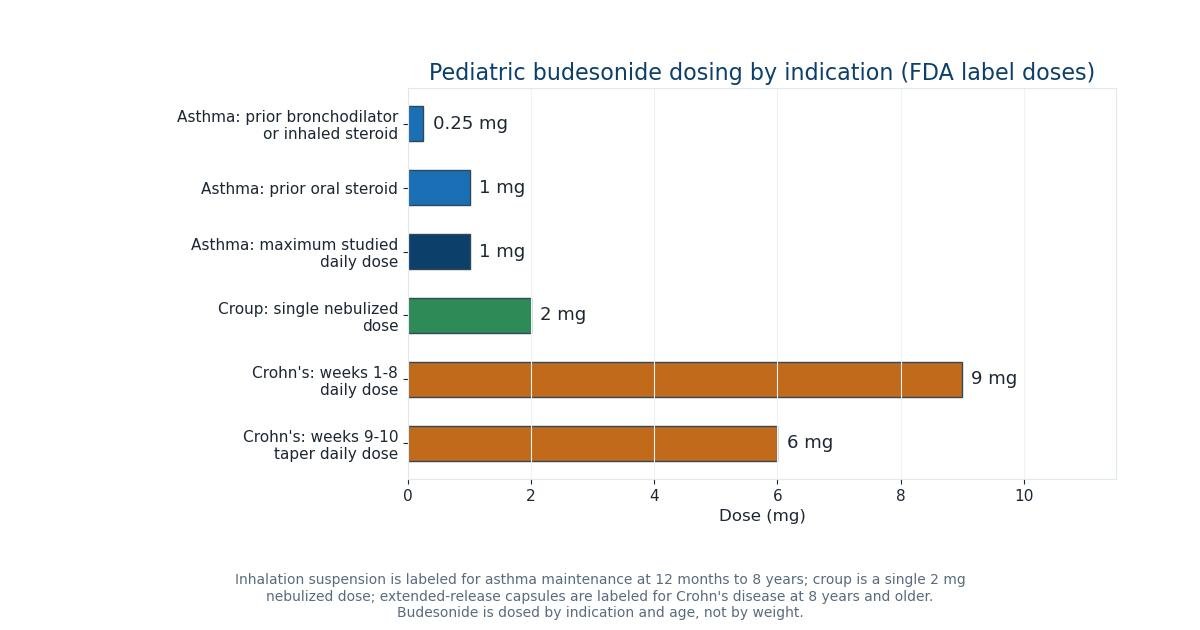
Each bar shows the labeled dose for one pediatric use. The asthma suspension doses apply to children 12 months to 8 years; the croup dose is a single treatment; the Crohn's capsule course applies from age 8 and includes a taper. All doses are fixed by indication and age, not by body weight.
What budesonide is
Budesonide is a corticosteroid medicine that calms inflammation. In asthma and croup, inflammation and swelling in the airways make breathing difficult, and budesonide delivered directly to the airways reduces that inflammation day after day. In Crohn's disease, inflammation in the lining of the intestine causes abdominal pain, diarrhea, and poor growth, and budesonide in a delayed-release capsule delivers the medicine to the ileum and ascending colon where the inflammation sits. The same active ingredient therefore appears in three different pediatric products because the delivery method decides where the medicine acts.
The inhalation suspension (brand name Pulmicort Respules) is a liquid placed in a nebulizer machine, which turns it into a fine mist the child breathes in through a mouthpiece or face mask. It is approved by the FDA for maintenance treatment of asthma in children 12 months to 8 years of age, which makes it the standard inhaled corticosteroid for toddlers and preschoolers who are too young to coordinate a metered-dose inhaler or dry-powder inhaler. The extended-release capsules (brand name Entocort EC) are approved for mild to moderate Crohn's disease involving the ileum and/or the ascending colon in patients 8 years of age and older, given as one morning capsule each day.
Budesonide belongs to the glucocorticoid class, the same family as the steroids the body makes naturally, but it is designed so that most of an inhaled or gut-targeted dose acts locally and relatively little reaches the rest of the body compared with a systemic steroid tablet. That local action is the reason budesonide is preferred for these uses, but it does not make it free of systemic effects: with long-term use, especially at higher doses, steroid effects elsewhere in the body remain possible, which is why the labels carry warnings about adrenal function, growth, and immune effects. Every dose decision is the prescriber's, weighing the child's condition against these risks.
Why the dose is not based on weight
Many parents expect every children's medicine to be dosed in milligrams per kilogram, because antibiotics and fever medicines usually are. Budesonide breaks that expectation on purpose: the FDA labels set fixed doses by indication and age, and weight never enters the calculation. A 15 kg toddler and a 25 kg preschooler with the same asthma history start on the same 0.25 mg of inhalation suspension; a 30 kg child and a 60 kg teenager with Crohn's disease both take the same 9 mg capsule. This is not an oversight. Inhaled and gut-targeted budesonide acts where it lands, and the doses that proved safe and effective in the clinical trials were fixed doses, so the labels kept them fixed.
Weight still matters, just not for setting the dose. The prescriber records height and weight at visits because inhaled corticosteroids can slow growth velocity, and because weight changes help the clinician judge whether the underlying disease is under control. The lookup tool on this page deliberately has no weight field: for budesonide, asking for weight would imply it changes the answer, and it does not. If a different children's medicine is dosed by weight, the prescriber or pharmacist will say so explicitly. Do not convert a budesonide dose to milligrams per kilogram yourself and do not adjust it because a child has gained or lost weight.
Asthma maintenance: budesonide inhalation suspension (12 months to 8 years)
The FDA label for budesonide inhalation suspension covers children 12 months to 8 years of age who need a daily controller for persistent asthma. The starting dose depends on what the child was treated with before, because children stepping up from oral steroids need a higher starting dose to keep the asthma controlled while the systemic steroid is withdrawn. Once control is achieved, the label directs the prescriber to titrate down to the lowest effective dose, and 1 mg total per day is the maximum studied dose.
| Child's previous treatment | Labeled starting dose | Notes |
|---|---|---|
| Bronchodilators alone | 0.25 mg once daily | Lowest starting dose; given in the evening or morning per prescriber |
| Inhaled corticosteroid | 0.25 mg once daily | Same starting dose when switching from another inhaled steroid |
| Oral corticosteroid | 1 mg once daily | Higher starting dose while systemic steroid is tapered and stopped |
| Any of the above, after control is achieved | Titrate to the lowest effective dose | The label's standing direction once the desired effect is reached |
| Maximum studied | 1 mg total per day | Doses above this were not the studied range; the ceiling is not a target |
Children previously on oral corticosteroids need extra care during the switch. The label warns that deaths from adrenal insufficiency have occurred during and after transfer from systemic steroids to inhaled steroids, so the oral steroid is tapered slowly, not stopped abruptly, and the child is watched for signs that the body is not making enough of its own steroid: unusual tiredness, weakness, nausea, vomiting, or low blood pressure. Families should know that during stress such as surgery, infection, or a severe asthma attack, a child recently transferred from oral steroids may need systemic steroids again, and the prescriber gives specific instructions for those situations.
The suspension is given with a jet nebulizer, never with an ultrasonic nebulizer, because the label's dosing was established with jet nebulizers. If the child's asthma does not respond adequately to the starting dose after one to two weeks, the label allows the prescriber to consider increasing the dose within the studied range, always aiming for the lowest dose that keeps symptoms controlled. Parents judge control by daytime symptoms, night waking, rescue inhaler use, and activity limitation, and report these at each visit rather than adjusting the dose themselves.
Croup: the single 2 mg nebulized dose
Croup is the barking cough and noisy breathing, called stridor, that appears when a viral infection swells the airway just below the vocal cords. It is most common between 6 months and 5 years of age, often arrives at night, and frightens parents because the child sounds much worse than the illness usually is. Steroids reduce the airway swelling, and the evidence-based budesonide regimen is strikingly simple: a single 2 mg nebulized dose.
| Use | Labeled or evidence-based dose | Notes |
|---|---|---|
| Croup, single treatment | 2 mg nebulized, one time | Given in a clinical setting with observation for response |
This dose comes from the randomized trial by Johnson DW and colleagues (JAMA, 1998), which compared 2 mg of nebulized budesonide with intramuscular dexamethasone and oral dexamethasone in children with croup, and it is the dose reflected in the major clinical reviews of croup management (Cherry JD, New England Journal of Medicine, 2008; Bjornson CL and Johnson DW, The Lancet, 2008). The reviews position nebulized budesonide as an effective option alongside oral dexamethasone, with the choice depending on the setting, the child's ability to swallow, and clinician preference. Because it is a single-dose treatment given where the child can be watched, families should not try to repeat it at home or keep nebulizing extra doses through the night.
Practical points for parents: croup often looks worse than it is, but stridor at rest, difficulty breathing, drooling, or unusual drowsiness are reasons to seek care promptly rather than waiting to see. Cool night air and calm handling sometimes ease mild symptoms, but they do not replace medical assessment when the child is struggling. After the single budesonide dose, the clinician observes the child to confirm the breathing eases; many children improve within a few hours, and the clinician decides whether further treatment or admission is needed.
Crohn's disease: budesonide extended-release capsules (ages 8 and older)
Entocort EC is approved for mild to moderate active Crohn's disease involving the ileum and/or the ascending colon, in patients 8 years of age and older. The capsule has a delayed-release coating so the medicine is released in the lower small intestine and upper colon rather than the stomach, putting the steroid where the inflammation is. The labeled course is 9 mg once daily in the morning for up to 8 weeks, followed by a taper of 6 mg once daily for 2 weeks, and then the medicine is stopped.
| Phase | Labeled dose | Notes |
|---|---|---|
| Active treatment | 9 mg once daily in the morning, up to 8 weeks | Swallow whole; do not chew, crush, or open the capsule |
| Taper | 6 mg once daily for 2 weeks | Completes the course; do not stop the 9 mg dose abruptly on your own |
| Under 8 years | Not labeled | Safety and effectiveness are established from age 8; younger children need a different plan from the prescriber |
The morning timing matters because it mimics the body's natural steroid rhythm and the label specifies it. Grapefruit juice and medicines that strongly block the liver enzyme CYP3A4, such as ketoconazole, can raise budesonide levels in the blood, so the prescriber reviews everything the child takes before starting. Because Crohn's disease itself can slow growth and delay puberty through inflammation and poor nutrition, the prescriber tracks height, weight, and pubertal development during treatment: improvement in growth is often one of the signs the treatment is working. Families should report ongoing abdominal pain, blood in the stool, fever, or weight loss rather than extending the course beyond the labeled 8 weeks on their own.
How to use the nebulizer correctly
Good technique decides how much of the 0.25 mg or 1 mg actually reaches the child's lungs, so it is worth doing carefully every time. Use a jet nebulizer, the compressor type with a cup and tubing, because that is the device the label's dosing was studied with. Wash your hands, then shake the Respule ampule gently and twist the top off. Squeeze the full contents into the nebulizer cup and attach the mouthpiece or face mask. For toddlers who cannot seal a mouthpiece, a snug face mask is the practical choice; the mask should fit closely without pressing hard on the face.
Seat the child upright, leaning slightly forward is fine, and start the compressor. Ask the child to breathe in and out normally through the mouth, not to take exaggerated deep breaths, which mostly deposits medicine in the mouth and throat. A treatment usually takes several minutes; it is finished when the mist sputters and stops, at which point a small amount of liquid left in the cup is normal and expected. Stay with young children for the whole treatment so the mask stays in place and the child keeps breathing through it.
After every treatment, have the child rinse the mouth with water and spit it out. This simple step is in the label to reduce the risk of oral thrush, the white patches of a yeast infection that inhaled steroids can encourage. For babies and toddlers who cannot rinse, wiping the face after a mask treatment and offering a drink of water helps reduce skin and mouth exposure. Wash the nebulizer cup, mouthpiece, or mask in warm soapy water after each use, rinse well, and air-dry; once a week, disinfect according to the manufacturer's instructions. A dirty nebulizer can grow germs that are then breathed straight into the lungs, so cleaning is part of the treatment, not an optional extra. Keep spare ampules at room temperature, use each ampule promptly once opened, and check the expiry date before every treatment.
Safety: what to watch for
Budesonide is a steroid, and even with local delivery the labels carry the class warnings that families should know. The most practical one for the suspension is oral candidiasis: white patches in the mouth or throat that can make eating uncomfortable. Rinsing after every treatment, as described above, is the main prevention, and the prescriber treats thrush promptly if it appears. Hoarseness and throat irritation are also reported and usually ease with good technique and rinsing.
With long-term use, systemic steroid effects become the concern the labels emphasize. Inhaled corticosteroids can suppress the adrenal glands' own steroid production, particularly at higher doses and when a child is transferred from oral steroids, so the prescriber watches for unusual fatigue, weakness, nausea, or vomiting, and gives a stress-dose plan for surgery or severe illness. Other labeled warnings include possible effects on bone mineral density with long-term use, eye effects such as cataract and increased eye pressure, and a higher susceptibility to infections: children using corticosteroids should avoid exposure to chickenpox and measles when possible, and the prescriber is told promptly if exposure happens. Budesonide can also mask the signs of an existing infection, which is one more reason treatment changes stay with the clinician.
Hypersensitivity reactions are uncommon but the label lists them, so any rash, swelling of the face or tongue, or difficulty breathing right after a dose needs immediate medical attention. Paradoxical bronchospasm, wheezing that starts immediately after inhaling the suspension, is also listed: if it happens, the treatment is stopped and the prescriber is contacted at once. None of these warnings means the medicine is unsafe when used as directed; they mean the family knows what to watch for and the prescriber monitors for them at follow-up visits.
Growth monitoring
The FDA labels for inhaled corticosteroids, including budesonide, state that they may cause a reduction in growth velocity in pediatric patients, and they direct the prescriber to monitor the growth of children routinely. In practice this means height is measured at regular visits, ideally with the same stadiometer and plotted on a growth chart, so that any slowing is visible against the child's own previous pattern rather than judged from a single measurement. Weight is tracked alongside, because poor weight gain can signal either uncontrolled disease or a treatment effect worth discussing.
Two points keep this warning in perspective. First, the label's standing instruction is to titrate to the lowest effective dose, and much of the growth concern relates to higher or prolonged doses, so regular dose reviews are part of safe long-term use. Second, uncontrolled asthma and active Crohn's disease themselves impair growth through chronic inflammation, disturbed sleep, and poor nutrition, which means the comparison is never between budesonide and perfect growth but between treated disease and untreated disease. Never stop a child's budesonide because of a growth worry without talking to the prescriber: an unplanned stop can trigger an asthma flare or a Crohn's relapse that harms growth far more than the medicine. Bring the concern to the next visit, ask whether the dose can be stepped down, and keep the growth chart as the shared evidence.
Key takeaways
- The FDA label for budesonide inhalation suspension (Pulmicort Respules) covers children 12 months to 8 years.
- Budesonide pediatric doses are set by the FDA labels by indication and age, not by kilograms.
- No.
- The 2 mg single nebulized dose for croup is a clinical-setting treatment, given in an urgent-care clinic or emergency department where the child can be observed for response.
Frequently asked questions
What is the starting dose of budesonide inhalation suspension for a 3-year-old with asthma?
A 3-year-old falls in the labeled 12 months to 8 years range. If the child was previously treated with bronchodilators alone or with an inhaled corticosteroid, the labeled starting dose is 0.25 mg once daily. If the child was previously treated with oral corticosteroids, the starting dose is 1 mg once daily. The prescriber then titrates to the lowest effective dose, and 1 mg per day is the maximum studied dose.
Why is the budesonide dose not based on my child's weight?
The FDA labels fix budesonide doses by indication and age because those were the doses studied in the clinical trials. The asthma suspension dose depends on the child's previous treatment, the croup dose is a single 2 mg for every child, and the Crohn's capsule dose is 9 mg daily for every labeled patient 8 and older. Weight is used for monitoring growth and safety, not for calculating the dose.
Can budesonide stop an asthma attack?
No. Budesonide is a controller for daily long-term control and is not indicated for relief of acute bronchospasm. Use the child's prescribed rescue bronchodilator for attacks and seek urgent care if breathing is severely affected or the rescue medicine does not work. Every family should have a written asthma action plan separating daily controller doses from rescue steps.
Is the single 2 mg budesonide dose for croup given at home?
No. The 2 mg single nebulized dose is given in a clinic or emergency department where the child is observed for response. It was established in a randomized trial (Johnson DW and colleagues, JAMA 1998) and is reflected in the major croup reviews. Do not repeat it at home on your own.
How long does a child take Entocort EC for Crohn's disease?
The labeled course for ages 8 and older is 9 mg once daily in the morning for up to 8 weeks, followed by a 6 mg once daily taper for 2 weeks. The capsule is swallowed whole, never chewed or opened. Finish the full course including the taper exactly as the prescriber directed.
Does budesonide affect my child's growth?
Inhaled corticosteroids may reduce growth velocity, which is why the label directs routine growth monitoring and titration to the lowest effective dose. Height should be measured and plotted at regular visits. Discuss any concern with the prescriber rather than stopping the medicine, since uncontrolled asthma or Crohn's disease also impairs growth.
References
- Pulmicort Respules (budesonide inhalation suspension) FDA prescribing information. Maintenance treatment of asthma in children 12 months to 8 years: 0.25 mg once daily after bronchodilators alone or inhaled corticosteroids; 1 mg once daily after oral corticosteroids; titrate to the lowest effective dose; maximum studied dose 1 mg per day; not indicated for relief of acute bronchospasm; jet nebulizer administration.
- Entocort EC (budesonide) extended-release capsules FDA prescribing information. Mild to moderate Crohn's disease involving the ileum and/or ascending colon, patients 8 years and older: 9 mg once daily in the morning for up to 8 weeks, then 6 mg once daily for 2 weeks.
- Johnson DW, Jacobson S, Edney PC, et al. A comparison of nebulized budesonide, intramuscular, and oral dexamethasone for croup: a randomized controlled trial. JAMA. 1998;280(11):959-964. (source of the single 2 mg nebulized budesonide dose for croup)
- Cherry JD. Croup. N Engl J Med. 2008;358(4):384-391. (clinical review reflecting nebulized budesonide in croup management)
- Bjornson CL, Johnson DW. Croup. Lancet. 2008;371(9609):329-339. (clinical review of croup diagnosis and treatment)
- American Academy of Pediatrics
- electronic medicines compendium
Related pediatric dosing guides
- Fluticasone pediatric dosing guide: another inhaled corticosteroid used in childhood asthma, with the same weight-independent dosing principle.
- Pediatric dosage guides: the full collection of label-verified children's dosing references.
- All calculators: browse the complete Doctor With Data tool library.