Fluticasone Propionate HFA (Flovent HFA) Pediatric Dosing Guide and Dose Lookup
In short: Label-verified pediatric dosing for fluticasone propionate HFA (Flovent HFA): the labeled 88 mcg twice-daily dose for ages 4 to 11, starting and maximum doses for 12+, canister puff math, inhaler technique, growth and candidiasis safety, and stepping down. Free dose lookup. Use the calculator above, then read the guide below to interpret your result and its limitations.
Label-verified dosing for fluticasone propionate inhalation aerosol in children and adolescents with asthma: the fixed 88 mcg twice-daily dose for ages 4 to 11, starting and maximum doses for 12 and older, canister puff math, inhaler technique with a spacer, candidiasis prevention, growth monitoring, and stepping down to the lowest effective dose. Use the lookup below, then read the full guide. Medically reviewed by Dr. Taimoor Asghar.
Dose lookup: labeled dose by age band and control status
Reference only. Every number comes from the FDA prescribing information for Flovent HFA (fluticasone propionate inhalation aerosol), revised April 2024, checked 2026-10-05. The lookup covers labeled doses; titration, step-ups, and any change of regimen are clinician-directed. Doses are fixed by age band, not by weight, which is why the lookup does not ask for weight.
Dose ladder: what the label gives by age band
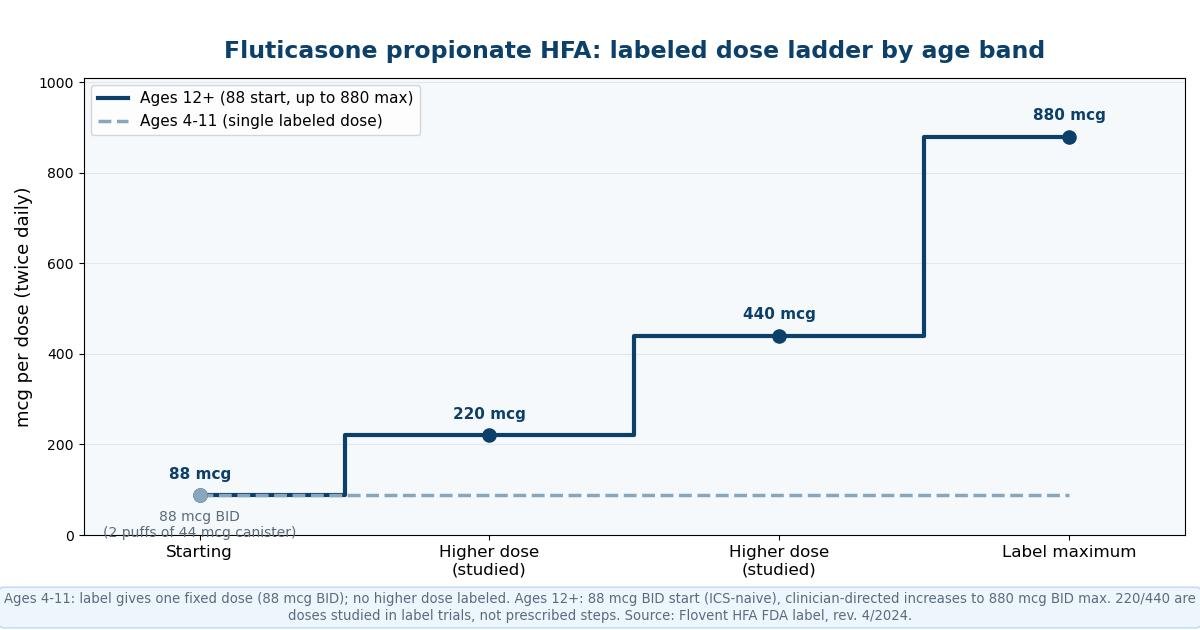
The ladder shows the labeled positions. Ages 4 to 11 sit at a single fixed dose, 88 mcg twice daily, because the label specifies no higher dose for this band. Ages 12 and older start at 88 mcg twice daily (for patients not already on an inhaled corticosteroid) and the prescriber may move higher, up to the labeled maximum of 880 mcg twice daily, based on prior therapy and severity. The 220 and 440 mcg twice-daily points are doses studied in the label's clinical trials, shown for orientation; they are not prescribed steps, and the label gives no fixed increment sizes. Older summaries that quote 440 mcg twice daily as the ceiling are outdated: the current label maximum for 12 and older is 880 mcg twice daily.
What fluticasone propionate HFA is
Flovent HFA is the brand name for fluticasone propionate inhalation aerosol, an inhaled corticosteroid (often shortened to ICS) used as a daily controller medicine for asthma. The FDA prescribing information indicates it for the maintenance treatment of asthma as prophylactic therapy in adult and pediatric patients aged 4 years and older. Fluticasone propionate itself was first approved in the United States in 1994; the HFA-propelled aerosol formulation was approved in May 2004 for patients 12 years of age and older, and the indication was later extended to children aged 4 to 11 after a 12-week trial showed that 88 mcg twice daily improved peak expiratory flow, reduced daily rescue albuterol use, and reduced nighttime awakenings due to asthma compared with placebo in that age group.
The word "maintenance" in the indication is doing important work. This is a medicine taken every day, twice a day, whether or not the child has symptoms that day. It prevents asthma symptoms and flare-ups by keeping airway inflammation down; it does not open the airways during an attack. The label's Limitations of Use states this plainly: Flovent HFA is not indicated for the relief of acute bronchospasm. Parents sometimes discover an old inhaler in a drawer during a bad night and wonder whether a few extra puffs will help the child breathe; the label's answer is no, and the contraindications section goes further, barring its use as the primary treatment of status asthmaticus or other acute episodes of asthma where intensive measures are required. The rescue plan for those moments is a short-acting bronchodilator, and the label directs that if symptoms arise between Flovent HFA doses, an inhaled short-acting beta2-agonist should be used for immediate relief.
It helps to keep fluticasone propionate HFA distinct from its relatives. It is not the same as fluticasone propionate dry powder (the Diskus), which has its own pediatric dosing of 50 mcg twice daily to start for ages 4 to 11 with a 100 mcg twice-daily maximum, and it is not fluticasone furoate (the once-daily Ellipta). The numbers on this page apply only to the HFA metered-dose aerosol: 44, 110, and 220 mcg per actuation from the mouthpiece, delivered from the dark orange plastic inhaler with the peach cap that contains 120 metered inhalations and is fitted with a dose counter.
How inhaled corticosteroids work
Asthma is, at its core, a disease of chronic airway inflammation. Between visible attacks, the lining of the airways stays inflamed and twitchy, which is why symptoms return and why a rescue inhaler alone never gains lasting control. Inhaled corticosteroids treat that underlying inflammation directly at its site: the steroid is breathed into the airways, where it suppresses the inflammatory response, reduces swelling of the airway lining, and over time makes the airways less hyperresponsive to triggers such as colds, allergens, exercise, and cold air. Fluticasone propionate is a synthetic corticosteroid with potent anti-inflammatory activity, and delivering it by inhalation puts the medicine where the disease is while keeping the amount that reaches the rest of the body far lower than an equivalent oral steroid dose would.
Because it works on inflammation rather than on the airway muscle spasm of an attack, the effect builds slowly. The label cautions that individual patients will experience a variable time to onset and degree of symptom relief, and that maximum benefit may not be achieved for 1 to 2 weeks or longer after starting treatment. This lag matters for expectations: a child who starts Flovent HFA on Monday is not expected to be transformed by Friday, and judging the dose a failure after a few days is premature. It also matters for safety, because the drug is absorbed into the circulation and can be systemically active at higher doses; the label notes that the benefit of minimizing HPA-axis suppression can be expected only when recommended dosages are not exceeded and each patient is titrated to the lowest effective dose. In plain terms, more is not better with this medicine: the aim is the smallest dose that keeps asthma controlled, held steady over time.
The controller-plus-reliever partnership is the backbone of the whole treatment plan. The inhaled steroid is the quiet daily work; the short-acting beta2-agonist is the emergency tool. The label directs patients to contact their physician immediately when episodes of asthma that are not responsive to bronchodilators occur during treatment, because during such episodes patients may require therapy with oral corticosteroids. A child on Flovent HFA should therefore always have a reliever inhaler available and a written asthma action plan, and the family should know that needing the reliever more often is a signal to call the prescriber, not a signal to add extra puffs of the controller.
Dosing for ages 4 to 11: one fixed dose
The pediatric dosing of Flovent HFA is strikingly simple, and the simplicity is deliberate. For patients aged 4 to 11 years, the label gives a single recommended dosage: 88 mcg twice daily by oral inhalation, approximately 12 hours apart, expressed as 2 inhalations of the 44 mcg canister per dose. There is no weight calculation, no starting-versus-maintenance split, and no titration schedule for this band. The daily total is 176 mcg. The label supports this fixed dose with pediatric data: Flovent HFA was evaluated for safety in 56 pediatric subjects who received 88 mcg twice daily for 4 weeks, with adverse reaction types generally similar to those seen in adults and adolescents, and the efficacy extension to ages 4 to 11 rested on the 12-week trial described above plus pharmacokinetic studies in the 4 to 11 group.
| Age band | Labeled dose | How the label expresses it | Daily total | Labeled higher dose or maximum |
|---|---|---|---|---|
| 4 to 11 years | 88 mcg twice daily, about 12 hours apart | 2 inhalations of the 44 mcg canister per dose | 176 mcg per day | None specified: the label gives no higher fixed dose and no maximum for this band |
Source: FDA prescribing information for Flovent HFA, Dosage and Administration 2.2, checked 2026-10-05.
The absence of a labeled step-up for ages 4 to 11 deserves emphasis because it is the point where this page most differs from casual summaries. The label's general dosing guidance does say that for patients who do not respond adequately to the starting dosage after 2 weeks of therapy, higher dosages may provide additional asthma control, and that a regimen that fails to provide adequate control should be re-evaluated, with options including replacing the current strength with a higher strength, starting an ICS plus long-acting beta2-agonist combination product, or starting oral corticosteroids. But the label attaches no numbers to these options for the 4 to 11 band. Choosing among them, and choosing any higher dose, is a clinician's judgment call made with the individual child in front of them. The lookup tool on this page therefore returns an advisory, not a number, for the inadequate-control case in this age band, and this page flags that behavior as a deliberate correction rather than a gap.
Dosing for ages 12 and older: a starting dose and a ceiling
For adult and adolescent patients aged 12 years and older, the label is more flexible. The recommended starting dosage for patients in this group who are not already on an inhaled corticosteroid is 88 mcg twice daily, again 2 inhalations of the 44 mcg canister, approximately 12 hours apart. The starting dosage is based on previous asthma therapy and asthma severity, including consideration of the patient's current control of symptoms and risk of future exacerbation. The maximum recommended dosage for patients aged 12 years and older is 880 mcg twice daily.
| Age band | Labeled starting dose (not on an ICS) | How the label expresses it | Daily total at start | Labeled maximum |
|---|---|---|---|---|
| 12 years and older | 88 mcg twice daily, about 12 hours apart; higher starting doses used based on prior therapy and severity | 2 inhalations of the 44 mcg canister per dose at the starting level | 176 mcg per day at the starting level | 880 mcg twice daily |
Source: FDA prescribing information for Flovent HFA, Dosage and Administration 2.2, checked 2026-10-05.
Two corrections belong here, because older references still circulate with different numbers. First, the ceiling: many secondary sources quote 440 mcg twice daily as the maximum for adolescents and adults. That figure comes from the label's clinical trial tables, where 440 mcg twice daily was the highest dose studied in the 26-week and 52-week trials, but the current label's maximum recommended dosage for ages 12 and older is 880 mcg twice daily. This page uses the current label figure. Second, the increments: the label prescribes no fixed step sizes between the starting dose and the maximum for this formulation. The 220 and 440 mcg twice-daily doses appear in the label because they were the doses tested in the 12-week trials, which is why the chart shows them as orientation points, but a prescriber moving a teenager upward chooses the next dose clinically rather than following a labeled ladder.
For both age bands, the label adds the same closing instruction, and it is the most important sentence in the dosing section: after asthma stability has been achieved, titrate to the lowest effective dosage to reduce the possibility of side effects. Every increase is therefore provisional, and the long-term direction of travel is always downward toward the smallest dose that holds control.
Canister strengths and the puff math
Flovent HFA comes in three canister strengths, and the arithmetic of puffs is where families most often go wrong, so it is worth doing slowly. Each actuation delivers 44, 110, or 220 mcg of fluticasone propionate from the mouthpiece, depending on the canister. The labeled pediatric dose of 88 mcg is exactly 2 puffs of the 44 mcg canister. It is not 1 puff of the 110 mcg canister: a single actuation of the 110 mcg canister delivers 110 mcg, which is more than the labeled 88 mcg dose, and a single actuation of the 220 mcg canister delivers 220 mcg, two and a half times the labeled dose. The canister strengths exist so that prescribers can reach higher doses for older patients with fewer puffs, not so that families can substitute across strengths. The lookup tool shows the puff mapping for all three canisters precisely to make this visible.
The inhaler itself holds 120 metered inhalations and is fitted with a counter, so the remaining doses are visible and there is no need to guess or to test-spray into the air to check whether it is empty. Priming is a separate, specific ritual: before the first use, prime by releasing 4 sprays into the air away from the face, shaking well for 5 seconds before each spray. If the inhaler has not been used for more than 7 days, or if it has been dropped, prime it again by shaking well for 5 seconds and releasing 1 spray into the air away from the face. The label adds one more small instruction that is easy to overlook: avoid spraying in the eyes.
Inhaler technique and the spacer
A metered-dose inhaler only works if the medicine reaches the airways, and children, especially young ones, often struggle with the coordination the device demands. The label addresses this directly: a valved holding chamber and mask may be used to deliver Flovent HFA to young patients. A spacer (holding chamber) catches the spray cloud and lets the child breathe it in over a few breaths instead of requiring perfect press-and-breathe timing, and a mask attachment lets a young child who cannot seal their lips around a mouthpiece breathe the dose through a soft mask. For a 4 or 5 year old, the spacer plus mask is usually not optional in practice even though the label phrases it permissively: it is the difference between the labeled dose reaching the lungs and most of it landing on the tongue and cheeks.
The technique the clinician or pharmacist will teach follows the label's sequence: shake the inhaler well for 5 seconds before each spray, prime as described above when needed, breathe out gently away from the device, seal the lips around the mouthpiece (or fit the mask), press the canister as a slow deep breath begins, and continue breathing in steadily. The second puff of the dose follows after a short pause, with another 5-second shake first. Then comes the step the label insists on: rinse the mouth with water, without swallowing, after the inhalation. Families should treat the rinse as part of the dose, not as an optional extra, because it is the main defense against the most common local side effect, described in the next section but one.
Safety: mouth and throat infections
The most common local problem with inhaled steroids is also the most preventable. In clinical trials, localized infections of the mouth and pharynx with Candida albicans developed in subjects treated with Flovent HFA, and the label lists oropharyngeal candidiasis among its warnings. The trial numbers give a sense of scale: candidiasis of the mouth or throat occurred in 4 percent of subjects at 88 mcg twice daily, 2 percent at 220 mcg twice daily, and 5 percent at 440 mcg twice daily, compared with less than 1 percent on placebo, and the label's adverse-reaction summary lists candidiasis among the most common reactions at over 3 percent incidence. Esophageal candidiasis appears in the postmarketing reports. When thrush develops, it is treated with appropriate local or systemic antifungal therapy while Flovent HFA treatment continues, though at times the inhaler has to be interrupted.
Prevention is a single habit: after every inhalation, rinse the mouth with water without swallowing. The "without swallowing" matters because the point is to wash residual steroid out of the mouth and throat, not to ingest it. For children using a spacer, the same rinse applies, since some deposition in the mouth still occurs. Parents should watch for the signs the label implies: white patches on the tongue or inner cheeks, soreness when eating, or a change in the child's voice (hoarseness and dysphonia are also reported in the trials), and report them rather than stopping the inhaler on their own, because stopping a controller abruptly can destabilize asthma.
Safety: growth monitoring
This is the safety issue parents of young children ask about most, and the label answers it directly. Orally inhaled corticosteroids may cause a reduction in growth velocity when administered to pediatric patients, and the label directs that the growth of pediatric patients receiving Flovent HFA be monitored routinely, for example via stadiometry, which is precise height measurement with a wall-mounted device rather than a casual mark on a doorframe. To minimize the systemic effects of inhaled corticosteroids, the label says to titrate each patient's dosage to the lowest dosage that effectively controls symptoms. Postmarketing reports include growth velocity reduction in children and adolescents, alongside other systemic corticosteroid effects such as Cushingoid features, hyperglycemia, osteoporosis, and weight gain.
Two things keep this risk in proportion. First, it is a velocity effect: the concern is a slowing of the rate of growth while on treatment, which is why the measurement that matters is the growth curve over months, plotted at clinic visits, not a single height reading. Second, it is dose-related in principle, which is why the lowest-effective-dose instruction is repeated in both the dosing and the growth sections of the label. If the growth curve falters, the prescriber's review covers the dose, the regimen, and whether continued treatment at the current level is still justified. Uncontrolled asthma itself can impair a child's growth and development, so the clinical question is always the balance between the two, and it is answered with measurements, not with stopping the medicine at home.
Safety: adrenal function and systemic effects
Although the medicine is inhaled, some of it reaches the bloodstream, and at higher doses, or in susceptible individuals, it can suppress the body's own steroid production. The label describes two related risks. Hypercorticism and adrenal suppression may occur with very high dosages or at the regular dosage in susceptible individuals; if such changes occur, Flovent HFA should be reduced slowly, consistent with accepted procedures for reducing systemic corticosteroids. A relationship between plasma fluticasone levels and inhibition of stimulated cortisol production was shown after 4 weeks of treatment, and individual sensitivity varies, which the prescriber weighs when choosing a dose.
The sharper warning concerns children transferred from systemic corticosteroids, such as prednisone, to the inhaler. Deaths due to adrenal insufficiency have occurred in patients with asthma during and after transfer from systemic corticosteroids to less systemically available inhaled steroids, and a number of months are required for recovery of hypothalamic-pituitary-adrenal function after systemic steroids are withdrawn. During this vulnerable period, the child may show signs of adrenal insufficiency, such as fatigue, lassitude, weakness, nausea and vomiting, and low blood pressure, when exposed to trauma, surgery, or infection. The label is explicit that in recommended doses Flovent HFA supplies less than normal physiological amounts of glucocorticoid systemically and does not provide the mineralocorticoid activity needed for coping with these emergencies, so during periods of stress or a severe asthma attack, such patients should resume oral corticosteroids in large doses immediately and contact their physician, and they should carry a warning card stating they may need supplementary systemic steroids. Prednisone reduction itself is done slowly: the label describes reducing the daily prednisone dose by 2.5 mg on a weekly basis during Flovent HFA therapy, with lung function, reliever use, and symptoms carefully monitored. Transfer can also unmask allergic conditions previously suppressed by the systemic steroid, such as rhinitis, conjunctivitis, or eczema, and some patients experience withdrawal symptoms such as joint or muscular pain, lassitude, or depression despite their breathing improving.
Safety: infections, bronchospasm, eyes, bones, and interactions
Several further warnings complete the safety picture, and each has a practical consequence for families. Because corticosteroids suppress the immune system, chickenpox and measles can have a more serious or even fatal course in susceptible children using them; the label says children who have not had these diseases or been properly immunized should take particular care to avoid exposure, with varicella zoster immune globulin prophylaxis if exposed to chickenpox and pooled immunoglobulin if exposed to measles. Inhaled steroids should be used with caution, if at all, in patients with active or quiescent tuberculosis of the respiratory tract, systemic fungal, bacterial, viral, or parasitic infections, or ocular herpes simplex. Paradoxical bronchospasm, an immediate increase in wheezing after dosing, can occur as with other inhaled medicines; if it happens, it is treated immediately with an inhaled short-acting bronchodilator, Flovent HFA is discontinued immediately, and alternative therapy is started. Immediate hypersensitivity reactions including anaphylaxis may occur after administration, which is why hypersensitivity to any ingredient is a contraindication.
With long-term use, the label notes glaucoma, increased intraocular pressure, and cataracts have been reported, and it suggests considering referral to an ophthalmologist for patients who develop eye symptoms or use the medicine long term. Decreases in bone mineral density have been observed with long-term inhaled steroid use, although a 2-year trial of fluticasone propionate aerosol at 88 or 440 mcg twice daily showed no statistically significant changes in bone density at the lumbar spine at any measured time point. Finally, drug interactions: the use of strong CYP3A4 inhibitors such as ritonavir or ketoconazole with Flovent HFA is not recommended, because they can substantially raise systemic fluticasone exposure; in one cited interaction, ketoconazole produced a 1.9-fold increase in plasma fluticasone exposure with a 45 percent decrease in plasma cortisol exposure. Families should make sure every prescriber knows the child uses an inhaled steroid before any new medicine, especially antifungals or HIV medicines, is started.
What it is not for
It is worth gathering the exclusions in one place, because each is a common misunderstanding. Flovent HFA is not a reliever: the label says it is not to be regarded as a bronchodilator and is not indicated for rapid relief of bronchospasm. It is not for the primary treatment of status asthmaticus or acute episodes where intensive measures are required: that is a contraindication, not a caution. It is not dosed by weight: the pediatric dose is the same 88 mcg twice daily for a small 4-year-old and a large 11-year-old. It is not for children under 4: the indication starts at 4 years, and the lookup tool returns a named not-labeled result for younger children rather than a dose. And it is not a medicine to stop suddenly when the child feels well: stopping a controller abruptly removes the inflammation control the label spent 1 to 2 weeks building, and any discontinuation or step-down is a prescriber's decision made against the lowest-effective-dose principle.
Stepping down: the lowest effective dose
The label's dosing section opens with how to start and closes with how to reduce, and the closing instruction governs the whole multi-year course of treatment. After asthma stability has been achieved, the prescriber titrates to the lowest effective dosage to reduce the possibility of side effects. In practice this means regular review visits where the prescriber weighs symptom frequency, nighttime awakenings, reliever use, and lung function against the dose the child is taking, and steps down when control has been solid. The step-down is the mirror image of the step-up: gradual, observed, and reversible if control slips. It is also the main lever the prescriber has against the growth and adrenal effects described above, since both are dose-related. Families can support the process by keeping the reliever-use and symptom diary the prescriber asks for, by never adjusting the dose at home, and by understanding that a lower dose after a good year is a success, not a sign the medicine was unnecessary: the low dose is working because the inflammation stayed controlled.
Key takeaways
- For a 6-year-old, the FDA label gives one fixed dose: 88 mcg twice daily, taken by oral inhalation approximately 12 hours apart.
- The label does not specify a higher fixed dose for ages 4 to 11, so there is no labeled step-up number for this band.
- For patients aged 12 years and older, the current FDA label (revised April 2024) sets the maximum recommended dosage at 880 mcg twice daily, with the recommended starting dosage of 88 mcg twice daily for patients not already on an inhaled corticosteroid.
- Orally inhaled corticosteroids may cause a reduction in growth velocity when administered to pediatric patients, according to the FDA label's warnings.
Frequently asked questions
What is the labeled starting dose of Flovent HFA for a 6-year-old?
For a 6-year-old, the FDA label gives one fixed dose: 88 mcg twice daily, taken by oral inhalation approximately 12 hours apart. The label expresses this as 2 inhalations of the 44 mcg canister per dose, for a daily total of 176 mcg. Unlike many pediatric medicines, there is no weight calculation and no titration schedule for the 4 to 11 age band in the label: 88 mcg twice daily is the recommended dosage for every child aged 4 to 11, and the label does not specify a higher fixed dose or a maximum for this band. A valved holding chamber and mask may be used to deliver it to young patients.
Can the Flovent HFA dose be increased for a child aged 4 to 11 whose asthma is still not controlled?
The label does not specify a higher fixed dose for ages 4 to 11, so there is no labeled step-up number for this band. The label's general dosing guidance says that for patients who do not respond adequately to the starting dosage after 2 weeks of therapy, higher dosages may provide additional asthma control, and that if a regimen fails to provide adequate control the therapy should be re-evaluated: replacing the current strength with a higher strength, starting an ICS plus long-acting beta2-agonist combination product, or starting oral corticosteroids. Which of these to choose is a clinician's decision, not something a parent should select from this page. Note that maximum benefit may take 1 to 2 weeks or longer, so an early judgment of failure can be premature.
What is the maximum Flovent HFA dose for a 14-year-old?
For patients aged 12 years and older, the current FDA label (revised April 2024) sets the maximum recommended dosage at 880 mcg twice daily, with the recommended starting dosage of 88 mcg twice daily for patients not already on an inhaled corticosteroid. The starting dose is based on previous asthma therapy and asthma severity. Older summaries that quote 440 mcg twice daily as the ceiling are outdated: 440 mcg twice daily was the highest dose studied in the label's 26-week and 52-week safety trials, but the labeled maximum is 880 mcg twice daily. Doses between starting and maximum are clinician-directed; the label does not prescribe fixed increment sizes.
Does Flovent HFA affect a child's growth?
Orally inhaled corticosteroids may cause a reduction in growth velocity when administered to pediatric patients, according to the FDA label's warnings. The label directs that the growth of pediatric patients receiving Flovent HFA be monitored routinely, for example via stadiometry (precise height measurement), and that each patient's dosage be titrated to the lowest dosage that effectively controls symptoms to minimize systemic effects. This is the main reason the label insists on stepping down to the lowest effective dose once asthma is stable. If a child's growth curve slows, the prescriber reviews whether the dose, the regimen, or continued treatment needs adjusting. Postmarketing reports include growth velocity reduction in children and adolescents.
Why must the mouth be rinsed after using Flovent HFA?
Because inhaled corticosteroids can cause localized Candida albicans infections of the mouth and pharynx (oral thrush). The label advises rinsing the mouth with water without swallowing after each inhalation to help reduce this risk. In the label's clinical trials, candidiasis of the mouth or throat occurred in 4 percent of subjects at 88 mcg twice daily, 2 percent at 220 mcg twice daily, and 5 percent at 440 mcg twice daily, compared with less than 1 percent on placebo. If thrush develops, it is treated with appropriate local or systemic antifungal therapy while Flovent HFA treatment continues, though the inhaler sometimes has to be interrupted.
Can Flovent HFA be used for a sudden asthma attack?
No. Flovent HFA is a maintenance controller medicine, not a rescue inhaler. The label states it is not indicated for the relief of acute bronchospasm and is not to be regarded as a bronchodilator; it is contraindicated for the primary treatment of status asthmaticus or other acute episodes of asthma where intensive measures are required. The label directs that if symptoms arise between doses, an inhaled short-acting beta2-agonist should be used for immediate relief, and patients should contact their physician immediately when episodes of asthma that are not responsive to bronchodilators occur during treatment. During such episodes, patients may require therapy with oral corticosteroids.
References
1. U.S. Food and Drug Administration prescribing information for Flovent HFA (fluticasone propionate inhalation aerosol), for oral inhalation use. DailyMed. Available at: dailymed.nlm.nih.gov/dailymed/drugInfo.cfm?setid=7117b2bb-fcd1-43b8-a78d-3f7f9ceefaa0 (revised April 2024; accessed 2026-10-05). Source for the indication and limitation of use (1), administration and priming (2.1), all recommended dosages and maxima (2.2), dosage forms (3), contraindications (4), all warnings and precautions (5.1 to 5.12), adverse reactions including the pediatric 4 to 11 safety data and candidiasis rates (6.1, 6.2), and the CYP3A4 interaction data (7.1).
2. GlaxoSmithKline announcement of FDA approval of Flovent HFA for children aged 4 to 11. Available at: biospace.com/fda-approves-glaxosmithkline-s-flovent-r-hfa-inhalation-aerosol-for-children-four-to-eleven (accessed 2026-10-05). Source for the 12-week pediatric trial findings: 88 mcg twice daily improved peak expiratory flow, reduced daily rescue albuterol use, and reduced nighttime awakenings due to asthma compared with placebo in children 4 to 11, with adverse events similar to placebo.
Further reading
Related pediatric dosing guides
More pediatric dosing references in this series: budesonide pediatric dosing info and the pediatric dosage calculators index.