Acyclovir Dosage Calculator for Children
In short: Pediatric acyclovir dosage calculator with verified regimens: neonatal HSV IV 20 mg/kg q8h, HSV encephalitis, immunocompromised VZV, and oral chickenpox dosing with renal adjustment. Free, with worked examples and FAQs. Use the calculator above, then read the guide below to interpret your result and its limitations.
Verified pediatric acyclovir regimens from the AAP Red Book line and the FDA drug label: neonatal HSV, HSV encephalitis, immunocompromised mucocutaneous HSV and VZV, plus oral chickenpox, with renal dose adjustment. Medically reviewed by Dr. Taimoor Asghar.
Calculate a pediatric acyclovir dose
A serum creatinine alone cannot give clearance in children without height (Schwartz equation). Enter creatinine clearance above if it has been calculated; otherwise the calculator shows standard dosing and reminds you to confirm kidney function.
Reference doses only. Neonatal HSV is an emergency: start empiric therapy in hospital immediately; do not wait for laboratory confirmation. Dosing is clinician-directed.
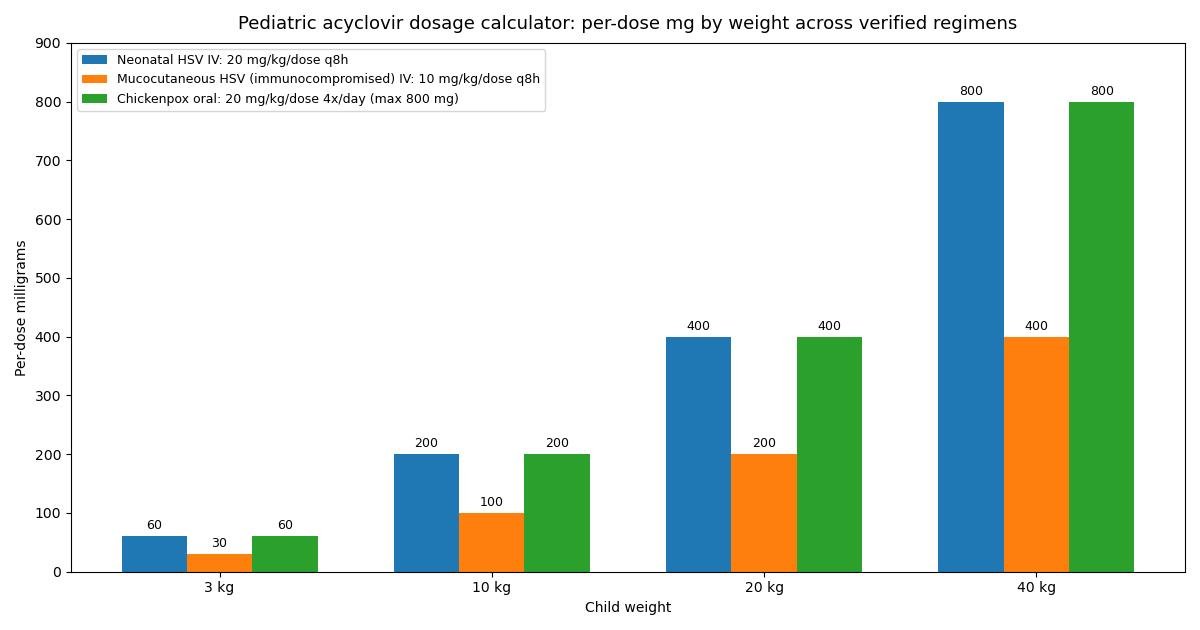
Dose chart
What this calculator covers
Acyclovir is a guanine analogue antiviral that stops herpes simplex virus (HSV) and varicella zoster virus (VZV) from replicating. In children it is used for neonatal herpes, herpes simplex encephalitis, severe mucocutaneous herpes in immunocompromised patients, varicella and zoster in immunocompromised patients, and ordinary chickenpox in immunocompetent children. Dosing is almost always weight based, expressed as milligrams per kilogram per dose, and the interval and duration depend on the indication.
This calculator covers five verified pediatric regimens. Four are intravenous: neonatal HSV, HSV encephalitis, mucocutaneous HSV in immunocompromised children, and VZV in immunocompromised children. One is oral: chickenpox in immunocompetent children aged 2 years and older. Every number on this page is traceable to a cited source, either the American Academy of Pediatrics or the FDA-approved drug label. Nothing here is estimated or carried over from adult dosing without a pediatric reference.
The calculator also handles renal impairment. Acyclovir is cleared by the kidneys, so reduced kidney function requires the interval to be extended or the dose to be reduced, using the standard creatinine clearance bands from the intravenous label. You can enter a creatinine clearance value if one has been calculated, or tick the dialysis box; otherwise the calculator shows standard dosing and flags that kidney function still needs clinical confirmation.
Neonatal herpes simplex: why speed matters
Neonatal HSV is acquired around the time of birth, usually from the birth canal, and it presents in three forms: disease limited to the skin, eyes and mouth (SEM disease), central nervous system disease (encephalitis with or without skin lesions), and disseminated disease affecting multiple organs including the liver and lungs. The American Academy of Pediatrics recommends parenteral acyclovir at 20 mg per kg per dose every 8 hours for neonatal HSV, based on the Collaborative Antiviral Study Group trials which showed that this higher dose improved outcomes compared with the older lower dose.
Treatment duration is 14 days for SEM disease and 21 days for disseminated or central nervous system disease. Infants with central nervous system involvement should have a repeat lumbar puncture near the end of the 21-day course to confirm the cerebrospinal fluid PCR is negative; if it remains positive, therapy continues with repeat lumbar punctures until negativity is documented. Premature infants may need a longer dosing interval based on their creatinine clearance, because their kidneys clear the drug more slowly.
After the intravenous course, many infants receive oral acyclovir suppression at 300 mg per square meter per dose three times daily for 6 months to reduce skin recurrences and improve neurodevelopmental outcomes. Suppression dosing is by body surface area rather than weight, so it is deliberately outside this calculator; it must be set by the treating specialist.
The verified dosing regimens used here
The table below lists every regimen this calculator implements, exactly as verified. Intravenous doses are infused at a constant rate over one hour with adequate hydration.
| Indication | Regimen | Duration | Source |
|---|---|---|---|
| Neonatal HSV, birth to under 3 months | 20 mg/kg/dose IV every 8 hours | 14 days (SEM); 21 days (CNS or disseminated) | AAP NeoReviews 2018 (Kimberlin CASG) |
| HSV encephalitis, 3 months to under 12 years | 20 mg/kg/dose IV every 8 hours | 10 days | FDA Zovirax IV label |
| HSV encephalitis, 12 years and older | 10 mg/kg/dose IV every 8 hours | 10 days | FDA Zovirax IV label |
| Mucocutaneous HSV, immunocompromised, under 12 years | 10 mg/kg/dose IV every 8 hours | 7 days | FDA Zovirax IV label |
| Mucocutaneous HSV, immunocompromised, 12 years and older | 5 mg/kg/dose IV every 8 hours | 7 days | FDA Zovirax IV label |
| VZV (chickenpox or zoster), immunocompromised, under 12 years | 20 mg/kg/dose IV every 8 hours | 7 days | FDA Zovirax IV label |
| VZV (chickenpox or zoster), immunocompromised, 12 years and older | 10 mg/kg/dose IV every 8 hours | 7 days | FDA Zovirax IV label |
| Chickenpox, immunocompetent, 2 years and older | 20 mg/kg/dose orally 4 times daily, max 800 mg/dose; over 40 kg: 800 mg 4 times daily | 5 days | DailyMed acyclovir oral label |
The intravenous label doses obese patients by ideal body weight; the calculator uses the entered weight and flags obesity as a limitation below. The calculator omits a weight-based oral regimen for first-episode genital HSV in young children because the verified references give only adult fixed doses for that indication; rather than guess, the page leaves it out.
How the dose is calculated
The arithmetic is simple and fully deterministic. The per-dose amount in milligrams equals the milligrams-per-kilogram figure for the chosen indication multiplied by the child's weight in kilograms. For oral chickenpox, if that product exceeds 800 mg it is capped at 800 mg, which is reached at exactly 40 kg of body weight; children over 40 kg receive the adult 800 mg dose. The daily total equals the per-dose amount multiplied by the number of doses per day: every 8 hours means 3 doses per day, every 12 hours means 2, every 24 hours means 1, and the oral chickenpox schedule is 4 times daily.
Renal adjustment changes the factor and the interval, not the weight-based starting point. For intravenous regimens the calculator applies the label bands: full dose every 8 hours above 50, full dose every 12 hours at 25 to 50, full dose every 24 hours at 10 to 25, half dose every 24 hours at 0 to 10, and half dose every 24 hours after dialysis for hemodialysis patients. For oral chickenpox it extends the interval the way the oral label does: 4 times daily above 25, 3 times daily at 10 to 25, and twice daily below 10. The result panel always shows which renal band was applied, or states that standard dosing is shown because no renal value was entered.
Kidney function and dose adjustment
Acyclovir and its metabolites leave the body through the kidneys, so impaired renal function causes the drug to accumulate and raises the risk of neurotoxicity (tremor, confusion, agitation, seizures) and of crystal nephropathy. This is why the label gives explicit creatinine clearance bands rather than a vague instruction to reduce the dose. The bands used by this calculator, in mL per min per 1.73 m2, are:
| Creatinine clearance | IV adjustment | Oral chickenpox adjustment |
|---|---|---|
| Over 50 (IV) / over 25 (oral) | Full dose every 8 hours | 4 times daily (standard) |
| 25 to 50 | Full dose every 12 hours | 4 times daily (standard) |
| 10 to 25 | Full dose every 24 hours | 3 times daily (every 8 hours) |
| 0 to 10 | Half dose every 24 hours | 2 times daily (every 12 hours) |
| Hemodialysis | Half dose every 24 hours, given after dialysis | Specialist direction needed |
Creatinine clearance in children is usually estimated with the Schwartz equation, which needs the child's height as well as the serum creatinine, so a creatinine value alone is not enough. If you know the clearance, enter it; the calculator applies the band. If not, the calculator shows standard dosing and states the assumption plainly. In premature neonates, clearance is physiologically low and the interval may need to be lengthened beyond the standard bands under specialist guidance.
IV infusion and hydration safety
Intravenous acyclovir must never be given as a rapid bolus. The label requires each dose to be infused at a constant rate over one hour, diluted appropriately, because rapid peaks in plasma concentration are linked to the rapid rises in blood urea and creatinine described in the label's warnings. Adequate hydration must be maintained throughout therapy: a well-hydrated patient keeps urine flowing and reduces the chance of drug crystals precipitating in the renal tubules.
Monitor renal function during intravenous therapy, especially in the first days, in dehydrated children, and in any child receiving other nephrotoxic drugs. The label notes that renal impairment from acyclovir usually responds rapidly to rehydration and to dose reduction or withdrawal of the drug, but progression to acute renal failure can occur in exceptional cases. These safety points are why the calculator's intravenous result always carries the one-hour infusion and hydration note, even when renal function is normal.
Oral chickenpox dosing: the details
For immunocompetent children aged 2 years and older with chickenpox, the label dose is 20 mg per kg per dose orally four times daily (80 mg per kg per day) for 5 days, and children over 40 kg receive the adult dose of 800 mg four times daily for 5 days. The label states that therapy should begin at the earliest sign or symptom of chickenpox and that there is no information on efficacy when treatment starts more than 24 hours after the onset of signs and symptoms, so timing matters as much as the dose.
Oral dosing is not established for chickenpox under 2 years of age, and intravenous acyclovir is indicated for varicella zoster infections in immunocompromised patients rather than the oral route. The calculator enforces both boundaries: it refuses an oral chickenpox calculation for neonates and directs immunocompromised varicella to the intravenous regimens. These refusals are deliberate safety features, not gaps; each names the reason so the clinician knows exactly which rule fired.
Worked examples
Example 1. A 3 kg neonate with suspected HSV infection. The neonatal regimen is 20 mg per kg per dose: 20 times 3 = 60 mg per dose, given every 8 hours (3 doses per day), for a daily total of 180 mg. Duration is 14 days for skin-eye-mouth disease or 21 days for central nervous system or disseminated disease.
Example 2. A 20 kg child with chickenpox who is immunocompetent. The oral regimen is 20 mg per kg per dose: 20 times 20 = 400 mg per dose, below the 800 mg cap, four times daily, for a daily total of 1600 mg over 5 days.
Example 3. A 45 kg adolescent with chickenpox. The raw dose would be 20 times 45 = 900 mg, which exceeds the 800 mg cap, so the per-dose amount is capped at 800 mg four times daily, for a daily total of 3200 mg.
Example 4. A 20 kg child with HSV encephalitis and a creatinine clearance of 8 mL per min per 1.73 m2. The standard dose is 20 times 20 = 400 mg every 8 hours, but the 0 to 10 band requires half the dose every 24 hours: 200 mg once daily, with renal function monitored.
What this calculator does not cover
Several important situations are outside this calculator and must be handled by the treating clinician. Obesity is one: the intravenous label directs dosing obese patients by ideal body weight, but this calculator uses the weight you enter, so an obese child's result should be recalculated on ideal body weight by the clinician. Prematurity is another: premature neonates clear acyclovir more slowly and may need longer intervals than the standard bands, decided with a specialist.
Oral suppression after neonatal HSV (300 mg per square meter per dose three times daily for 6 months) is dosed by body surface area, not weight, and is intentionally excluded. Valacyclovir, which some clinicians prefer for older children because of better oral absorption and simpler schedules, is a different drug with its own dosing and is not covered here. Topical acyclovir for cold sores is also excluded. The first-episode genital herpes oral regimen was omitted because the verified references give only adult fixed doses for that indication; the page states this openly rather than presenting an unverified weight-based number.
Finally, every result assumes the diagnosis is correct and that the indication was chosen appropriately. The calculator checks internal consistency (right age band, right route, valid weight) but it cannot check the patient. Clinical judgement, renal monitoring, and follow-up remain essential.
Key takeaways
- Neonatal herpes simplex infection can progress to disseminated disease involving multiple organs or to central nervous system disease with brain injury, and outcomes depend on starting intravenous acyclovir without delay.
- The dose comes from the National Institute of Allergy and Infectious Diseases Collaborative Antiviral Study Group trials, which showed that the higher dose of 20 mg per kg per dose every 8 hours (60 mg per kg per day) improved outcomes compared with the older lower dose.
- The cap applies only to the oral chickenpox regimen.
- Acyclovir is cleared by the kidneys, so when creatinine clearance falls the drug accumulates and the interval must be extended.
Frequently asked questions
Why is neonatal HSV treated as a medical emergency?
Neonatal herpes simplex infection can progress to disseminated disease involving multiple organs or to central nervous system disease with brain injury, and outcomes depend on starting intravenous acyclovir without delay. The American Academy of Pediatrics states that parenteral acyclovir at 20 mg per kg per dose every 8 hours is the treatment for neonatal HSV, and therapy should begin empirically in hospital as soon as the diagnosis is suspected rather than waiting for laboratory confirmation. Any newborn with fever, poor feeding, lethargy, skin blisters or seizures in the first weeks of life needs immediate medical assessment.
Why is the neonatal dose 20 mg per kg every 8 hours?
The dose comes from the National Institute of Allergy and Infectious Diseases Collaborative Antiviral Study Group trials, which showed that the higher dose of 20 mg per kg per dose every 8 hours (60 mg per kg per day) improved outcomes compared with the older lower dose. The American Academy of Pediatrics NeoReviews article on neonatal HSV recommends this high-dose regimen for 14 days in skin-eye-mouth disease and 21 days in disseminated or central nervous system disease. Premature infants may need a longer interval based on their creatinine clearance.
When does the 800 mg per-dose cap apply?
The cap applies only to the oral chickenpox regimen. The drug label states that children 2 years and older receive 20 mg per kg per dose orally four times daily, and children over 40 kg receive the adult dose of 800 mg four times daily. The calculator therefore caps any single oral dose at 800 mg, which is reached at exactly 40 kg of body weight. The intravenous regimens have no fixed per-dose cap in the label; they are dosed strictly by weight with renal adjustment.
How does kidney function change the dose?
Acyclovir is cleared by the kidneys, so when creatinine clearance falls the drug accumulates and the interval must be extended. The intravenous label adjusts by bands: over 50 mL per min per 1.73 m2 keeps the full dose every 8 hours, 25 to 50 gives the full dose every 12 hours, 10 to 25 gives the full dose every 24 hours, 0 to 10 gives half the dose every 24 hours, and patients on hemodialysis receive half the dose every 24 hours after dialysis. For oral chickenpox the calculator extends the interval the same way the label does: three times daily at 10 to 25 and twice daily below 10. This calculator applies these bands automatically when you enter a creatinine clearance value.
Why must intravenous acyclovir be infused slowly with fluids?
Acyclovir can crystallize in the kidney tubules and cause crystal nephropathy with a rapid rise in blood urea and creatinine, especially if the patient is dehydrated or receives the drug as a rapid bolus. The label therefore requires the intravenous dose to be infused at a constant rate over one hour with adequate hydration, and renal function should be monitored during therapy. Keeping the child well hydrated before and during the infusion is an essential part of safe administration.
Can I use this calculator to dose my own child at home?
No. This calculator is a reference for clinicians and for understanding prescriptions, not a tool for self-dosing. Neonatal HSV is an emergency that must be treated in hospital with intravenous therapy started by a physician, and even routine oral chickenpox dosing should be confirmed by the prescribing clinician, especially when kidney function is impaired, the child is very young, or the immune system is compromised. Never start, change or stop acyclovir for a child on the basis of this page; dosing is clinician-directed.
References
1. American Academy of Pediatrics. Neonatal Herpes Simplex Virus Infection. NeoReviews 2018;19(2):e89. Available at: publications.aap.org/neoreviews (accessed 2026-10-05). Source for the neonatal 20 mg/kg/dose every 8 hours regimen, durations, and repeat lumbar puncture guidance.
2. Zovirax (acyclovir) IV infusion prescribing information: intravenous dosing for mucocutaneous HSV, HSV encephalitis, zoster in immunocompromised patients, infusion over one hour, and Table 5 renal dosage adjustments.
3. Acyclovir oral suspension prescribing information (DailyMed, US National Library of Medicine): chickenpox dosing for children 2 years and older (20 mg/kg/dose 4 times daily, 800 mg cap, adult dose over 40 kg) and Table 3 renal dosage modification.
Further reading
Related pediatric dosing calculators
More weight-based dosing tools in this series: amoxicillin dosage calculator, azithromycin dosage calculator, ibuprofen dosage calculator, and paracetamol (acetaminophen) dosage calculator.