Albuterol (Salbutamol) Pediatric Dosing Guide and Calculator
In short: Pediatric albuterol (salbutamol) dosing calculator with verified regimens: MDI with spacer 4-8 puffs, weight-based nebulizer 0.15 mg/kg (2.5-5 mg), continuous nebulization, and home reliever use. Free, with worked examples and FAQs. Use the calculator above, then read the guide below to interpret your result and its limitations.
Verified pediatric albuterol dosing from NHLBI EPR-3 guidance: MDI with spacer, weight-based nebulizer doses with minimum and maximum clamps, continuous nebulization for severe attacks, and home reliever use. Medically reviewed by Dr. Taimoor Asghar.
Calculate a pediatric albuterol dose
Reference doses only. Acute scenarios should be managed with a clinician; home reliever use must follow the child's written asthma action plan. Dosing is clinician-directed.
Dose chart
What this page covers
Albuterol and salbutamol are the same medicine: albuterol is the name used in the United States, and salbutamol is the name used internationally and in most drug references outside the US. It is a short-acting beta2 agonist, which means it relaxes the smooth muscle around the airways within minutes and makes breathing easier during wheezing, coughing, or chest tightness. In children it is used mainly for asthma: as a reliever at home, and in higher repeated doses for acute asthma attacks.
This page covers four verified pediatric scenarios. The first is the acute attack treated with a metered-dose inhaler (MDI) and spacer: 4 to 8 puffs of 90 micrograms per puff, repeated every 20 minutes for up to 3 doses, then every 1 to 4 hours as needed. The second is the acute attack treated with a nebulizer: a weight-based dose of 0.15 mg per kg, with a minimum of 2.5 mg and a maximum of 5 mg per treatment, on the same every-20-minutes schedule. The third is continuous nebulization for severe attacks that do not respond: 0.5 mg per kg per hour, capped at the guideline ceiling of 10 to 15 mg per hour, given in hospital. The fourth is ordinary home reliever use: 2 puffs every 4 hours as needed. Every number on this page traces back to the cited guideline sources, and anything that could not be verified was left out rather than estimated.
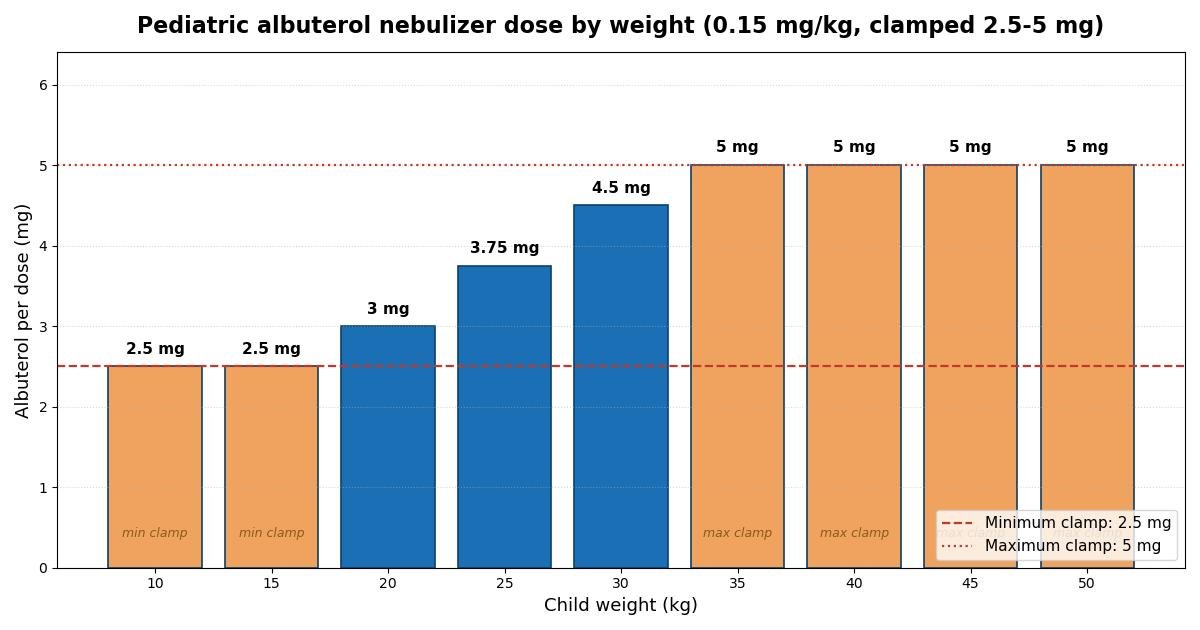
The calculator at the top turns these regimens into a concrete result. Enter the child's weight and choose the scenario, and it returns the dose, the puffs or milligrams, the frequency, and the next-step notes, including which safety clamp was applied and why. The chart above shows how the nebulizer dose rises with weight and where the minimum and maximum clamps take over.
The verified dosing regimens used here
The table below lists every regimen this calculator implements, exactly as verified against the sources. Albuterol MDI canisters deliver 90 micrograms per puff, which is the basis for all puff counts on this page.
| Scenario | Regimen | Frequency | Source |
|---|---|---|---|
| Acute attack, MDI with spacer | 4-8 puffs (90 mcg/puff) | Every 20 minutes for 3 doses, then every 1-4 hours as needed | NHLBI EPR-3 |
| Acute attack, nebulizer (intermittent) | 0.15 mg/kg per dose; minimum 2.5 mg, maximum 5 mg | Every 20 minutes for 3 doses, then every 1-4 hours as needed | NHLBI EPR-3; pediatric acute-asthma algorithm (0.15 mg/kg, max 5 mg) |
| Severe attack, continuous nebulization (hospital) | 0.5 mg/kg/hour; ceiling 10-15 mg/hour | Continuous via large-volume nebulizer | NHLBI EPR-3 |
| Home reliever | 2 puffs (90 mcg/puff) with spacer | Every 4 hours as needed | NHLBI EPR-3 reliever guidance |
The nebulizer dose is diluted to at least 3 mL total volume with normal saline for each treatment. For moderate to severe attacks, guidelines add ipratropium bromide 0.25 to 0.5 mg to the first three nebulized doses; the calculator flags this as a next-step note rather than calculating it, because the add-on decision is clinical.
How the calculator works out the dose
The arithmetic is simple and fully deterministic. For the intermittent nebulizer scenario, the raw dose in milligrams equals 0.15 multiplied by the child's weight in kilograms. Two safety clamps are then applied: if the raw result is below 2.5 mg it is raised to 2.5 mg, and if it is above 5 mg it is lowered to 5 mg. The minimum clamp protects small children, for whom the pure weight-based number would be too low to be effective, and the maximum clamp stops the dose from growing without limit in heavier children, where the verified references top out at 5 mg per treatment. The result panel always states whether a clamp was applied and shows the raw calculation, so nothing is hidden.
For continuous nebulization, the rate equals 0.5 multiplied by the weight in kilograms, giving milligrams per hour, capped at 15 mg per hour. This cap reflects the NHLBI EPR-3 ceiling of 10 to 15 mg per hour for continuous therapy. The MDI and home reliever scenarios need no weight calculation because the guidance gives fixed puff counts: 4 to 8 puffs for an acute attack and 2 puffs for home reliever use, both at 90 micrograms per puff with a spacer.
Validation is strict and named. A weight of zero or less returns the weight-invalid error, and a missing or unknown scenario returns the scenario-missing error. Weights above 120 kg return the weight-too-high error, because that is outside the pediatric range this tool is built for and the dose must be confirmed by the clinician. The age band is optional and only changes the spacer advice, never the dose.
Worked examples
Example 1. A 15 kg child having an asthma attack, nebulizer scenario. The raw dose is 0.15 times 15 = 2.25 mg, which is below the 2.5 mg minimum, so the minimum clamp applies and the child receives 2.5 mg per treatment, every 20 minutes for 3 doses, then every 1 to 4 hours as needed.
Example 2. A 30 kg child, nebulizer scenario. The raw dose is 0.15 times 30 = 4.5 mg, which sits inside the 2.5 to 5 mg range, so no clamp applies and the child receives 4.5 mg per treatment on the same schedule.
Example 3. A 45 kg child, nebulizer scenario. The raw dose is 0.15 times 45 = 6.75 mg, which exceeds the 5 mg maximum, so the maximum clamp applies and the child receives 5 mg per treatment. If the child still needs more bronchodilator after the initial treatments, the guideline path is continuous nebulization in hospital, not larger single doses.
Example 4. A 20 kg child with a severe attack not responding to intermittent treatment, continuous nebulization scenario. The rate is 0.5 times 20 = 10 mg per hour, below the 15 mg per hour ceiling, so the child receives 10 mg per hour by continuous nebulization with hospital monitoring. A 40 kg child would calculate to 20 mg per hour, which the ceiling lowers to 15 mg per hour.
Example 5. A 7-year-old with mild wheeze at home, home reliever scenario. The dose is 2 puffs (90 micrograms per puff) through a spacer, repeated every 4 hours as needed, with the not-a-controller warning: if the reliever is needed more than twice a week outside of exercise, the asthma plan needs review.
Age and weight bands
The nebulizer clamps create three natural weight bands. Children up to about 16.7 kg fall under the minimum clamp and receive 2.5 mg, because 0.15 mg per kg of their weight would give less than the effective minimum. Children from about 16.7 kg to about 33.3 kg get the true weight-based dose, from 2.5 mg up to 5 mg. Children above about 33.3 kg fall under the maximum clamp and receive 5 mg. The chart at the top of this page shows these bands visually: the flat orange segments are the clamped regions and the blue slope is the true weight-based middle.
Age matters most for the delivery device rather than the dose. Children under 4 years cannot reliably coordinate a mouthpiece, so they need the spacer with a face mask that seals gently around the nose and mouth. From about 4 years, most children can use a spacer with a mouthpiece: lips sealed around it, one puff at a time, breathing in slowly. The calculator asks for the age band optionally and tailors the spacer note; the dose itself does not change with age, only with weight and scenario.
For continuous nebulization, the weight-based rate means small children get proportionally less per hour while the 15 mg per hour ceiling only binds for children above 30 kg. This is exactly the guideline intent: weight-proportional dosing with a flat ceiling so that no child receives more than the studied hourly maximum.
Spacer technique, step by step
Technique decides how much of each puff actually reaches the airways, which is why every MDI dose on this page assumes a spacer (valved holding chamber) is used. The steps are: remove the inhaler cap and shake the inhaler well; attach it to the spacer; have the child breathe out gently away from the spacer; seal the lips around the mouthpiece, or fit the mask snugly over the nose and mouth for a child under 4; press the canister once to release a single puff into the chamber; then have the child breathe in slowly and deeply through the spacer, and hold the breath for up to 10 seconds if able, before breathing out. Young children using a mask should take 3 to 5 normal breaths from the chamber per puff.
Give one puff at a time and shake the inhaler again before the next puff. Do not fire several puffs into the spacer at once: the drug settles on the chamber walls and the child gets less, not more. After the dose, especially if the child is also using an inhaled corticosteroid, rinsing the mouth helps avoid local irritation. If the child coughs hard or the technique looks wrong, the effective dose is lower than the counted puffs, which is one reason the acute attack range is 4 to 8 puffs rather than a single exact number.
A spacer is not optional equipment for children. Without one, most of each puff lands on the tongue and the back of the throat instead of the airways, and the dose that reaches the lungs can be a small fraction of what was intended. Every spacer dose in the calculator assumes this device is in use.
Albuterol is a reliever, not a controller
This is the single most important concept on the page. Albuterol relaxes the muscles around the airways and relieves wheezing, cough, and chest tightness within minutes, but it does nothing about the inflammation inside the airway walls that causes asthma in the first place. That inflammation is treated by controller medicines, usually inhaled corticosteroids, which NHLBI calls the most effective long-term control medication for persistent asthma. A child who only ever uses albuterol is treating the symptom while the underlying disease goes unchecked.
The guidance gives a clear warning signal: needing the reliever more than twice a week, other than before exercise, means the asthma is not well controlled. When the calculator returns a home reliever result, it always carries this warning, because frequent reliever use is the sign that the controller plan needs review by the clinician, not that the reliever dose should keep rising. Parents sometimes reach for the blue inhaler more and more often as control slips; the correct response is a clinic visit to step up the controller, not a bigger reliever habit.
During an acute attack the repeated 4 to 8 puff or nebulizer doses are appropriate rescue treatment, and the every-20-minutes schedule exists precisely for that situation. But once the attack settles, the question to bring to the clinician is always what controller the child is on and whether it is doing its job.
Side effects to watch for
The effects parents notice most are shakiness or tremor of the hands and a faster heartbeat. Both come directly from the medicine stimulating beta receptors beyond the airways, and both usually fade as the dose wears off over a few hours. Children may also feel jittery, restless, or unusually excited after a dose, and some get a headache. These effects are dose-related: they are more noticeable after the repeated every-20-minute attack doses than after a single 2-puff reliever dose.
At the high doses used in hospital for severe attacks, albuterol can disturb blood salts, particularly potassium, which is one reason continuous nebulization is given with monitoring and never set up at home. Tell the clinician promptly if the heartbeat feels very fast or irregular, if the child has chest pain, or if tremor is severe enough to interfere with drinking or writing. These are uncommon at home reliever doses but deserve attention whenever they appear. As with any medicine, an allergic reaction with swelling of the lips or face or sudden worsening of breathing after a dose needs emergency care.
When to seek emergency care
Use the home reliever and the acute attack doses within the child's written asthma action plan, but know the red flags that mean the plan has been outgrown by the attack. Go to the emergency department if the child does not improve after three albuterol treatments in the first hour; is too breathless to talk or finish a sentence; has the ribs or the muscles of the neck visibly pulling in with each breath; has lips or a face turning blue or grey; or becomes drowsy, exhausted, or confused. If you measure peak flow, a reading below half of the child's personal best is an emergency sign.
Do not keep repeating reliever doses at home while these signs are present. In hospital the team can move to continuous nebulization, add systemic corticosteroids, give oxygen, and monitor the child continuously, which is treatment that cannot be reproduced at home. Calling emergency services early is safer than waiting to see whether one more dose will work. After any attack that needed emergency care, book a follow-up with the child's clinician within a few days to review what happened and whether the controller plan needs stepping up.
What this calculator does not cover
Several related situations are deliberately outside this tool. Levalbutamol, which contains only the active half of the racemic albuterol mixture, is dosed at half the milligram dose of racemic albuterol with comparable effect; the calculator covers racemic albuterol (salbutamol) only and does not compute levalbutamol doses. Intravenous salbutamol for severe attacks is a hospital specialist treatment and is excluded. Wheezing illnesses other than asthma follow different guidance and are outside this calculator's scope.
The calculator also does not adjust for other medicines the child takes or for conditions such as heart rhythm problems, which can change how aggressively a clinician uses beta agonists. It assumes the diagnosis of asthma is correct and the scenario was chosen appropriately. Every result is a reference dose from the verified regimens above; the treating clinician makes the final call, especially for severe attacks, very young infants, and children who are not responding as expected.
Key takeaways
- For an acute asthma attack, the NHLBI EPR-3 guidance gives 4 to 8 puffs of albuterol MDI (90 micrograms per puff) through a spacer, repeated every 20 minutes for up to 3 doses, then every 1 to 4 hours as needed.
- The calculator multiplies the child's weight by 0.15 mg per kg, then applies the safety clamps: the dose is never less than 2.5 mg and never more than 5 mg for a single intermittent treatment.
- The 5 mg cap comes from the verified pediatric references used on this page: the pediatric acute-asthma algorithm doses 0.15 mg per kg with a maximum of 5 mg, and NHLBI EPR-3 lists 2.5 to 5 mg per treatment for children.
- No.
Frequently asked questions
How many puffs of albuterol does a child need during an asthma attack?
For an acute asthma attack, the NHLBI EPR-3 guidance gives 4 to 8 puffs of albuterol MDI (90 micrograms per puff) through a spacer, repeated every 20 minutes for up to 3 doses, then every 1 to 4 hours as needed. The range exists because technique and the child's response matter more than the exact puff count inside the range: a spacer with good technique delivers far more drug to the airways than more puffs without one. Children under 4 years should use the spacer with a face mask. If there is no improvement after the three doses in the first hour, the child needs urgent medical care, not more puffs at home.
How is the nebulizer dose worked out from my child's weight?
The calculator multiplies the child's weight by 0.15 mg per kg, then applies the safety clamps: the dose is never less than 2.5 mg and never more than 5 mg for a single intermittent treatment. So a 15 kg child gets 2.5 mg (the calculated 2.25 mg is raised to the minimum), a 30 kg child gets 4.5 mg, and a 45 kg child gets 5 mg (the calculated 6.75 mg is lowered to the maximum). The treatment is repeated every 20 minutes for up to 3 doses, then every 1 to 4 hours as needed, with each dose diluted to at least 3 mL with normal saline.
Why does the calculator cap a single nebulizer dose at 5 mg?
The 5 mg cap comes from the verified pediatric references used on this page: the pediatric acute-asthma algorithm doses 0.15 mg per kg with a maximum of 5 mg, and NHLBI EPR-3 lists 2.5 to 5 mg per treatment for children. Doses above 5 mg for a single intermittent treatment are outside these verified references, so the calculator stops there rather than guessing. When a child still needs more bronchodilator after the initial treatments, the guideline escalation path is continuous nebulization in hospital (0.5 mg per kg per hour, ceiling 10 to 15 mg per hour), not ever-larger single doses at home.
Is albuterol a controller medicine for asthma?
No. Albuterol is a reliever (rescue) medicine: it relaxes the airway muscles and eases symptoms within minutes, but it does nothing about the underlying airway inflammation. The controller medicines, usually inhaled corticosteroids, are the ones that prevent attacks, and NHLBI calls inhaled corticosteroids the most effective long-term control medication for persistent asthma. A practical rule from the guidance: needing the reliever more than twice a week, other than before exercise, means the asthma is not well controlled and the controller plan needs review by the clinician.
When should I take my child to the emergency department instead of treating at home?
Seek emergency care if the child does not improve after three albuterol treatments in the first hour, is too breathless to talk or finish a sentence, has ribs or neck muscles pulling in with each breath, has lips or a face turning blue or grey, or becomes drowsy, exhausted, or confused. If you measure peak flow, a reading below half of the child's personal best is also an emergency sign. Do not keep repeating reliever doses at home while these signs are present; the child needs hospital treatment, which may include continuous nebulization, systemic corticosteroids, and monitoring.
Can I use this calculator to decide my child's dose on my own?
This calculator is a reference for understanding prescriptions and guideline-based doses, not a tool for self-dosing. Home reliever use must follow the child's written asthma action plan, and any acute attack dosing should be confirmed with the child's clinician. Continuous nebulization is a hospital treatment and must never be set up at home. Never start, change, or stop a child's asthma medicines based on this page alone; dosing is clinician-directed.
References
1. National Heart, Lung, and Blood Institute. Guidelines for the Diagnosis and Management of Asthma 2007 (EPR-3). Available at: nhlbi.nih.gov/health-topics/guidelines-for-diagnosis-management-of-asthma (accessed 2026-10-05). Source for the 4-8 puffs MDI regimen, the nebulizer and continuous nebulization dosing, reliever use, and controller guidance.
2. National Center for Biotechnology Information. Expert Panel Report 3: Guidelines for the Diagnosis and Management of Asthma. NCBI Bookshelf NBK7232. Available at: ncbi.nlm.nih.gov/books/NBK7232 (accessed 2026-10-05). Full text of the EPR-3 report.
3. Plaza V et al. Treatment of asthma in children (Figure 5.1, treatment of asthma attacks in children). J Investig Allergol Clin Immunol 2010;20 Suppl 1:32-36. Available at: jiaci.org/issues/vol20s1/8.pdf (accessed 2026-10-05). Source for the weight-based pediatric nebulizer algorithm: 0.15 mg per kg, maximum 5 mg, every 20 minutes, up to 3 doses.
Further reading
Related pediatric dosing calculators
More weight-based dosing tools in this series: acyclovir dosage calculator, albendazole pediatric info, amoxicillin dosage calculator, and azithromycin dosage calculator.