Calculator
What cephalexin is
Cephalexin is a first-generation cephalosporin antibiotic, sold under brand names including Keflex. It belongs to the beta-lactam family, the same broad family as the penicillins, and it works by interfering with the construction of the bacterial cell wall. When bacteria try to divide, the weakened wall cannot hold, and the cell breaks apart. Because human cells have no cell wall, this mechanism targets the germ while leaving our own cells alone, which is one reason cephalosporins are used so widely in children.
Doctors prescribe cephalexin for a defined set of infections. The FDA-approved prescribing information lists respiratory tract infections such as pharyngitis, otitis media (middle ear infection), skin and skin-structure infections, and urinary tract infections including cystitis. It is also used for certain bone infections. Notably, the label is candid about where the drug is less reliable: most cases of acute pharyngitis are viral, and for bacterial pharyngitis the label reminds prescribers that penicillin remains the usual choice for Streptococcus pyogenes, with cephalexin positioned where it is appropriate.
One of the most practical facts about cephalexin is how well children usually take it. The oral suspension is fruit-flavored, which matters enormously when a four-year-old must swallow medicine four times a day for a week or more. Taste does not change the pharmacology, but it changes whether the full course actually gets taken, and an antibiotic that is not taken cannot work. Still, palatability is never a reason to adjust the dose: every dose is set by weight and indication, and the numbers below come directly from the approved label.
Parents sometimes wonder how cephalexin differs from amoxicillin, the other workhorse of pediatric prescribing. Both are beta-lactams, both come as suspensions, and both are dosed by weight. The organisms they cover overlap but are not identical: first-generation cephalosporins like cephalexin are stronger against many staphylococci, including some that produce penicillinase, which is why they are often chosen for skin infections. Amoxicillin, by contrast, reaches a little further into certain respiratory bacteria. The choice between them is a prescriber decision based on the likely germ, local resistance patterns, and the child's allergy history, not a matter of one being universally better.
How pediatric cephalexin dosing works
The label defines pediatric dosing as a band rather than a single number: 25 to 50 mg per kilogram of body weight per day, given in equally divided doses. The word "divided" carries real weight. A daily total of, say, 750 mg is never given as one gulp; it is split into four equal doses of 187.5 mg, because the label specifies four equal doses (every six hours). Keeping blood levels reasonably steady across the day matters for beta-lactams, whose killing power tracks how long the drug concentration stays above the level that stops the germ.
The calculator above works in three steps that mirror how a prescriber thinks. First, it multiplies the child's weight by a per-kilogram rate chosen within the indication band. Second, it divides the daily total into four equal doses for the every-six-hour schedule. Third, it converts milligrams into milliliters of suspension using whichever strength the pharmacy dispensed, 125 mg per 5 mL or 250 mg per 5 mL. Each step is deterministic arithmetic with no hidden assumptions, and the results panel shows the intermediate values (daily total, per-dose milligrams, milliliters, and the achieved mg per kg per day) so you can see exactly what the calculation did.
The band exists because not every infection needs the same intensity. A mild skin infection in an otherwise healthy child may be treated at the lower end, while a more aggressive or deeper infection pushes the prescriber toward the upper end. The calculator's low, middle, and high selector maps to the bottom, midpoint, and top of the chosen band. For the standard band, that means 25, 37.5, and 50 mg per kg per day; the calculator displays which rate it used, so nothing is hidden. This selector is a planning aid, not a prescribing license: the prescriber sets the target, and this tool simply does the arithmetic faithfully.
A detail worth understanding is why the dose is rounded in milliliters but not in the underlying milligrams. Pharmacies measure suspension with oral syringes marked in fractions of a milliliter, and the calculator rounds the volume to the nearest 0.1 mL, the smallest graduation most syringes show reliably. The milligram display keeps one decimal place so you can confirm the volume against the prescription. If the prescribed dose and the syringe reading ever disagree, the prescription wins and the pharmacist should be asked to reconcile the difference.
The three indication bands on the label
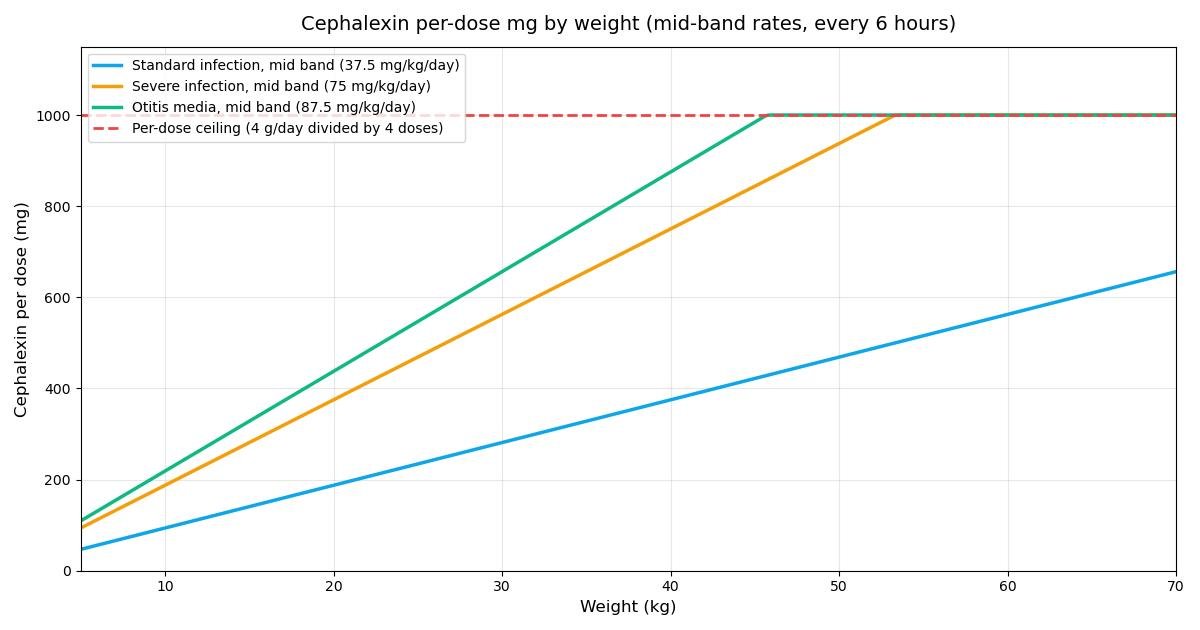
The standard band, 25 to 50 mg per kg per day, covers the bulk of routine pediatric prescribing: respiratory infections, skin infections, and uncomplicated urinary infections. A 20 kg child treated at the middle of this band (37.5 mg per kg per day) receives 750 mg per day, or 187.5 mg every six hours. With the 250 mg per 5 mL suspension, that dose measures 3.75 mL, which the calculator rounds to 3.8 mL, the nearest readable graduation on an oral syringe.
The severe-infection band doubles the ceiling: 50 to 100 mg per kg per day, still in four divided doses. The label reserves this band for infections that are more serious, where the prescriber deliberately accepts a higher exposure to overwhelm the pathogen. At the middle of the severe band (75 mg per kg per day), our 20 kg child would receive 1,500 mg per day, or 375 mg every six hours. The high end of this band (100 mg per kg per day) is where the 4 gram daily maximum begins to matter for larger children, and the calculator flags it explicitly whenever the arithmetic total crosses that ceiling.
Otitis media gets its own band on the label: 75 to 100 mg per kg per day in four divided doses. Middle ear infections are treated at these higher rates because the drug must reach adequate concentrations in the middle ear fluid, a compartment that is harder for antibiotics to penetrate than, say, the urinary tract. At the middle of the otitis band (87.5 mg per kg per day), a 20 kg child receives 1,750 mg per day, or 437.5 mg every six hours. The label also provides an alternative total-daily-dose formulation for otitis media, but the four-divided-dose version is what this calculator implements, since it matches the q6h schedule used everywhere else on the label.
One number governs all three bands: the maximum of 4 grams per day, stated plainly on the label. Weight-based math does not know about ceilings, so a large child at the high end of a band can easily exceed it. A 100 kg adolescent at 100 mg per kg per day would mathematically reach 10,000 mg per day, but the label caps the day at 4,000 mg, and the calculator enforces that cap, shows the reduced per-dose amount of 1,000 mg every six hours, and displays a clear warning that the maximum was applied. A cap is never something to negotiate around; it reflects the studied safety boundary.
The every-six-hour schedule, and what it really means
"Every six hours" sounds simple until you try to live it. Four doses a day means the schedule wraps around the clock: roughly 6 AM, noon, 6 PM, and midnight, or whatever equally spaced anchors fit the family's day. The label calls for four equal doses because cephalexin is cleared from the body relatively quickly, and the antimicrobial effect depends on keeping the concentration above the effective level for as much of the day as possible. Stretching the interval to three doses a day would let levels fall too low between doses; compressing them would stack too much drug at once.
In practice, families make this work with anchors rather than alarms. Breakfast, lunch, dinner, and bedtime can serve as four roughly six-hour anchors across a waking day, with the bedtime dose pushed a little later to even out the overnight gap. What matters is regularity: pick four times, keep them consistent, and keep going for the full prescribed duration. Antibiotics are not painkillers; stopping early because the child feels better is the classic way to leave the toughest bacteria alive, and the label's course lengths exist precisely to prevent that.
Missed doses deserve a calm, specific plan. If a dose is remembered within a couple of hours, give it and shift the remaining doses to keep reasonable spacing. If it is nearly time for the next dose, skip the missed one and continue the schedule; never double up to catch up, because two doses at once can push drug levels above what was intended without adding any benefit. If doses are being missed repeatedly, that is information the prescriber needs, since poor adherence can look exactly like a drug that is not working.
Adherence is the quiet failure mode of every q6h antibiotic, and it is worth planning for honestly. Four-times-daily dosing conflicts with school, naps, and sleep, which is why some prescribers choose twice-daily alternatives when the germ and the label allow it. When cephalexin q6h is what the child needs, set the four anchors in writing, keep the suspension where it is visible (refrigerated, as the label directs for the reconstituted product), and keep a simple tick sheet on the fridge. A week of 28 doses is easy to lose track of; a sheet with 28 boxes is easy to complete.
Measuring the suspension correctly
The calculator's milliliter output is only as good as the measurement that follows it, so technique matters. Always use the oral syringe or dosing cup the pharmacy provided, never a kitchen teaspoon or tablespoon, whose volumes vary wildly and are the single most common source of home dosing error. Shake the bottle well before every dose, because the drug particles settle between doses and the first unshaken pour can be mostly flavored water while the last becomes a concentrated sludge.
Read the syringe at eye level with the plunger, not the meniscus curve, and confirm the number against the prescription label before the medicine goes near the child. The two suspension strengths look identical in the bottle, which is why the calculator asks which one the pharmacy dispensed: 3.8 mL of the 250 mg per 5 mL suspension is a very different dose from 3.8 mL of the 125 mg per 5 mL strength. If a refill arrives at a different strength than the previous bottle, every milliliter number changes, and the calculator should be re-run for the new strength rather than carrying the old volume forward by habit.
Storage and shelf life close the loop. The dry powder keeps at room temperature, but once the pharmacist reconstitutes it, the suspension belongs in the refrigerator and is typically discarded after 14 days, per the label. Write the discard date on the bottle the day it comes home. A half-used bottle from a previous illness is not a head start on the next one; expired suspension has unknown potency, and guessing at potency is the opposite of weight-based dosing.
Safety information from the label
Every antibiotic label carries its warnings, and cephalexin's deserve a careful read. The most important is allergy. Cephalexin is related to penicillin, and the label warns that allergic cross-reactivity can occur: a child with a known penicillin allergy may also react to cephalexin. Any history of penicillin allergy must be disclosed to the prescriber before the first dose, and the decision to use cephalexin in that situation belongs to the prescriber, not to a calculator. Signs of an allergic reaction include hives, swelling of the lips or face, wheezing, or difficulty breathing, and any of these after a dose is a reason to seek emergency care, not to wait and see.
Gastrointestinal effects are the most common adverse reactions. Diarrhea, nausea, and abdominal discomfort occur in a meaningful minority of children on cephalexin, usually mild and self-limited. The label also carries the class-wide warning about Clostridioides difficile-associated diarrhea, which can range from mild to severe and can appear during treatment or in the weeks after it ends. Diarrhea that is watery, bloody, or accompanied by cramping and fever during or after a course should be reported to the prescriber rather than treated with anti-diarrhea medicine on your own.
The label notes that dose adjustment is needed in renal impairment, because cephalexin is cleared by the kidneys. This calculator does not attempt that adjustment; the numbers it produces assume normal kidney function. A child with known kidney disease, or one taking other medicines that affect the kidneys, needs prescriber-set dosing, full stop. Similarly, the weight range here is pediatric: very small infants, premature babies, and children whose weight falls outside the expected range for their age need individualized prescriber dosing rather than band arithmetic.
Two practical cautions round out the picture. First, cephalexin can interfere with certain laboratory tests: the label notes false-positive urine glucose results with some test methods and effects on Coombs testing. Mention the antibiotic if blood or urine tests are drawn during the course. Second, finish the course. The full prescribed duration exists to clear the infection completely; stopping early selects for the hardiest bacteria and is how relapses and resistance begin. If side effects make finishing feel impossible, call the prescriber for guidance rather than quietly quitting.
Sources
All dosing bands, the 4 gram daily maximum, the every-six-hour schedule, the suspension strengths, and the safety information above are taken from the FDA-approved prescribing information for cephalexin (Keflex), as published in the DailyMed database maintained by the U.S. National Library of Medicine. The otitis media band of 75 to 100 mg per kg per day in four divided doses, the severe-infection band of 50 to 100 mg per kg per day, the standard band of 25 to 50 mg per kg per day, and the 4 g per day ceiling are stated directly on the label. This page was medically reviewed by Dr. Taimoor Asghar. It is an educational aid for checking the arithmetic of a prescribed dose; it does not prescribe, diagnose, or replace the judgment of the child's doctor or pharmacist.
Key takeaways
- The FDA-approved label defines the usual pediatric dose as 25 to 50 mg per kg of body weight per day, given in four equally divided doses, with a maximum of 4 grams per day.
- Every six hours, four times per day, in equally divided doses, as specified on the FDA-approved cephalexin label.
- The label gives otitis media its own band: 75 to 100 mg per kg per day in four divided doses, subject to the 4 gram daily maximum.
- No.
Frequently asked questions
What is the standard pediatric dose of cephalexin?
The FDA-approved label defines the usual pediatric dose as 25 to 50 mg per kg of body weight per day, given in four equally divided doses, with a maximum of 4 grams per day. The calculator above implements exactly this: it multiplies weight by the chosen rate in the band, divides by four for the every-six-hour schedule, and checks the 4 gram ceiling.
How often do children take cephalexin?
Every six hours, which is four times per day, in equally divided doses. The label specifies four equal doses because cephalexin leaves the body relatively quickly, and steady levels across the day keep the drug effective against the infection. Pick four consistent daily anchors and keep the same times each day.
What is the cephalexin dose for otitis media in children?
The label gives otitis media its own band: 75 to 100 mg per kg per day in four divided doses. The higher rate reflects the need to reach effective concentrations in the middle ear fluid. For a 20 kg child at the middle of this band (87.5 mg per kg per day), that is 1,750 mg per day, or 437.5 mg every six hours, subject to the 4 gram daily maximum.
Can I measure the suspension with a kitchen spoon?
No. Kitchen spoons vary widely in volume and are a leading cause of home dosing errors. Always use the oral syringe or dosing cup supplied by the pharmacy, shake the bottle before every dose, and read the volume at eye level. The two suspension strengths (125 mg and 250 mg per 5 mL) look identical, so confirm which strength your bottle is before measuring.
My child is allergic to penicillin. Can they take cephalexin?
Only the prescriber can decide that. The label warns that cephalexin, as a cephalosporin, can cross-react in people with penicillin allergy. Always disclose any penicillin allergy before the first dose. Signs of an allergic reaction after a dose, such as hives, facial swelling, wheezing, or trouble breathing, require emergency care.
What should I do if my child misses a dose?
Give it when you remember, unless it is nearly time for the next dose, in which case skip the missed one and continue the schedule. Never give two doses at once to catch up. If doses are being missed often, tell the prescriber, because poor adherence can look exactly like a treatment that is failing.