What this calculator does
Body mass index, or BMI, is a simple ratio of weight to height that clinicians use as a first screening step for weight-related health risk. It was devised in the 1830s by the Belgian statistician Adolphe Quetelet, adopted for population research in the twentieth century, and formalized for adults by the World Health Organization in 1997 and 2000. It is cheap, fast, and reproducible, which is why it appears in guidelines, research papers, and clinic notes around the world.
This page is built for women specifically. The number itself works the same way for everyone, but its meaning changes across the life stages that only women experience: the months before pregnancy, when BMI sets the recommended weight-gain range; the postpartum year, when retained weight predicts long-term risk; and the menopausal transition, when fat redistributes toward the abdomen even when the scale barely moves. The calculator above therefore offers two modes. The general mode gives you the WHO category for any adult. The pre-pregnancy mode adds the single most useful thing a BMI number can do for a woman planning pregnancy: it maps her category to the Institute of Medicine 2009 recommended gestational weight-gain range, which the American College of Obstetricians and Gynecologists (ACOG) endorses.
One framing matters before anything else: BMI is a screening tool, not a diagnosis. It estimates weight relative to height; it does not measure body fat, and it cannot say anything about your health on its own. Think of it the way clinicians do: a flag that says "worth a closer look," paired here with the context that makes the flag useful at each stage of a woman's life.
The BMI formula: metric and imperial
The metric formula is the definition itself:
BMI = weight in kilograms divided by the square of height in meters.
In imperial units, the equivalent is:
BMI = (weight in pounds divided by the square of height in inches) multiplied by 703.
The 703 is simply the conversion factor that keeps the two formulas consistent. The calculator above uses exactly these two formulas, and you can verify this yourself with a worked example. Take a woman who is 1.62 meters tall and weighs 68 kilograms. Square the height: 1.62 times 1.62 equals 2.6244. Divide the weight by that: 68 divided by 2.6244 equals 25.9 after rounding to one decimal place. That lands in the overweight category, which starts at 25.0. You can check the arithmetic backward: 2.6244 times 25.9 equals 67.97, which rounds to 68, confirming the calculation. The imperial path gives the same answer for the same body: 150 pounds and 65 inches gives 150 divided by 4,225 (65 squared), times 703, which equals 25.0 to one decimal place after rounding differences between the two unit systems.
Precision matters more than it looks. Rounding height to the nearest inch or weight to the nearest pound can shift a result that sits exactly on a boundary, such as 24.95 versus 25.0. The calculator displays one decimal place so that you can see where you sit relative to the cutoffs rather than guessing from a rounded integer.
WHO BMI categories for adults
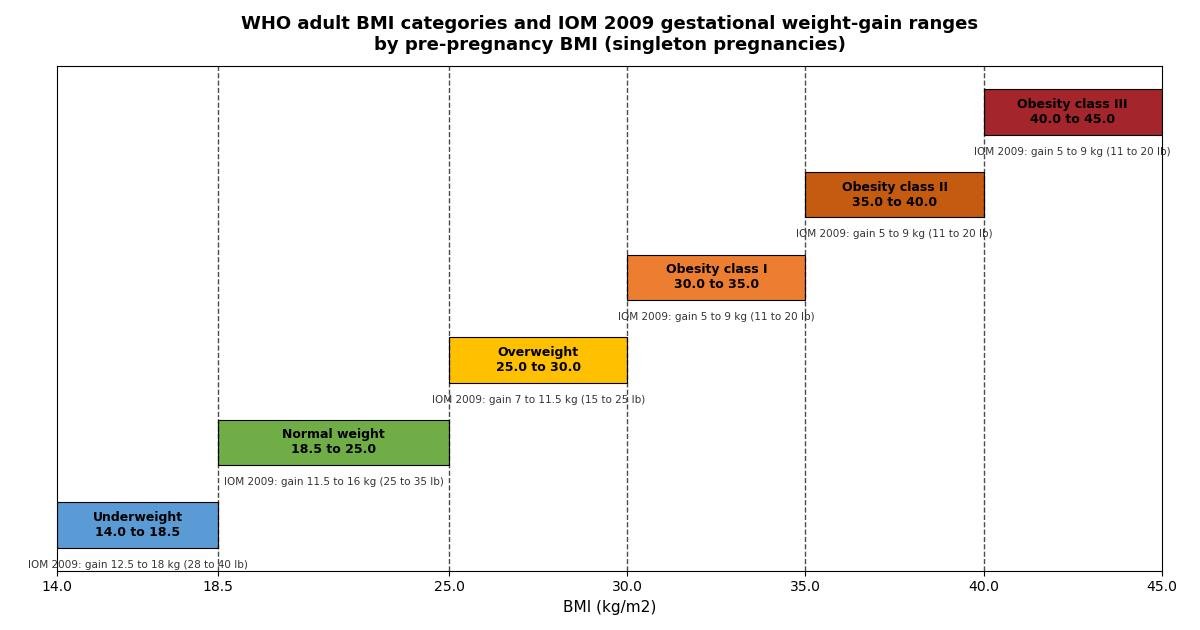
The World Health Organization's adult classification uses four main categories, with obesity subdivided into three classes:
| Category | BMI range (kg/m2) |
|---|---|
| Underweight | Below 18.5 |
| Normal weight | 18.5 to 24.9 |
| Overweight (pre-obese) | 25.0 to 29.9 |
| Obesity class I | 30.0 to 34.9 |
| Obesity class II | 35.0 to 39.9 |
| Obesity class III | 40.0 and above |
These cutoffs apply to adults aged 20 and older and are the same for women and men in the WHO classification. They were chosen because, at the population level, the risk of conditions such as type 2 diabetes, hypertension, and cardiovascular disease begins to rise discernibly above a BMI of 25 and rises more steeply above 30. The thresholds are statistical landmarks, not biological cliffs: a BMI of 24.9 and a BMI of 25.1 describe nearly identical bodies, but the categories give clinicians a shared language for screening and follow-up.
At the same BMI, women on average carry a higher proportion of body fat than men do, and where fat sits also matters. Abdominal fat carries more metabolic risk than fat on the hips and thighs, which is one reason many clinicians pair BMI with a waist measurement. The categories above remain the standard starting point; the sections below explain how to interpret them before pregnancy, after birth, and through menopause.
Pre-pregnancy BMI and the IOM 2009 weight-gain guidance
Of all the uses of BMI in women's health, the pre-pregnancy calculation is the most consequential. In 2009, the Institute of Medicine (with the National Research Council) published Weight Gain During Pregnancy: Reexamining the Guidelines, which set recommended total gestational weight-gain ranges according to the woman's pre-pregnancy BMI, using the WHO categories above. ACOG subsequently endorsed these ranges in its committee opinion on weight gain during pregnancy. The logic is straightforward: a woman who begins pregnancy underweight needs to gain more to support fetal growth, while a woman who begins pregnancy obese needs to gain less, because excess gain adds risk of gestational diabetes, preeclampsia, cesarean delivery, and having a baby who is large for gestational age.
For singleton pregnancies, the 2009 IOM recommendations are:
| Pre-pregnancy BMI category | BMI range | Recommended total gain (kg) | Recommended total gain (lb) |
|---|---|---|---|
| Underweight | Below 18.5 | 12.5 to 18 | 28 to 40 |
| Normal weight | 18.5 to 24.9 | 11.5 to 16 | 25 to 35 |
| Overweight | 25.0 to 29.9 | 7 to 11.5 | 15 to 25 |
| Obese | 30.0 and above | 5 to 9 | 11 to 20 |
The 2009 update changed the older 1990 guidance in important ways: it adopted the WHO BMI cutoffs (so the boundary between normal and overweight moved to 25.0) and it set a bounded range for the obese category, 5 to 9 kilograms, where the older guidance had recommended only a minimum of about 6.8 kilograms with no upper limit. The IOM committee also published separate provisional ranges for twin and higher-order multiple pregnancies, which differ from the singleton ranges above; if you are carrying multiples, these singleton targets do not apply and your provider should set an individualized plan.
To use the calculator in pre-pregnancy mode, enter your height and the weight you had before conception (a weight from a routine visit within the year before pregnancy is the standard proxy when the exact pre-pregnancy weight is unknown). The calculator then shows your WHO category and the matching IOM 2009 range. These are total-gain targets for the whole pregnancy, not week-by-week prescriptions: gain is typically smallest in the first trimester and then steadier through the second and third trimesters, which is why providers set individualized pacing after the first visit. Your provider plots your gain on a chart at each visit, because the trend across visits matters more than any single weigh-in.
A realistic concern deserves a direct answer: roughly half of pregnancies are unplanned, so many women first learn their pre-pregnancy BMI at the first prenatal visit, using a recalled weight. When the exact pre-pregnancy weight is unknown, a measured weight from a routine visit within the year before conception is the standard proxy. If you are planning a pregnancy, a current measured weight and this calculator give you the most accurate starting point.
After birth: postpartum weight
The scale drops sharply at delivery, because the baby, placenta, and amniotic fluid leave all at once, but the rest of the gestational gain declines much more gradually. What follows is individual: sleep deprivation, feeding patterns, appetite changes, and how much was gained during pregnancy all shape the pace. This is where the pre-pregnancy targets earn their importance. The evidence reviewed in the 2009 IOM report identified gaining above the recommended range as the strongest modifiable predictor of weight still retained after birth, and subsequent research has repeatedly confirmed that excessive gestational weight gain predicts postpartum retention and, over years, higher long-term weight.
None of this means a new mother should diet aggressively in the early weeks. Recovery from birth, establishing feeding, and sleep all come first, and restrictive dieting while breastfeeding can reduce milk supply and maternal energy. A practical approach is to return to the pre-pregnancy BMI as a reference point rather than a deadline: track the trend across months, keep movement gentle and regular once cleared by your provider, and discuss nutrition with your clinician or a dietitian if the weight is not moving by the six to twelve month mark. If breastfeeding is part of your plan, any calorie restriction should be modest and discussed with your provider first.
Menopause and midlife weight change
Many women notice weight creeping up through their late forties and fifties and assume menopause itself is the cause. The longitudinal research tells a more nuanced story. The Study of Women's Health Across the Nation (SWAN), which has followed thousands of midlife women, found an average three-year weight increase of about 2.1 kilograms in women aged 40 to 55; the Healthy Women's Study reported gains of about 0.7 kilograms, roughly 1.5 pounds, per year during the fifth and sixth decades. Multiple analyses conclude that this steady gain is mostly explained by aging rather than by the menopausal transition itself, and that physical activity attenuates it.
What the menopausal transition clearly does change is body composition. Peer-reviewed reviews of the SWAN data describe visceral fat rising from about 5 to 8 percent of total body fat in the premenopausal years to about 15 to 20 percent after menopause, alongside declining lean muscle mass. In plain terms: the scale may move at the same pace it would have anyway, but more of the weight sits around the abdomen, which is the depot most strongly linked to metabolic and cardiovascular risk. That shift is why, from the perimenopausal years onward, clinicians put growing weight on waist circumference and muscle-preserving activity alongside the BMI number. Strength training twice a week and adequate protein intake are the two most evidence-aligned habits for defending lean mass through this stage, and they matter more than chasing a particular BMI target.
Limitations of BMI: when the number misleads
BMI is a screening tool with well-documented blind spots, and women encounter several of them.
Pregnancy. Never interpret a BMI calculated with your current pregnant weight. The categories were defined for non-pregnant adults, and every healthy pregnancy involves weight gain by design. Use the pre-pregnancy mode above, and let your provider's gestational weight chart take over from there.
Muscle mass. BMI cannot distinguish muscle from fat. Women who strength train seriously, athletes, and those in physically demanding jobs can land in the overweight or even obese category with low body fat. If you train regularly and your waist measurement is modest, the category label is misleading for you.
Older adults. With age, people lose height as spinal discs compress and lose muscle mass, both of which distort the ratio. An older woman with a "normal" BMI may still carry excess fat with too little muscle, a combination sometimes called sarcopenic obesity, while a shorter measured height inflates the BMI artificially. For women over 65, trends in weight, waist, strength, and function tell more than a single BMI reading.
Ethnicity-adjusted thresholds. The standard cutoffs were developed mainly from European populations, and metabolic risk rises at lower BMIs in several Asian populations. The WHO expert consultation on Asian populations kept 18.5 as the underweight cutoff but identified lower public health action points, around 23 and 27.5, where risk of type 2 diabetes and cardiovascular disease climbs. UK NICE guidance has incorporated similar lower thresholds for Asian groups. If this applies to you, discuss adjusted interpretation with your clinician rather than reading the standard table literally.
Fluid and body composition shifts. Significant edema, large fibroids, or other conditions that add non-fat weight will inflate BMI. The number reflects total mass, whatever its source.
None of these limitations mean BMI is useless. They mean it is one input. A waist circumference, a blood pressure reading, a lipid panel, and a conversation with your clinician complete the picture that BMI alone cannot draw.
Using your result wisely
Start with the category, then add context. If your BMI is in the normal range and you are not planning pregnancy, the most useful action is maintenance: the habits that hold the number steady are the same ones that protect long-term health. If it falls outside the normal range, treat the number as a prompt for one concrete next step rather than a verdict: a waist measurement, a review of recent weight trends, or a conversation with your provider about what else to check.
If you are planning pregnancy, the pre-pregnancy mode above is the highest-value use of this page. Knowing your category before conception lets you and your provider set the IOM 2009 gain target early, when it can actually guide the pregnancy. If you are postpartum, use your pre-pregnancy BMI as the reference point and give the trend months, not weeks. If you are approaching or past menopause, watch the waistline and your strength as closely as the scale.
Finally, remember what the number cannot do. It cannot diagnose a condition, it cannot measure your body fat, and it cannot capture how you eat, move, sleep, or feel. It is a starting point for a better conversation, and this page is built to make that conversation specific to the stage of life you are in.
Key takeaways
- The formula is the same: weight in kilograms divided by the square of height in meters.
- No.
- A pre-pregnancy BMI from 18.5 to 24.9 is the WHO normal-weight range.
- There is no single safe rate that fits everyone.
Frequently asked questions
Does BMI work the same for women as for men?
The formula is the same: weight in kilograms divided by the square of height in meters. At the same BMI, women typically carry a higher percentage of body fat than men, and fat distribution differs by sex, which is why this page adds life-stage context rather than using the number alone. BMI is a screening tool for both sexes, not a body-fat measurement, so borderline results and significant muscle mass both deserve a clinician's interpretation.
Can I use this calculator while I am pregnant?
No. BMI categories are defined for non-pregnant adults, and weight rises normally throughout pregnancy. Use your pre-pregnancy BMI instead: enter the height and the weight you had before pregnancy, select the pre-pregnancy mode, and the calculator shows the Institute of Medicine 2009 gestational weight gain range for your category. Tracking during pregnancy should follow your own provider's chart, not this calculator.
What pre-pregnancy BMI is considered healthy, and how much weight should I gain?
A pre-pregnancy BMI from 18.5 to 24.9 is the WHO normal-weight range. For a singleton pregnancy, the Institute of Medicine 2009 guidelines recommend a total gain of 11.5 to 16 kilograms (25 to 35 pounds) for this range, 12.5 to 18 kilograms (28 to 40 pounds) if underweight, 7 to 11.5 kilograms (15 to 25 pounds) if overweight, and 5 to 9 kilograms (11 to 20 pounds) if obese. These targets are endorsed by ACOG and apply to total gain, not a week-by-week prescription.
How quickly should weight come off after giving birth?
There is no single safe rate that fits everyone. The weight of the baby, placenta and amniotic fluid is lost at birth, and the rest declines gradually; breastfeeding, sleep and activity all influence the pace. Research reviewed in the 2009 IOM report found that gaining above the recommended range is the strongest modifiable predictor of weight retained after birth, which is why the pre-pregnancy targets matter. Discuss a realistic plan with your own provider, especially before dieting while breastfeeding.
Why does weight change around menopause?
Longitudinal studies, including the Study of Women's Health Across the Nation (SWAN), find that midlife women gain roughly 1.5 pounds (about 0.7 kilograms) per year during their fifties, but the rate of gain is mostly explained by aging rather than menopause itself. What the menopausal transition does change is distribution: visceral fat rises from about 5 to 8 percent of total body fat before menopause to about 15 to 20 percent after, and lean muscle mass declines. That is why waist measurements and strength activity matter more at this stage, not only the BMI number.
When does BMI mislead?
BMI misleads when weight does not reflect fatness: in athletes and very muscular people, during pregnancy, with significant fluid retention or edema, and in older adults who have lost height and muscle. It also applies differently across populations: the WHO expert consultation for Asian populations kept 18.5 as the underweight cutoff but identified lower public health action points, around 23 and 27.5, for overweight and obesity risk. If your situation matches any of these, treat BMI as one data point alongside waist circumference and a clinician's assessment.