What this screening tool does
The Edinburgh Postnatal Depression Scale (EPDS) is a 10-question self-report questionnaire that screens for symptoms of depression in the weeks and months after childbirth. It asks how you have felt during the past 7 days, and most people complete it in under five minutes. The calculator above presents the 10 original questions exactly as published by Cox, Holden and Sagovsky in 1987, applies the official scoring (including the reverse scoring on seven of the ten items), and interprets your total against the standard cutoffs.
A screening tool is not a diagnosis. The EPDS identifies people whose symptoms deserve a closer clinical look; it cannot by itself say whether someone has depression. Used as intended, it is one of the most widely validated instruments in perinatal mental health. A score in the concerning range is a reason to talk to your midwife, GP, health visitor or obstetrician: not a reason to panic, and not something to ignore.
How the EPDS was developed
In the 1980s, psychiatrist John Cox and colleagues Jennifer Holden and Ruth Sagovsky worked in Edinburgh with mothers in the postnatal period. They faced a practical problem: depression after childbirth was common and often missed, partly because the questionnaires available at the time leaned on physical symptoms such as tiredness, broken sleep and appetite changes. In the weeks after having a baby, almost every mother is tired, sleeps badly and eats irregularly, so those symptoms could not separate depression from normal recovery.
The team therefore built a scale deliberately free of somatic items. The ten questions focus on mood, anxiety, guilt, coping, tearfulness and thoughts of self-harm: the cognitive and affective features of depression rather than the bodily ones. The scale was published in 1987 in the British Journal of Psychiatry (volume 150, pages 782 to 786) and validated against clinical interviews. In that original validation study it detected depression with a sensitivity of 86 percent and a specificity of 78 percent, figures that made it immediately useful in clinics and in research. It has since been translated into dozens of languages, used in more than 20 countries, and remains the most widely used perinatal depression screening instrument in the world.
How the scoring works
Each of the 10 questions offers four response options, scored 0, 1, 2 or 3, so the total ranges from 0 to 30. Higher scores mean more depressive symptoms. There is one twist that catches people out: seven of the ten items are reverse scored.
Questions 1, 2 and 4 are scored in the order the answers appear: the top answer scores 0 and the bottom answer scores 3. These are the positively worded items. Being able to laugh and see the funny side of things, looking forward with enjoyment to things, and having been anxious or worried for no good reason (where "No, not at all" is the healthy end) all sit in this group.
Questions 3, 5, 6, 7, 8, 9 and 10 are reverse scored: the top answer scores 3 and the bottom answer scores 0. These are the negatively worded items: blaming yourself unnecessarily, feeling scared or panicky, things getting on top of you, difficulty sleeping from unhappiness, feeling sad or miserable, crying from unhappiness, and thoughts of harming yourself. For these, the most concerning answer sits at the top of the list.
The reverse scoring is deliberate. It guards against response bias: the tendency some people have to tick the same position down a whole questionnaire without reading carefully. Because the healthiest answer moves between the top and bottom of the list, a valid pattern of answers zigzags down the page, and a straight line of ticks is immediately visible as careless or invalid responding. The calculator above applies this scoring automatically; you only need to answer honestly.
A worked example shows how the total is built. Suppose a mother answers "Not quite so much now" (1 point) to question 1, "Rather less than I used to" (1 point) to question 2, "Yes, some of the time" (2 points, reverse scored) to question 3, "Hardly ever" (1 point) to question 4, and the healthiest option (0 points) to questions 5 through 10. Her item scores are 1, 1, 2, 1, 0, 0, 0, 0, 0, 0, giving a total of 5: below the screening threshold. Now change only question 8 to "Yes, most of the time" (3 points, reverse scored) and question 10 to "Hardly ever" (1 point, reverse scored). The total becomes 9: still below 10, but question 10 is no longer zero, which changes what should happen next. That is why the calculator flags question 10 separately.
What your score means
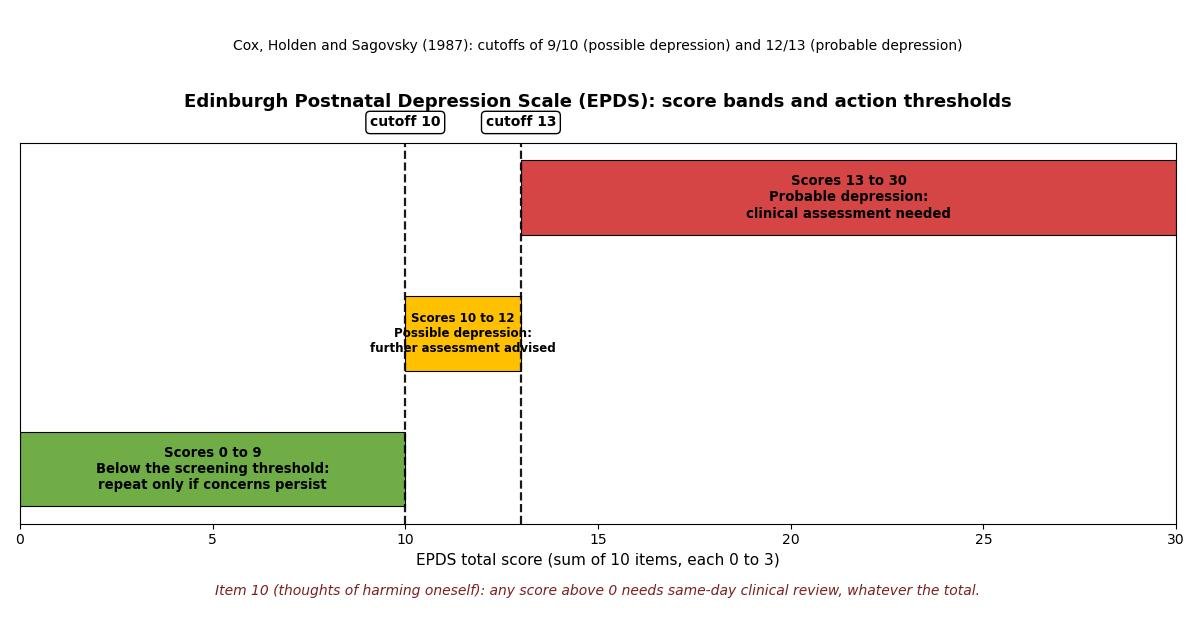
The scale's authors selected two cutoffs: 9/10 for possible depression and 12/13 for probable depression. In practice this gives three bands, and the same 10 and 13 thresholds are the ones used in UK perinatal services under NICE's antenatal and postnatal mental health guidance.
| Score band | Meaning | Suggested next step |
|---|---|---|
| 0 to 9 | Below the screening threshold; depression unlikely | No action needed from screening alone. If concerns persist or grow, repeating the scale after a couple of weeks is reasonable: the authors noted that in doubtful cases it can be useful to repeat the tool after 2 weeks. |
| 10 to 12 | Possible depression | Arrange a follow-up conversation with your midwife, GP, health visitor or obstetrician. Many perinatal services use 10 as the threshold for a more detailed assessment. |
| 13 to 30 | Probable depression | Arrange a clinical assessment promptly. Scores at or above 13 indicate a high likelihood of a depressive illness of varying severity. |
These bands are screening thresholds, not diagnostic labels. A score of 13 does not by itself mean a diagnosis of major depression, and a score of 9 does not guarantee its absence. The original validation found that the scale correctly identified 86 percent of depressed mothers and correctly cleared 78 percent of non-depressed mothers, which also means some cases were missed and some well mothers scored high. The score should never override clinical judgment: a careful clinical assessment is what confirms a diagnosis.
Why question 10 is treated separately
Question 10 asks whether the thought of harming yourself has occurred to you. The standard guidance printed on every official EPDS form is unambiguous: always look at item 10. Any answer other than "Never", that is, any score above 0 on this item, should prompt a same-day clinical conversation, whatever the total score.
This rule exists because thoughts of self-harm carry a safety weight that a total score cannot capture. A mother can score 6 overall and still need urgent support if she answers "Sometimes" to question 10, while a mother scoring 16 with "Never" on question 10 needs assessment but not the same immediate safety review. The calculator above flags any positive answer to question 10 separately and prominently, even when the total sits below 10. If you are having thoughts of harming yourself, contact your midwife, GP, health visitor or local emergency services now, or reach a crisis helpline in your country. You do not need to wait for an appointment.
How accurate is the EPDS
The original 1987 validation reported a sensitivity of 86 percent and a specificity of 78 percent at the 12/13 threshold. Sensitivity of 86 percent means that among mothers who were clinically depressed, the scale correctly flagged 86 out of every 100. Specificity of 78 percent means that among mothers who were not depressed, it correctly cleared 78 out of every 100. No screening test is perfect, and these figures explain both the strengths and the limits: most depressed mothers are caught, but roughly one in seven is missed, and roughly one in five non-depressed mothers scores above the line. That is exactly why a high score leads to a conversation, not a label.
Later research has broadly confirmed these properties. A 2020 review of EPDS validation studies found that using a threshold of 11 or higher gave a sensitivity of 81 percent and a specificity of 88 percent: in the same range as the original figures. The scale's consistent performance is one reason it is endorsed in perinatal guidelines internationally, including in the UK, where NICE's antenatal and postnatal mental health guidance recommends the EPDS as a screening instrument.
Using the EPDS during pregnancy
Although the name says postnatal, the scale has been validated for use during pregnancy as well as after birth, and it is widely used antenatally. Depression in pregnancy is common and it predicts postnatal depression, so identifying symptoms before birth matters: support and treatment planning can begin early, when they protect both mother and baby.
The same 10 questions and the same 0 to 30 scoring apply. Some antenatal studies have used a slightly higher cutoff for probable depression (14/15 rather than 12/13), reflecting differences in how symptoms present during pregnancy, but the standard 10 and 13 thresholds remain the most widely used. If you are pregnant and score 10 or more, or give any positive answer to question 10, tell your midwife or obstetrician at your next contact, or sooner if question 10 is positive.
What the EPDS cannot do
The scale's authors were explicit about its limits, and they still apply. The EPDS will not detect mothers with anxiety disorders, phobias or personality disorders; it screens for depressive symptoms specifically. Because it deliberately excludes physical symptoms, it can miss depression that presents mainly through the body, although in the perinatal period that design choice is a strength rather than a weakness.
It is also not a diagnostic instrument. The gold standard for diagnosing depression remains a clinical interview with a trained professional, using formal diagnostic criteria. Questionnaires can be influenced by the day you are having, by how you interpret a question, and by reluctance to answer honestly about difficult feelings. A low score on a hard day can hide real distress, and a high score on an exhausting week can overstate it. Treat the result as the start of a conversation, not its conclusion.
What to do with your result
If your score is 0 to 9 and question 10 is "Never", there is no screening indication of depression. Keep an eye on how you feel: mood in the perinatal period can shift, and you can repeat the scale at any time.
If your score is 10 to 12, arrange a follow-up. Contact your midwife, GP, health visitor or obstetrician and mention your EPDS score. They will likely want to talk through your answers and may repeat the scale or use a fuller assessment.
If your score is 13 or above, arrange a clinical assessment promptly. Effective help exists: talking therapies, peer and practical support, and, where appropriate, medication. Decisions about medication during pregnancy or breastfeeding are nuanced and personal; make them with a clinician who can weigh the benefits and risks for your situation, not from a web page.
Whatever your score, a positive answer to question 10 means seeking help the same day. And if you ever feel you might act on thoughts of harming yourself, treat it as an emergency: contact your local emergency number or go to your nearest emergency department.
Partners and family members have a role too. If someone you love has a high score or a positive question 10, the most helpful response is practical and non-judgmental: offer to arrange the appointment, go with them, and take over baby care so they can attend. Depression can make the logistics of seeking help feel impossible; removing those barriers is genuine treatment support.
Key takeaways
- A score from 0 to 9 is below the screening threshold and suggests depression is unlikely.
- A score of 10 to 12 indicates possible depression and 13 or more indicates probable depression, using the cutoffs selected by the scale's authors (9/10 and 12/13).
- Questions 3 and 5 through 10 are reverse scored (top answer 3, bottom answer 0) while questions 1, 2 and 4 score top to bottom as 0 to 3.
- Yes.
Frequently asked questions
What is a good EPDS score?
A score from 0 to 9 is below the screening threshold and suggests depression is unlikely. There is no perfect score to aim for: the scale measures symptoms over the past 7 days, and low scores simply mean few depressive symptoms were reported in that window.
What does an EPDS score of 10 or more mean?
A score of 10 to 12 indicates possible depression and 13 or more indicates probable depression, using the cutoffs selected by the scale's authors (9/10 and 12/13). Either result warrants a follow-up conversation with your midwife, GP, health visitor or obstetrician. It is a screening result, not a diagnosis: a clinical assessment confirms whether depression is present.
Why are some EPDS questions scored backwards?
Questions 3 and 5 through 10 are reverse scored (top answer 3, bottom answer 0) while questions 1, 2 and 4 score top to bottom as 0 to 3. This guards against response bias: because the healthiest answer moves position, someone ticking the same box down the page produces an obviously invalid pattern. The calculator above applies the official scoring automatically.
Can I use the EPDS while I am pregnant?
Yes. The scale has been validated for use during pregnancy as well as after birth, and guidelines recommend screening in both periods. The same questions and 0 to 30 scoring apply; some antenatal studies use a slightly higher cutoff (14/15) for probable depression, but the standard 10 and 13 thresholds are the most widely used.
Is the EPDS a diagnosis of postpartum depression?
No. The EPDS is a screening instrument: it identifies people whose symptoms merit clinical assessment. Diagnosis requires a clinical interview with a trained professional. The scale's authors state explicitly that the score should not override clinical judgment.
What should I do if I answer anything other than Never to question 10?
Take it seriously the same day, whatever your total score. Contact your midwife, GP, health visitor or obstetrician now, or your local emergency services or a crisis helpline if you feel you might act on the thoughts. A positive answer to question 10 always needs a clinical conversation.