Calcium and Vitamin D Needs Calculator by Age and Life Stage
Enter your age, sex, and life stage to get your daily calcium and vitamin D recommended intakes from the Institute of Medicine 2011 guidelines, with the food servings that supply them.
In short: Enter your age, sex, and life stage to get your daily calcium and vitamin D recommended intakes from the Institute of Medicine 2011 guidelines, with the food servings that supply them. Use the calculator above, then read the guide below to interpret your result and its limitations.
The calculator
Why your calcium and vitamin D needs change across life
Calcium is the most abundant mineral in the human body, and almost all of it sits in bones and teeth, where it gives the skeleton its hardness and structure. The remainder does quiet but essential work: muscles need calcium to contract, nerves need it to carry messages, blood vessels use it to regulate blood flow, and it helps release hormones that affect many functions. Vitamin D's best known job is helping the gut absorb calcium; without enough vitamin D, dietary calcium passes through poorly absorbed and the skeleton pays the price. The two nutrients are therefore always discussed together, and the Institute of Medicine evaluated them together in its 2011 report on dietary reference intakes.
The recommended amounts are not flat across life because the skeleton's demands are not flat. In childhood and adolescence, the body is building bone at its fastest rate, so calcium needs peak in the teenage years: ages 9 to 18 carry the highest calcium target of any life stage, at 1300 mg per day. In adulthood the target settles to 1000 mg from 19 to 50, then rises again for women from 51, because the skeleton starts losing more mineral than it gains. The IOM committee reviewed roughly 1,000 published studies and scientific testimonies before concluding, in the words of committee chair Catharine Ross, that "amounts higher than those specified in this report are not necessary to maintain bone health." That sentence matters: it is the evidence-based answer to the supplement industry's suggestion that more is always better.
It is also worth knowing that the US recommendations are among the highest in the world. Britain's National Health Service advises 700 mg of calcium per day for adults, and the European Food Safety Authority recommended 950 mg per day for adults over 25 in 2015. The IOM numbers reflect the intake levels needed to keep the US and Canadian populations' bones healthy as demonstrated in the reviewed trials, not a universal biological constant. The calculator on this page uses the IOM 2011 values because they are the most detailed life-stage breakdown available and the reference most clinicians in North America use, but readers elsewhere should know their national guidance may differ.
The reference values this calculator uses (IOM 2011)
The table below is the complete Institute of Medicine 2011 calcium and vitamin D table for ages 1 and older, published by Ross and colleagues in the Journal of Clinical Endocrinology and Metabolism. RDA means recommended dietary allowance, the intake covering the needs of more than 97.5 percent of people in that group. UL means tolerable upper intake level, the daily intake above which the risk of adverse effects rises; it is a ceiling, not a goal.
| Life stage | Calcium RDA (mg/day) | Calcium UL (mg/day) | Vitamin D RDA (IU/day) | Vitamin D UL (IU/day) |
|---|---|---|---|---|
| 1 to 3 years | 700 | 2500 | 600 | 2500 |
| 4 to 8 years | 1000 | 2500 | 600 | 3000 |
| 9 to 13 years | 1300 | 3000 | 600 | 4000 |
| 14 to 18 years | 1300 | 3000 | 600 | 4000 |
| 19 to 50 years | 1000 | 2500 | 600 | 4000 |
| 51 to 70 years, men | 1000 | 2000 | 600 | 4000 |
| 51 to 70 years, women | 1200 | 2000 | 600 | 4000 |
| 71 years and older | 1200 | 2000 | 800 | 4000 |
| Pregnant or lactating, 14 to 18 | 1300 | 3000 | 600 | 4000 |
| Pregnant or lactating, 19 to 50 | 1000 | 2500 | 600 | 4000 |
Two details in this table deserve attention because they correct common simplifications. First, the 1200 mg calcium target does not apply to all adults over 50. It applies to women from age 51 and to everyone from 71; men aged 51 to 70 stay at 1000 mg. The difference reflects the evidence the committee found on bone loss rates by sex and age, not a judgment that men need less care. Second, pregnant and lactating teenagers need 1300 mg of calcium, not the 1000 mg that applies to pregnant adults, because they are still building their own skeletons while also supplying a fetus or breast milk. The vitamin D line is simpler: 600 IU per day for everyone from age 1 through 70, including pregnancy and lactation, rising to 800 IU from 71 to accommodate the physical and behavioral changes of aging that reduce sun exposure and skin synthesis.
Infants are deliberately outside this table and outside this calculator's range. For babies the IOM set adequate intakes rather than RDAs (200 mg calcium and 400 IU vitamin D for 0 to 6 months; 260 mg calcium and 400 IU vitamin D for 6 to 12 months), and infant feeding is a matter for the pediatrician, not a web calculator. The tool therefore accepts ages 1 to 120.
Why pregnancy, lactation, and menopause change the numbers
Pregnancy and lactation are calcium-intensive in a way that shows up directly in the numbers. The fetus draws calcium across the placenta for its own skeleton, and lactation exports several hundred milligrams of calcium into breast milk daily. The mother's body adapts impressively: during pregnancy, intestinal calcium absorption roughly doubles, driven by hormonal changes including higher levels of the active form of vitamin D. But the adaptation does not cover the full transfer, and the IOM kept the target at 1000 mg for pregnant and lactating adults rather than lowering it. For pregnant teenagers, who are still accruing their own peak bone mass, the committee kept the full teenage target of 1300 mg, acknowledging that a growing mother and a growing fetus are competing for the same mineral.
Vitamin D needs, interestingly, do not rise in pregnancy or lactation in the IOM framework: the target stays at 600 IU. The committee found insufficient evidence to set a higher RDA for pregnant women, a position the 2024 Endocrine Society guideline later revisited with conditional suggestions (discussed below). This is one of the places where guidelines have moved since 2011, and it is worth knowing that the 600 IU figure is the IOM's bone-health-based RDA, not the last word on optimal pregnancy intake.
Menopause changes the equation through estrogen. Estrogen restrains bone resorption, the process by which bone tissue is broken down and its calcium released into blood. When estrogen falls at menopause, resorption outpaces formation and bone density declines, with the fastest loss in the first years after the final menstrual period. That is why the calcium target for women rises from 1000 mg to 1200 mg from age 51: the skeleton is leaking more mineral, so more dietary calcium is needed to keep the balance. About 10.2 million US adults aged 50 and older have osteoporosis and another 43.4 million have low bone mass, with women carrying most of the burden (about 8.2 million cases), according to the Bone Health and Osteoporosis Foundation. Adequate calcium and vitamin D do not guarantee protection, but chronic shortfall makes the trajectory worse.
One honest caveat: calcium and vitamin D are necessary for bone health but not sufficient on their own. Weight-bearing exercise, not smoking, limiting alcohol, and adequate protein all contribute to bone strength, and the IOM evidence review found that the benefits of calcium and vitamin D beyond bone health, the claims about heart disease, cancer, or immune function that sometimes appear in marketing, were not supported by the evidence available at the time. Supplements of calcium plus vitamin D do reduce fracture risk in some trials, but the effect is modest and clearest in people who are deficient to begin with.
Calcium: food sources with milligrams per serving
The IOM committee's consistent advice, repeated in its public guidance, is that calcium is best obtained from food. Dairy is the main source for most people in the United States, but the table below, drawn from the National Institutes of Health Office of Dietary Supplements fact sheet values, shows that the options are wider than milk alone. The calculator above uses these figures to estimate how many servings of each food would cover your personal RDA.
| Food | Serving | Calcium (mg) |
|---|---|---|
| Yogurt, low fat, plain | 8 oz (1 cup) | 415 |
| Mozzarella cheese | 1.5 oz | 333 |
| Sardines, canned with bones | 3 oz | 325 |
| Cheddar cheese | 1.5 oz | 307 |
| Milk, nonfat | 8 oz (1 cup) | 299 |
| Soymilk, calcium-fortified | 8 oz (1 cup) | 299 |
| Orange juice, calcium-fortified | 6 oz | 261 |
| Tofu, firm, made with calcium sulfate | half cup | 253 |
| Salmon, canned with bones | 3 oz | 181 |
| Turnip greens, boiled | half cup | 99 |
| Kale, cooked | 1 cup | 94 |
Two practical points make these numbers more useful. First, the body absorbs calcium best in doses of about 600 mg or less at a time, so spreading calcium-rich foods across meals beats a single large dose; three modestly calcium-rich meals cover the day better than one dairy-heavy dinner. Second, calcium from some plant foods is less available than the table suggests. Spinach, Swiss chard, rhubarb, beets, and some nuts contain oxalates or phytates that bind calcium in the gut and block absorption, so they look good on paper and deliver less in practice. Tofu set with calcium sulfate, fortified plant milks, kale, broccoli, and Chinese cabbage are the more reliable non-dairy choices. Lactose intolerance does not have to mean calcium shortfall: hard cheeses and yogurt are often tolerated, fortified soy milk matches dairy milk milligram for milligram, and lactose-free dairy is widely available.
US intake data show why the food-first message matters: in national survey analyses, a large share of adults fall short of even the estimated average requirement from food alone. Women aged 19 to 30 had a median dietary calcium intake around 686 mg per day, well below the 1000 mg RDA, and roughly 39 percent of Americans aged 4 and older took in less than the estimated average requirement from food and supplements combined. A supplement can close a genuine gap, but the IOM's position is that food should be the first attempt, and that a supplement decision deserves a clinician's input because dose, timing, and interactions matter.
Vitamin D: food sources and the sunlight caveat
Vitamin D is scarce in food by nature. Few foods contain meaningful amounts without fortification, which is why the vitamin D column of the food table looks thin compared with calcium. The figures below come from the NIH Office of Dietary Supplements vitamin D fact sheet.
| Food | Serving | Vitamin D (IU) |
|---|---|---|
| Cod liver oil | 1 tablespoon | 1360 |
| Salmon (sockeye), cooked | 3 oz | 447 |
| Mackerel, cooked | 3 oz | 388 |
| Tuna, canned in water, drained | 3 oz | 154 |
| Orange juice, fortified with vitamin D | 1 cup | 137 |
| Milk, vitamin D-fortified | 1 cup | 115 to 124 |
| Yogurt, fortified | 6 oz | 88 |
| Margarine, fortified | 1 tablespoon | 60 |
| Sardines, canned in oil, drained | 2 sardines | 46 |
| Egg, 1 large (vitamin D is in the yolk) | 1 egg | 41 |
Read that table against the 600 IU RDA and the gap becomes obvious: one cup of fortified milk supplies about a fifth of the daily target, an egg about seven percent. Only fatty fish and cod liver oil move the needle in a single serving, and few people eat them daily. This scarcity is exactly why the IOM allowed supplements "in combination with diet" to meet the RDA, while warning that intakes above the recommended values showed no consistent additional benefit.
Sunlight is the missing row in the table, and it deserves an honest discussion. Skin exposed to ultraviolet B radiation synthesizes vitamin D, and regular outdoor time does contribute. But the IOM deliberately set the vitamin D DRI assuming minimal or no sun exposure, for reasons it stated plainly: synthesis varies enormously with season, latitude, time of day, skin pigmentation, age, clothing, and sunscreen use, and recommending sun exposure as a health strategy collides with skin cancer risk. The committee concluded that the only workable basis for a reference value was to assume all the vitamin D comes from the diet. In practice, that means the 600 IU target is deliberately conservative for someone who spends summer midday hours outdoors, and exactly right for someone who works indoors through a northern winter. If you are counting on sunlight, talk to your clinician rather than guessing, especially if you have darker skin (which synthesizes less vitamin D for the same exposure), are older (skin synthesis declines with age), or live at high latitude.
A note on units you will meet on supplement bottles: vitamin D is labeled in both IU and micrograms (mcg). The conversion is 1 mcg = 40 IU, so 600 IU = 15 mcg and 800 IU = 20 mcg. The calculator shows both.
The 2024 Endocrine Society debate, stated honestly
In June 2024 the Endocrine Society published a new clinical practice guideline, "Vitamin D for the Prevention of Disease" (Demay and colleagues, Journal of Clinical Endocrinology and Metabolism), that re-examined the trial evidence on vitamin D supplementation beyond bone health. Its headline conclusion will disappoint the supplement industry: for healthy adults under 75, the panel suggests against taking vitamin D above the IOM recommended intake to prevent disease, and against routine blood testing for vitamin D levels in people without an established reason to test. Large trials had not shown the hoped-for reductions in fractures, cancer, or cardiovascular events from pushing vitamin D above the RDA, and the panel said so plainly.
The guideline did not, however, leave the RDA unchallenged for everyone. It conditionally suggested that certain groups may benefit from intake above the recommended level: children and adolescents up to 18 (to prevent rickets and possibly reduce respiratory infections), adults 75 and older (where trial data suggested a small mortality benefit), pregnant people (possible reductions in pre-eclampsia, preterm birth, and related outcomes), and adults with high-risk prediabetes (possible slowing of progression to diabetes). Crucially, the panel set no doses for any of these groups, stating that the optimal doses for supplementation above the recommended intake remain unclear. That deliberate gap is the honest state of the science: there are signals of benefit in specific populations, but no agreed numbers.
This calculator stays on the IOM 2011 RDA values, and the prose here explains why: the RDA is the one intake level backed by a full dietary reference intake process and endorsed again by the 2024 panel for the general population. Anything above it is, in the panel's own framing, empiric supplementation for a specific population and a specific reason, which means it belongs in a clinician's office, not in a self-directed calculator result. If your clinician recommends a higher vitamin D intake because you are pregnant, over 75, or deficient, that recommendation supersedes this page.
Upper limits: what too much looks like
The upper limits in the IOM table deserve their own section because the supplement market sometimes treats them as suggestions. They are not. The tolerable upper intake level is the daily intake above which the risk of harm rises, and the committee explicitly noted that it is "not intended as a target intake" because there is no consistent evidence of greater benefit above the RDA.
For vitamin D, the adult upper limit is 4000 IU per day (lower for children: 3000 IU for ages 4 to 8, 2500 IU for ages 1 to 3). Chronic excess vitamin D raises blood calcium, a condition called hypercalcemia, whose symptoms include nausea, vomiting, weakness, frequent urination, and in severe cases kidney damage and calcium deposits in soft tissues. Vitamin D toxicity from food or sun alone is essentially unheard of; it comes from supplements, usually from manufacturing errors or from megadose regimens taken without medical supervision. Certain conditions, including hyperparathyroidism, lymphoma, and tuberculosis, make people more sensitive to the calcium-raising effect of vitamin D, which is another reason high-dose supplementation should be medically supervised.
For calcium, the adult upper limits are 2500 mg for ages 19 to 50 and 2000 mg from age 51, with 3000 mg for ages 9 to 18. The best documented harm from chronic excess is kidney stones, and the IOM committee specifically advised caution with calcium supplements for that reason. Large single supplement doses can also cause constipation and can interfere with the absorption of iron and zinc when taken together. The practical takeaway is straightforward: if food already brings you near your RDA, a supplement on top adds risk without benefit, and total intake from food plus supplements should stay comfortably below the upper limit. The calculator reports your RDA and the relevant upper limit side by side so the gap between "enough" and "too much" stays visible.
Worked example
A 34-year-old woman who is pregnant enters age 34 and selects "Pregnant". The steps the calculator follows:
1. Life stage check: pregnancy is an IOM-defined life stage for ages 14 to 50, and 34 falls inside that range, so the pregnancy bands apply.
2. Calcium: the IOM 2011 band for pregnant adults 19 to 50 is 1000 mg per day, with an upper limit of 2500 mg. (If she were 17, the pregnant teen band of 1300 mg would apply instead.)
3. Vitamin D: 600 IU per day (15 mcg), with an upper limit of 4000 IU. The pregnancy target is the same as for non-pregnant adults in the IOM framework.
4. Food check: 1000 mg of calcium is about 3.3 cups of milk at 299 mg per cup (1000 / 299 = 3.34), or about 2.4 cups of low-fat yogurt at 415 mg per cup (1000 / 415 = 2.41), or a mix of the two across the day. For vitamin D, 600 IU needs roughly 5 cups of fortified milk at 120 IU per cup (600 / 120 = 5), or about 1.3 servings of cooked sockeye salmon at 447 IU per 3 oz (600 / 447 = 1.34), which shows why food alone often falls short and why her clinician may discuss a supplement.
5. Output: calcium 1000 mg/day, vitamin D 600 IU/day (15 mcg), with the upper limits and the servings table for her personal numbers.
Change one input and watch the target move: the same 34-year-old selecting "Female (not pregnant or breastfeeding)" gets the identical 1000 mg and 600 IU, because the IOM pregnancy band for adults matches the non-pregnant band. The numbers diverge at other life stages: select "Postmenopausal" at age 55 and calcium rises to 1200 mg while vitamin D stays at 600 IU; enter age 71 and vitamin D rises to 800 IU (20 mcg).
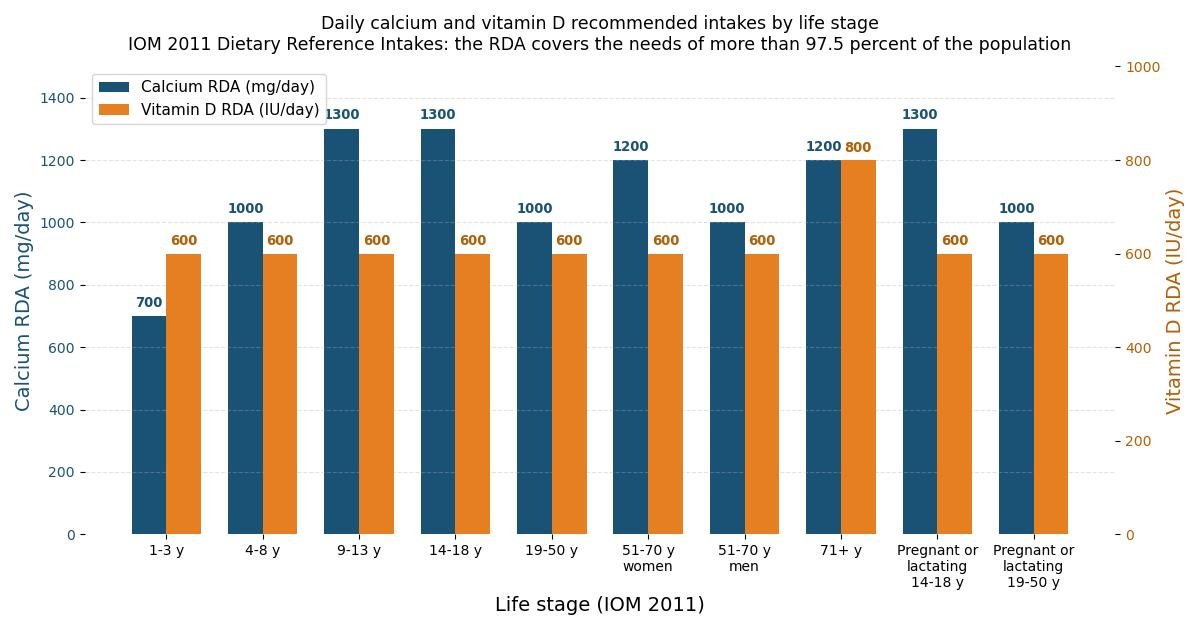
IOM 2011 recommended dietary allowances by life stage. Calcium peaks at 1300 mg for ages 9 to 18 (and pregnant teens); vitamin D is 600 IU from age 1 through 70, rising to 800 IU from 71. Values from Ross et al., Journal of Clinical Endocrinology and Metabolism 2011.
Key takeaways
- The Institute of Medicine 2011 dietary reference intakes set calcium at 700 mg for ages 1 to 3, 1000 mg for ages 4 to 8, 1300 mg for ages 9 to 18, 1000 mg for adults 19 to 50, 1200 mg for women 51 to 70 and all adults over 70 (men 51 to 70 stay at 1000 mg), and 1000 mg for pregnant and lactating adults (1300 mg for pregnant teens 14 to 18).
- In pregnancy and lactation the body transfers calcium to the growing fetus and then into breast milk, so the Institute of Medicine keeps the calcium target high (1000 mg for adults, 1300 mg for pregnant teens) rather than letting the mother deplete her skeleton.
- Skin exposed to ultraviolet B light does make vitamin D, which is why sunlight is a real source, but the Institute of Medicine set the 600 IU recommended intake assuming minimal or no sun exposure because of skin cancer risk and because synthesis varies hugely with season, latitude, skin pigmentation, age, sunscreen use, and time outdoors.
- The tolerable upper intake level is not a target: the Institute of Medicine sets the vitamin D upper limit at 4000 IU per day for ages 9 and older (3000 for ages 4 to 8, 2500 for ages 1 to 3), and the calcium upper limit at 2500 mg for ages 19 to 50, 2000 mg from age 51, and 3000 mg for ages 9 to 18.
Frequently asked questions
How much calcium and vitamin D do I need each day?
The Institute of Medicine 2011 dietary reference intakes set calcium at 700 mg for ages 1 to 3, 1000 mg for ages 4 to 8, 1300 mg for ages 9 to 18, 1000 mg for adults 19 to 50, 1200 mg for women 51 to 70 and all adults over 70 (men 51 to 70 stay at 1000 mg), and 1000 mg for pregnant and lactating adults (1300 mg for pregnant teens 14 to 18). Vitamin D is 600 IU per day for everyone from age 1 through 70, including pregnant and lactating women, rising to 800 IU per day after age 70. These are recommended dietary allowances covering the needs of more than 97.5 percent of the population, not minimum survival amounts.
Why do calcium needs rise in pregnancy, lactation, and after menopause?
In pregnancy and lactation the body transfers calcium to the growing fetus and then into breast milk, so the Institute of Medicine keeps the calcium target high (1000 mg for adults, 1300 mg for pregnant teens) rather than letting the mother deplete her skeleton. After menopause, falling estrogen accelerates bone loss because bone resorption outpaces bone formation, which is why the calcium target for women rises from 1000 mg to 1200 mg from age 51. The body partly compensates in pregnancy by absorbing calcium more efficiently from the gut, but that adaptation does not cover the full transfer cost, so intake matters.
Can I get enough vitamin D from sunlight alone?
Skin exposed to ultraviolet B light does make vitamin D, which is why sunlight is a real source, but the Institute of Medicine set the 600 IU recommended intake assuming minimal or no sun exposure because of skin cancer risk and because synthesis varies hugely with season, latitude, skin pigmentation, age, sunscreen use, and time outdoors. Treating sunlight as your whole plan is unreliable, especially in winter or at high latitudes, and dermatologists do not recommend unprotected sun exposure as a vitamin D strategy. Food sources and, where a clinician advises it, supplements are the predictable routes.
What happens if I take more than the upper limit?
The tolerable upper intake level is not a target: the Institute of Medicine sets the vitamin D upper limit at 4000 IU per day for ages 9 and older (3000 for ages 4 to 8, 2500 for ages 1 to 3), and the calcium upper limit at 2500 mg for ages 19 to 50, 2000 mg from age 51, and 3000 mg for ages 9 to 18. Chronic excess vitamin D can raise blood calcium (hypercalcemia), causing nausea, weakness, and kidney problems. Excess calcium is most associated with kidney stones and, with supplements taken in large single doses, constipation and interference with iron and zinc absorption. More is not better, and supplements should stay within the limits unless a clinician prescribes otherwise.
What did the 2024 Endocrine Society guideline change about vitamin D?
The 2024 Endocrine Society clinical practice guideline reviewed trial evidence on vitamin D for disease prevention and concluded that healthy adults under 75 should simply follow the Institute of Medicine recommended intake (600 IU to age 70, 800 IU above) and that there is no reason for routine vitamin D blood testing or for supplementation above the recommended intake to prevent disease. It did flag groups that may benefit from intake above the recommended level: children and adolescents under 18, adults over 75, pregnant people, and adults with high-risk prediabetes. It deliberately set no doses for those groups because the optimal doses remain unclear, which is why any intake above the recommended amount is a clinician decision, not a self-prescribed one.
Do children and teenagers need more calcium than adults?
Yes. Ages 9 to 18 have the highest calcium target of any life stage: 1300 mg per day, versus 1000 mg for adults 19 to 50. The reason is skeletal growth: adolescence is when the fastest bone mass accrual happens, and roughly 90 percent of adult peak bone mass is built by the late teens, so the skeleton is laying down mineral at its fastest rate. Children 4 to 8 need 1000 mg and children 1 to 3 need 700 mg, matching their smaller but still rapid bone growth. Falling short during the teenage window is harder to make up later because peak bone mass is largely set by early adulthood.