What is the FSFI?
The Female Sexual Function Index (FSFI) is a 19-item self-report questionnaire developed by Rosen, Brown, Heiman and colleagues and published in 2000 in the Journal of Sex and Marital Therapy (Rosen et al., 2000; doi:10.1080/009262300278597). It was created to give researchers and clinicians a standardised, multidimensional way to measure female sexual function, replacing the vague single questions ("do you have a sexual problem?") that had dominated earlier surveys. Each of the 19 questions asks about the past 4 weeks, and together they cover six domains of sexual function: desire, arousal, lubrication, orgasm, satisfaction, and pain. Because the same instrument is used worldwide, results from different studies, clinics, and countries can be compared directly.
The FSFI quickly became the reference standard in its field. It has been translated and validated in many languages and cultures, and it is routinely used as an outcome measure in clinical trials of treatments for female sexual dysfunction, including drug trials where regulators expect a sensitive, validated endpoint. Validation work extended the original findings to women with clinically diagnosed female orgasmic disorder and hypoactive sexual desire disorder, showing the instrument reliably separates women with and without these conditions (Meston, 2003; PMID: 12519660). In psychometric terms, the FSFI shows excellent internal consistency, with Cronbach's alpha typically above 0.90 across domains in validation studies.
The six domains of the FSFI
Each domain captures a different facet of sexual experience. Desire (questions 1-2) covers how often sexual desire or interest is felt and how strong it is. Arousal (questions 3-6) covers feeling "turned on" during sexual activity, the level of that arousal, confidence about becoming aroused, and satisfaction with arousal. Lubrication (questions 7-10) covers becoming and staying lubricated and how difficult that is. Orgasm (questions 11-13) covers how often orgasm occurs, how difficult it is to reach, and satisfaction with the ability to reach it. Satisfaction (questions 14-16) covers emotional closeness during sexual activity, satisfaction with the sexual relationship, and satisfaction with overall sexual life. Pain (questions 17-19) covers discomfort or pain during and after vaginal penetration, scored so that less pain gives a higher score, like every other domain.
The domain profile matters as much as the total. Two women can have the same total score for completely different reasons: one may score low on desire but have no pain, while another has strong desire but significant pain. The profile points the clinician toward the right follow-up questions, whether those concern low interest, arousal or lubrication difficulties, orgasm concerns, relationship satisfaction, or pain.
How the FSFI is scored
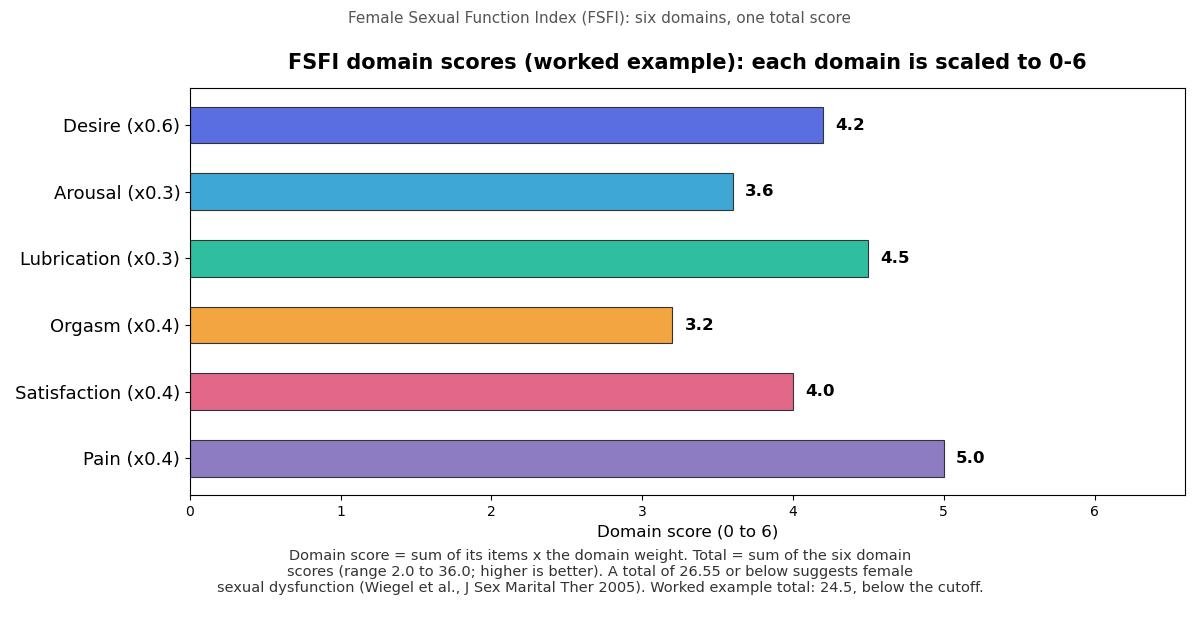
Scoring has two steps. First, each answer is converted to item points from 0 to 5, where higher is always better. For most questions the respondent picks 0 (no sexual activity, or intercourse not attempted) through 5, and the points are simply the response value reversed so that the best experience scores 5: a response of 1 becomes 5 points and a response of 5 becomes 1 point, while 0 stays 0. The desire questions (1-2) and two of the satisfaction questions (15-16) do not offer a zero option; they are answered 1 to 5 and reversed the same way. Second, the item points within each domain are added and multiplied by the domain weight, which scales every domain to a 0 to 6 range. The six domain scores are then added for the full-scale total.
| Domain | Questions | Response range | Weight | Domain score range |
|---|---|---|---|---|
| Desire | 1, 2 | 1-5 | x0.6 | 1.2-6.0 |
| Arousal | 3, 4, 5, 6 | 0-5 | x0.3 | 0-6.0 |
| Lubrication | 7, 8, 9, 10 | 0-5 | x0.3 | 0-6.0 |
| Orgasm | 11, 12, 13 | 0-5 | x0.4 | 0-6.0 |
| Satisfaction | 14, 15, 16 | 0-5 for Q14, 1-5 for Q15-16 | x0.4 | 0.8-6.0 |
| Pain | 17, 18, 19 | 0-5 | x0.4 | 0-6.0 |
The full-scale total therefore ranges from 2.0 to 36.0. The minimum is not zero: even the lowest possible answers give 1.2 for desire (two items at 1 point each, times 0.6) and 0.8 for satisfaction (zero for question 14 plus 1 point each for questions 15 and 16, times 0.4), while the other four domains can score zero. A perfect set of best answers gives 6.0 in every domain and 36.0 in total.
Understanding your total: the 26.55 cutoff
The widely used cutoff of 26.55 comes from a cross-validation study by Wiegel, Meston and Rosen published in 2005 in the Journal of Sex and Marital Therapy (Wiegel et al., 2005; doi:10.1080/00926230591006506). The authors compared FSFI scores of women with clinically diagnosed sexual dysfunction against women without dysfunction and found that a total of 26.55 or below best separated the two groups, with reported sensitivity around 71 percent and specificity around 88 percent. In plain terms, most women with a clinical diagnosis score at or below 26.55, and most women without one score above it, but neither group is perfectly separated, so the cutoff is a screening signal rather than a dividing line between sick and well.
If your total is 26.55 or below, the FSFI suggests a possible sexual dysfunction worth discussing with a clinician. If your total is above 26.55, your reported function falls in the range typical of women without sexual dysfunction in the validation studies. Either way, the number is only the start of the conversation: clinicians also consider how long difficulties have lasted, whether they cause personal distress (a requirement for most clinical diagnoses), relationship and life context, medications, and medical conditions before reaching any conclusion.
Domain-level thresholds and what they add
The same 2005 study published reference thresholds for individual domains: below 4.28 for desire, below 5.08 for arousal, below 5.45 for lubrication, below 5.05 for orgasm, and below 5.04 for satisfaction. These are shown in this calculator's results table for context. They are less firmly established than the total-score cutoff and should not be used on their own to label a domain as dysfunctional, but they help a reader see which areas sit below the levels typical of women without dysfunction. No published domain threshold exists for the pain domain; for pain, the rule is simply that higher is better, because higher means less pain.
Why clinicians and researchers trust the FSFI
Few questionnaires in sexual medicine have been scrutinised as thoroughly as the FSFI. Beyond the original 2000 development study, it has been validated against clinical diagnoses of female sexual arousal disorder, female orgasmic disorder, and hypoactive sexual desire disorder, and it reliably distinguishes women with these conditions from women without them (Meston, 2003). Its internal consistency is excellent, its scores are stable when the questionnaire is repeated, and it has been translated and revalidated across many languages and cultures, which is why multinational trials can use it as a common endpoint. Guidelines and regulators in the field treat it as the reference patient-reported measure of female sexual function.
Sexual difficulties are common, and help exists
Difficulty in one or more areas of sexual function is far from rare. In a landmark US population survey, about 43 percent of women aged 18 to 59 reported at least one sexual problem in the previous year (Laumann, Paik and Rosen, 1999; JAMA; PMID: 10235172). Prevalence estimates vary between studies because definitions and time frames differ, but the consistent message is that sexual concerns are a common part of women's health, not an unusual or shameful exception. Many contributing factors are treatable: relationship and psychological approaches such as sex therapy and cognitive behavioural therapy, pelvic floor physiotherapy for pain, lubricants and moisturisers for dryness, review of medications that affect desire or arousal, and medical management of conditions such as endometriosis or menopause-related changes. A low FSFI score is best viewed as a prompt to have that conversation, not as a verdict.
Important limitations to keep in mind
The FSFI has real limits that shape how scores should be read. First, zeros mean no activity, not necessarily dysfunction: a woman who was not sexually active in the past 4 weeks will score zero in several domains and get a low total even if nothing is wrong, which is why this calculator flags zero domains and why clinicians interpret them carefully. Second, the pain questions assume vaginal penetration was attempted; women who do not have vaginal intercourse may find those items less relevant. Third, the instrument was developed and validated mainly in partnered, largely heterosexual samples, so its wording can feel less fitting for women whose sexual lives look different, even though the underlying domains still apply. Fourth, like any self-report measure, it captures perception, which is exactly what matters for distress, but it is not a physical examination or a diagnosis. Finally, the published cutoff was derived in specific study populations; a score near the boundary deserves the same careful clinical follow-up as a score clearly below it.
Related screening in the same collection: the EPDS calculator screens for postnatal depression with the Edinburgh Postnatal Depression Scale, another widely validated women's health instrument. You can also browse the full women's health calculators collection.
How to use this calculator
Read each of the 19 questions and pick the answer that best fits your experience over the past 4 weeks, answering honestly and on your own. Where a zero option is offered, use it if you had no sexual activity or did not attempt intercourse. When all 19 questions are answered, press "Calculate my FSFI score" to see your total, your band relative to the 26.55 cutoff, and your six domain scores with reference notes. If any question is unanswered, the calculator will ask you to complete it before scoring. Consider saving or noting your domain profile if you plan to discuss it with a clinician, and remember that a single score is a snapshot: repeating the FSFI after an intervention is one of its most useful clinical roles.
When to talk to a clinician
Consider speaking with your GP, gynaecologist, or a sexual medicine specialist if your total is 26.55 or below, if any domain is persistently low and causing you distress, if you have pain during or after sex, or if sexual difficulties began after starting a new medication, after childbirth, or around menopause. Bring your domain scores: they give the clinician a structured starting point. Effective help exists for most sexual difficulties, and the first step is simply raising the topic, which clinicians in women's health hear every day.
References
- Rosen R, Brown C, Heiman J, et al. The Female Sexual Function Index (FSFI): a multidimensional self-report instrument for the assessment of female sexual function. J Sex Marital Ther. 2000;26(2):191-208. doi:10.1080/009262300278597
- Wiegel M, Meston C, Rosen R. The Female Sexual Function Index (FSFI): cross-validation and development of clinical cutoff scores. J Sex Marital Ther. 2005;31(1):1-20. doi:10.1080/00926230591006506
- Meston CM. Validation of the Female Sexual Function Index (FSFI) in women with female orgasmic disorder and in women with hypoactive sexual desire disorder. J Sex Marital Ther. 2003;29(1):39-46. PMID: 12519660
- Laumann EO, Paik A, Rosen RC. Sexual dysfunction in the United States: prevalence and predictors. JAMA. 1999;281(6):537-544. PMID: 10235172
- Isidori AM, Pozza C, Esposito K, et al. Development and validation of a 6-item version of the Female Sexual Function Index (FSFI) as a diagnostic tool for female sexual dysfunction. J Sex Med. 2010;7(2 Pt 1):849-860.
- American College of Obstetricians and Gynecologists
- WHO: Women's Health