What this calculator does
Human chorionic gonadotropin, or hCG, is the hormone produced by the developing placenta after implantation. In early pregnancy it rises fast: in a normally progressing pregnancy the blood level roughly doubles every 48 to 72 hours. Clinicians track this rise with serial quantitative beta hCG blood tests, usually two draws about two days apart, and compare how much the level climbed against what published studies say a viable pregnancy should do.
This calculator takes your two results and their exact draw times and returns four things: the doubling time in hours (and days), the percent rise normalized to a 48-hour window, an interpretation band that places your rise against the classic and updated published thresholds, and a projected hCG value 48 hours after your second draw, assuming the same rate of rise continues. The projection is a mathematical extension of your trend, not a prediction of what your next result will be.
Serial hCG is a trend tool, not a verdict. It helps your clinician decide whether the pregnancy is progressing as expected, whether more blood tests are needed, and when an ultrasound will be informative. It cannot by itself confirm that a pregnancy is viable or that it is located in the uterus, and no online calculator replaces your clinician's judgment.
The doubling time formula, with a worked example
In early pregnancy hCG rises exponentially, which means the doubling time can be computed from any two values with the standard exponential-growth formula: doubling time equals the natural log of 2 multiplied by the hours between draws, divided by the natural log of the second value over the first. In symbols: DT = ln(2) x hours / ln(C2 / C1). The 48-hour percent rise is simpler: rise = (C2 - C1) / C1 x 100, after normalizing the interval to 48 hours with rise48 = (C2 / C1)^(48 / hours) - 1. The projected value follows the same exponential curve: C(t) = C2 x 2^(t / DT).
A worked example makes this concrete. Suppose the first draw is 100 mIU/mL and the second, exactly 48 hours later, is 200 mIU/mL. The ratio is 2, the natural log of 2 divided into the natural log of 2 times 48 gives a doubling time of exactly 48.0 hours, and the 48-hour rise is 100 percent: a textbook doubling. Now suppose the draws are 72 hours apart instead: 200 mIU/mL rising to 320 mIU/mL. The doubling time is ln(2) x 72 / ln(1.6), which is 49.9 / 0.470, or about 106.2 hours (4.4 days). Normalizing to 48 hours gives (1.6)^(48/72) - 1, or about a 36.8 percent rise. That second example shows why the exact interval matters: the same pair of numbers means something different over 48 hours than over 72, and the calculator handles the normalization for you.
These formulas describe the observed curve; they do not explain why a particular pregnancy rises faster or slower. The interpretation of the number comes from studies of real pregnancies, which is where the 66 percent and 53 percent thresholds come from.
The classic rule: a 66 percent rise in 48 hours
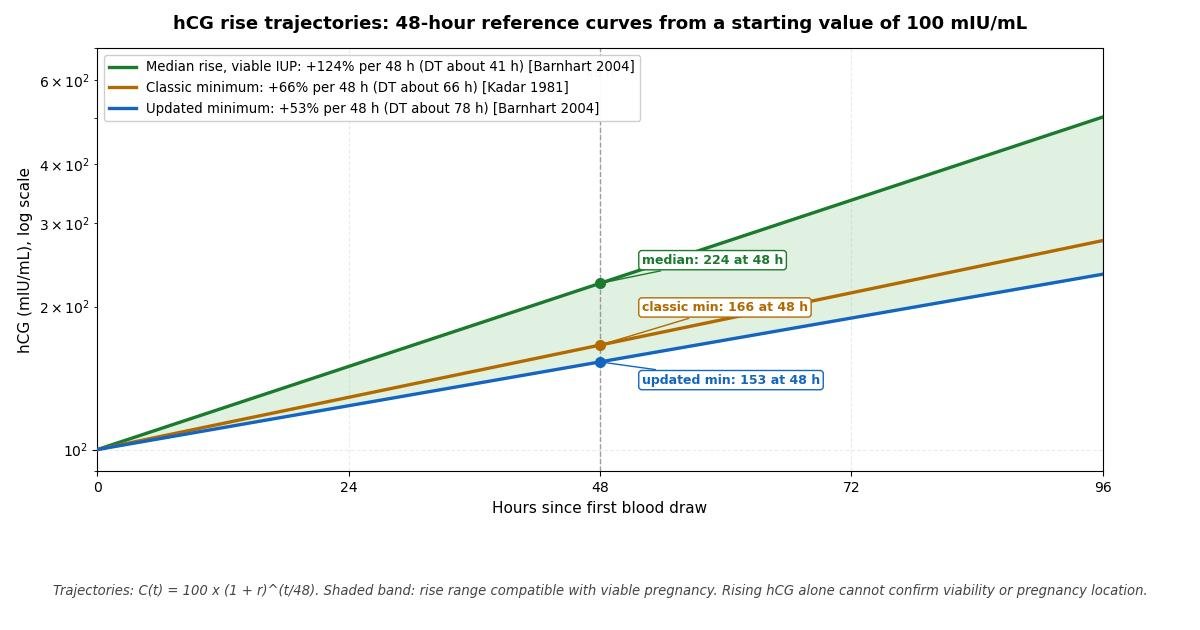
For decades, the teaching was that a viable early pregnancy should raise its hCG by at least 66 percent every 48 hours. This rule comes from Kadar and colleagues, published in 1981, who reported that viable intrauterine pregnancies rose at least 66 percent over 2 days. The figure was derived from only 20 women and used an 85 percent confidence interval, which by modern standards is a thin evidence base, but it became the bedside rule because it was simple and roughly right: about 85 percent of viable intrauterine pregnancies in the first 40 days of gestation do show at least a 66 percent rise in 48 hours.
The problem with a simple rule is what happens at its edges. Under the 66 percent cutoff, a pregnancy rising 55 percent in 48 hours would be labeled abnormal, even though many such pregnancies turn out fine. Because the cost of mislabeling a wanted pregnancy as nonviable is so high, researchers went back and measured the true slowest rise of viable pregnancies properly, with far larger samples and stricter statistics. That work changed the number.
The updated evidence: 53 percent can still be viable
In 2004, Barnhart and colleagues published the study that redefined hCG curves (Obstetrics and Gynecology, 2004, volume 104, pages 50 to 55; PMID 15229000; DOI 10.1097/01.AOG.0000128174.48843.12). They followed 287 women who presented with pain or bleeding and a nondiagnostic ultrasound, all of whom ultimately proved to have viable intrauterine pregnancies, contributing 861 hCG measurements. The median rise was 50 percent after 1 day, 124 percent after 2 days, and 400 percent after 4 days. The slowest rise, the lower bound of the 99 percent confidence interval, was 24 percent at 1 day and 53 percent at 2 days.
The conclusion was deliberately cautious: the minimal rise compatible with viability is slower than previously reported, and intervention to diagnose and treat an abnormal gestation should be more conservative. In plain terms, a rise of 53 percent in 2 days still falls inside the range of viable pregnancies, and acting on a slower rise alone risks ending a pregnancy that would have continued normally.
Later work refined the picture further. Because hCG rises faster at low levels and slower at high levels, the minimum expected 2-day rise depends on where you start: about 49 percent when the initial hCG is below 1500 mIU/mL, about 40 percent between 1500 and 3000, and about 33 percent above 3000. And the most conservative threshold in clinical use, 35 percent in 2 days, comes from the 99.9 percent confidence bound (Seeber et al., 2006): it was proposed specifically to minimize the chance of misclassifying, and possibly interrupting, a wanted pregnancy. The calculator's bands reflect this layered evidence rather than a single cutoff.
How to read your result
The calculator places your normalized 48-hour rise into one of five bands. Each band is anchored to a published figure, and each one ends with the same advice: these numbers inform your clinician, they do not replace clinical assessment.
| 48-hour rise | Band | What it means |
|---|---|---|
| 66 percent or more | Within the expected range | Matches the classic teaching for a normally progressing early pregnancy (Kadar et al., 1981). Continue follow-up as your clinician advised. |
| 53 to 66 percent | Within updated expectations | Slower than the classic rule, but at or above the slowest rise seen in 99 percent of viable intrauterine pregnancies (Barnhart et al., 2004). Compatible with viability; needs clinical correlation and usually an ultrasound. |
| 35 to 53 percent | Indeterminate: slower than expected | Below the 99 percent confidence minimum, but at or above the most conservative published threshold (35 percent; Seeber et al., 2006). Needs close follow-up with repeat hCG and ultrasound. |
| Above 0 but below 35 percent | Suboptimal rise | Below even the most conservative published minimum for viability. Concerning for a nonviable intrauterine pregnancy or an ectopic pregnancy; contact your clinician promptly. |
| No rise, or a fall | Plateau or declining | A plateau is not a normal early-pregnancy pattern. A fall of more than about 13 percent over 48 hours suggests a failing pregnancy; falls of 21 to 35 percent over 2 days are most typical of miscarriage. Needs clinical follow-up until hCG is undetectable. |
Two subtleties deserve emphasis. First, the bands assume your draws were taken while hCG was still in its rising phase, roughly the first 6 to 7 weeks. Later in pregnancy the rise naturally slows, so applying these thresholds near the hCG peak would mislead. Second, a single pair of draws is a snapshot: clinicians often want a third value, because a borderline second result followed by a normally rising third can reclassify the picture.
What rising hCG cannot tell you
The most important limitation of serial hCG is that a reassuring rise does not confirm where the pregnancy is. About 21 percent of ectopic pregnancies show an hCG rise that mimics a normally developing pregnancy, so a good doubling time cannot rule out an ectopic gestation. This is why guidelines pair hCG trends with ultrasound: once hCG reaches the discriminatory zone, a gestational sac should be visible on transvaginal ultrasound, and an empty uterus at that point makes ectopic pregnancy much more likely.
Nor can hCG confirm viability on its own. The thresholds describe populations, not individuals: 99 percent of viable pregnancies rose at least 53 percent in 2 days in Barnhart's study, which also means 1 percent of viable pregnancies rose more slowly. That is exactly why the authors warned against diagnosing nonviability from hCG changes alone. Viability is confirmed by ultrasound showing appropriate development, not by a number crossing a line.
hCG also cannot reliably tell you how many babies there are. Levels in twin pregnancies average higher than in singleton pregnancies, but the ranges overlap so widely that hCG alone cannot diagnose multiples; ultrasound is the definitive tool. Unusually high hCG for gestational age, or a very irregular pattern, can occasionally signal a molar pregnancy, a rare condition in which abnormal placental tissue grows instead of a normal pregnancy: another reason abnormal results belong with a clinician, not a search engine.
The practical upshot: treat a good result as reassuring but not conclusive, and a borderline result as a reason for more testing, not a diagnosis. If you have abdominal pain, shoulder-tip pain, dizziness or fainting, or vaginal bleeding along with any hCG result, seek emergency care the same day: those symptoms can signal a ruptured ectopic pregnancy, which is a medical emergency regardless of what the numbers say.
When hCG starts falling
Sometimes the second value is lower than the first. When that happens the calculator does not compute a doubling time, because a declining hormone has no doubling time; instead it reports the percent fall normalized to 48 hours and places it in context. A small dip can occasionally be laboratory variation, but a genuine fall means the pregnancy is not progressing normally at that time.
Published data give a sense of scale. An hCG ratio (second value divided by first, 48 hours apart) below 0.87, meaning a fall of more than 13 percent, predicted a failing pregnancy with a sensitivity of 92.7 percent and a specificity of 96.7 percent in the study by Condous and colleagues. More rapid falls, in the range of 21 to 35 percent over 2 days depending on the starting level, are most characteristic of miscarriage. A decline can also represent a resolving ectopic pregnancy, which is why falling levels still need clinical follow-up, typically with weekly blood tests until hCG is undetectable, to make sure nothing is left behind.
If your hCG is falling, your clinician will also want to know about symptoms. Bleeding with falling hCG often means a miscarriage is under way; pain with falling hCG still needs an ectopic pregnancy kept in mind until excluded. Either way, the next step is a clinical conversation, not another home calculation.
Getting the most from serial blood draws
The math is exact but the inputs are biological, so small practical details matter. Both samples should be quantitative beta hCG measured by the same laboratory using the same assay: different assays can report meaningfully different numbers for the same blood sample, and mixing laboratories can create an apparent rise or fall that is really an assay difference. Record the exact date and time of each draw, because the doubling time formula depends on the true interval; "Tuesday morning" versus "Tuesday afternoon" is a 6-hour difference that shifts the result.
Timing in pregnancy matters too. hCG becomes detectable in blood around the time of a missed menstrual period, rises steeply through the first weeks, and typically peaks between 8 and 11 weeks of pregnancy before declining and plateauing. Serial doubling assessment is most informative in the first 6 to 7 weeks, while the curve is still steep; after the peak, ultrasound is the better window into how the pregnancy is developing, and hCG trends lose their meaning.
Finally, remember what the test is for. In early pregnancy with pain or bleeding and no clear ultrasound findings, serial hCG helps distinguish a viable intrauterine pregnancy from a miscarriage or an ectopic pregnancy, guiding whether to watch, intervene, or image again. Used that way, as one input among several, it is a genuinely useful test. Used as a home verdict on your pregnancy, it is a source of unnecessary fear. Bring your results, and this calculator's output, to your clinician and let them put the numbers in context.
Key takeaways
- In a normally progressing early pregnancy, hCG typically doubles every 48 to 72 hours, which corresponds to a rise of about 66 percent or more in 48 hours.
- The 66 percent rule comes from Kadar and colleagues (1981), who reported that viable pregnancies rose at least 66 percent in 48 hours; it was based on only 20 women and an 85 percent confidence interval.
- Yes, sometimes.
- No.
Frequently asked questions
What is a normal hCG doubling time in early pregnancy?
In a normally progressing early pregnancy, hCG typically doubles every 48 to 72 hours, which corresponds to a rise of about 66 percent or more in 48 hours. Updated research found that the slowest rise seen in 99 percent of viable intrauterine pregnancies was 53 percent in 2 days (a doubling time of about 78 hours), so doubling times up to roughly 3.3 days can still be compatible with a viable pregnancy. The calculator above computes your exact doubling time from your two results.
What is the difference between the 66 percent and 53 percent rules?
The 66 percent rule comes from Kadar and colleagues (1981), who reported that viable pregnancies rose at least 66 percent in 48 hours; it was based on only 20 women and an 85 percent confidence interval. Barnhart and colleagues (2004) studied 287 women with pain or bleeding whose pregnancies proved viable and found the true slowest rise (the lower 99 percent confidence bound) was 53 percent in 2 days. The 53 percent figure is the more evidence-based minimum, and using the older 66 percent cutoff alone risks misclassifying viable pregnancies as nonviable.
Can a slow-rising hCG still be a healthy pregnancy?
Yes, sometimes. A rise between 35 and 53 percent in 48 hours is slower than the slowest rise seen in 99 percent of viable pregnancies, but it sits at or above the most conservative published threshold (35 percent in 2 days), which was chosen specifically to avoid interrupting wanted pregnancies. Such a result is indeterminate, not a diagnosis: it calls for close follow-up with repeat hCG testing and ultrasound, not for conclusions from the numbers alone.
Can hCG doubling confirm that the pregnancy is in the uterus?
No. A normal hCG rise does not confirm an intrauterine location: about 21 percent of ectopic pregnancies show an hCG rise that mimics a normal viable pregnancy. Conversely, a slow rise does not prove an ectopic pregnancy either. Location is confirmed by ultrasound, which is why clinicians pair serial hCG with imaging rather than relying on the blood results alone.
What does it mean if my hCG level is falling?
A falling hCG means the pregnancy is not progressing normally at that time. A fall of more than about 13 percent over 48 hours predicts a failing pregnancy with high accuracy in published studies, and falls of 21 to 35 percent over 2 days are most typical of miscarriage. A decline can also occur with a resolving ectopic pregnancy, so falling levels still need clinical follow-up, usually with repeat blood tests until hCG is undetectable.
How accurate are the two blood draws, and what can distort the result?
The calculation is only as good as its inputs. Both samples should be quantitative beta hCG measured by the same laboratory and the same assay, because different assays can report different numbers for the same blood. Record the exact date and time of each draw, since the math depends on the true interval. Serial hCG is most informative in the first 6 to 7 weeks; after hCG peaks at 8 to 11 weeks, levels plateau and fall, and ultrasound becomes the better tool.