HELLP Syndrome Diagnostic Criteria Calculator
In short: Check Tennessee criteria for HELLP syndrome (platelets, AST/ALT, LDH) and assign the Mississippi triple-class severity grade. Educational obstetric calculator reviewed by Dr. Taimoor Asghar. Use the calculator above, then read the guide below to interpret your result and its limitations.
Tennessee criteria check plus Mississippi triple-class severity grading from platelets, AST, ALT, and LDH. Reviewed by Dr. Taimoor Asghar.
Calculator
Enter the most recent laboratory values. Platelets and LDH are required, plus at least one of AST or ALT. This tool checks the published diagnostic cutoffs; it does not replace clinical judgment.
What is HELLP syndrome?
HELLP syndrome is a serious complication of pregnancy whose name is an acronym: Hemolysis (destruction of red blood cells), ELevated Liver enzymes, and LP Low Platelet count. It was described as a distinct syndrome in 1982 by Weinstein. It occurs in about 0.5 to 0.9 percent of all pregnancies and in about 10 to 20 percent of cases of severe preeclampsia (Harms et al., BMC Pregnancy and Childbirth 2007; review of clinical reports 2000 to 2008). It is regarded as a variant or severe complication on the preeclampsia spectrum, but it develops without hypertension or proteinuria in about 10 to 20 percent of cases, so normal blood pressure never rules it out.
About 70 percent of cases develop before delivery, most between the 27th and 37th gestational weeks, with about 10 percent before the 27th week and about 20 percent after the 37th week. The remainder appear in the postpartum period, usually within the first 48 hours after delivery, often in women who had proteinuria and hypertension before delivery. Onset is usually rapid, and symptoms tend to worsen at night and ease during the day. Typical clinical symptoms are right upper quadrant or epigastric abdominal pain, nausea, and vomiting; the pain can be fluctuating and colicky. Many patients report several days of malaise before presentation. Headache affects 30 to 60 percent of women and visual symptoms about 20 percent, but some patients have only vague preeclampsia-like or viral-illness-like symptoms. Because the symptoms overlap with common pregnancy complaints, the diagnosis rests on laboratory findings, which is exactly what the Tennessee and Mississippi systems formalize.
The Tennessee (Sibai) diagnostic criteria
The Tennessee Classification System, proposed by Sibai for what he called true or complete HELLP syndrome, requires all three of the following at the same time:
| Criterion | Tennessee cutoff | What it measures |
|---|---|---|
| Hemolysis | LDH at or above 600 IU/L (this tool uses LDH as the hemolysis marker) | Red blood cell destruction; classically confirmed by abnormal peripheral smear, bilirubin at or above 1.2 mg/dL, and low haptoglobin |
| Elevated liver enzymes | AST or ALT at or above 70 IU/L | Hepatocellular injury from periportal necrosis and sinusoidal fibrin deposition |
| Low platelets | Platelets at or below 100,000 per microlitre | Platelet consumption from endothelial injury and microangiopathy |
The strict Sibai definition diagnoses hemolysis by an abnormal peripheral blood smear plus increased bilirubin (at or above 20.5 micromol/L, equivalent to 1.2 mg/dL) and elevated LDH. In practice, and in this calculator, LDH at or above 600 IU/L serves as the working hemolysis criterion, because it is the single value most consistently used across the published criteria sets (Harms et al., BMC Pregnancy and Childbirth 2007). Note that BMJ Best Practice uses slightly different wording, requiring LDH more than twice the laboratory-specific upper limit of normal for hemolysis, AST or ALT more than twice the upper limit of normal, and platelets below 100 times 10 to the power of 9 per litre (equivalent to 100,000 per microlitre). The fixed numbers 70 and 600 used here follow the Sibai and Martin publications, but laboratories differ, so the treating clinician should interpret borderline values against local reference ranges.
The Mississippi triple-class system (Martin)
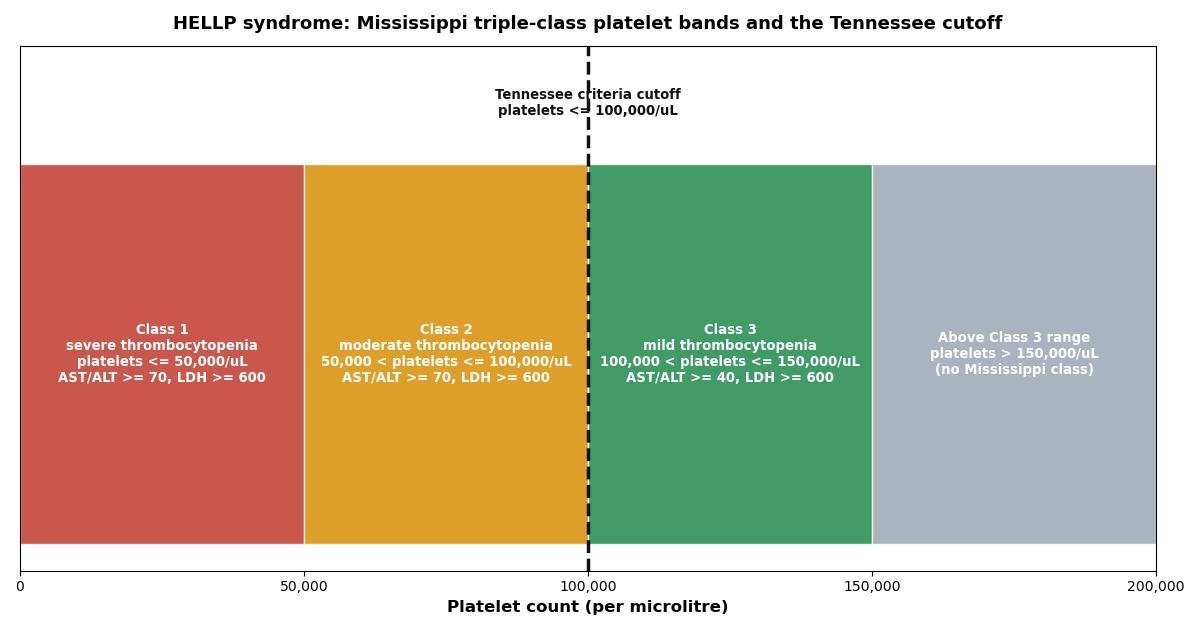
The Mississippi Triple-Class System, introduced by Martin and colleagues in 1991, classifies the disorder by the nadir (lowest) platelet count observed at any point during the illness, combined with the enzyme criteria. It is dynamic: the assigned class can change as the mother's condition worsens or improves. The classes carry graduated expected severity of maternal illness, which helps clinicians plan management intensity and lets researchers compare outcomes across studies.
| Class | Platelets (per microlitre) | AST or ALT | LDH | Severe maternal morbidity |
|---|---|---|---|---|
| Class 1 (severe thrombocytopenia) | At or below 50,000 | At or above 70 IU/L | At or above 600 IU/L | 40 to 60 percent |
| Class 2 (moderate thrombocytopenia) | Above 50,000 up to 100,000 | At or above 70 IU/L | At or above 600 IU/L | 20 to 40 percent |
| Class 3 (mild thrombocytopenia) | Above 100,000 up to 150,000 | At or above 40 IU/L | At or above 600 IU/L | About 20 percent |
The morbidity figures come from BMJ Best Practice. Class 3 deserves special attention: its enzyme cutoff is 40 IU/L rather than 70 IU/L, and because its platelet range extends to 150,000 per microlitre, Class 3 can be assigned even when the Tennessee platelet criterion is not met. It is considered a clinically significant transition stage that can progress to a more severe class, so a Class 3 result is never a reason to relax surveillance. Both maternal morbidity and mortality are significantly higher when HELLP syndrome worsens to Class 1, whether or not eclampsia is present. Women with Class 3 or partial HELLP have severe maternal morbidity of about 20 percent, comparable to preeclampsia with severe features.
How this calculator classifies your values
The tool applies the published cutoffs deterministically. For the Tennessee verdict it requires platelets at or below 100,000 per microlitre, AST or ALT at or above 70 IU/L, and LDH at or above 600 IU/L, with LDH standing in for hemolysis. It then assigns a Mississippi class from the top down: Class 1 when platelets are at or below 50,000 with enzymes at or above 70 IU/L and LDH at or above 600 IU/L; Class 2 when platelets are above 50,000 and at or below 100,000 with the same enzyme cutoffs; Class 3 when platelets are above 100,000 and at or below 150,000 with AST or ALT at or above 40 IU/L and LDH at or above 600 IU/L. Because Class 3 uses the lower 40 IU/L enzyme cutoff, the tool can report "Tennessee criteria not met" together with a Class 3 assignment. That combination means the laboratory pattern is in the HELLP transition zone: not full criteria, but abnormal enough to warrant urgent obstetric assessment and repeat labs.
Crucially, the tool cannot rule out HELLP syndrome. The full strict diagnosis also weighs the blood smear, haptoglobin, bilirubin, and anemia, which this calculator does not take as inputs, and partial or incomplete HELLP, defined by meeting only one or two of the three laboratory criteria (for example elevated liver enzymes plus low platelets without hemolysis, sometimes called ELLP), has no single universally agreed definition but is a real and recognized entity that can progress to complete HELLP. The Mississippi classification is based on the nadir platelet count during the course of the disease, so a single time-point entry may understate the eventual class. If criteria are not met but symptoms persist, repeat the full blood count, liver enzymes, LDH, and coagulation profile serially, because the syndrome evolves rapidly.
Symptoms that should trigger urgent evaluation
The classic warning pattern is right upper abdominal or epigastric pain with nausea or vomiting in the third trimester or early postpartum period. Add headache, visual disturbances, sudden swelling, or a general feeling of being unwell, and the suspicion rises sharply. The differential diagnosis includes acute fatty liver of pregnancy, thrombotic thrombocytopenic purpura, hemolytic uremic syndrome, systemic lupus erythematosus flare, viral hepatitis, and gallbladder disease. Some of these, particularly thrombotic thrombocytopenic purpura and acute fatty liver of pregnancy, are themselves emergencies that require different specific treatment, which is why a clinician, not a calculator, must interpret the full picture including the smear, coagulation studies, and renal function.
Management and treatment
Delivery is the definitive treatment for HELLP syndrome: the pathophysiology is driven by the placenta, and signs and symptoms diminish and gradually disappear after its delivery. The ACOG Task Force on Hypertension in Pregnancy recommends that women with HELLP syndrome who are remote from term be cared for at a tertiary center with maternal and neonatal intensive care. Between 24 and 34 weeks of gestation with stable maternal and fetal condition, expectant management in a tertiary center may include antenatal corticosteroids for fetal lung maturity (a single course, for example 12 mg betamethasone twice 24 hours apart, with delivery planned after the course), magnesium sulfate for seizure prophylaxis, antihypertensive drugs, and close maternal and fetal surveillance with serial laboratory tests. High-dose and repeated corticosteroid courses should be avoided because of concern about long-term effects on the fetal brain. Delivery is indicated without delay for maternal stabilization when there is eclampsia, pulmonary edema, disseminated intravascular coagulation, uncontrollable severe hypertension, abnormal fetal testing, placental abruption, or fetal demise. After 34 weeks, or whenever the maternal or fetal condition deteriorates, delivery is indicated regardless of the steroid course. Vaginal delivery is preferred when feasible, with cervical ripening if the cervix is unfavorable, though many cases require cesarean delivery. Close surveillance of the mother should continue for at least 48 hours after delivery, because postpartum deterioration is well described.
The maternal complications that make HELLP an emergency include placental abruption, disseminated intravascular coagulation, acute kidney injury, pulmonary edema, subcapsular liver hematoma or hepatic rupture, and stroke. The short-term and long-term prognosis for the infant depends mainly on gestational age at delivery and birth weight; preterm delivery and low birth weight are common, but maternal HELLP itself does not impair fetal or neonatal liver function. Future pregnancies carry an increased risk of HELLP, preeclampsia, and gestational hypertension, so women with a history of HELLP need early and vigilant antenatal care in subsequent pregnancies.
References and further reading
Key takeaways
- The Tennessee (Sibai) criteria for complete HELLP syndrome require all three findings together: platelets at or below 100,000 per microlitre, AST or ALT at or above 70 IU/L, and LDH at or above 600 IU/L as the marker of hemolysis.
- The Mississippi triple-class system grades severity by the lowest platelet count observed: Class 1 is platelets at or below 50,000 per microlitre with AST or ALT at or above 70 IU/L and LDH at or above 600 IU/L; Class 2 is platelets above 50,000 up to 100,000 per microlitre with the same enzyme cutoffs; Class 3 is platelets above 100,000 up to 150,000 per microlitre with LDH at or above 600 IU/L and AST or ALT at or above 40 IU/L.
- Yes.
- HELLP syndrome can progress rapidly to placental abruption, disseminated intravascular coagulation, acute kidney injury, pulmonary edema, subcapsular liver hematoma or liver rupture, and stroke.
Frequently asked questions
What are the Tennessee diagnostic criteria for HELLP syndrome?
The Tennessee (Sibai) criteria for complete HELLP syndrome require all three findings together: platelets at or below 100,000 per microlitre, AST or ALT at or above 70 IU/L, and LDH at or above 600 IU/L as the marker of hemolysis. All three must be present at the same time for the criteria to be met.
How do the Mississippi classes 1, 2, and 3 differ?
The Mississippi triple-class system grades severity by the lowest platelet count observed: Class 1 is platelets at or below 50,000 per microlitre with AST or ALT at or above 70 IU/L and LDH at or above 600 IU/L; Class 2 is platelets above 50,000 up to 100,000 per microlitre with the same enzyme cutoffs; Class 3 is platelets above 100,000 up to 150,000 per microlitre with LDH at or above 600 IU/L and AST or ALT at or above 40 IU/L. Class 1 carries the highest severe maternal morbidity, reported at 40 to 60 percent in BMJ Best Practice.
Can you have HELLP syndrome without meeting all the Tennessee criteria?
Yes. Partial or incomplete HELLP syndrome is diagnosed when only one or two of the three laboratory criteria are present, sometimes with severe preeclampsia. It can progress to complete HELLP syndrome, so patients with partial criteria need serial laboratory monitoring. Clinical diagnosis by the treating obstetrician can also be made when the pattern is strongly suggestive even if one cutoff is narrowly missed.
Why is suspected HELLP syndrome treated as an emergency?
HELLP syndrome can progress rapidly to placental abruption, disseminated intravascular coagulation, acute kidney injury, pulmonary edema, subcapsular liver hematoma or liver rupture, and stroke. It typically appears in the third trimester or within 48 hours after delivery. Anyone with symptoms such as right upper abdominal pain, headache, visual changes, nausea, or vomiting in pregnancy needs immediate in-person evaluation, ideally at a center with maternal and neonatal intensive care.
Does HELLP syndrome always occur with preeclampsia?
No. HELLP syndrome occurs in about 10 to 20 percent of cases of severe preeclampsia, but it develops without hypertension or proteinuria in about 10 to 20 percent of cases. The absence of high blood pressure does not rule it out, which is why laboratory criteria are central to diagnosis.
What treatment is used for HELLP syndrome?
Delivery of the baby is the definitive treatment, because the disease process resolves once the placenta is delivered. Between 24 and 34 weeks of gestation, corticosteroids for fetal lung maturity, magnesium sulfate seizure prophylaxis, and blood pressure control are used while delivery is arranged, ideally within 48 hours. Management decisions depend on gestational age and maternal and fetal condition, and are made by the obstetric team.
Sources
- Harms K, Rath W, Herting E, Pour H. Maternal hemolysis, elevated liver enzymes, low platelet count, and neonatal outcome. Am J Perinatol. 1995;12(1):1-6. (Tennessee criteria, Sibai; Mississippi triple-class system, Martin et al. 1990/1991, as reviewed in Harms K et al., BMC Pregnancy and Childbirth 2007, "The HELLP syndrome: clinical issues and management. A review".)
- Harms K, Rath W, Herting E, Pour H. The HELLP syndrome: clinical issues and management. A review. BMC Pregnancy and Childbirth. 2007;7:8. DOI: 10.1186/1471-2393-7-8. Tennessee criteria table (platelets at or below 100 x 10^9/L, AST at or above 70 IU/L, LDH at or above 600 IU/L); Mississippi classes (Class 1 platelets at or below 50 x 10^9/L with AST or ALT at or above 70 and LDH at or above 600; Class 2 platelets 50 to 100 x 10^9/L; Class 3 platelets 100 to 150 x 10^9/L with AST at or above 40 and LDH at or above 600). Incidence 0.5 to 0.9 percent of pregnancies; 10 to 20 percent of severe preeclampsia.
- Martin JN Jr, Blake PG, Lowry SL, Perry KG Jr, Files JC, Morrison JC. Pregnancy complicated by preeclampsia-eclampsia with the syndrome of hemolysis, elevated liver enzymes, and low platelet count: how rapid is delivery? Obstet Gynecol. 1990;76(5 Pt 1):737-741. (Mississippi triple-class system origin.)
- BMJ Best Practice. HELLP syndrome: criteria. Mississippi classes with severe maternal morbidity estimates (Class 1: 40 to 60 percent; Class 2: 20 to 40 percent; Class 3: about 20 percent); partial HELLP defined by one or two criteria.
- American College of Obstetricians and Gynecologists. Hypertension in Pregnancy. Task Force on Hypertension in Pregnancy. Washington, DC: ACOG; 2013. (Tertiary-center care for HELLP remote from term; antenatal corticosteroids 24 to 34 weeks; indications for delivery.)
- American College of Obstetricians and Gynecologists. Practice Bulletin No. 222: Gestational Hypertension and Preeclampsia. Obstet Gynecol. 2020;135(6):e237-e260. DOI: 10.1097/AOG.0000000000003891.
More women's health tools: Women's health calculators | All calculators